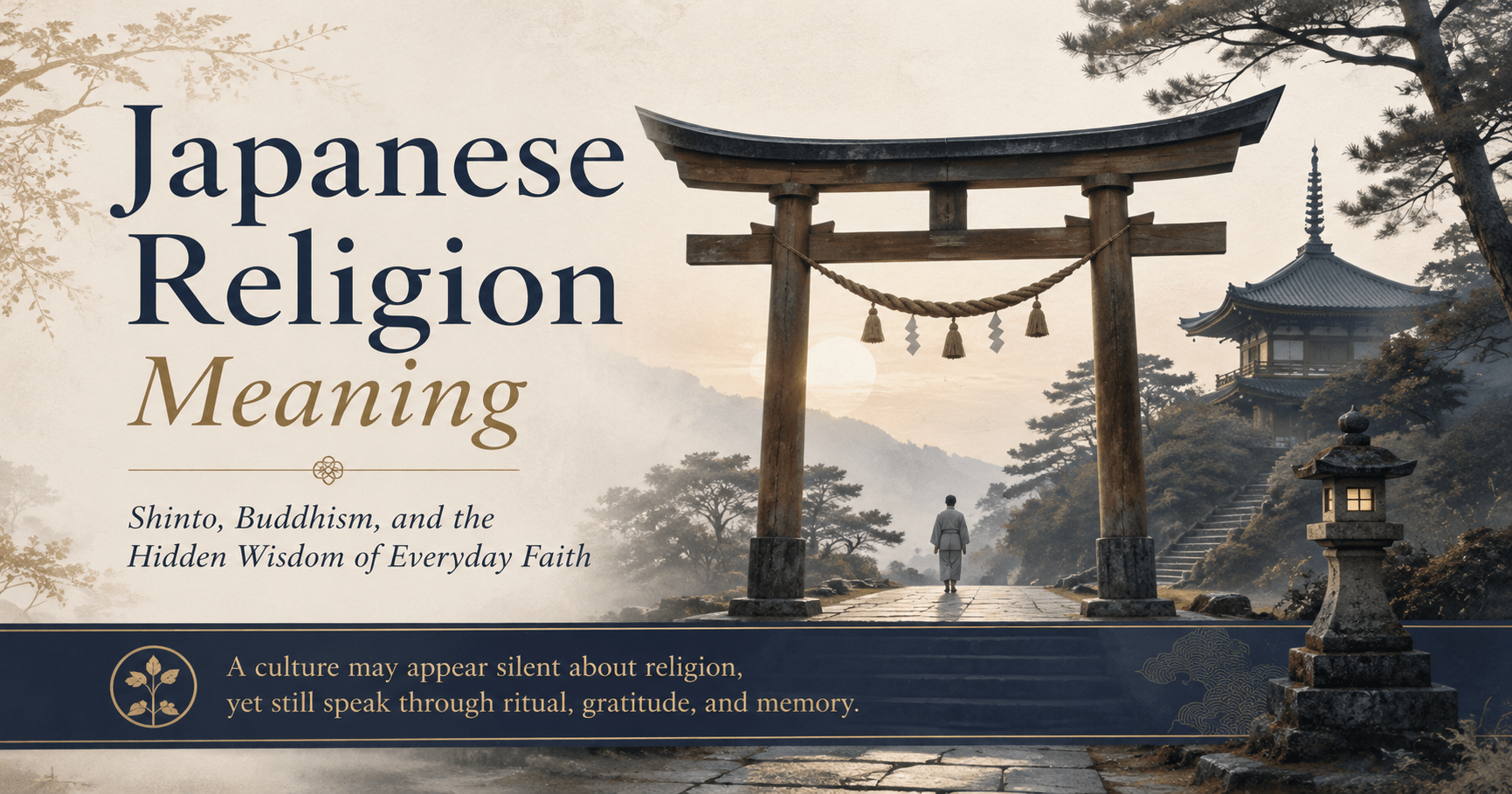
※This site uses affiliate advertising.Many people in Japan have visited a shrine or a Buddhist temple at least once. They may have prayed for success before an exam, bowed before a torii gate, visited a family grave, bought a protective charm, or whispered a wish at the beginning of a new year.And yet, when asked about religion, many Japanese people casually say, “I’m not religious.”This contradiction is one of the most fascinating cultural mysteries of Japan. It is not a ghost story in the usual sense, but it is a strange and meaningful tale about memory, ritual, fear, gratitude, and identity. It asks a quiet question: What is faith when it has become so deeply woven into daily life that people no longer notice it?To understand this, we need to walk slowly through Japan’s spiritual history—through Shinto, Buddhism, their long blending, their painful separation, and the modern feeling that remains afterward.When Gods and Buddhas Shared the Same PathIn older Japan, shrines and temples were not always treated as completely separate worlds. The kami of Shinto and the Buddhas of Buddhism often lived side by side in the same spiritual landscape.This way of thinking is known as shinbutsu-shūgō, the blending of Shinto and Buddhism. In simple terms, it meant that the gods and the Buddhas were not sharply divided. A person could honor a local kami, pray before a Buddhist image, visit a temple, and bow at a shrine without feeling any contradiction.For English-speaking readers, it is important to understand that kami are not exactly the same as “gods” in the Western sense. In Shinto, kami may be sacred forces of nature, ancestral spirits, divine presences, or mysterious powers associated with mountains, rivers, trees, wind, fertility, protection, and place. They are often close to human life rather than distant from it.Buddhism brought another spiritual language: impermanence, karma, compassion, rebirth, suffering, enlightenment, and liberation. When it entered Japan, it did not simply replace the older reverence for nature and ancestors. Instead, Japan interpreted the new through the old.One influential idea was that kami could be understood as local appearances of Buddhist beings. A Buddha or bodhisattva might appear in Japan in the familiar form of a kami in order to guide people. This way of thinking is often connected to the concept of honji suijaku, in which a Buddhist figure is regarded as the deeper source, while a kami is a local manifestation.Whether read as theology, symbolism, or cultural imagination, the meaning is powerful. Japan found a way to let different sacred worlds speak to each other.A shrine could include Buddhist elements. A temple could stand near a shrine. Rituals could overlap. For many people, this was not confusion. It was harmony.The sacred was not one narrow road. It was a layered landscape.The Arrival of Buddhism: A New Language for Suffering and SalvationBuddhism is traditionally said to have entered Japan in the sixth century. It came not only as a religion, but also with art, architecture, writing, philosophy, medicine, ritual, and political ideas. It offered a vast vision of life and death.For a society already shaped by reverence for nature, ancestors, and invisible presences, Buddhism provided a new language for suffering. It taught that all things change, that attachment creates pain, and that compassion can open a path toward liberation.One famous Buddhist episode helps explain why the blending of gods and Buddhas may have felt natural. After the Buddha attained enlightenment, he is said to have hesitated to teach. What he had realized seemed too subtle and difficult for ordinary people to understand. Then Brahmā, a great deity from the Indian religious world, requested that he share his teaching for the sake of all beings.In this story, even the Buddhist world includes divine beings. For Japanese people familiar with kami, this may have made Buddhism feel less like an enemy of native belief and more like another layer of the sacred.Japan did not simply ask, “Which one is true?”It often asked, “How do these truths meet?”That question shaped centuries of religious life.Separation and Change: The Meiji Divide Between Shrine and TempleFor centuries, the blending of Shinto and Buddhism shaped Japanese life. But in the modern period, this harmony was deeply shaken.During the Meiji Restoration in the nineteenth century, Japan was rapidly rebuilding itself as a modern nation-state. The country had been forced to confront Western powers, and many leaders believed Japan needed a strong national identity in order to survive in a changing world.In that atmosphere, Shinto was redefined and elevated as a central symbol of national unity. The government issued policies separating Shinto and Buddhism, a process known as shinbutsu bunri, or the separation of kami and Buddhas.The intention was political and ideological as much as religious. Shrines and temples, once closely connected in many places, were now to be distinguished. Buddhist objects were removed from some shrines. Priests and monks were required to clarify their roles. Sacred spaces that had once been layered were redrawn into separate categories.In some areas, this movement led to haibutsu kishaku, an anti-Buddhist movement in which temples, statues, and Buddhist objects were damaged or destroyed. It is important to say carefully that not every act of destruction was directly ordered by the government. But the policy of separation created a climate in which long-held frustrations, political ambition, and social change could turn intense.What had once been a shared spiritual landscape became a divided map.And yet, memory does not disappear so easily.Even when institutions change, gestures remain. Even when labels shift, habits continue. The old blending of Shinto and Buddhism did not vanish from the hearts and routines of ordinary people. It remained in funerals, festivals, household altars, seasonal visits, and the instinctive movement of hands coming together in gratitude.War, State Shinto, and the Question of Modern BeliefIn the twentieth century, Japan’s religious identity was again transformed by war and defeat. Before and during World War II, elements of Shinto were tied to nationalism and the authority of the state. After Japan’s defeat, the Allied Occupation moved to dismantle State Shinto and separate religion from government power.This history is complex and sensitive. It should not be reduced to a simple claim that Japanese spirituality was “erased” overnight. Rather, the public role of religion changed dramatically. Myths, rituals, imperial symbolism, education, and national identity were all reconsidered under the new postwar order.Modern Japan’s constitution guarantees freedom of religion. Today, Japan does not have an official state religion. People are free to believe, not believe, practice, participate, or remain indifferent.But this freedom also created a curious cultural situation. Many Japanese people no longer describe themselves as religious, even while continuing practices shaped by religion. A family may hold a Buddhist funeral, visit a Shinto shrine at New Year, keep a household altar, buy a charm, and say “itadakimasu” before eating.From a Western perspective, this may look inconsistent. From a Japanese cultural perspective, it often feels ordinary.Religion is not always a declaration. Sometimes it is a rhythm.Key Quote / Affirmation“Faith does not always speak loudly; sometimes it bows, gives thanks, and walks quietly through ordinary days.”This sentence captures the heart of Japanese everyday spirituality. It does not claim that all Japanese people are secretly religious. Rather, it suggests that spirituality can exist in gestures before it becomes doctrine, and in gratitude before it becomes belief.Cultural Insight: Why Japan Can Feel Both Spiritual and Non-ReligiousA key to understanding Japanese religion is that it is often practice-centered rather than belief-centered.In many Western contexts, religion is associated with clear belief: Do you believe in God? Do you belong to a church? Do you follow a scripture? In Japan, religious life has often been expressed more through participation than confession.People may not explain their theology. They may simply visit a shrine at New Year. They may not define the afterlife. They may simply honor their ancestors. They may not call themselves Buddhist. They may still hold a Buddhist funeral. They may not describe nature as divine. They may still feel that a mountain, tree, waterfall, or old place has a certain presence.This is why Japanese religion can feel mysterious to outsiders. It is not always located in statements. It is located in gestures.The bow before the torii gate.The water used to purify the hands.The incense at a grave.The charm carried in a wallet.The quiet “itadakimasu” before a meal.Each act may seem small. But together, they form a cultural memory.Psychological and Philosophical Reflection: Why Quiet Rituals MatterHuman beings are drawn to rituals because they give shape to feelings that are difficult to explain. Fear, gratitude, grief, hope, uncertainty, and respect are not always easy to put into words. Ritual allows the body to speak when language is too small.A bow can express humility.A prayer can express hope.A memorial can express grief.A meal blessing can express gratitude.A shrine visit can express the desire to begin again.This is why old spiritual customs often survive even when formal belief declines. They answer emotional needs that modern life does not always name.In this sense, Japanese everyday spirituality is not merely a religious question. It is a psychological and philosophical one. It asks: How do people live with uncertainty? How do they honor what came before them? How do they express thanks for what cannot be fully controlled?Rather than proving the supernatural, these practices reveal how human beings search for meaning.Life Lesson: Gratitude May Be a Form of WisdomOne way to read this story is that Japan’s religious history teaches us the value of humility before complexity.Shinto and Buddhism were blended, separated, politicized, reinterpreted, and practiced in countless ways. No single sentence can fully explain Japanese religion. But perhaps that is the point. Some of the deepest parts of culture are not simple enough to fit into one label.In modern life, many people feel pressure to define themselves clearly. Religious or non-religious. Traditional or modern. Rational or spiritual. But human life is often more layered than that.You can be modern and still honor old customs.You can be skeptical and still feel reverence.You can avoid religious labels and still practice gratitude.You can live in a busy world and still pause before eating, bowing, remembering, or beginning again.The lesson is not that everyone should become religious. It is softer than that.This story may remind us that gratitude itself can be a kind of wisdom. To pause before receiving something, to recognize that life is supported by many visible and invisible hands, to remember those who came before us—these are not small things.Sometimes, the sacred is not hidden in another world.It is hidden in the way we treat this one.Reader Reflection: What Do We Really Mean by Faith?When Japanese people say they are “not religious,” perhaps they are not denying the sacred. Perhaps they are saying that the sacred does not always need to be explained.It can live in a shrine visit.It can live in a temple bell.It can live in a grave marker washed by rain.It can live in hands placed together before a bowl of rice.It can live in gratitude that has no single name.So the question may not be, “Are you religious?”A deeper question may be:What small gesture in your own life carries more meaning than you usually notice?