Explore the meaning of Bella in the Wych Elm through British folklore, wartime fear, silence, and the wisdom hidden in unsolved mysteries.

 Wonderful Proverbs Journey
※This site uses affiliate advertising.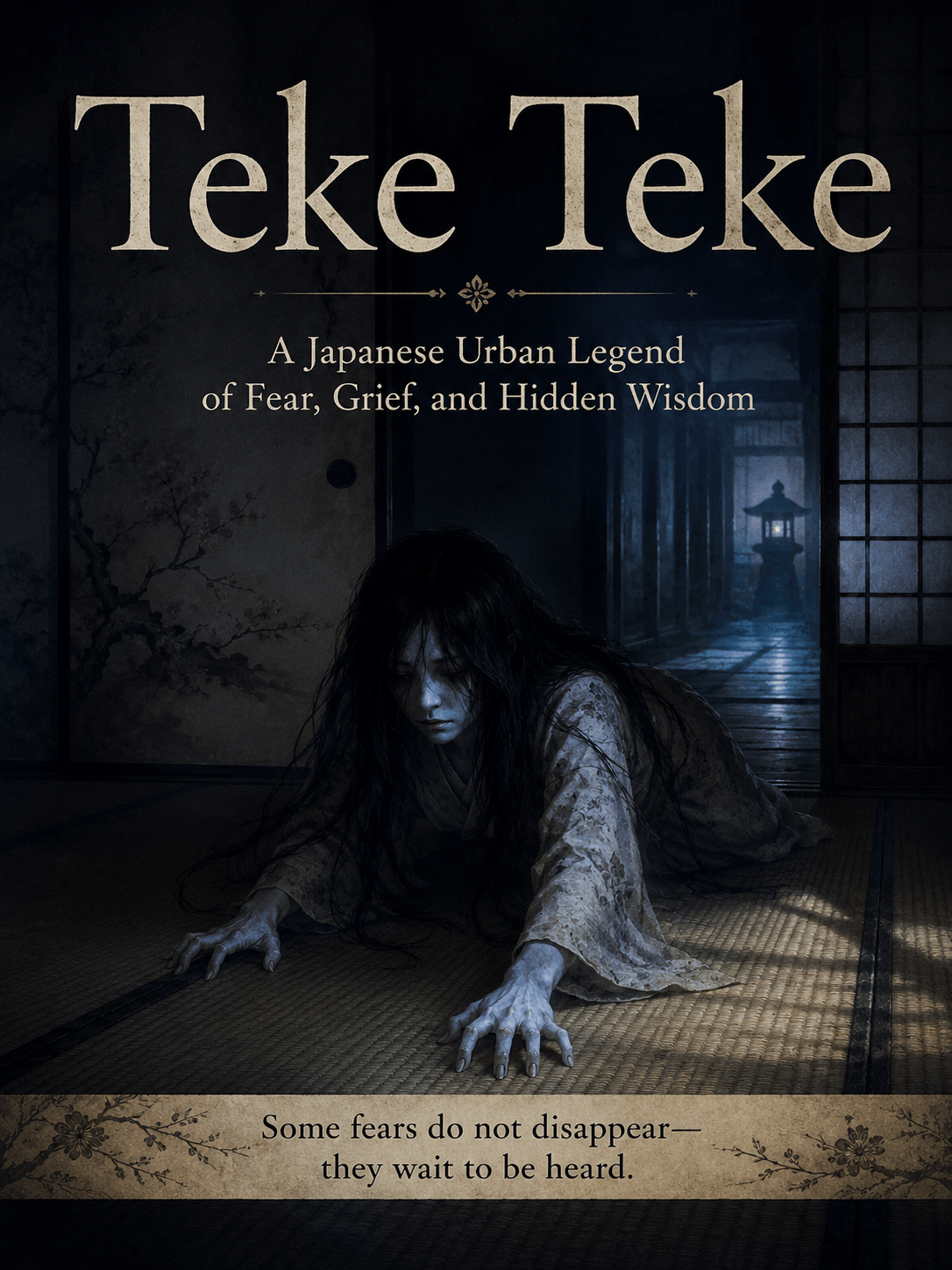
Some urban legends do not begin in ancient forests or ruined temples. They begin under electric lights, near train stations, on ordinary streets where tired people are only trying to get home.
Teke Teke is one of Japan’s most unsettling modern ghost stories. It is not usually told as a sacred myth or a polished folktale from long ago, but as an urban legend—one of those stories that seems to travel by whisper, school rumor, internet forum, and late-night imagination. In its most familiar form, it tells of a woman whose body was severed by a train and whose restless spirit now moves through the city with terrifying speed, dragging herself on her arms and making the sound that gives her name: teke teke, teke teke.
Yet beneath the fear lies something more reflective. This is not only a scary story about a vengeful ghost. It is also a story about being ignored, about the cruelty of indifference, about modern life moving too fast to notice pain until it is too late. Like many mysterious tales, Teke Teke gives a shape to anxieties that are difficult to name.
It asks a quiet question: What happens to grief when no one stops to listen?
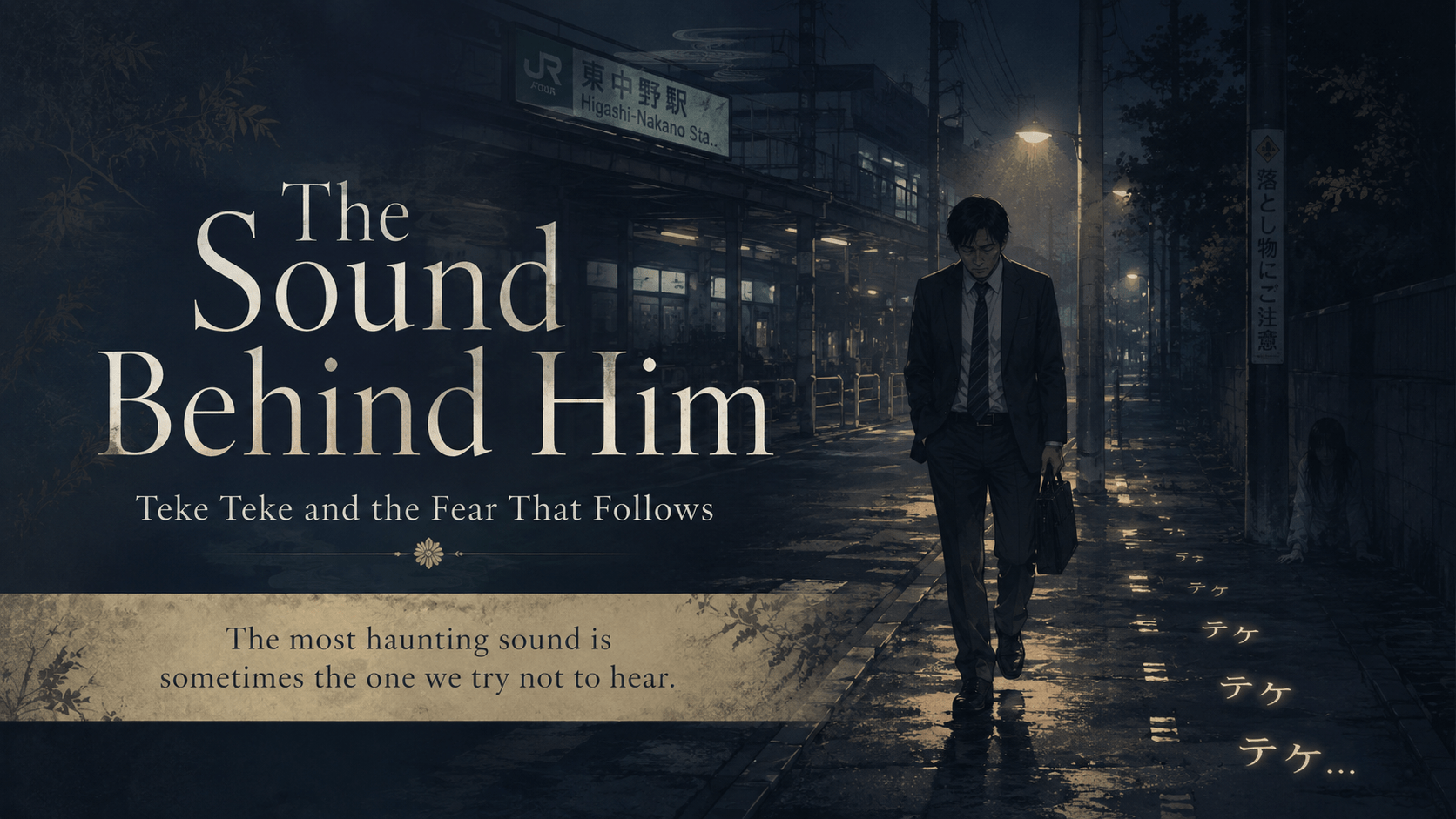
It is late at night near a train station.
The last trains have already carried most people away. The shops are closing. The vending machines glow in the dark like small islands of artificial warmth. Somewhere in the distance, a railway crossing bell has gone silent.
A salaryman walks alone down a narrow street. His shoulders are heavy from the day’s work. Perhaps he has had a drink or two with co-workers before heading home, as many exhausted workers do after a long evening. His steps are slow at first, not because he is careless, but because the night has made the whole city feel strangely distant.
Then he hears it.
Teke.
Teke.
At first, it is so faint that he thinks it may be the sound of his own shoes, or the echo of some loose sign tapping in the wind. He keeps walking.
Teke teke.
The sound comes again, sharper this time. Not metal. Not footsteps. Not exactly. It is a dry, scraping rhythm, as if something hard is striking the pavement again and again.
He turns around.
The street behind him is empty.
There is only the weak light from a lamp, the edge of a shuttered storefront, and a stretch of darkness where the road bends out of sight. He tells himself not to be foolish. Cities are full of strange noises at night. Pipes knock. Bicycles settle against walls. Plastic bags move like animals in the wind.
He walks faster.
Teke teke teke.
Now the sound is louder.
It is no longer behind the darkness. It is in the street.
A chill rises along his neck. He turns again, and this time he sees something low to the ground. At first, his mind refuses to understand it. It looks like a person who has fallen. A woman, perhaps. Her hair hangs forward. Her hands—or are they elbows?—strike the road with impossible speed.
Then she lifts her face.
In some tellings, she is a schoolgirl. In others, a young office worker. In some versions, she first appears as a beautiful woman half-hidden behind a wall, a fence, or a window ledge, her lower body concealed until the victim comes too close. Only when she drops to the ground does the truth reveal itself.
She has no lower body.
She moves with a speed that belongs neither to the living nor to the dead, pulling herself forward with her arms, her elbows beating against the pavement: teke teke, teke teke, teke teke.
In one skeletal hand, she carries a kama, a small sickle traditionally used in agriculture. In the legend, it becomes the tool of repetition, the instrument by which she recreates the injury that destroyed her. If she catches someone, the tale says, she cuts the person in half, forcing the living to become an image of her own unfinished death.
The salaryman runs.
The street that seemed ordinary a moment ago becomes endless. The station lights are behind him. His apartment is somewhere ahead. But every step he takes sounds too slow, too human, too heavy.
Behind him, the rhythm grows faster.
Teke teke teke teke.
The horror of the legend is not only that the ghost is grotesque. It is that she is fast. She is the thing one cannot outrun. She is not a ghost waiting in a graveyard, not a spirit that asks to be mourned from a distance. She enters the modern street. She follows. She catches up.
And in the final moment, when the man turns once more, the story gives him no heroic answer, no prayer, no wise trick, no escape.
Only the face of the woman who was not heard in time.
Only the sound.
Teke teke.
Like many urban legends, Teke Teke has no single verified origin. That uncertainty is part of its power. A story that cannot be traced to one fixed place can spread more easily, because each listener feels that it might have happened somewhere nearby.
In many versions, the woman’s death begins on a railway line in northern Japan during a bitterly cold season. She falls, or becomes trapped, on the tracks just as a train approaches. The details shift from one telling to another. Sometimes she is a student. Sometimes she is an office worker. Sometimes her name is never given.
What remains constant is the injury: the lower half of her body is destroyed by the train, leaving only the upper part intact.
The story then becomes even more disturbing—not because of the accident itself, but because of what follows. People assume she is already dead. Instead of calling for urgent medical help, the tale says that officials prepare to handle a body. Then, from the wreckage of the scene, a faint voice is heard.
She is still alive.
In some versions, the cold has slowed the bleeding. In others, shock has kept her barely conscious. Either way, her remaining life is fragile, almost impossible, and filled with pain. She cries for help. She asks to be saved.
But help comes too late—or does not come in the way she needs.
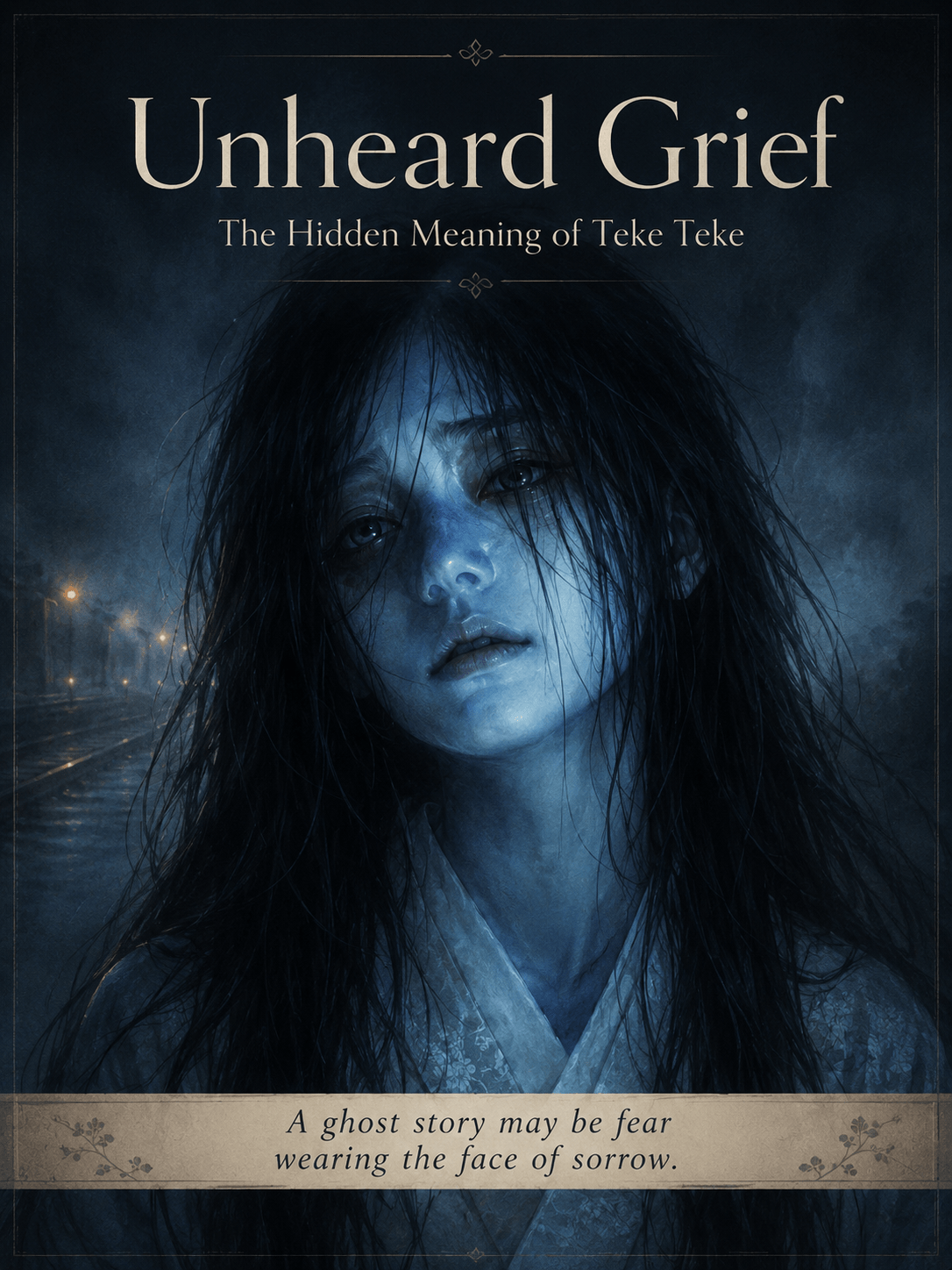
That moment is the emotional wound at the center of the legend. Teke Teke is not frightening only because she died horribly. She is frightening because, in the story, she died unheard. Her final human request was ignored, delayed, misunderstood, or dismissed as useless.
In Japanese ghost lore, an onryō is often understood as a vengeful spirit bound by powerful resentment. The idea appears in many forms across Japanese storytelling, from classical theater to modern horror. An onryō does not simply “haunt” because it is dead. It lingers because something unresolved has become stronger than rest.
Teke Teke, then, may be read as an urban onryō: not a spirit from an old battlefield or noble household, but a ghost born from tracks, stations, work commutes, and the cold machinery of modern life.
She is grief given speed.
She is pain that was not answered in time.
“What is ignored does not disappear; it waits to be heard.”
This line is not a traditional proverb, but it captures the emotional heart of the Teke Teke legend. Fear in folklore often grows from silence. A cry not answered, a truth not faced, a grief not mourned—these become the shadows that stories remember.
For readers who prefer an affirmation, the same idea can be softened into daily language:
I listen to fear with patience, because even fear may be carrying a message I need to understand.
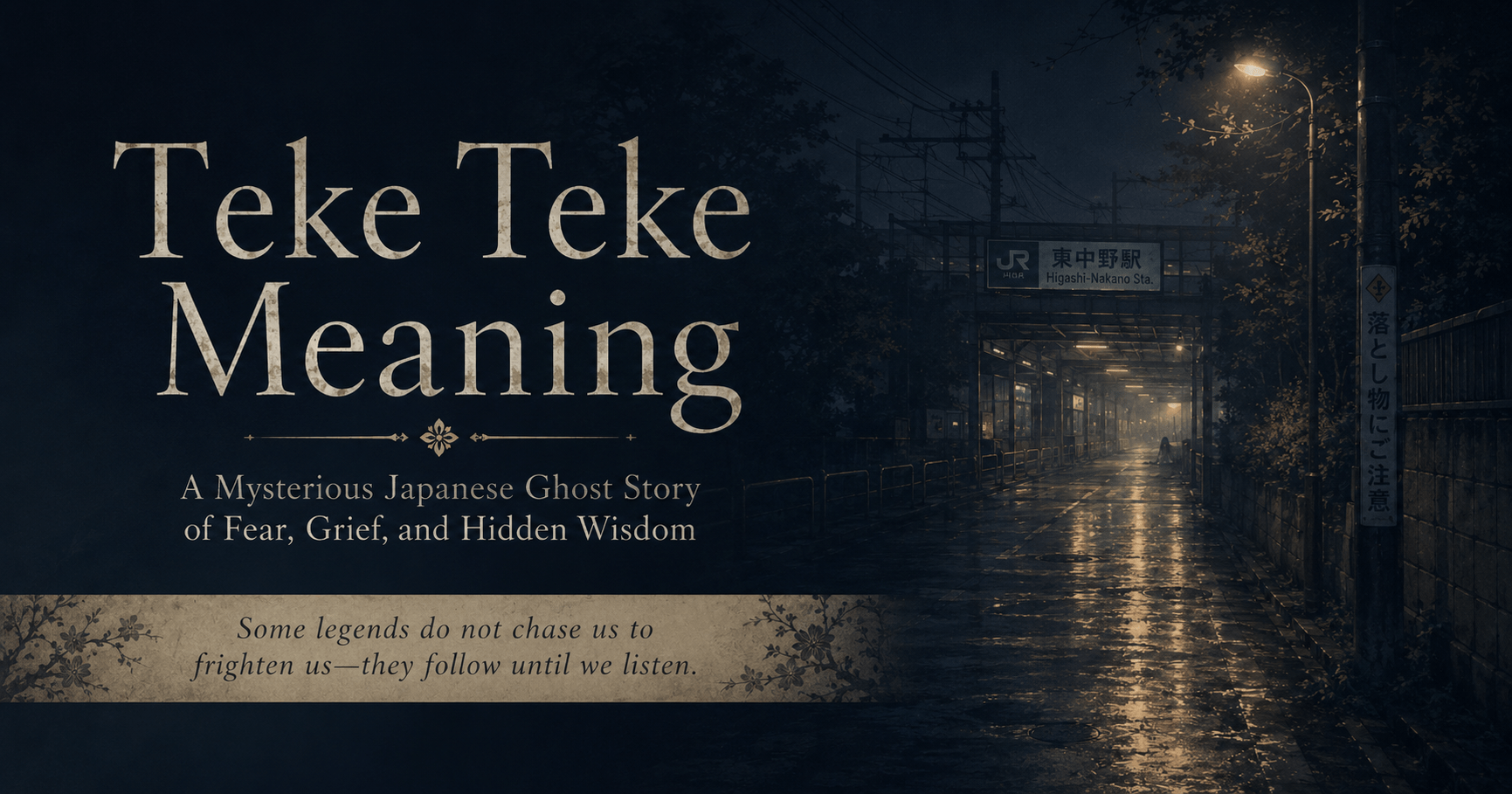
Teke Teke belongs to a family of Japanese urban legends that transform familiar places into stages of fear. Train stations, school bathrooms, apartment corridors, and late-night streets appear again and again in modern Japanese scary stories. These are not remote haunted castles. They are ordinary places where people lower their guard.
That is one reason such legends remain powerful. They make everyday life feel thin, as if the world of the strange is separated from the normal world by only a small mistake: looking back, answering the wrong question, walking alone, staying out too late.
The railway setting is especially meaningful. Trains are symbols of modern order, precision, speed, and social routine. In Japan, where trains are deeply woven into daily life, the image of a railway accident can carry emotional weight beyond physical danger. A train can represent progress, but also indifference. It moves according to schedule. It does not stop for one person’s private tragedy.
Teke Teke turns that fear inside out. The person destroyed by the machine becomes faster than the people who rely on machines. The victim becomes the pursuer. The sound of the city becomes the sound of a ghost.
The related legend of Kashima Reiko also shares this concern with missing legs, railway trauma, and the need to answer correctly. In some versions, Kashima Reiko appears in a bathroom stall and asks, “Where are my legs?” The victim’s survival depends not on strength, but on knowledge, words, and composure. This is a common feature in urban legends: fear becomes a test of memory and language.
In that sense, Teke Teke is not only about the body. It is about the consequences of not seeing the whole person. A woman is reduced to an injury, a noise, a rumor, a warning. The legend gives that reduction a frightening shape.
Why do people tell stories like Teke Teke?
One answer is simple: fear is memorable. A strange sound in the dark, a figure that moves too quickly, a rule that must be remembered—these elements cling to the mind. But the deeper answer may be that frightening stories allow us to approach painful ideas indirectly.
Most people do not want to think about sudden accidents, public indifference, loneliness in a crowded city, or the fear that help may not arrive when needed. These thoughts are too heavy when stated plainly. Folklore gives them a mask. It turns anxiety into a figure, a sound, a chase.
A ghost story lets us look at fear from a safe distance.
Teke Teke also reflects a philosophical unease about speed. Modern life often praises speed: faster trains, faster work, faster messages, faster decisions. But not every human pain can be processed quickly. Grief is slow. Healing is slow. Listening is slow.
In the legend, speed becomes monstrous. The ghost is terrifying because she moves faster than expected, faster than reason, faster than escape. Perhaps this is part of the story’s hidden wisdom: when life moves too quickly past suffering, suffering may return in a form that cannot be ignored.
The tale does not prove the supernatural. It reveals something about the human imagination. We create stories for what we cannot comfortably discuss. We give names to sounds in the dark because nameless fear is harder to bear.
Teke Teke is frightening because she is impossible.
But she is unforgettable because the emotion beneath her is real.
It would be too simple to say that the lesson of Teke Teke is “do not walk alone at night.” Urban legends often begin with such practical warnings, but their deeper meanings are usually more human.
One way to read this tale is as a reminder that ignored pain does not vanish. In daily life, we may not encounter ghosts on dark streets, but we do encounter small signals of distress—our own and other people’s. A tired voice. A message left unanswered. A silence that lasts too long. A fear we keep pushing aside because we do not have time to face it.
The legend asks us to listen before pain becomes a shadow.
It also reminds us that fear is not always an enemy. Sometimes fear is a messenger. It tells us where we feel vulnerable, where we need care, where something unresolved is still moving beneath the surface.
This does not mean we should live suspiciously or become trapped by anxiety. Rather, the story can be understood as a quiet invitation to slow down. To notice. To answer when someone calls for help. To take our own inner warnings seriously without letting them rule us.
In a world that rewards speed, Teke Teke is a frightening image of what happens when no one pauses.
Perhaps the wisdom is not to fear the sound behind us, but to ask what it represents.
What have we been moving too fast to hear?
Teke Teke remains powerful because it does not end neatly. Like many Japanese urban legends, it lingers in the mind as a sound rather than a conclusion. It does not tell us exactly where it began, whether the woman had a name, or whether the story was ever connected to a real event. It leaves us with uncertainty.
But perhaps that uncertainty is the point.
Folklore does not always preserve facts. Sometimes it preserves feelings. Fear. Guilt. Compassion. Regret. The unease of walking past someone else’s pain. The suspicion that the modern world has become very good at moving and not always good at noticing.
So when we hear the imagined sound—teke teke, teke teke—we might hear more than a ghost. We might hear a question following us through the ordinary streets of our own lives.
What fear in your life is asking to be understood rather than outrun?
What fear in your life is asking to be understood rather than outrun?