Explore mysterious Japanese urban legends through folklore, fear, cultural meaning, and quiet wisdom for modern life.
 Wonderful Proverbs Journey
※This site uses affiliate advertising.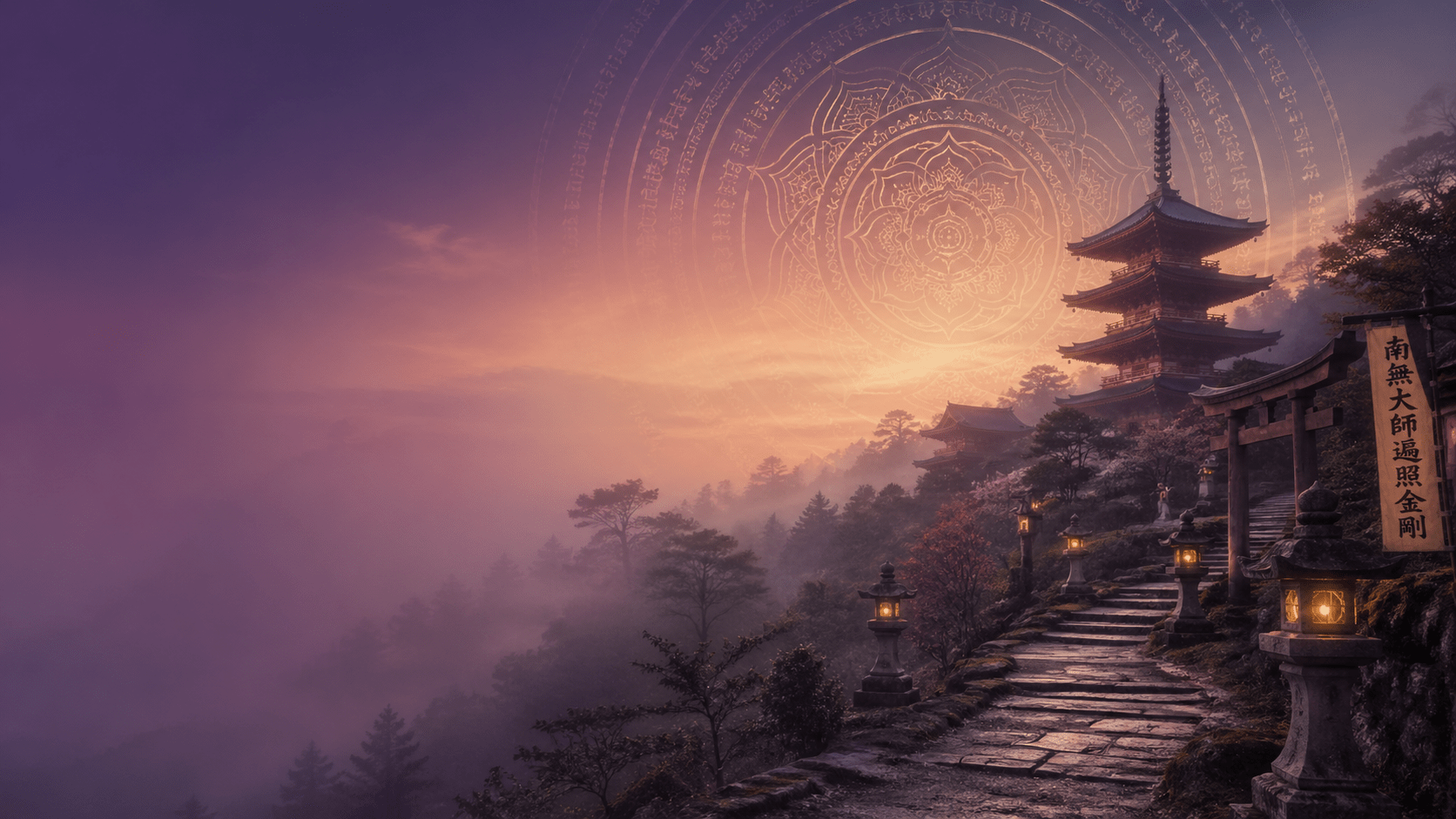
Japanese esoteric Buddhism, known as Mikkyō, is often surrounded by an atmosphere of mystery. To many people, it evokes images of sacred mantras, complex mandalas, secret rituals, wrathful deities, and temples hidden in mist-covered mountains.
Yet Mikkyō is not simply “mysterious” in the sense of being strange or frightening. Its mystery points toward something deeper: the belief that truth cannot always be explained by ordinary language. Some forms of wisdom, according to this tradition, must be approached through symbol, sound, gesture, meditation, and disciplined practice.
In this sense, Japanese esoteric Buddhism can be read as a spiritual story about fear, transformation, and the human longing to touch what lies beyond words. It is not a ghost story, yet it has the atmosphere of folklore. It is not merely philosophy, yet it asks philosophical questions. What is the self? What is the universe? Can human beings awaken to truth in this very life?
Rather than treating Mikkyō as supernatural fact, this article approaches it as a cultural and symbolic tradition—one that reveals how old stories, sacred images, and mysterious rituals can preserve wisdom across generations.
It is said that Mikkyō means “secret Buddhism.” The word “secret” does not necessarily mean that someone is trying to hide knowledge out of selfishness. Rather, it suggests that certain teachings are difficult to transmit through written words alone.
In more open forms of Buddhism, a person may study scriptures and learn doctrine through reading. Mikkyō, however, places great importance on direct transmission from teacher to disciple. The teaching is not only explained; it is embodied. It is chanted, visualized, practiced, and passed from one living person to another.
The roots of this tradition reach back to India, where Buddhist thought gradually absorbed ritual and symbolic elements such as mantras and sacred diagrams. Over time, these teachings moved through China and eventually arrived in Japan. In the early ninth century, two major figures helped shape Japanese esoteric Buddhism: Saichō, associated with the Tendai school, and Kūkai, founder of the Shingon school.
Saichō brought back teachings that would contribute to Taimitsu, the esoteric tradition within Tendai Buddhism. Tendai was broad and inclusive, combining several streams of Buddhist practice. It emphasized the possibility that all beings could eventually attain awakening. In this sense, it carried a generous vision: no life is outside the reach of wisdom.
Kūkai, on the other hand, developed the Shingon tradition as a more fully esoteric path. Shingon Buddhism teaches that the ultimate reality is embodied by Dainichi Nyorai, the Great Sun Buddha, a cosmic Buddha associated not merely with the physical sun but with the illuminating truth behind all things.
At the heart of Shingon lies the idea of sokushin jōbutsu—becoming a Buddha “in this very body.” This does not mean a simple or magical transformation. Rather, it expresses the possibility that awakening is not only a distant promise after death. It may be approached within ordinary human life, through disciplined body, speech, and mind.
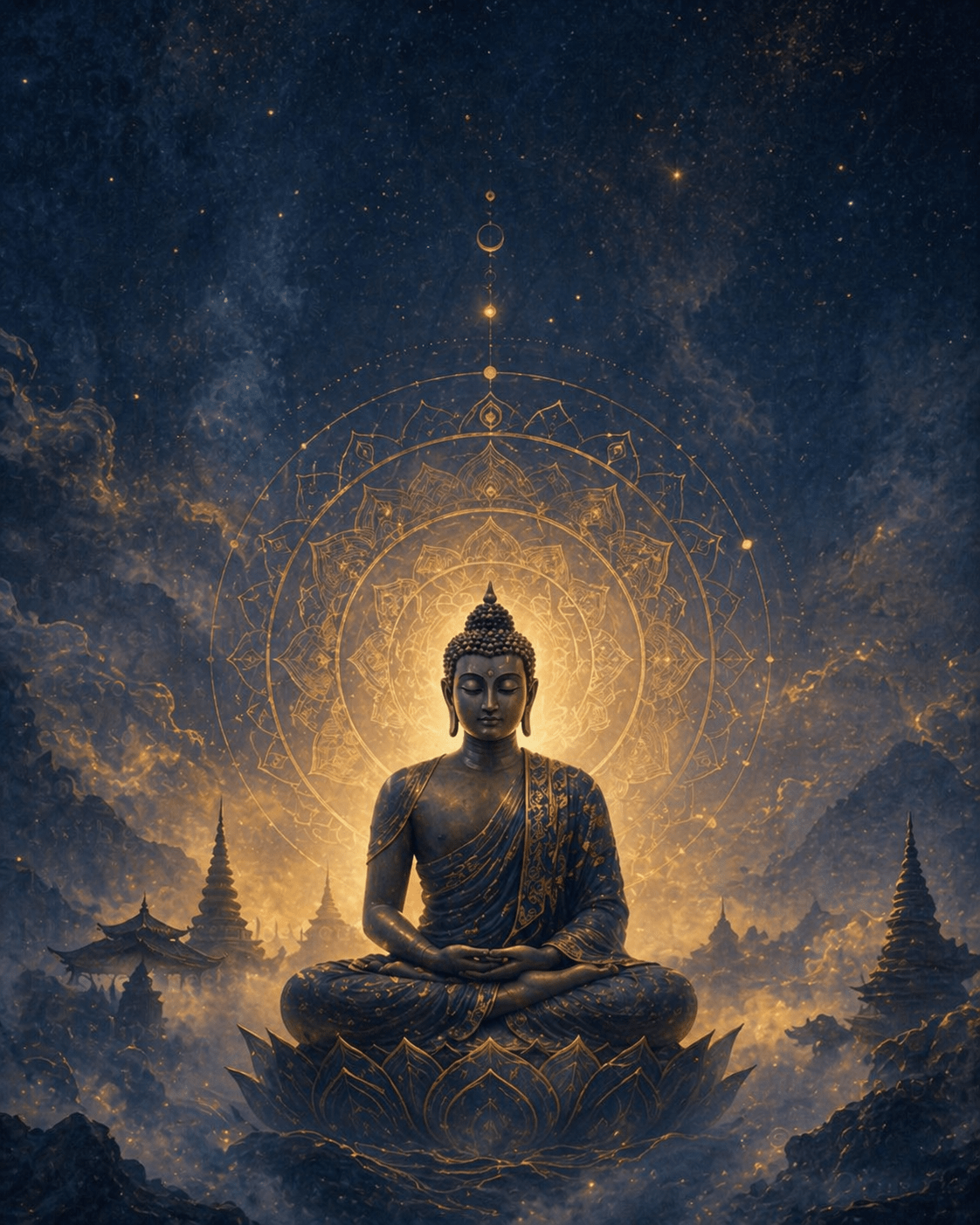
These three are known as the Three Mysteries:
A practitioner does not merely think about the Buddha. Through gesture, sound, and inner contemplation, the practitioner attempts to align the self with the Buddha’s wisdom.
This is where Mikkyō becomes especially fascinating. A mandala is not simply a beautiful religious painting. It is a map of reality. At its center is Dainichi Nyorai, surrounded by Buddhas, bodhisattvas, wisdom kings, and guardian deities. The mandala shows the universe not as chaos, but as a meaningful order.
Two famous mandalas are especially important: the Womb Realm Mandala, often associated with compassion, and the Diamond Realm Mandala, often associated with wisdom. Together, they suggest that reality is both nurturing and sharp, merciful and clear, expansive and disciplined.
Then there are the mantras—sacred phrases believed within the tradition to contain the essence of divine wisdom. To an outside listener, a mantra may sound strange, almost like a spell. But in Mikkyō, sound itself becomes a doorway. Words are not only tools for explanation; they are vessels of presence.
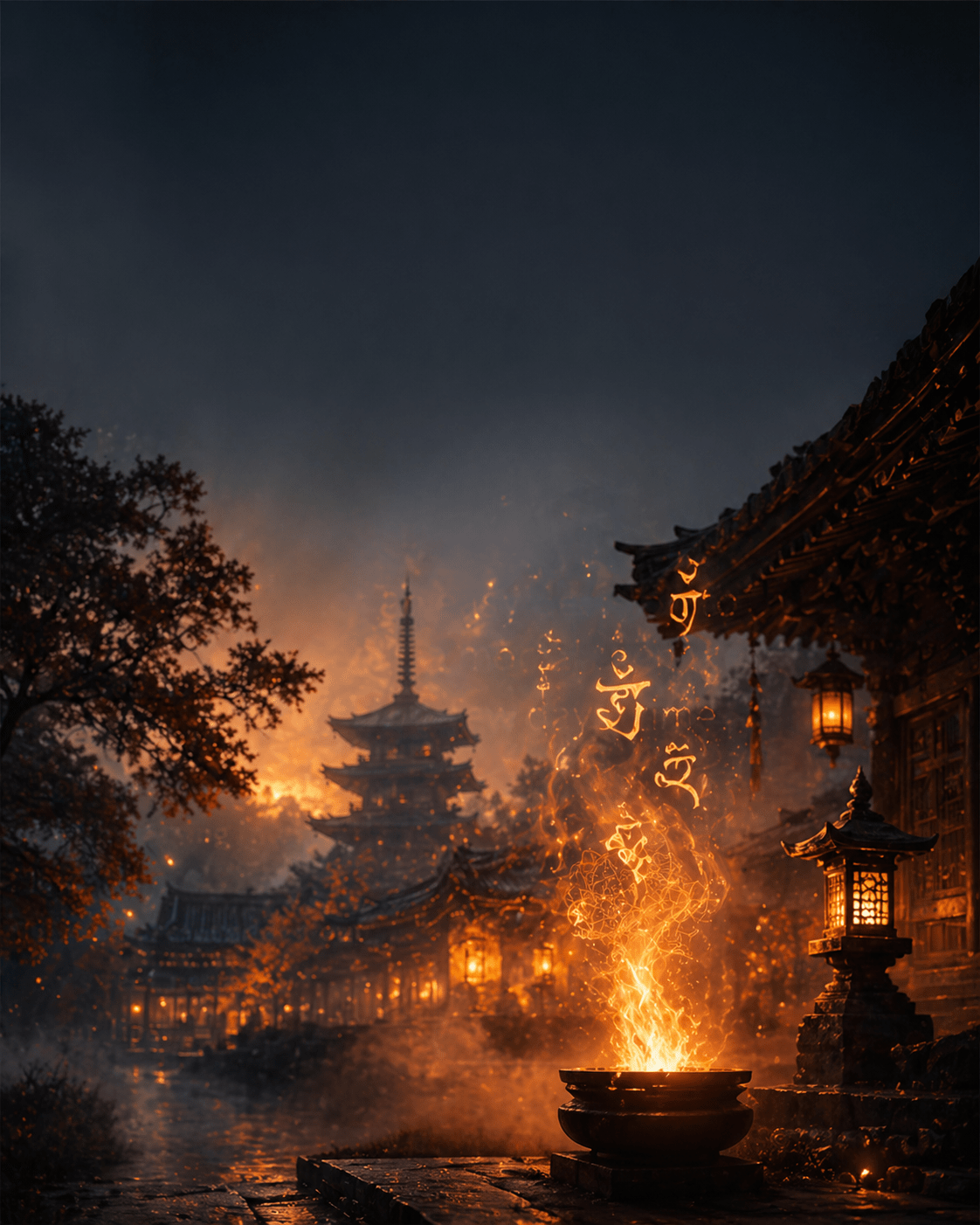
The same is true of the fierce figures known as Myōō, or Wisdom Kings. Among them, Fudō Myōō is especially famous. With a terrifying face, a sword, and flames behind him, he may seem frightening at first glance. Yet his anger is not ordinary rage. Symbolically, it is the fierce compassion that cuts through ignorance, fear, and attachment.
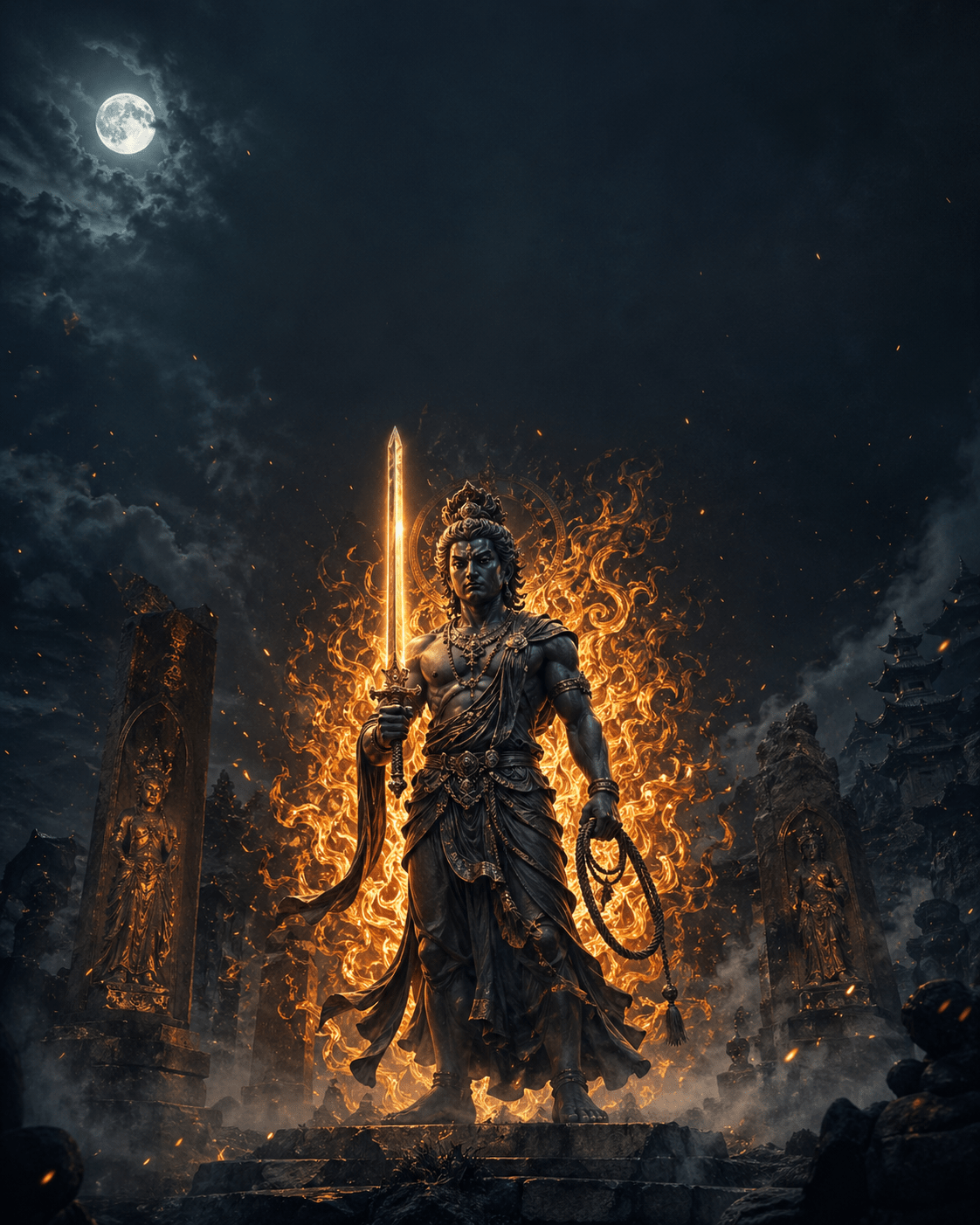
This is one of the most striking lessons of Japanese esoteric Buddhism: not everything that looks frightening is evil. Some frightening images are meant to protect. Some flames are not there to destroy the soul, but to burn away illusion.
Even deities with roots in Indian mythology were absorbed into the Buddhist universe as protectors. The world of Mikkyō is crowded, vivid, and layered—Buddhas, bodhisattvas, guardian gods, wrathful beings, sacred diagrams, hand signs, and mysterious syllables all working together as symbols of transformation.
To modern eyes, this may seem distant and strange. Yet one of the quiet insights of Mikkyō is that the sacred is not far away. Dainichi Nyorai is described not only as a cosmic presence beyond the world, but also as appearing through all things—human beings, animals, plants, and the natural world itself.
The mystery, then, is not hidden because it is absent. It is hidden because we do not always know how to see.
“Not every flame is meant to destroy; some are meant to illuminate.”
This original affirmation captures the symbolic heart of Mikkyō. The fierce images, burning halos, and wrathful deities are not merely frightening. They may also represent clarity, protection, and transformation.
For English-speaking readers, Mikkyō may appear similar to “magic” because it includes mantras, ritual gestures, mandalas, and secret transmissions. However, within its cultural context, these are not merely occult decorations. They are symbolic tools for approaching truth beyond ordinary language.
Japanese religion has often developed through layers of influence. Buddhism arrived from the Asian continent and interacted with native Japanese beliefs, including Shinto. Over time, some Buddhist figures were associated with Japanese kami, or local deities. Dainichi Nyorai, for example, was sometimes linked with Amaterasu, the sun goddess of Shinto, in traditions of shinbutsu shūgō, the blending of kami and Buddhas.
This blending helps explain why Japanese spiritual culture often feels richly symbolic rather than rigidly separated into categories. A deity may be cosmic and local, philosophical and folkloric, terrifying and compassionate, all at once.
The wrathful deities of Mikkyō also reveal an important cultural pattern: protection is not always gentle in appearance. A guardian may look frightening precisely because it stands between the human world and danger.
Human beings are drawn to mystery because mystery gives shape to what cannot be easily explained. Fear, death, desire, suffering, and hope are not simple problems with simple answers. Traditions like Mikkyō do not reduce these experiences to plain instructions. Instead, they surround them with symbols.
A mandala gives form to the invisible order we long to believe in. A mantra gives sound to a silence too deep for ordinary speech. A wrathful deity gives a face to the inner force that fights confusion and fear.
From a psychological perspective, these symbols may help people confront anxiety without being overwhelmed by it. Rather than saying “do not be afraid,” Mikkyō gives fear a place within a larger pattern. Even frightening images can belong to wisdom.
Philosophically, this tradition suggests that truth may not always arrive as an explanation. Sometimes it comes as a pattern, a sound, a ritual, a posture, or a story.
One way to read Japanese esoteric Buddhism is as a reminder that transformation often begins with what we do not understand.
In modern life, we tend to prefer clear explanations and quick solutions. But not every fear can be solved immediately. Not every confusion disappears when we name it. Some experiences must be approached slowly, with attention, humility, and practice.
Mikkyō may remind us that the frightening parts of life are not always enemies. Anger may conceal a need for justice. Fear may reveal what we value. Silence may contain a truth we are not ready to speak. A difficult symbol may invite us to look more carefully.
The lesson is not to romanticize fear. Nor is it to believe every mystery literally. Rather, it is to ask what a mystery may be teaching us about the limits of ordinary language and the depth of human experience.
When something in your life feels mysterious, frightening, or difficult to explain, could it be asking not for panic, but for deeper attention?
“Not every flame is meant to destroy; some are meant to illuminate.”
Japanese esoteric Buddhism is culturally significant because it blends Buddhist philosophy, ritual symbolism, Indian religious influence, Chinese transmission, and Japanese spiritual imagination. Its mantras, mandalas, and fierce deities should not be understood merely as “occult” elements, but as symbolic ways of approaching truth beyond ordinary language.
Mikkyō shows how human beings use symbols to face fear, uncertainty, and invisible truths. A frightening image can become a protector. A mysterious sound can become a form of meditation. A mandala can turn chaos into meaningful order.
This tradition may remind us that what seems frightening or confusing is not always meaningless. Sometimes fear asks us to look more carefully. Sometimes mystery invites humility. Sometimes transformation begins when we stop demanding quick answers.
What fear in your own life might be asking to be understood rather than avoided?