Explore Hyakki Yagyō, Japan’s mysterious night parade of demons, through folklore, fear, Kyoto history, and the wisdom hidden in darkness.
 Wonderful Proverbs Journey
※This site uses affiliate advertising.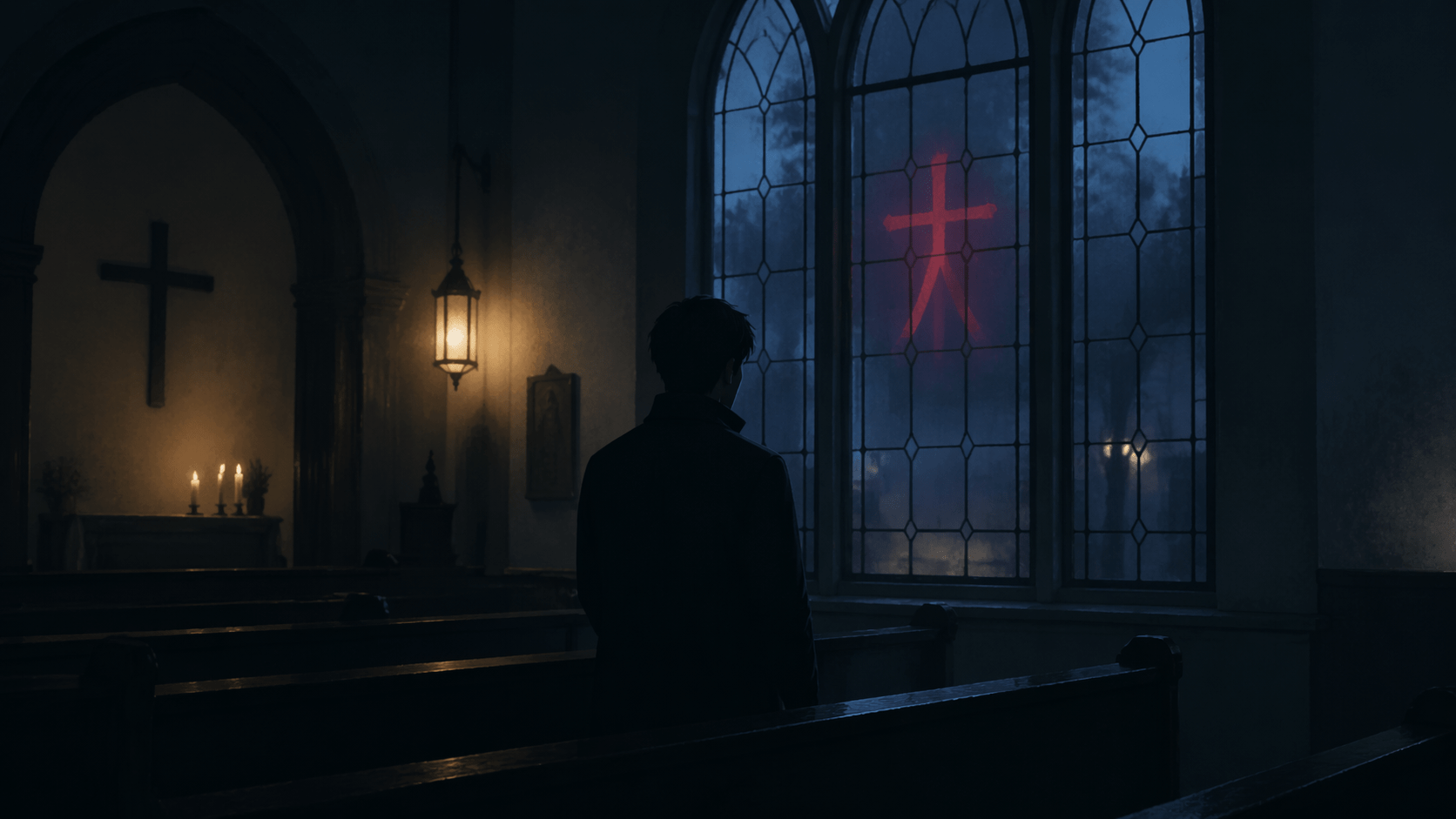
Some frightening stories begin in abandoned houses, dark forests, or lonely roads.
This one begins in a church.
That is part of what makes it unsettling. A church is usually imagined as a place of prayer, safety, order, and light. People gather there to seek comfort, forgiveness, guidance, and hope. Yet in many mysterious religious stories, the sacred place does not remove fear. Instead, it makes fear more meaningful.
The story introduced in the original article concerns an alleged incident at a church in Japan, remembered by a seminary student who had been assigned to serve there as an intern. One evening, after a long meeting, he stayed behind to help clean the sanctuary. While wiping the windows, he noticed faint red letters on the glass. What followed was later described as a frightening and confusing experience involving prayer, collapse, memory, and a word he would only later connect with the name “Apollyon.”
This article does not treat the story as verified fact, nor does it try to prove a supernatural event. Instead, it approaches the account as a mysterious spiritual tale — a story about fear, faith, perception, community, and the human need to give language to what cannot easily be explained.
Whether one reads it as religious testimony, folklore, psychological experience, or symbolic narrative, the story raises a question deeper than “Did it happen exactly this way?”
It asks:
What do people do when fear appears in a place where they expected peace?
And how does a community decide what an unsettling experience means?
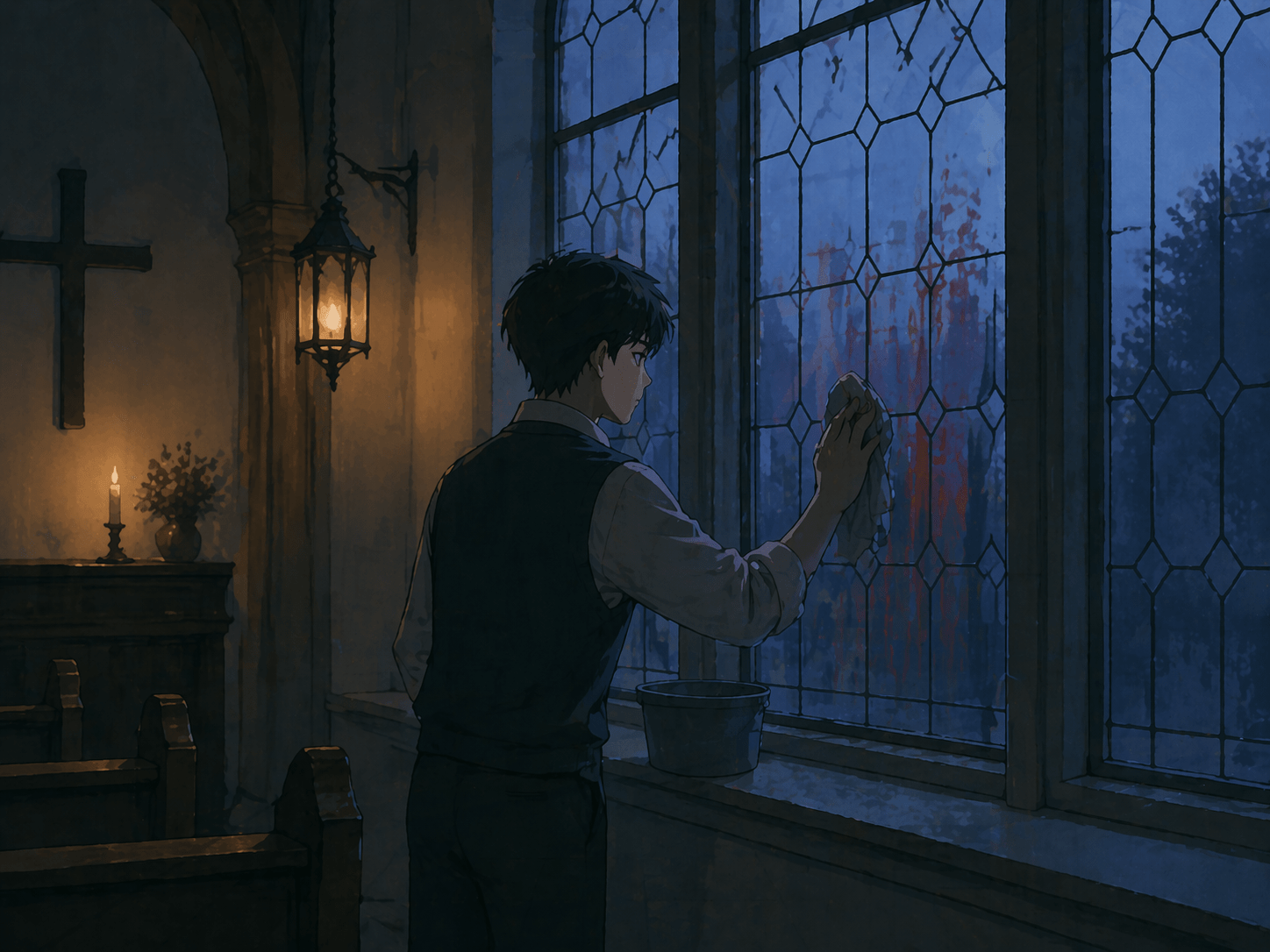
According to the account, the young man was still learning the rhythms of church life.
He was not yet a seasoned pastor. He was a seminary student, a person standing between study and service, between classroom theology and the unpredictable reality of ministry. He had likely learned doctrine, scripture, prayer, and pastoral responsibility. Yet learning about faith in books is not the same as meeting fear in a silent room after dark.
That evening, a meeting at the church had gone late. When the others began to leave, the building did not immediately return to ordinary silence. Anyone who has stayed behind in a large church, school, or public hall after people have gone home knows that such places change at night. A room made for voices becomes strangely hollow when empty. Chairs, windows, hallways, and doors seem to remember movement even after movement has stopped.
The student remained to clean.
It was an ordinary task. That ordinariness matters. Many strange stories begin not with dramatic rituals, but with simple acts: closing a door, turning off a light, wiping a window, walking down a hallway. The mind is relaxed enough to notice something small, but tired enough to question what it has noticed.
As he wiped the church windows, he saw something on the glass.
At first, it seemed like a stain.
Then it seemed like letters.
They were faint, but red. Not bright like a sign, not clear like printed ink, but visible enough to trouble him. He tried to wipe them away. They did not disappear.
The detail is important because windows are symbolic objects. A window separates inside from outside, yet allows one to see through. In a sacred space, a marked window can feel like a disturbance of boundaries. Something that should be transparent has become a message. Something that should simply let in light now appears to speak.
Troubled, the student called the pastor.
The pastor came, and several church leaders gathered to look at the window. The student did not understand what the letters meant. But he noticed the change in the others. Their expressions tightened. Their bodies seemed to recognize something before he did. The room, once ordinary, began to feel charged with meaning.
Then, according to his memory, the atmosphere shifted.
The leaders began to pray.
Not calmly. Not in the gentle rhythm of Sunday worship. Their voices were strained, urgent, almost groaning. The red letters seemed to flicker. Fear began to move through the space like a cold draft. The student felt that the faces around him were turning toward him, as if he had become part of the very thing they feared.
Then he felt overwhelmed.
The account suggests that he was seized by terror, confusion, or some force he could not name. The sacred space became unreadable. Prayer, which should have comforted him, now intensified the fear. The people around him, who should have been protectors, seemed for a moment like participants in something darker.
Finally, he lost consciousness.
When he awoke, the story had changed.
The pastor and church leaders told him they had not attacked him. They said they had been in other rooms when they heard a crash and came to find him collapsed on the floor. The red letters were gone. There was no clear evidence left to prove what he had seen, or what he thought he had seen.
This is where the story becomes more than a supernatural tale.
It becomes a story about perception.
What happened in that room?
Did the student see something real and external?
Was the experience shaped by exhaustion, suggestion, fear, and religious expectation?
Did the atmosphere of the group transform confusion into spiritual crisis?
Or did something occur that cannot be easily reduced to ordinary explanation?
The story does not answer.
And perhaps that is why it lingers.
What gives this story its lasting weight is what happened later.
Some time after the incident, the former student was studying Greek. In that study, he encountered a word that seemed to strike a hidden place in his memory: Apollyon.
In Christian scripture, Apollyon is associated with destruction. The name appears in the Book of Revelation, where it is connected to the “angel of the abyss.” For someone who had carried an unsettling memory from a church window, the recognition of such a word must have felt chilling. A blurred mark from the past seemed to receive a name.
But this moment can be read in more than one way.
From a religious point of view, the name may feel like confirmation — a sign that the experience had a spiritual meaning. From a psychological point of view, it may show how the mind searches for language to organize fear. From a folklore perspective, it reveals how stories become stronger when an image and a name come together.
Fear without a name is vague.
Fear with a name becomes a figure.
That is both comforting and dangerous. Naming fear can help us face it. A named fear is no longer a formless shadow. We can speak of it, pray about it, reflect on it, and place it within a tradition. But a name can also magnify fear. Once a frightening experience is connected to a powerful symbol, memory may become sharper, darker, and more certain than the original moment was.
This is not a reason to dismiss the student’s experience. It is a reason to treat it carefully.
Human beings do not remember like machines. We remember through meaning. Later knowledge can reshape earlier memory. A word learned years afterward can seem to illuminate the past, but it can also cast new shadows over it.
This is one of the reasons stories of possession, haunting, and spiritual attack are so powerful. They often involve a moment when confusion receives a name.
The unknown becomes “a demon.”
A collapse becomes “possession.”
A frightening atmosphere becomes “evil presence.”
A strange mark becomes “a message.”
Such interpretations may be sincere. They may also be shaped by culture, belief, fear, and expectation. The wiser response is neither mockery nor blind acceptance, but discernment.
In this story, the name Apollyon does not close the mystery.
It deepens it.
The phrase “alleged possession” must be used carefully.
It does not mean that the event is proven. It does not mean that the person involved should be reduced to a supernatural label. It means that some people, in a particular religious or cultural setting, interpreted a frightening experience through the language of possession, spiritual oppression, or demonic presence.
That distinction matters.
In religious communities, unusual events are rarely interpreted in isolation. A faint mark, a collapse, a cry, a strange atmosphere, or a disturbing dream may be understood through the community’s existing vocabulary. In a Christian setting, that vocabulary may include prayer, spiritual warfare, demons, deliverance, temptation, and protection. In another cultural setting, similar events might be described through spirits, curses, ancestral disturbance, emotional residue, or psychological distress.
The event itself may be one thing.
The language used to understand it may be another.
This does not mean language is false. Language is how human beings make meaning. But it does remind us that meaning is shaped by the community that receives the event.
In this story, the student’s experience took place in a church. That matters. Had the same collapse occurred in a hospital, the first interpretation might have been medical. Had it occurred in a school, it might have been treated as stress or exhaustion. In a church, surrounded by prayer and sacred symbols, the event became spiritually charged.
A sacred space can calm fear.
But it can also intensify fear, because the symbols are stronger there.
The cross, the sanctuary, the pastor, the act of prayer, the red letters on the window — each detail carries meaning. When fear enters such a place, it does not enter an empty room. It enters a room already full of symbols.
This is why the story can be read as a tale of interpretation.
Something happened.
Someone saw something.
Others responded.
The response changed the atmosphere.
The atmosphere changed the memory.
The memory later found a name.
Whether one reads the story spiritually or psychologically, it shows how fear becomes communal. One person’s experience can become a shared crisis when others gather around it with concern, prayer, alarm, and expectation.
Folklore often begins in exactly this way.
Not with proof.
But with a moment that people cannot stop interpreting.
When people think of possession and exorcism, many still think first of The Exorcist. Its cultural influence remains strong not simply because it is frightening, but because it leaves open an unsettling ambiguity: are we witnessing evil, illness, trauma, symbolism, or some painful overlap between them?
The alleged case at this Japanese church carries a similar ambiguity.
It can be read as a spiritual warning. It can also be read as a story about human vulnerability under pressure—about how sacred symbols, emotional tension, and communal expectation can intensify fear. Rather than forcing a final answer, the story invites us to sit with the unease of not fully knowing.
And in that uncertainty, meaning begins to emerge.
“Fear knocked at the door. Faith answered. No one was there.”
This saying is often shared as a proverb-like reflection. It should not be used to mock fear or dismiss troubling experiences. Instead, it offers a quiet space between fear and conclusion.
Fear often arrives before truth does.
It knocks loudly.
It demands interpretation.
It urges us to decide quickly what something means.
Faith, in this context, does not mean blind certainty. It means steadiness. It means the courage to open the door without surrendering the mind to panic.
A fitting affirmation for this story is:
“I do not let fear decide what is true.”
This affirmation does not deny mystery. It does not deny spiritual experience, psychological distress, or the possibility that some events remain difficult to explain. It simply reminds the reader that fear should not be the final judge.
Fear may be a messenger.
But wisdom must be the interpreter.
This story becomes especially interesting when read across cultures.
In many Western Christian traditions, demons are often understood as fallen spiritual beings associated with rebellion, temptation, deception, and spiritual disorder. A frightening event in a church may therefore be interpreted through the language of demonic attack, possession, or spiritual warfare.
Japanese spiritual imagination has a different history. While Japan certainly has stories of possession and harmful spirits, many Japanese ghost traditions emphasize unresolved emotion. Figures such as yūrei are often connected with grief, attachment, betrayal, longing, resentment, or unfinished relationships. The famous onryō, or vengeful spirit, is not simply evil in an abstract sense. It is often tied to suffering that has not been resolved.
This difference matters.
A Christian framework may ask, “Is this demonic?”
A Japanese folk framework may ask, “What feeling, memory, or disturbance remains?”
A psychological framework may ask, “What pressure, fear, or dissociation shaped the experience?”
A philosophical framework may ask, “How do human beings create meaning when certainty is absent?”
None of these questions fully cancels the others. Each reveals a different layer of interpretation.
In Japan, Christianity is a minority religion, which can make church settings feel culturally distinct. A church in Japan may carry both familiarity and foreignness: familiar as a place of prayer, foreign in its symbols and theological language compared with Shinto or Buddhist environments. This cultural mixture may make a religious mystery feel even more layered.
The story is therefore not simply “a possession story.”
It is a meeting point of symbolic languages.
Christian scripture.
Japanese sensitivity to unseen presence.
Modern psychology.
Group fear.
Memory.
The power of names.
From a cultural perspective, the tale shows how unseen fear is never interpreted in a vacuum. People reach for the stories, prayers, images, and words their traditions have given them.
This does not make them foolish.
It makes them human.
Possession stories disturb us because they touch one of the deepest human fears: the fear of losing oneself.
Many horror stories involve external danger — a monster, a storm, a dark road, a hidden attacker. Possession stories are different. They suggest that the boundary between self and other might become unstable. They raise the possibility that a person’s voice, body, memory, or will may no longer feel fully their own.
That fear can be spiritual.
It can also be psychological.
People may experience moments when they feel overwhelmed by emotion, dissociated from their surroundings, unable to explain their actions, or caught inside a group atmosphere stronger than their own private judgment. Such experiences can be terrifying even without supernatural interpretation.
In this church story, the most unsettling element may not be the red letters alone. It is the collapse of ordinary trust.
The window cannot be trusted.
The room cannot be trusted.
The faces of familiar leaders cannot be trusted.
Even memory cannot be fully trusted.
That is why the story lingers.
It places the reader in a world where interpretation itself becomes unstable. The student’s memory says one thing. The leaders’ explanation says another. The later discovery of the word Apollyon seems to confirm something, yet also raises new questions.
Human beings are deeply uncomfortable with this kind of ambiguity.
We want one clear answer.
But fear often lives in the space between possible answers.
A strange tale allows us to approach that space safely. We can read the story, feel the unease, and ask what it reveals about our own need for certainty. In that sense, possession folklore is not only about demons or spirits. It is about identity, agency, memory, and the fragile boundary between inner experience and outer reality.
Rather than proving the supernatural, the story reveals how people live with uncertainty.
And how quickly fear asks to be named.
The deepest wisdom in this story may lie in the pause before interpretation.
Something frightening happens.
Immediately, the mind wants to explain it.
That is natural. Explanation gives us a sense of control. If we can name the danger, we feel less helpless. If we can place an event inside a familiar category — illness, spirit, stress, evil, dream, sign, coincidence — we feel that the world has become readable again.
But the desire for quick interpretation can also mislead us.
A frightening experience is not always false.
A strong feeling is not always truth.
A symbol is not always a command.
A memory is not always complete.
A community’s interpretation is not always final.
Wisdom begins when we allow a little space between experience and conclusion.
This is not weakness. It is discernment.
In many wisdom traditions, discernment is the ability to see carefully — not only with fear, not only with desire, not only with inherited assumptions, but with patience. It does not demand that we reject spiritual meaning. Nor does it demand that we reduce everything to psychology. Instead, it asks us to remain honest before mystery.
The story of the red letters may be read as a warning against panic disguised as certainty.
When people are afraid, certainty can become seductive. It feels strong. It gives the group something to do. It turns confusion into action.
But not all certainty is wisdom.
Sometimes wisdom sounds quieter:
Wait.
Breathe.
Observe.
Pray, if prayer is your language.
Seek help, if help is needed.
Do not let fear become the author of the truth.
This is why the story belongs naturally to a site about proverbs and affirmations. Old sayings do not solve every mystery, but they can steady the mind at the moment when fear tries to rush ahead of understanding.
For modern readers, the value of this story may not lie in deciding whether the event was supernatural.
Its deeper value may lie in the question it leaves behind:
How quickly do we let fear decide what is true?
This question reaches far beyond religion.
In daily life, fear often arrives before clarity does. A message goes unanswered, and we assume rejection. A person speaks coldly, and we assume hatred. A mistake happens, and we assume disaster. A silence appears, and fear fills it with meaning.
The mind does not like empty spaces.
So it writes into them.
This church story shows what can happen when symbols, exhaustion, belief, and fear gather in one place. The red letters may represent any unsettling sign we do not yet understand. The praying leaders may represent the community’s attempt to respond. The student’s collapse may represent the moment when fear overwhelms the self. The later discovery of Apollyon may represent the way memory searches for a name.
One way to read the tale is this:
Not every frightening sign should be ignored.
But not every frightening sign should be obeyed.
Between denial and panic, there is a wiser path.
That path includes patience, careful observation, compassion, and humility. It allows spiritual people to pray without becoming reckless. It allows thoughtful people to consider psychology without mocking faith. It allows communities to support the frightened without turning them into symbols of their own fear.
The lesson is not “nothing happened.”
The lesson is not “everything was demonic.”
The lesson is that human beings need wisdom when fear becomes meaningful.
In modern life, this may mean pausing before sending the angry message, before assuming the worst, before naming someone an enemy, before turning anxiety into certainty. It may mean asking: What do I know? What do I fear? What am I adding to the story? What kind of wisdom would help me respond with care?
Fear can be loud.
But truth is often patient.
The story of the alleged church possession in Japan remains powerful because it refuses to become simple.
It is not only a horror story.
It is not only a religious warning.
It is not only a psychological puzzle.
It is not only folklore.
It is a story about what happens when fear enters a meaningful place.
A church.
A window.
A mark.
A prayer.
A collapse.
A memory.
A name.
Each element asks to be interpreted. Yet the story also warns us that interpretation is not innocent. The words we choose can calm fear, but they can also strengthen it. The names we give to mystery can help us face it, but they can also make it larger than it was.
Perhaps the deepest wisdom of the tale is not that we should deny fear.
Fear may be telling us something.
But it may not be telling us everything.
When an unsettling experience comes before understanding, we do not have to rush into panic. We can pause. We can seek help. We can pray, reflect, investigate, and listen. We can honor the seriousness of what was felt without allowing fear to become the only voice in the room.
Perhaps that is what faith, in its wisest form, offers.
Not the refusal to feel fear.
But the courage to answer fear without obeying it.
Proverb-like reflection:
“Fear knocked at the door. Faith answered. No one was there.”
Affirmation:
“I do not let fear decide what is true.”
When an experience unsettles you before you can explain it, what speaks first within you — fear, interpretation, or the quiet wisdom that teaches you to pause?