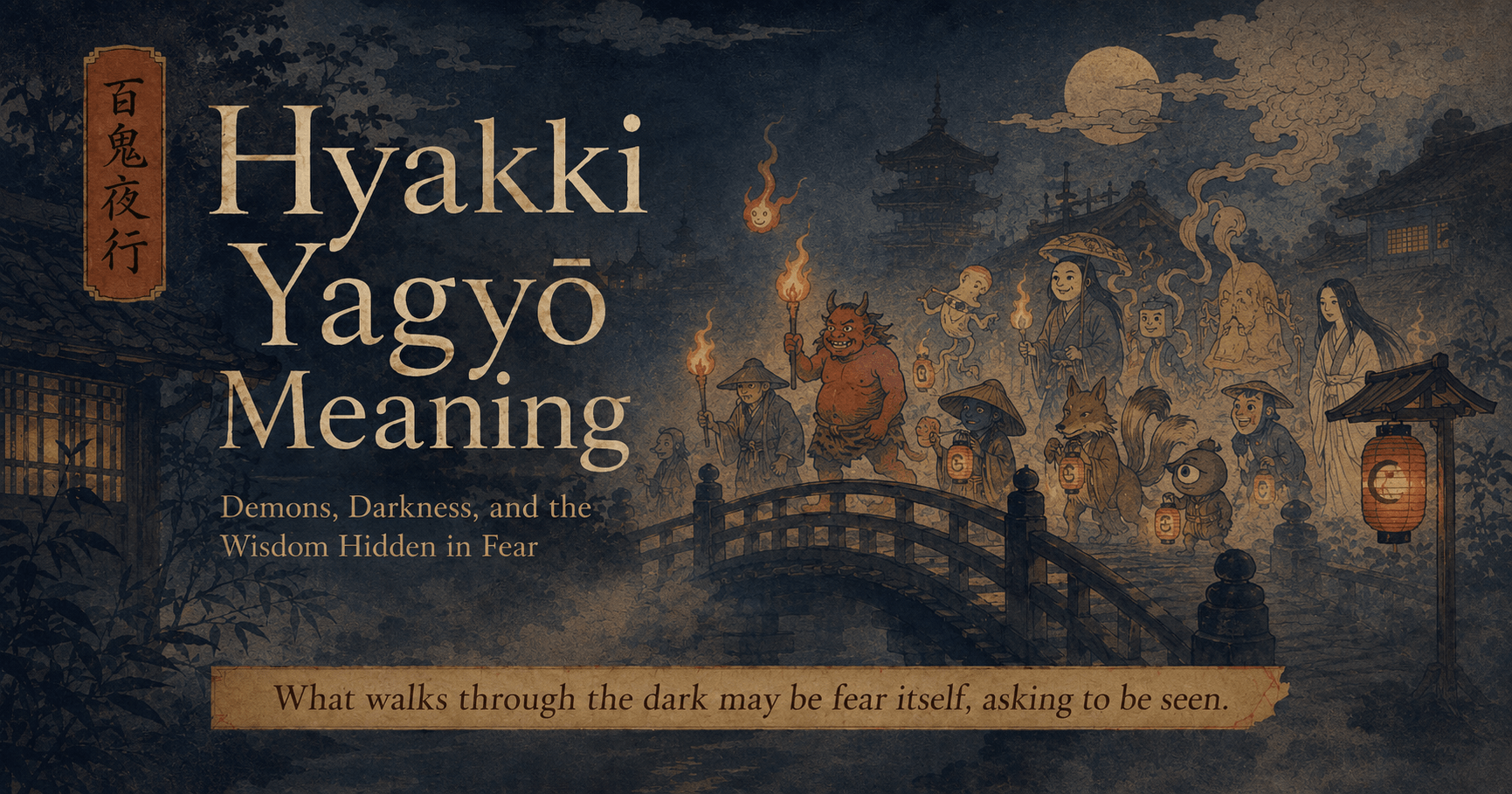
Explore Hyakki Yagyō, Japan’s mysterious night parade of demons, through folklore, fear, Kyoto history, and the wisdom hidden in darkness.
 Wonderful Proverbs Journey
※This site uses affiliate advertising.
In many Western stories, demons are imagined as absolute enemies of goodness: dark beings opposed to divine light, moral order, and human salvation. But in Shinto, Japan’s traditional spiritual worldview, the picture is far more complex.
The Japanese world of kami is not divided simply into angels and devils, good spirits and evil spirits. It is a living landscape filled with sacred presences: mountains, seas, forests, storms, ancestors, local guardians, and mysterious forces that cannot always be neatly named.
Some bless.
Some disturb.
Some protect when honored, yet become dangerous when neglected.
This is why “Shinto demonology” should not be understood as a horror category in the ordinary sense. It is closer to a spiritual language of balance. What appears “demonic” may not be evil in an absolute moral sense. It may be a wounded force, an angry kami, a polluted spirit, or the wild side of nature demanding recognition.
At the heart of this worldview are several important ideas: kami, the sacred presences that fill the world; kegare, impurity or spiritual pollution; harae, purification; and Yomi, the shadowy land of death found in ancient Japanese myth.
Together, these ideas form a strange and beautiful vision of fear: not fear as something to sensationalize, but fear as a sign that harmony has been disturbed.
Before speaking of demons, we must first understand the world they emerge from. In Shinto thought, the frightening is not always separate from the sacred. Sometimes it is the sacred in its wild, wounded, or unbalanced form.
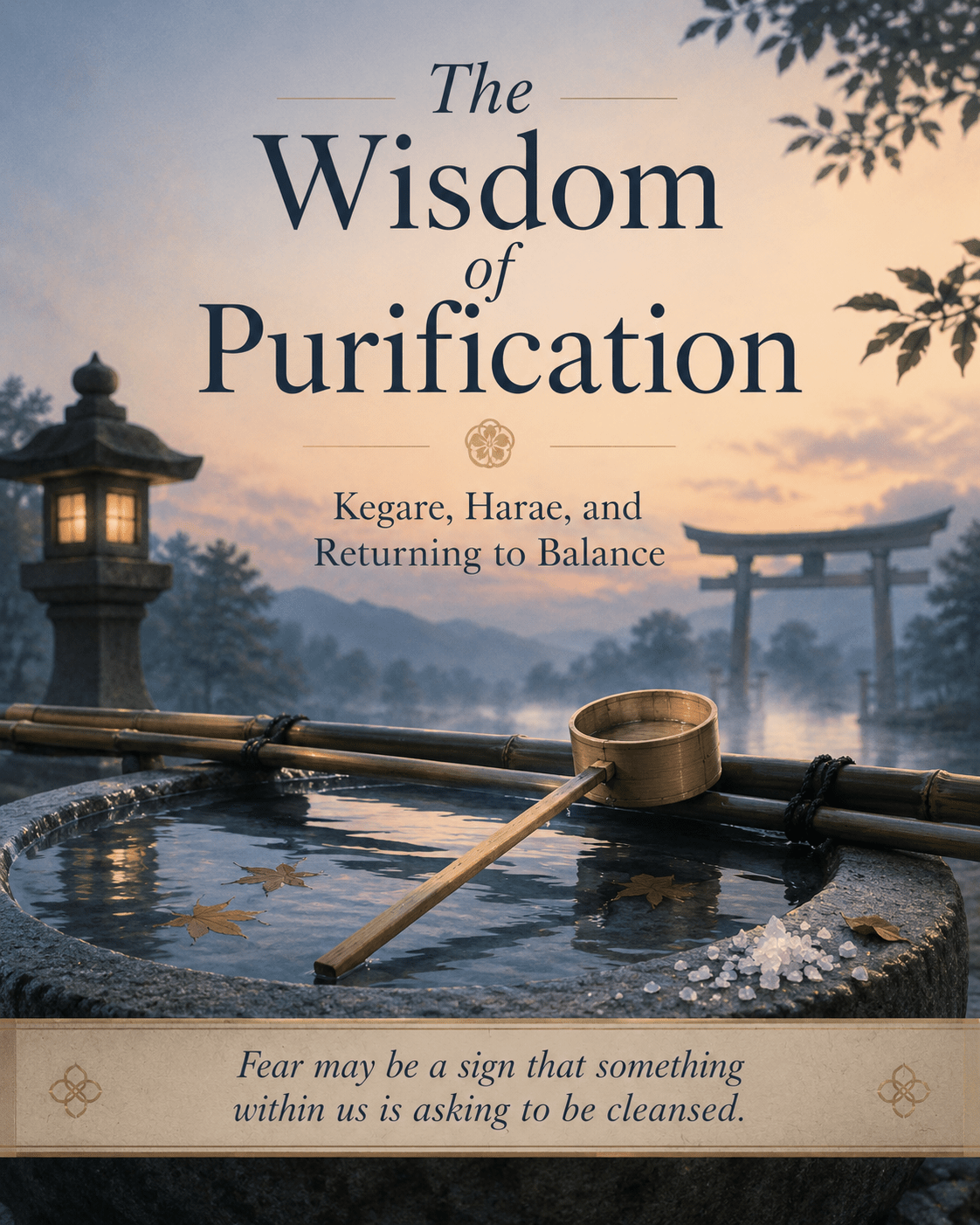
The word kami is often translated as “god” or “spirit,” but neither English word fully captures its meaning.
Kami may be great deities of the sun, mountains, sea, or storms. They may also be ancestral spirits, local guardians, or presences associated with unusual places and objects. In Shinto thought, the world is not spiritually empty. It is alive with unseen significance.
There is an old Japanese expression, yaoyorozu no kami, often rendered as “eight million kami.” The number does not need to be taken literally. It suggests a countless multitude of sacred presences woven through ordinary life.
A waterfall may inspire reverence.
A mountain may be approached as holy.
A great tree may feel as though it has watched generations pass beneath its branches.
This worldview does not imagine nature as a lifeless background for human activity. Nature has mood, dignity, memory, and power.
But kami are not always gentle.
In some Shinto traditions, a kami may have different aspects. The peaceful, harmonious side is called nigi-mitama. The rough, wild, or forceful side is called ara-mitama. A deity that blesses in one state may become dangerous in another if angered, neglected, or approached without proper respect.
This does not make the kami “evil” in a simple sense. It makes them powerful.
Like the sea, they may nourish or destroy.
Like fire, they may warm or burn.
Like a storm, they may cleanse or devastate.
Kegare: When Harmony Becomes Clouded
Another important idea is kegare, often translated as impurity, pollution, or defilement. But this should not be understood only as dirt in a physical sense, nor as sin in the moral sense familiar from some religious traditions.
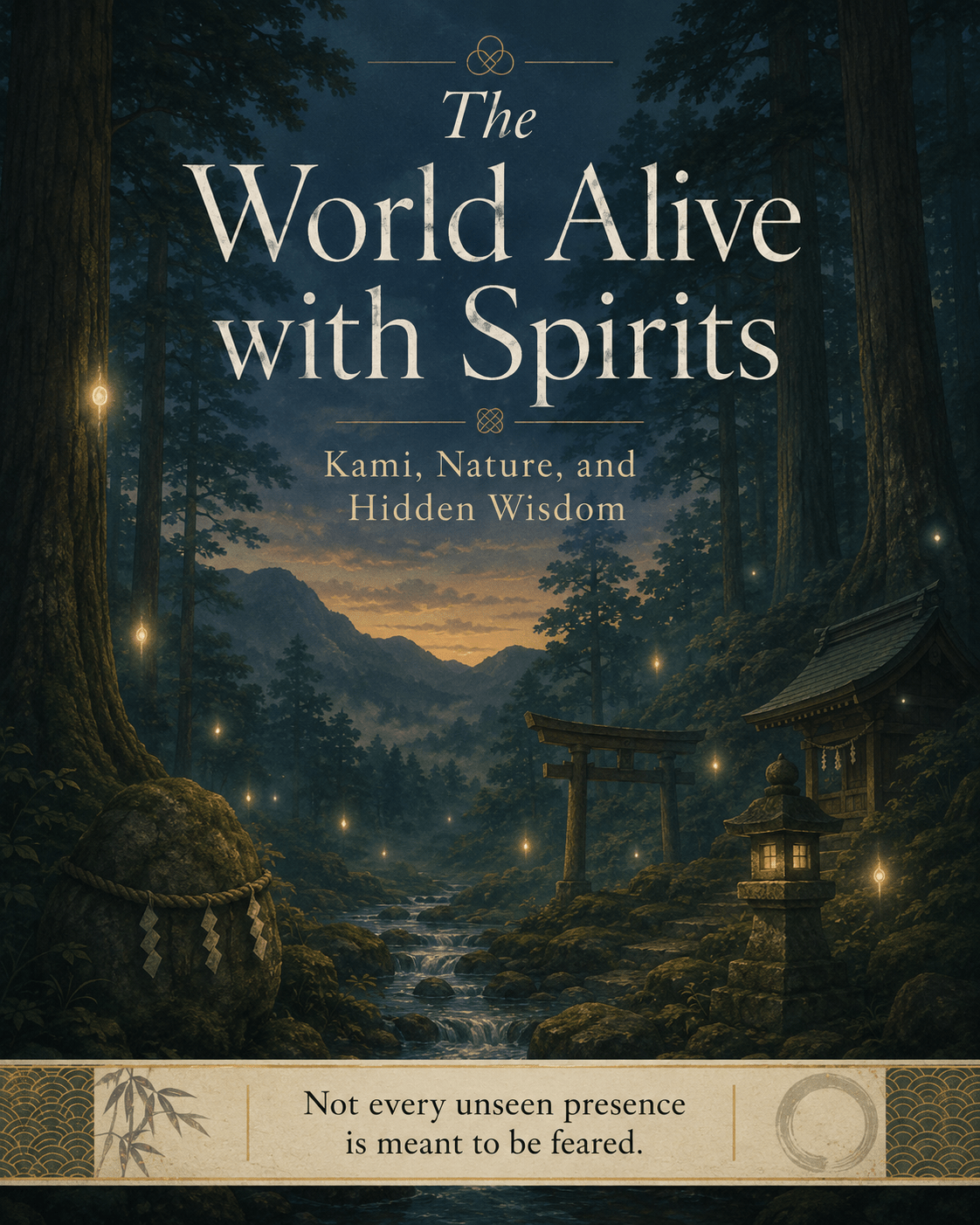
Death, blood, disease, trauma, and disorder were traditionally associated with impurity because they disturb the flow of life. A person who dies with unresolved anger or sorrow might be imagined as unable to rest. A place touched by violence or misfortune might be felt as spiritually heavy. A community that ignores ritual order may become vulnerable to imbalance.
In this worldview, harmful spirits are not always enemies from outside. Sometimes they arise where grief has not been settled, where death has not been ritually acknowledged, or where the boundary between the living and the dead has become unclear.
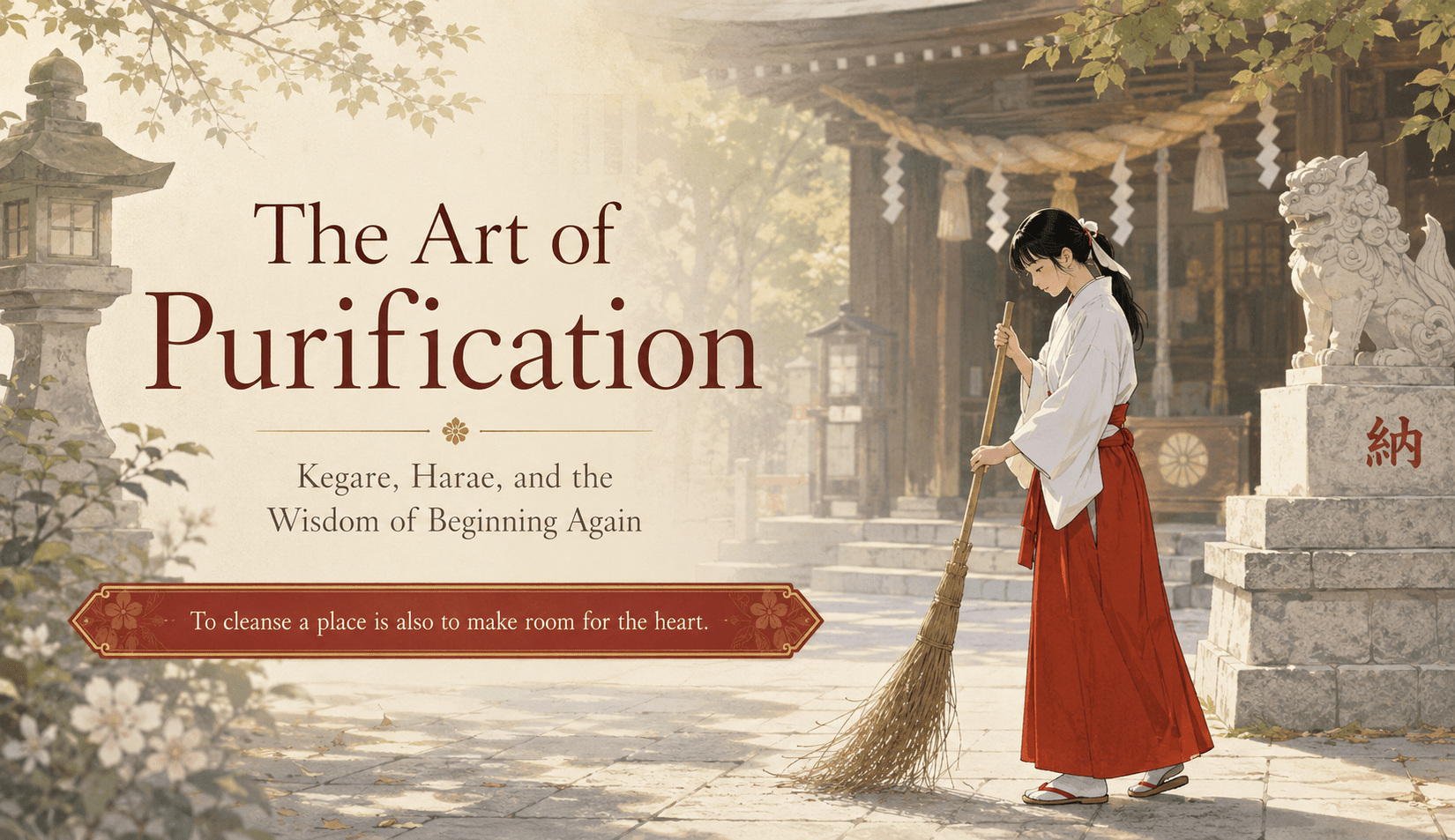
This is why purification matters.
Harae, or purification, may involve water, salt, prayers, offerings, ritual words, or formal ceremonies. These acts are not merely symbolic decoration. They are ways of restoring relationship: between people and place, between the living and the dead, between the visible world and the unseen.
In this sense, Shinto demonology is not simply about fighting monsters.
It is about restoring balance.
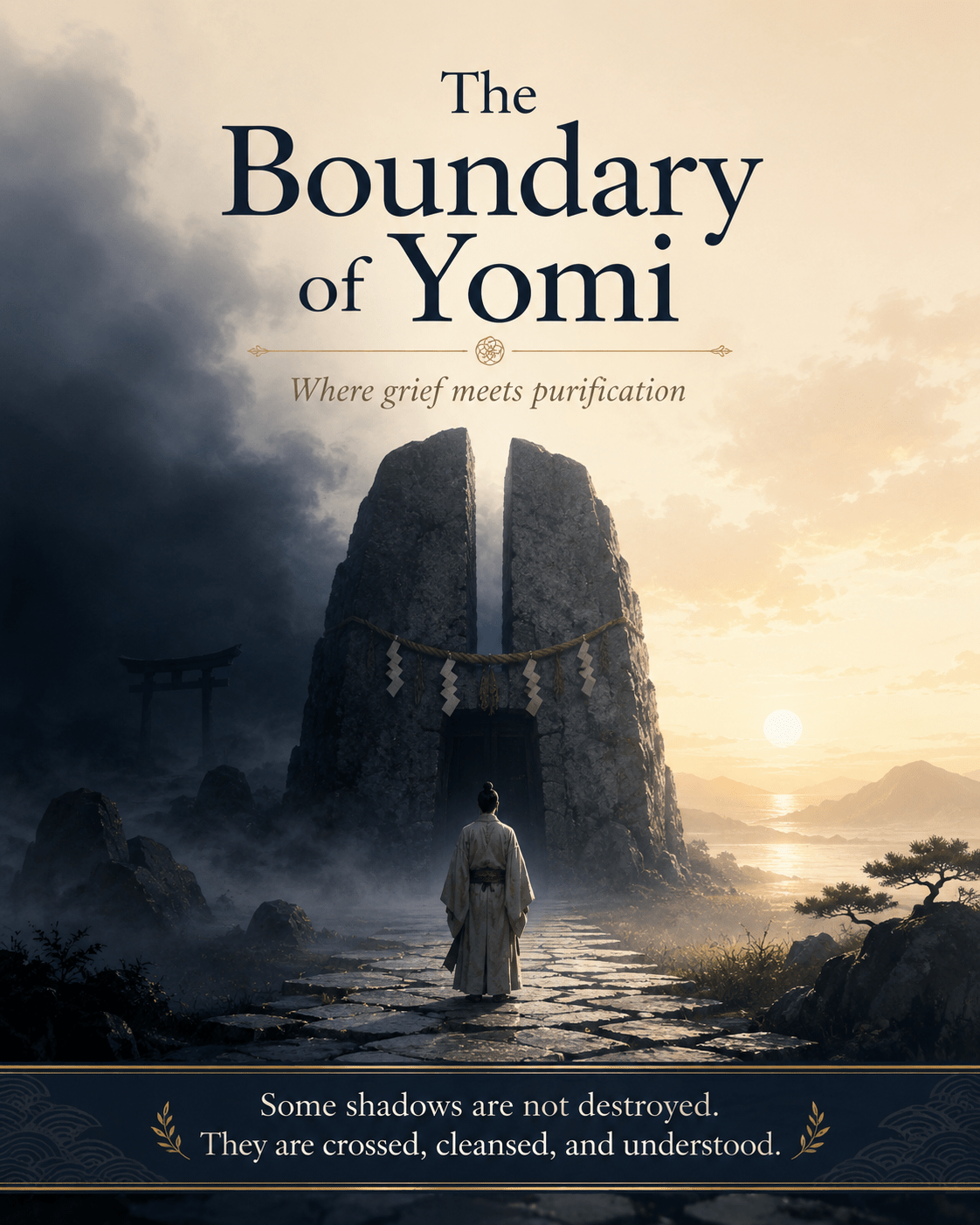
Among the oldest recorded Japanese myths, found in texts such as the Kojiki and Nihon Shoki, the story of Izanagi and Izanami gives a powerful image of death, taboo, and purification.
Izanagi and Izanami are the divine couple associated with the creation of the Japanese islands. But their story turns sorrowful when Izanami dies after giving birth to the fire deity. Overcome by grief, Izanagi follows her into Yomi, the shadowy land of the dead.
The journey is not merely a rescue attempt. It is a crossing of boundaries.
Yomi is not described as a fiery hell in the later Western sense. It is a dim, heavy, mysterious realm of death. Izanagi longs to bring Izanami back, but she warns him not to look at her. She has eaten the food of the underworld and now belongs, at least partly, to that realm.
Yet grief is impatient. Love mixed with fear becomes difficult to control.
Izanagi lights a flame and looks.
What he sees is not the wife he remembered. Izanami’s body has changed in death. The myth describes a terrifying transformation, with decay and thunder deities emerging from her remains. The sight is unbearable. Izanagi flees. Izanami, humiliated and enraged, pursues him through the darkness of Yomi.
The story is haunting not because it merely shocks, but because it touches a universal human fear: the fear that love cannot undo death.
When Izanagi finally escapes, he blocks the entrance to Yomi with a great stone. The separation between the living and the dead becomes fixed. Afterward, he performs purification, washing away the pollution of the underworld. From this act of cleansing, new deities are born.
Here, fear leads not to despair, but to purification.
Death is not denied.
Grief is not mocked.
But the living must return to life.
The world of Shinto spirits suggests that fear is not always a sign of evil. Sometimes it is a sign that something needs cleansing, recognition, or balance.
I do not need to fear every shadow; I can return to balance, one quiet act of cleansing at a time.
Shinto demonology is best understood through relationship, not opposition. The question is not only “Is this spirit good or evil?” but “Has harmony been maintained?”
In many traditions, demons are defined by their opposition to divine goodness. In Shinto, however, the dangerous or frightening is often understood through imbalance.
A kami may become violent if angered.
A spirit may become restless if death is unresolved.
A place may feel polluted if grief, blood, disease, or disorder has marked it.
A community may feel vulnerable if ritual respect has been neglected.
This does not mean that Shinto has no sense of danger. It does. But danger is often treated as something to be pacified, purified, or ritually addressed rather than condemned as eternally evil.
This is a very different spiritual imagination.
It reflects a culture deeply attentive to boundaries: between pure and impure, living and dead, human and divine, inside and outside, order and disorder. Ritual is a way of maintaining those boundaries without pretending that darkness does not exist.
In this sense, purification is not about shame. It is about renewal.
The old stories do not say that humans are permanently stained. Rather, they suggest that impurity can be cleansed, balance can be restored, and life can continue after contact with grief, fear, and death.
We are drawn to frightening spiritual stories not only because they scare us, but because they give shape to experiences we struggle to explain.
The myth of Izanagi and Izanami is not merely an ancient tale about gods. It is also a story about grief, denial, curiosity, and the painful limit of love.
Izanagi wants to bring Izanami back. This desire is deeply human. When someone beloved is gone, the heart often refuses reality before the mind accepts it. The journey into Yomi can be read as the emotional journey into grief: the wish to reverse what cannot be reversed.
The taboo against looking also carries psychological meaning. Sometimes we fear seeing the truth because truth changes memory. Izanagi wants the wife he remembers. But when he sees what death has made of her, the image cannot be forgotten.
This is one reason old myths endure. They do not give us easy comfort. They give us symbolic language.
Yomi becomes the place we go when grief pulls us toward what cannot return.
Kegare becomes the heaviness that follows trauma, loss, and disorder.
Purification becomes the slow act of coming back to life.
Rather than proving supernatural realities, these stories reveal how people have long tried to live with uncertainty, death, and fear.
They remind us that fear is not always meaningless. Sometimes fear is the soul’s way of saying: something has changed, and we must learn how to cross back into life.
The ancient language of purification can still speak to modern life, even outside a religious context. We all know what it means to feel heavy after grief, conflict, stress, or emotional disorder.
In modern life, we may not describe our troubles as angry spirits or kegare. Yet we often understand the feeling.
A room feels heavy after an argument.
The body feels tired after grief.
A relationship feels clouded after words left unsaid.
A mind feels polluted after too much noise, fear, or resentment.
One way to read Shinto purification is as a reminder that restoration matters.
We cannot avoid every sorrow.
We cannot prevent every loss.
We cannot live without touching uncertainty.
But we can return.
We can wash our hands.
Open a window.
Speak an apology.
Light a candle.
Visit a quiet place.
Offer gratitude.
Name what hurt us.
Let silence settle.
These acts may be small, but human beings often heal through small repeated gestures. The wisdom of purification is not that life can remain untouched by darkness. It is that darkness does not have to be the final condition.
The story of Izanagi returning from Yomi suggests a difficult but hopeful truth: once we have encountered grief, we may not be the same as before. But through cleansing, reflection, and renewed attention to life, we can begin again.
Old spiritual stories do not only ask whether we believe in spirits. They ask how we live with what feels heavy, unresolved, or unseen.
What in your life feels like fear, but may actually be asking for cleansing, balance, or gentle attention?
Perhaps the deepest wisdom of Shinto demonology is this: not every shadow must be destroyed. Some shadows must be understood, honored, purified, and allowed to pass.
What in your life feels like fear, but may actually be asking for cleansing, balance, or gentle attention?