Explore Hyakki Yagyō, Japan’s mysterious night parade of demons, through folklore, fear, Kyoto history, and the wisdom hidden in darkness.
 Wonderful Proverbs Journey
※This site uses affiliate advertising.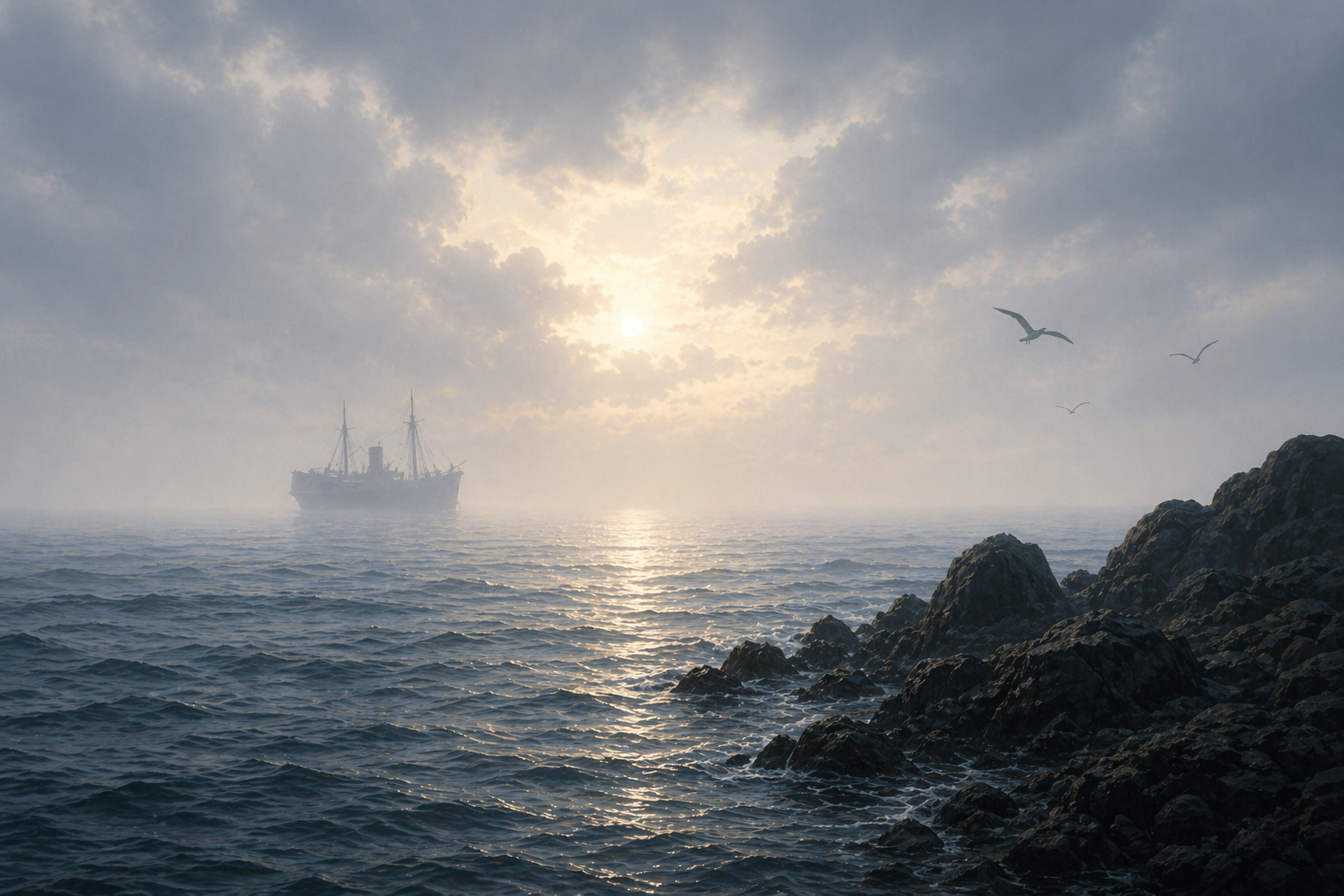
Ghost ships occupy a strange place in human imagination.
They are not always ghosts in the literal sense. Sometimes they are abandoned vessels found drifting across the sea. Sometimes they are ships connected to disaster, rumor, or unexplained disappearance. Sometimes they are stories that began with real events, then slowly gathered shadow as they passed from sailor to sailor, newspaper to book, memory to legend.
What makes ghost ship stories so powerful is not only the fear of death at sea. It is the fear of absence.
A ship should have voices.
Footsteps.
Orders shouted over wind.
Hands pulling rope.
Someone watching the horizon.
But in a ghost ship story, the vessel remains while the people are gone.
That absence unsettles us. It feels like a sentence with the final words removed. The sea has kept something, and we are left standing before the silence.
The original article introduces several famous ghost ship stories — including the Ourang Medan, Octavius, Mary Celeste, Valencia, and Kaz II — not simply as horror tales, but as strange stories with emotional and cultural meaning. This expanded version follows that spirit. Rather than treating every rumor as fact or every mystery as supernatural proof, it reads these maritime legends as folklore: stories that reveal how human beings respond to uncertainty, loss, fear, and the limits of control.
A ghost ship is more than a vessel without a crew.
It is a symbol of interrupted journeys.
Unanswered questions.
Human ambition humbled by distance.
And the old truth that the sea, like life itself, does not always explain what it takes.
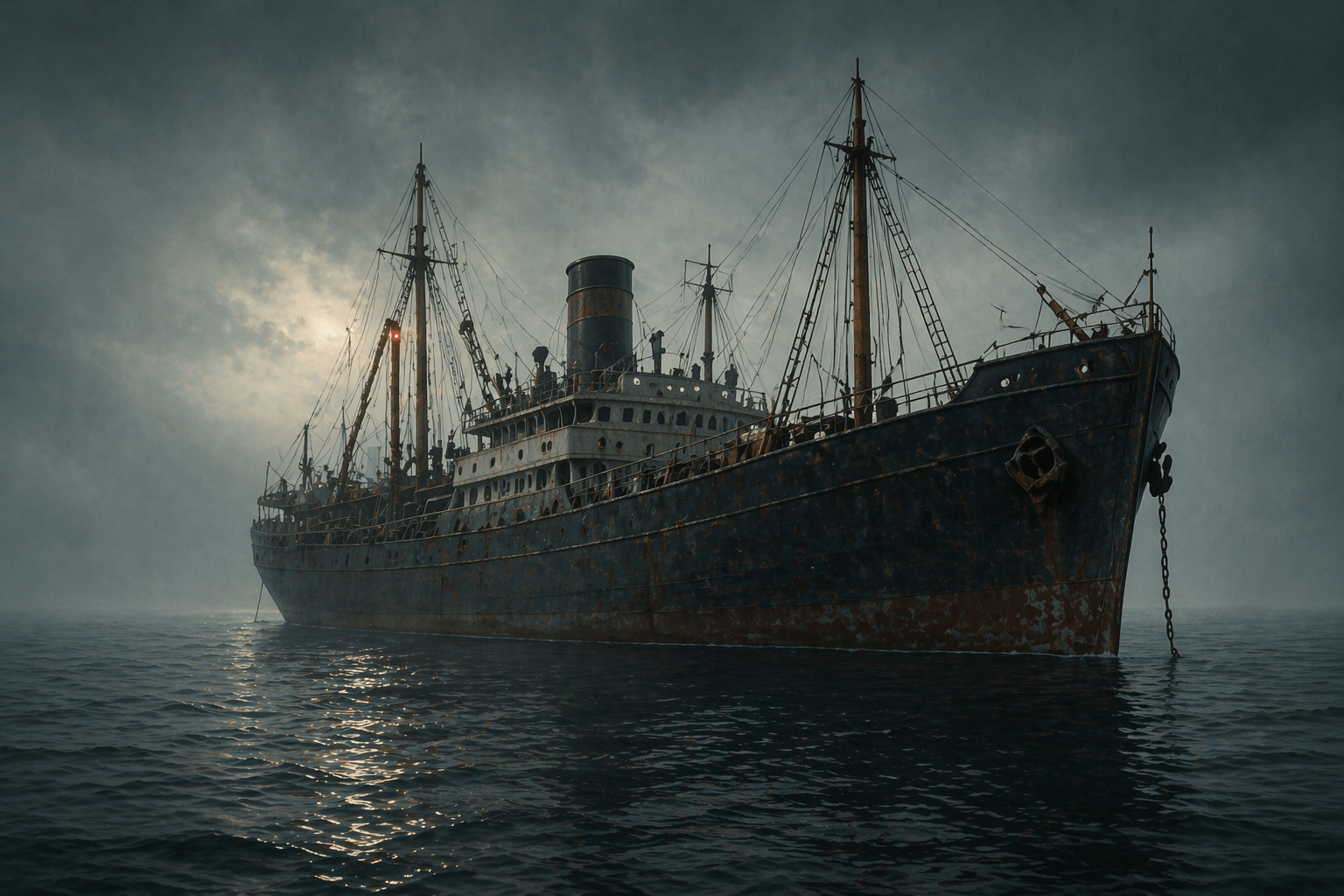
Among ghost ship stories, few are as eerie as the tale of the Ourang Medan.
According to the most repeated version, sometime around 1947, a distress signal was received from a Dutch vessel said to be sailing near the Strait of Malacca. The message was short, broken, and terrifying. It reportedly claimed that the captain and crew were dead. Then came a final line suggesting that the sender, too, was dying.
After that, silence.
An American ship, often identified in retellings as the Silver Star, was said to have responded to the call. When rescuers boarded the Ourang Medan, they reportedly found the entire crew dead. The bodies were said to be frozen in strange positions, faces twisted in shock, as though the men had seen something beyond language.
Before the ship could be fully examined, the story continues, smoke began rising from below deck. The rescuers retreated. Soon after, the vessel exploded and sank, taking its secrets with it.
It is important to say this carefully: the Ourang Medan story is widely told, but its historical record is uncertain. It belongs more securely to maritime legend than to verified history. That does not make it meaningless. Folklore often survives not because it provides proof, but because it gives shape to a fear many people already understand.
The terror of the Ourang Medan is not only that people died.
It is that the explanation disappeared with them.
No clear cause.
No final testimony.
No evidence left long enough to settle the matter.
The sea closes over the ship, and the mind is left open.
This is why the story remains powerful. It touches the human fear of reaching the edge of explanation. In ordinary life, we often believe that knowledge will calm us. If we can identify the cause, name the danger, and understand the sequence of events, fear becomes manageable.
But some stories resist that comfort.
The Ourang Medan is frightening because it refuses the reader a stable answer. It leaves only a message, a boarded ship, a terrible sight, and an explosion that erases certainty.
As a piece of mysterious folklore, the tale may be read as a warning about the limits of human confidence. We are creatures who want explanations. Yet the world does not always give them at the moment we need them most.
Fear often grows fastest where explanation ends.
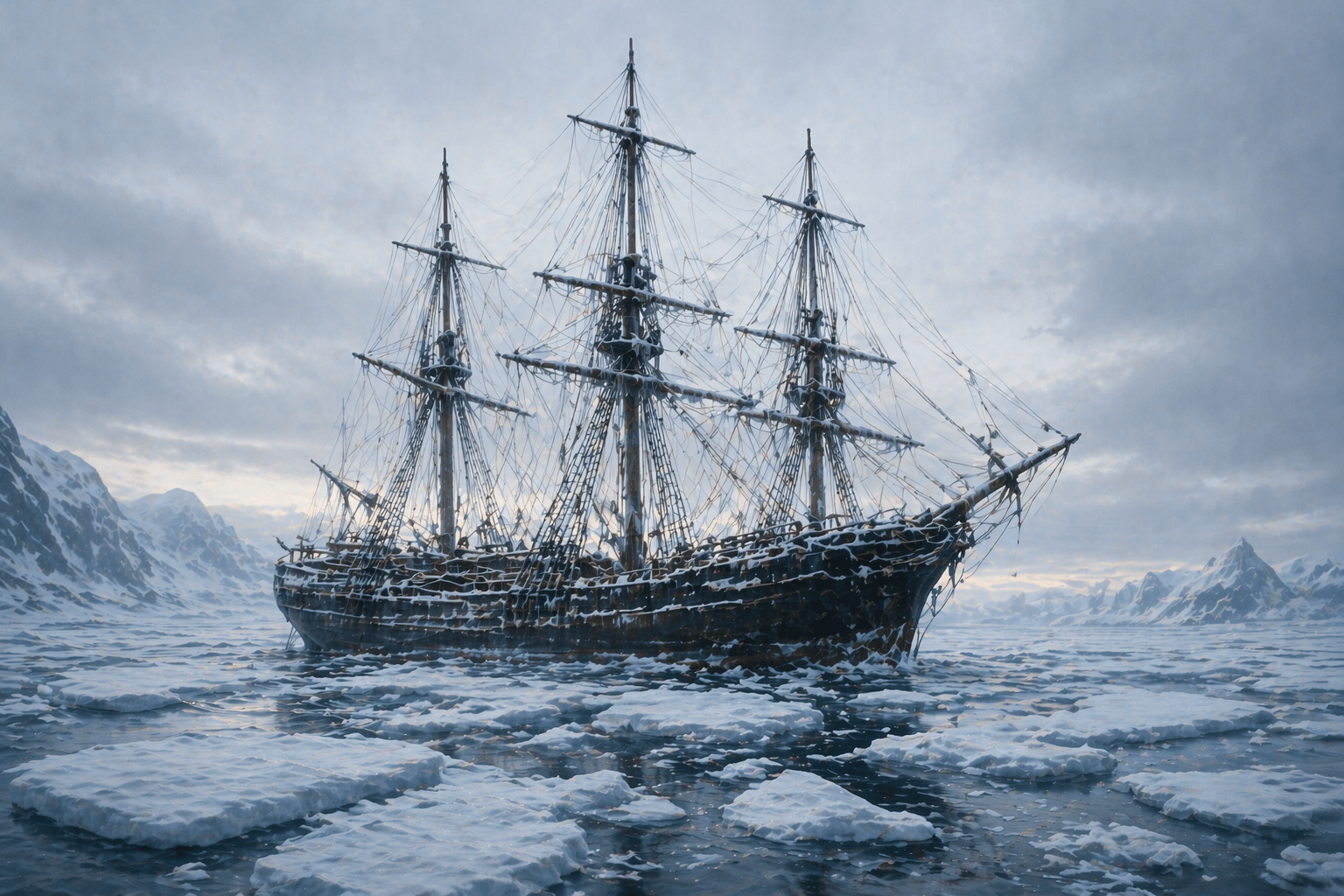
The legend of the Octavius is quieter than the Ourang Medan, but perhaps even colder.
According to the story, the Octavius was a ship that left China for London in the eighteenth century. Its captain, seeking a shorter route, attempted to pass through Arctic waters. The decision promised speed, profit, and perhaps reputation. It also carried risk.
Then the ship vanished.
Years later, the tale says, a whaling vessel discovered the Octavius trapped in ice. When the sailors boarded it, they found a scene preserved by cold: the captain, crew, and even members of the captain’s family frozen where they had died. One image appears again and again in retellings — the captain seated at his desk, pen or logbook before him, as if still trying to navigate.
Whether this account is historically exact or partly shaped by later imagination, its symbolic power is clear. The Octavius is not merely a story about a frozen ship. It is a story about ambition meeting a world too vast to be mastered.
The captain’s decision may be read in more than one way. Perhaps it was courage. Perhaps it was pride. Perhaps it was calculation made under pressure. The Arctic route promised a kind of victory over distance. But the sea and ice do not recognize human urgency.
That is one reason the Octavius feels less like a monster story and more like a meditation on humility.
The ship does not scream.
It waits.
The ice does not attack.
It preserves.
The horror lies in stillness.
There is something deeply human in the image of the captain at his desk. Even at the edge of disaster, he remains connected to duty, measurement, and control. A logbook suggests order. Navigation suggests direction. Writing suggests that events can be recorded and therefore understood.
But in the legend, all that order is surrounded by ice.
The story may remind us that not every shortcut leads home. Sometimes the path chosen to save time becomes the very place where time stops.
As folklore, the Octavius gives voice to an old wisdom found in many cultures: human intelligence is powerful, but it is not absolute. There are moments when survival depends not on forcing a route, but on recognizing the limits of one’s map.
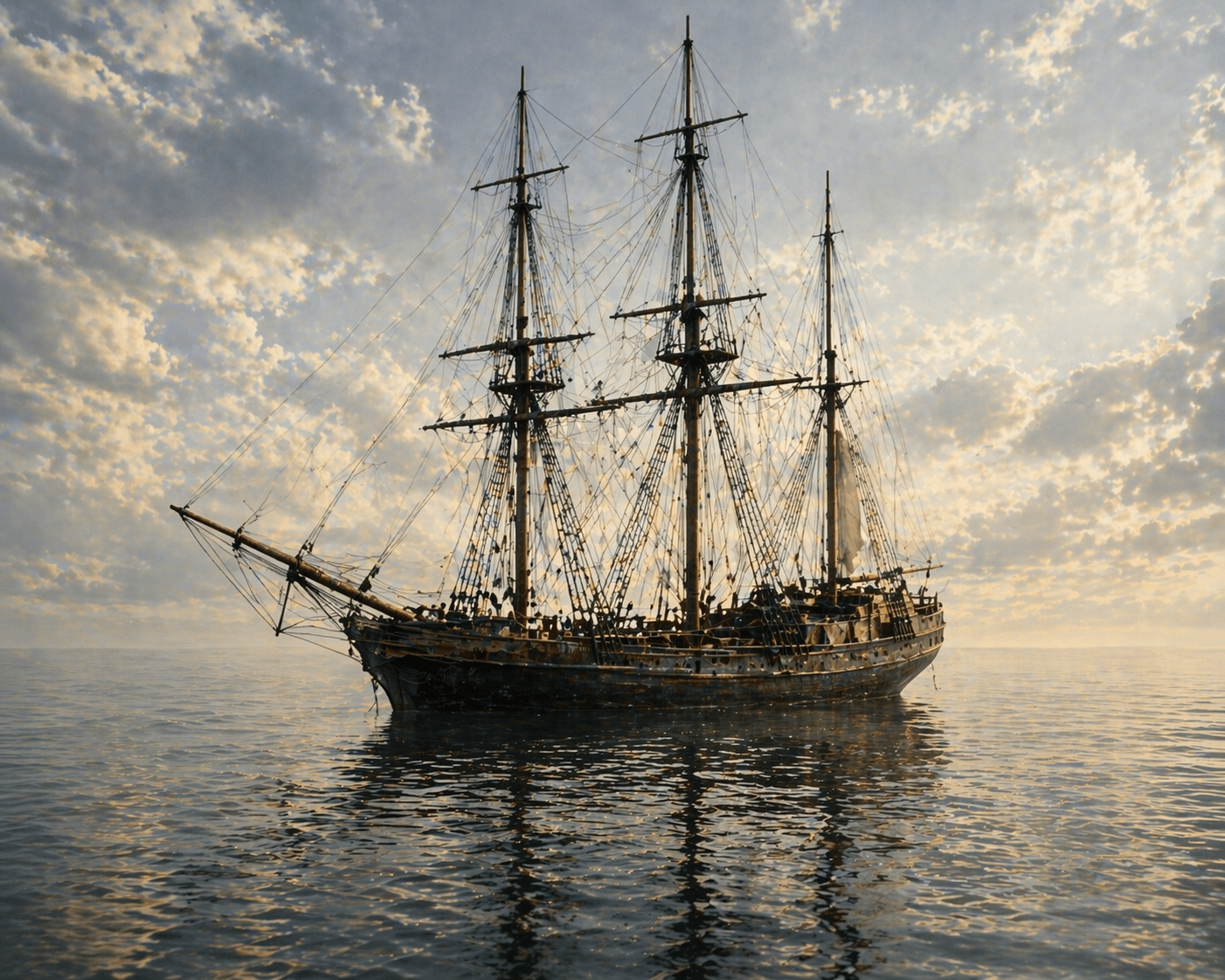
Of all ghost ship stories, the Mary Celeste is perhaps the most famous.
Unlike some tales shaped almost entirely by rumor, the Mary Celeste was a real vessel with a documented mystery. In December 1872, she was found adrift in the Atlantic near the Azores by the brig Dei Gratia. The ship was abandoned, yet not destroyed. The cargo remained largely intact. Personal belongings were still on board. The lifeboat was missing, but the captain, his family, and the crew were never found.
The enduring power of the Mary Celeste lies not in spectacle, but in incompletion.
There was no dramatic wreck.
No visible battlefield.
No clear evidence of violence.
No final explanation that satisfied everyone.
The ship was there. The people were not.
This is why the Mary Celeste continues to fascinate historians, writers, and readers of mysterious folklore. The story is not terrifying because it shows too much. It is haunting because it shows too little.
Absence can be more disturbing than destruction.
A broken mast tells one kind of story.
A burned deck tells another.
But a table, a cabin, personal items, and an empty ship tell a story that refuses to finish itself.
The mind keeps returning to the missing moment. When did they leave? Why did they leave? Did they believe they were escaping danger? Did they intend to return? What did they see, hear, smell, or fear in those final hours?
The Mary Celeste reveals one of the deepest psychological features of ghost ship stories: human beings are troubled by unfinished narratives. We want a beginning, middle, and end. We want the cause to match the consequence. We want the visible world to explain the invisible loss.
But sometimes the most famous mysteries endure because they deny us that structure.
In symbolic terms, the Mary Celeste is not only a sea mystery. It is a story about the unanswered spaces in human life. The conversation that ended without closure. The person who left without explanation. The question that remains on the mind long after everyone else has stopped asking.
The ship becomes a floating metaphor for absence.
And perhaps that is why its story has lasted so long. It reminds us that mystery is not always loud. Sometimes it arrives quietly, in the shape of what is missing.
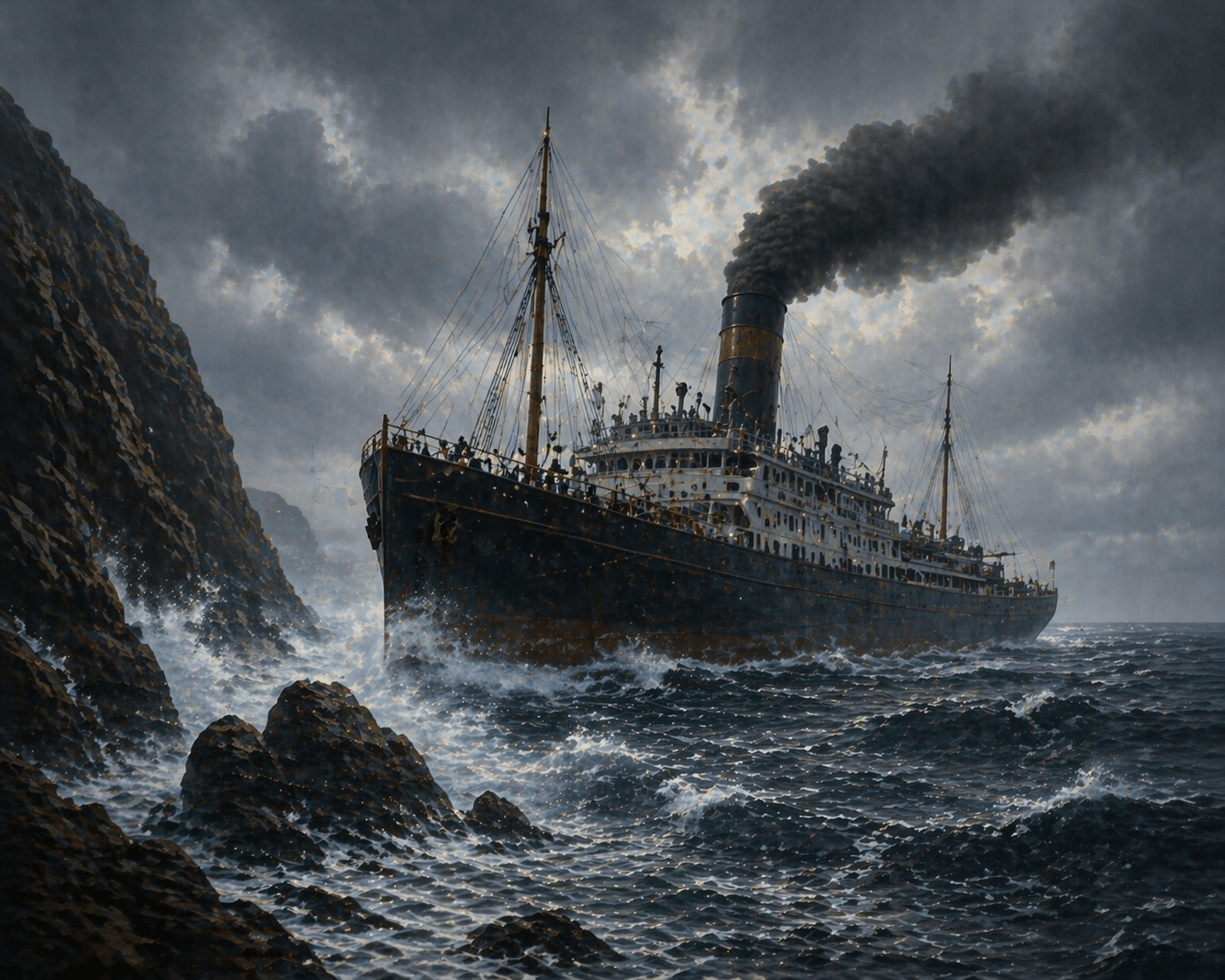
The story of the SS Valencia differs from many ghost ship legends because it is grounded in a real and devastating maritime disaster.
In January 1906, the Valencia sank off the west coast of Vancouver Island. Parks Canada notes that the disaster resulted in the deaths of 136 passengers, including women and children, and led to major reconsideration of maritime safety and rescue policy in Pacific waters.
Here the horror is not merely legendary. It is historical.
The Valencia was caught in terrible conditions. Rescue efforts were hindered by rough seas, weather, and the limitations of the time. People waited, struggled, hoped, and died within sight of a coastline that still could not save them.
This is a different kind of ghost ship story.
The Ourang Medan gives us uncertainty.
The Octavius gives us silence.
The Mary Celeste gives us absence.
The Valencia gives us grief.
Over time, stories reportedly grew around the disaster — accounts of ghostly lifeboats, strange sightings, and the ship appearing again on the water. The original article notes how such tales can emerge after trauma, turning a historical tragedy into a symbolic story that communities continue to carry.
From a cultural perspective, this is not unusual. Human beings do not remember loss only through official reports. We remember through places, weather, repeated names, family stories, local rumors, images, anniversaries, and warnings.
A disaster becomes part of the landscape.
The coast remembers.
The water remembers.
The community remembers.
A ghost story may sometimes be grief in narrative form.
When people say they saw a lost ship again, they may not only be describing an apparition. They may be expressing the feeling that certain losses do not fully disappear. The dead are gone, but the emotional shape of the event remains. The place where it happened continues to feel marked.
The Valencia story reminds us that folklore can serve memory. It allows communities to speak about what is too painful to leave as statistics alone. A number can tell us how many died. A legend can suggest how deeply the loss was felt.
This does not mean we should confuse history with rumor. Rather, it means we can understand why rumor gathers around history. When grief cannot reach shore, it may return as story.
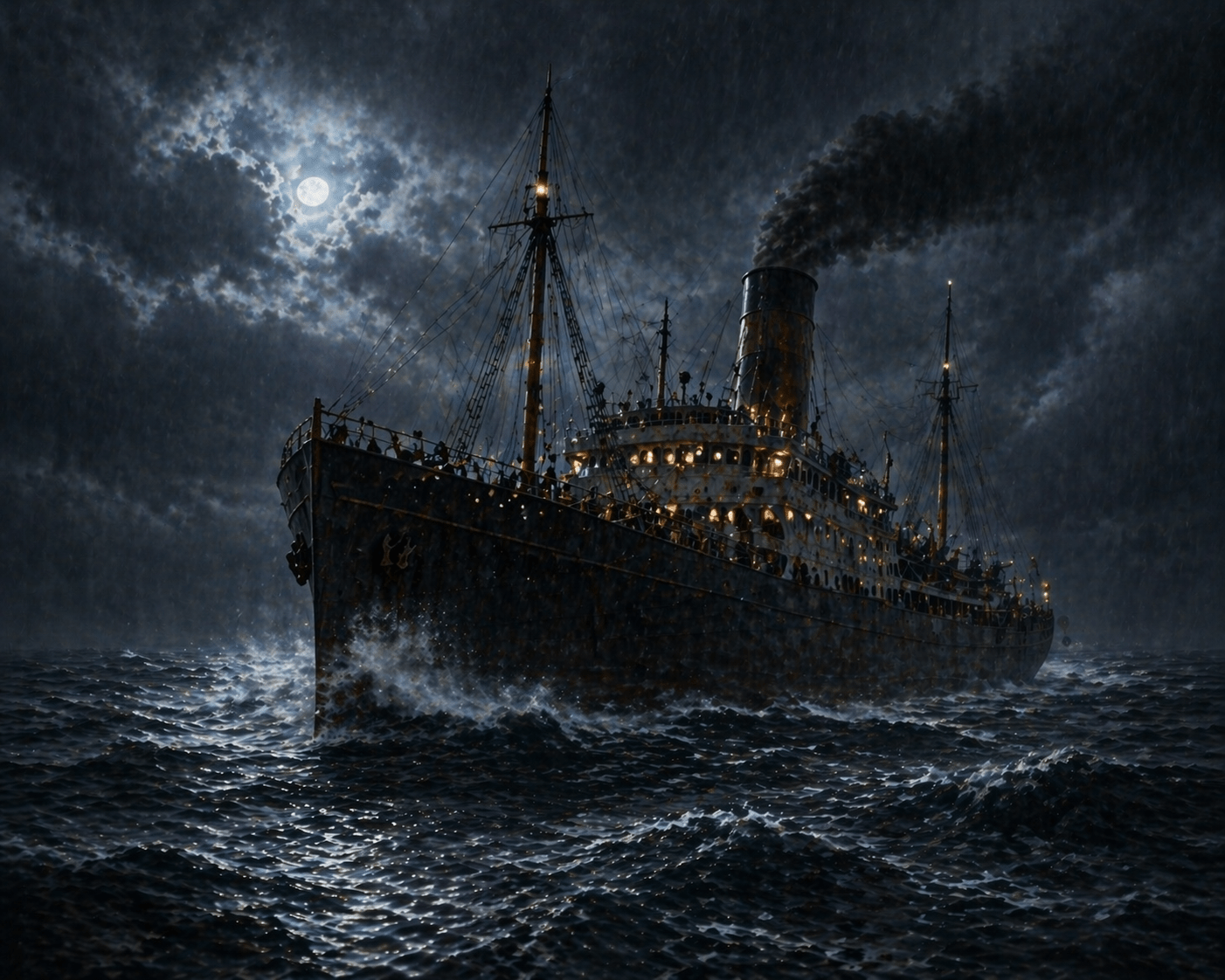
Not all ghost ship stories belong to distant centuries.
The Kaz II was a modern catamaran found drifting off Australia in 2007 with no one on board. Contemporary reports and the later inquest described unsettling details: the vessel was found adrift, the crew had vanished, and investigators considered accidental scenarios rather than supernatural causes.
What makes the Kaz II story especially striking is its modernity.
This was not a wooden ship from the age of sail.
Not a medieval legend.
Not a rumor carried through taverns and harbors.
It was a modern vessel in an age of search operations, communications technology, media coverage, and forensic investigation. Yet the emotional effect was strangely familiar. A boat remained. The people were gone. Ordinary objects seemed to preserve the outline of life just after life had disappeared.
The original article notes that the Kaz II had the kind of unsettling incompleteness common to older sea legends: personal belongings remained, food had been prepared, and the missing people created a stronger mystery than visible damage would have done.
That is what makes modern ghost ship stories so important. They challenge the assumption that technology has ended mystery.
We often believe that the modern world has made uncertainty smaller. Satellites, radios, GPS systems, cameras, rescue teams, databases, and investigations all promise clarity. And often, they do help. Yet stories like Kaz II remind us that uncertainty has not vanished. It has simply changed its clothing.
The sea remains larger than our systems.
From a psychological point of view, the Kaz II story unsettles us because it places mystery inside the ordinary. A prepared meal, working equipment, personal belongings — these are not Gothic details. They are familiar details. That familiarity makes the disappearance more intimate.
The story does not require darkness, ancient curses, or supernatural imagery.
It only requires an empty boat.
And sometimes that is enough.
The Kaz II may be read as a modern lesson in humility. Not because we should fear travel or distrust investigation, but because certainty is more fragile than we like to admit. Even in an age of information, some answers arrive late, some remain partial, and some never fully satisfy the human need for closure.
“Smooth seas do not make skillful sailors.”
This proverb fits these stories especially well. It does not glorify danger, and it does not romanticize suffering. Instead, it suggests that uncertainty, fear, and difficulty often become places of inner formation. Not every mystery gives us answers, but many mysteries sharpen attention, humility, and courage.
A gentle affirmation that also fits this article might be:
“I can face the unknown with calm, patience, and wisdom.”
The proverb speaks to courage.
The affirmation speaks to steadiness.
Together, they help us read ghost ship stories not only as tales of dread, but as reflections on how to remain human when certainty disappears.
Ghost ship stories appear across many cultures because the sea has long symbolized the unknown.
The sea is beautiful, useful, and life-giving. It carries trade, migration, food, memory, and dreams. Yet it is also vast, changeable, and indifferent. It can connect continents, but it can also erase people without explanation.
That double nature makes the sea one of humanity’s oldest symbols.
It represents possibility and danger.
Freedom and exile.
Journey and disappearance.
Hope and mourning.
A ghost ship gathers all these meanings into a single image. It is a journey without arrival, a home without inhabitants, a question without a clear answer.
In folklore, abandoned vessels often symbolize unresolved grief or interrupted destiny. A ship is built to move toward a destination. When it drifts without command, the natural order of the journey has been broken. That brokenness is what the imagination notices.
For English-speaking readers, ghost ship stories may also connect with a broader literary tradition: sea ballads, sailor legends, shipwreck narratives, and Gothic tales of isolation. Across these traditions, the sea often becomes a place where human control weakens and deeper truths emerge.
The cultural meaning is not limited to fear. Ghost ships also teach humility.
They remind us that not every mystery can be conquered by force. Not every silence can be filled immediately. Not every loss can be explained in a way that satisfies the heart.
Old maritime stories preserve social values: caution, respect for nature, patience in uncertainty, and the importance of remembering those who did not return.
We are drawn to ghost ship stories because they give visible form to invisible uncertainty.
Most fears in life do not arrive as storms. They arrive as unanswered messages, unfinished conversations, missing explanations, and quiet absences. A ghost ship turns those inner experiences into an image we can look at.
There is the vessel.
There is the sea.
There is the silence.
There is the question.
From a psychological perspective, ghost ship stories help us approach anxiety from a safe distance. We can imagine danger without being in danger. We can think about disappearance, loss, and uncertainty while remaining on shore. In that sense, folklore becomes a container for fear.
But the philosophical meaning goes further.
Ghost ships challenge the modern belief that every mystery must be solved quickly. They remind us that the unknown is not always an enemy. Sometimes it is a teacher. It teaches patience, humility, careful attention, and the courage to live without complete certainty.
This does not mean we should abandon investigation or accept confusion passively. The search for truth matters. Evidence matters. Compassion for the missing and the dead matters.
But wisdom also requires knowing the difference between seeking truth and inventing certainty too soon.
A ghost ship is frightening because it drifts between those two needs: the need to know, and the need to endure not knowing.
Ghost ship stories do not ask us to believe every rumor.
They ask something quieter: how do we respond when certainty disappears?
In modern life, we often meet our own versions of ghost ships. A relationship ends without explanation. A plan collapses for reasons we never fully understand. A person changes, leaves, or becomes unreachable. A dream we trusted drifts away from us, still visible but no longer alive in the way we hoped.
In those moments, the mind often rushes toward dramatic answers. It wants a villain, a final cause, a complete explanation. Sometimes answers do come, and when they do, they should be welcomed. But sometimes life remains partly open.
This story may remind us that we do not always need immediate certainty in order to remain steady.
We can investigate without panicking.
Grieve without inventing false explanations.
Remember without being trapped.
Accept mystery without surrendering wisdom.
The lesson of ghost ship stories is not to fear the sea. It is to respect the sea.
Likewise, the lesson of uncertainty is not to fear life. It is to respect the unknown parts of it.
A skillful sailor does not control the ocean. A skillful sailor learns to read wind, weather, silence, and change. In the same way, a wise person does not control every outcome. A wise person learns to remain attentive, humble, and courageous when the horizon is unclear.
Perhaps ghost ships continue to move us because they carry more than mystery.
They carry questions.
What remains when people disappear?
What do we do with stories that cannot be completed?
How do we honor the lost without turning grief into spectacle?
How do we seek truth without forcing certainty where none yet exists?
The sea has always been a place of departure. People leave shore with plans, maps, prayers, cargo, and hope. But not every journey returns in the way it was expected to return. Some come back as wreckage. Some as records. Some as rumor. Some as silence.
And some come back as stories.
A ghost ship, then, is not only a frightening image. It is a reminder that life contains unanswered chapters. We may not be able to close them all. But we can learn to stand before them with patience, reverence, and courage.
When the empty ship appears in the imagination, perhaps it is asking us not merely to be afraid.
Perhaps it is asking us to listen.
Proverb:
“Smooth seas do not make skillful sailors.”
Affirmation:
“I can face the unknown with calm, patience, and wisdom.”
When you face an unanswered chapter in your own life, what do you reach for first: fear, certainty, or reflection?