
The Charm of Origami in Traditional Japanese Culture
We will show you the charm of origami, one of the traditional cultures of Japan.
 Wonderful Proverbs Journey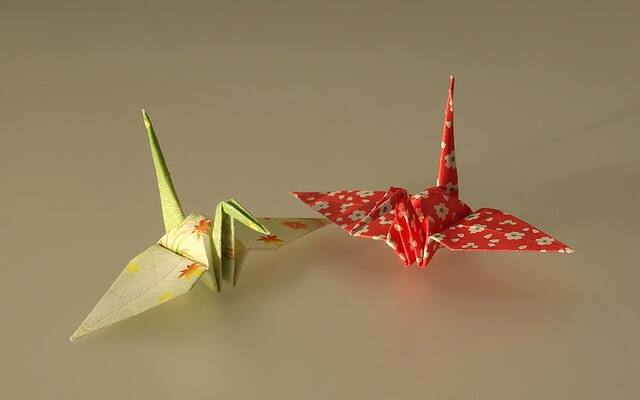
Origami" is a well-known traditional Japanese culture. Such origami is now very popular all over the world as a communication tool between parents and children and for training the brain. In this article, we will explain the history and appeal of origami.
Most Japanese people were familiar with origami when they were young, but many may have lost touch with it as they grew up. Overseas, however, origami is booming among children and adults of all ages.
Origami is believed to have various educational effects. In fact, in the United States, where there is an origami enthusiast group, origami is actively used in education as an item for cultivating thinking skills.
For example, the higher the level of the work, the more complicated the folds become, which increases "concentration" and "thinking ability. As a result, the ability to imagine the finished product is acquired, leading to an improvement in "spatial comprehension" and "mathematical ability.
Paper first came to Japan around the Nara period (710-794). The manufacturing method of paper was introduced from the continent, and Japanese people's originality and ingenuity led to the birth of thin and strong washi paper.
At that time, washi was used as recording paper. Washi was also used as paper to wrap offerings to the gods, as its whiteness reminded many people of "purity.
The "ritual fold," in which the wrapping paper is folded neatly, was born, focusing on the folds that are made when offerings are wrapped in washi paper.
Japanese Origami for Beginners Kit: 20 Classic Origami Models: Kit with 96-page Origami Book, 72 Origami Papers and Instructional DVD: Great for Kids and Adults!
PapaKit Deluxe Origami Large Wall Decoration Set (Assorted Paper Fans & Pom-poms) Birthday Party Baby Shower Wedding Event Decor | Creative Art Design
Japanese Origami Paper Pack: More than 250 Sheets of Origami Paper in 16 Traditional Patterns Paperback – Coloring Book
Washi (Japanese paper) is a type of paper that has been used in Japan since ancient times. Unlike Western paper, which was introduced from Europe and the United States, Washi is made from paper that is made from materials that are indigenous to Japan.
Japanese paper and Western paper are the same in terms of "paper," but they are different.
The differences are too numerous to mention, but one of the most significant is the difference in printing suitability.
In the past, Japanese paper was generally used with raw materials and manufacturing methods (handmade) unique to Japan.
However, with the arrival of paper-making machines from the West in the Meiji era (1868-1912), paper mills were built and the history of paper in Japan began.
Washi is not suitable for printing because its rough and bumpy surface makes it difficult for ink to adhere to it.
On the other hand, since washi is made from wood pulp with finely crushed fibers, its surface is smooth, ink glides well, and it is suitable for printing.
Because of these differences in characteristics, the age of paper came after the Meiji period (1868-1912) as printing became more widespread.
However, Washi has many advantages that Western paper does not have, and it has been used for a variety of things up to the present.
Double-Sided Japanese Chiyogami Designed Paper Black 4pattern Each 15 Sheets
Washi Kawasumi Chiyo Paper, Yuzen Washi Paper, 5.9 x 5.9 inches (15 x 15 cm), 100 Patterns, 1 Each of 100 Sheets
JapanBargain 3587, 300 Sheets Origami Paper Japanese Washi Paper Chiyogami Paper Folding Paper, Yuzen Style 3 inch, Made in Japan, 7.5 cm
Working process of Washi paper
Washi has excellent preservation, flexibility, and durability.
Because of its strength, some kimonos are made from washi umbrellas and paper cloth (shifu).
Let me briefly explain the process of making washi.
The raw materials are soaked in running water for one day and night, and then the black bark and other debris are washed away and the fibers are boiled in an alkaline solution. (In the past, alkaline solution was made from wood ash.)
The boiled material is then ground into small pieces using a machine (in the old days, the process involved beating the material with a stick and bundling it). (In the old days, the fibers were beaten with a stick to break up the bundles of fibers.)
Finally, the fibers are broken up into small pieces in water and made into thin sheets of paper, which is called papermaking.
After the water is drained and the paper is dried, it becomes Japanese paper.
The process is explained briefly, but it is a difficult work. In the past, it would have been much more difficult.


