Discover Koizumi Yakumo, the Greek-born British writer who loved Japan and its ghost stories so deeply that he became Japanese. Explore Hoichi, Yuki-Onna, Rokurokubi, and Mujina.
 Wonderful Proverbs Journey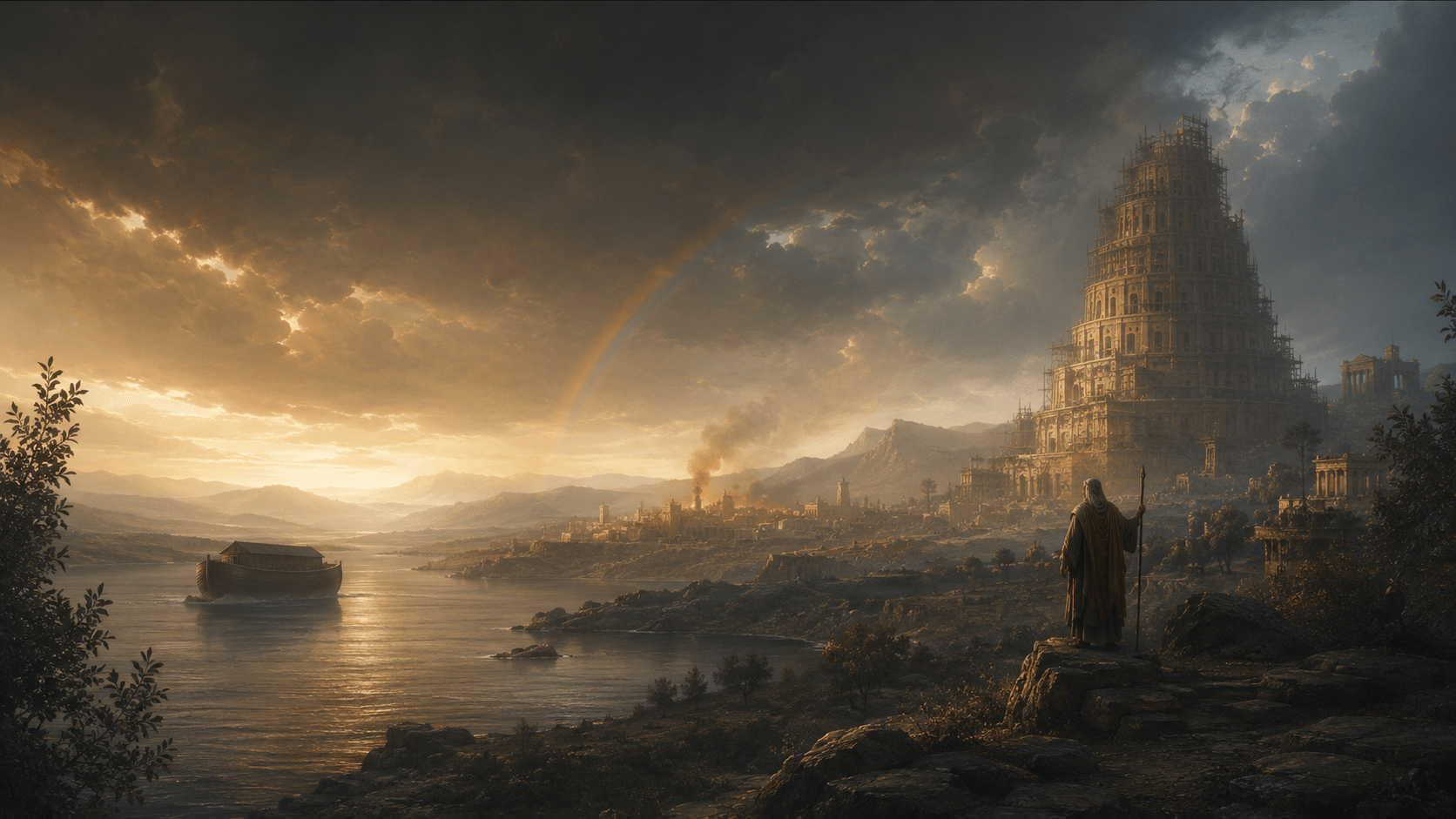
※This site uses affiliate advertising.
The Bible contains many stories that are not easily reduced to comfort, inspiration, or simple moral teaching. Some of its most unforgettable episodes are unsettling: waters rise over the earth, cities burn, plagues fall upon a kingdom, a golden idol leads to bloodshed, and a tower meant to reach heaven collapses not by stone, but by broken language.
These stories are often described as tales of divine judgment. Yet if we read them only as frightening punishments, we may miss their deeper power. Like mysterious folklore from many cultures, these biblical stories preserve human anxiety in symbolic form. They ask difficult questions: What happens when desire outruns wisdom? What happens when fear becomes impatience? What happens when people seek security, power, or unity without humility?
This article does not treat these stories as proof of supernatural events. Rather, it reads them as sacred narratives, cultural memory, and moral symbolism. Whether approached through faith, literature, folklore, or psychology, these tales continue to speak because they reveal something timeless about human beings: we are capable of hope, courage, devotion, and renewal—but also arrogance, panic, violence, and forgetting.
The source material introduces five famous biblical episodes often associated with divine punishment: Noah’s Flood, Sodom and Gomorrah, the Ten Plagues of Egypt, the Golden Calf, and the Tower of Babel.
Here, we will revisit them not merely as disasters, but as strange tales with hidden wisdom.
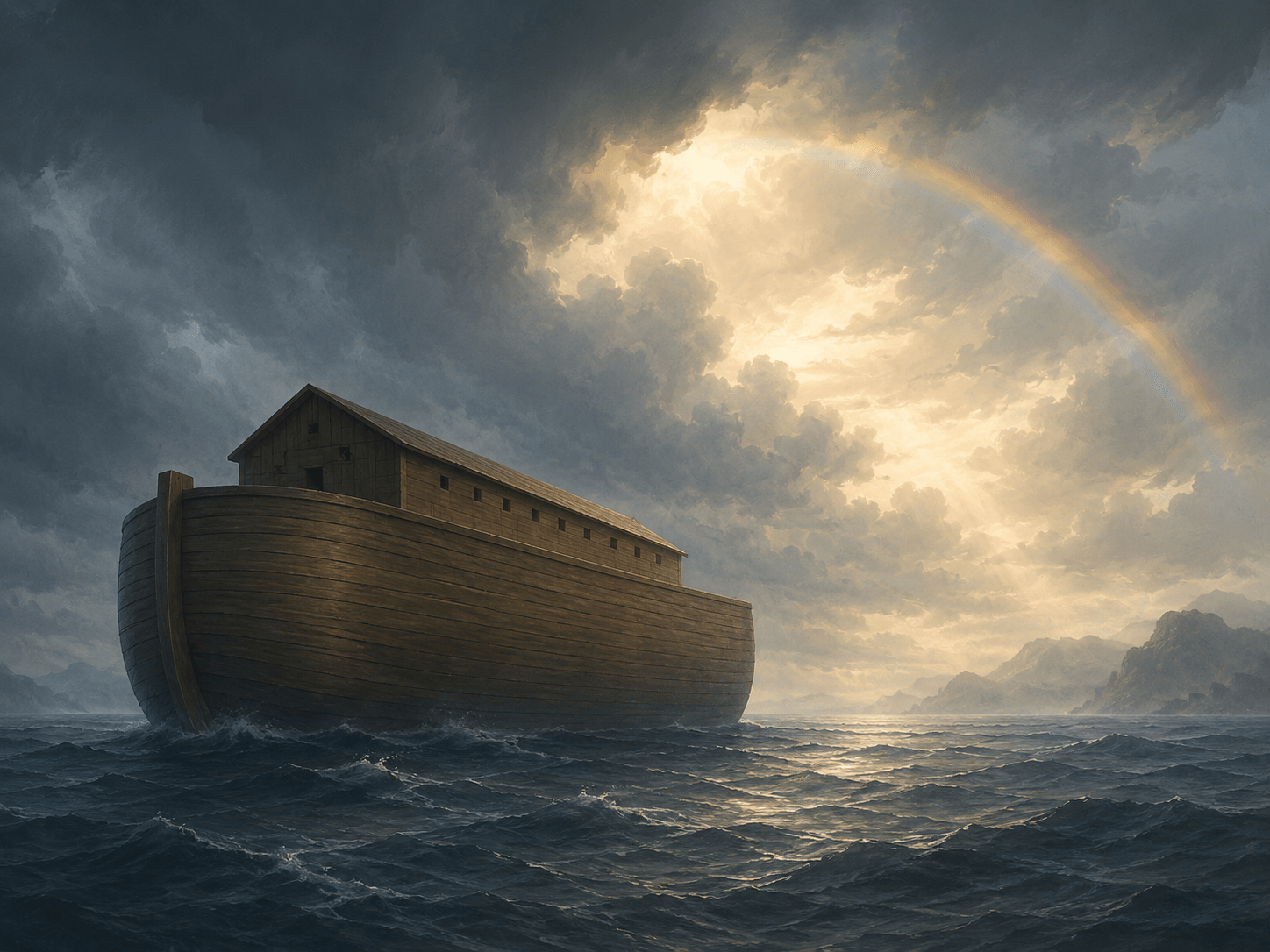
Before Noah’s ark became a symbol of rescue, it was a story about a world that had lost its moral direction. The flood is frightening not only because water covers the earth, but because it asks what happens when human desire, violence, and forgetfulness grow too powerful to ignore.
Among all biblical tales of judgment, Noah’s Flood is perhaps the most widely known. Many people remember the outline: the world becomes corrupt, God sends a great flood, Noah builds an ark, animals enter two by two, and the rainbow appears afterward as a sign of promise.
But the emotional force of the story lies in its atmosphere before the rain begins.
According to the Book of Genesis, humanity had multiplied across the earth, yet growth did not bring wisdom. Violence spread. Desire became lawless. Human beings, created with possibility, had become absorbed in cruelty, conflict, and self-interest. The world was not merely noisy; it was morally exhausted.
In some readings of the story, the presence of the Nephilim—mysterious giant-like beings associated with unions between divine beings and human women—adds an even stranger tone. The boundary between heaven and earth, divine and human, order and chaos, appears blurred. The result is not wonder, but disorder.
Then comes the terrifying sentence: the world will be washed clean.
Noah stands apart. He is not presented as perfect in every modern sense, but as faithful, receptive, and willing to listen. In a world drowning before the waters arrive, Noah hears a warning. He is instructed to build an ark of gopher wood, a vast vessel with rooms, levels, and enough space for his family and living creatures.
The image is haunting: one man building a boat under a sky that has not yet broken.
The people around him may have seen only absurdity. Why build an ark on dry land? Why prepare for a disaster no one else believes is coming? Yet folklore often gives its wisdom to the person who listens before the danger becomes visible.
Then the rain begins.
For forty days and forty nights, water falls. The fountains of the deep break open. The familiar earth disappears beneath a moving surface of gray. Mountains become islands, then vanish. The ark does not conquer the flood; it merely survives it. It drifts, vulnerable and enclosed, carrying the fragile seed of a future no one inside can yet see.
After the rain stops, the waiting continues. This is important. The story does not move quickly from disaster to peace. Noah must wait in uncertainty. He sends out a raven. He sends out a dove. At first, there is no place to rest. Then, at last, the dove returns with an olive leaf.
That small green branch is one of the most powerful symbols in world literature. It is not a thunderous miracle. It is not a voice from the sky. It is a leaf: quiet proof that the earth is beginning again.
When Noah finally leaves the ark, he builds an altar. The story ends not only with survival, but with covenant. God promises never again to destroy all life by flood, and the rainbow becomes a sign suspended between heaven and earth.
The flood is a story of judgment, but also of memory. It says that destruction without renewal is despair, while renewal without memory is dangerous.
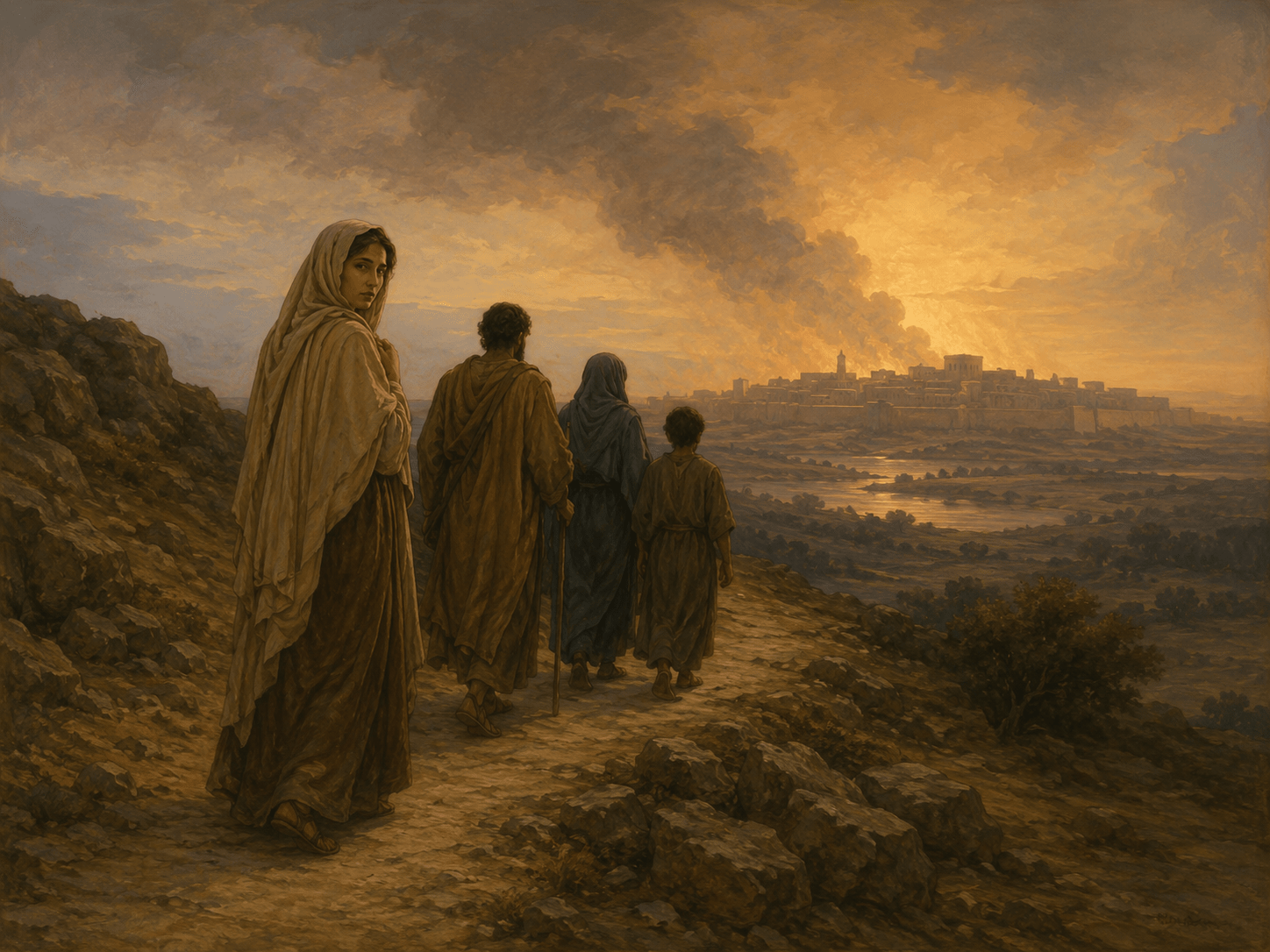
Sodom and Gomorrah are remembered as cities destroyed by fire, but the deeper tragedy begins long before the flames fall. This is a story about a community that forgot hospitality, dignity, and the sacred duty to protect the vulnerable.
The destruction of Sodom and Gomorrah is often remembered as one of the Bible’s most severe stories. Two cities, known for corruption, become the focus of divine investigation. Their names later become symbols of moral collapse.
But before fire falls from heaven, the story gives us a negotiation.
Abraham hears that the cities may be destroyed, and he pleads. His concern is not abstract. His nephew Lot lives in Sodom. Human compassion often begins not with the whole world, but with one face we cannot bear to lose.
Abraham asks: if there are fifty righteous people, will the city be spared? What about forty-five? Forty? Thirty? Twenty? Finally, ten?
The exchange is almost startling in its intimacy. A human being bargains with divine judgment. Beneath the formal language is a painfully human question: Can a place be saved for the sake of a small number of good people?
The answer, in the story, is yes. If ten righteous people can be found, the city will not be destroyed.
But the tragedy is that even ten cannot be found.
When two angelic visitors arrive in Sodom, Lot receives them into his home. In the ancient Near Eastern world, hospitality was not merely politeness; it was a sacred social duty. A stranger at the gate was vulnerable. To offer shelter was to defend the boundary between civilization and cruelty.
Sodom fails precisely at that boundary.
The men of the city gather with violent intent. Lot tries to protect his guests. The scene is deeply disturbing, and modern readers rightly approach it with care. Rather than sensationalizing its violence, we may read it as a symbolic collapse of hospitality, restraint, and human dignity. The city has become a place where the vulnerable are not protected, but threatened.
The visitors reveal themselves as messengers of judgment and urge Lot’s family to flee. The warning is clear: do not look back.
Then sulfur and fire fall. The cities vanish under a catastrophe that becomes, in later memory, a symbol of complete ruin.
Yet one of the most haunting moments comes not from the city itself, but from the road away from it. Lot’s wife looks back and becomes a pillar of salt.
Why does she look back? The story does not fully explain. Was it fear? Grief? Attachment? Disbelief? The silence is part of the power. She becomes an image of the human difficulty of leaving what is doomed, even when escape has already begun.
Sodom and Gomorrah is not only a story about punishment. It is a story about what happens when a community loses reverence for the vulnerable, and when the past holds the human heart even as danger burns behind it.
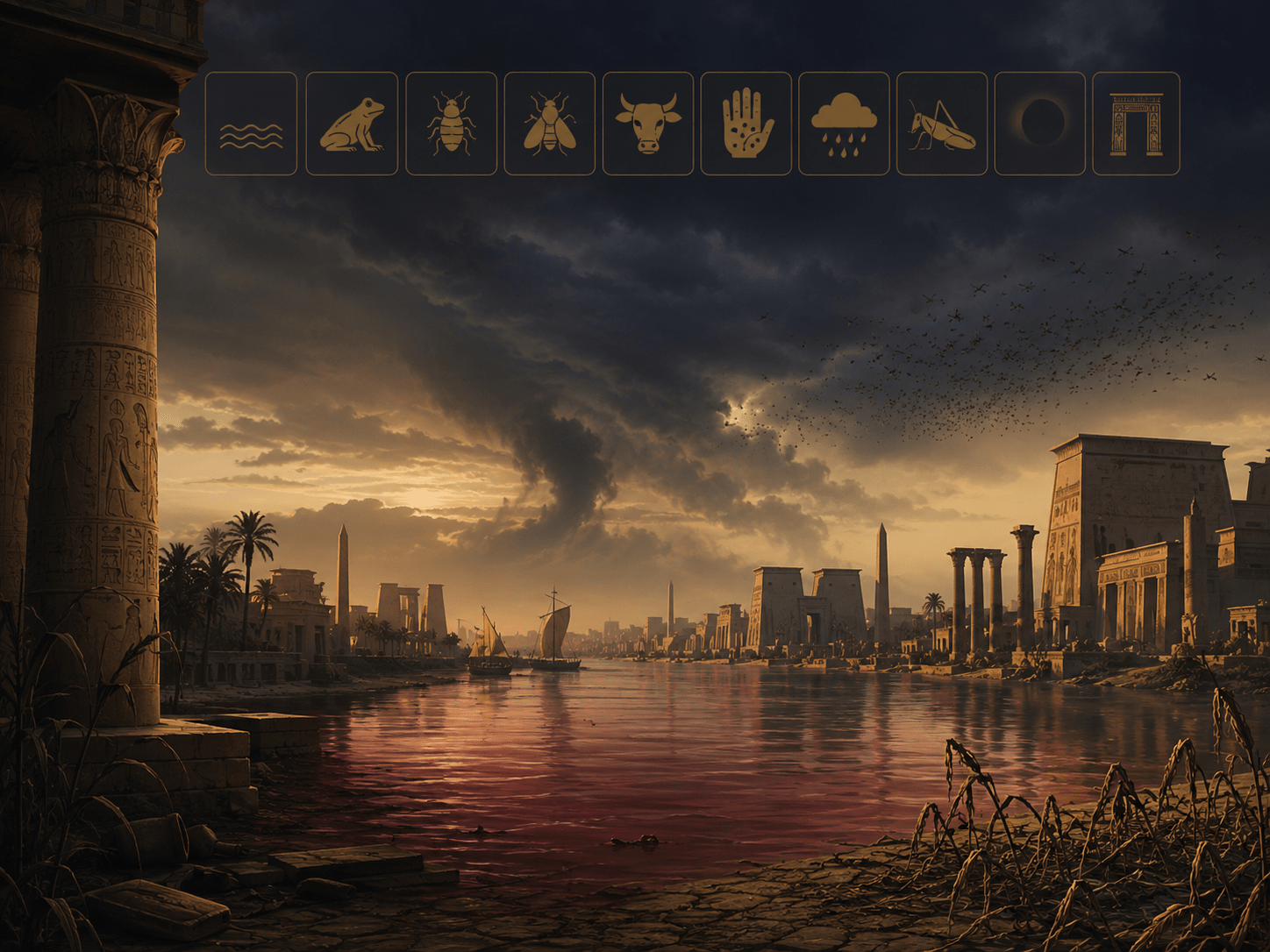
The Ten Plagues are among the most dramatic episodes in the Bible, but beneath their terrifying scale lies a quieter psychological warning. When power refuses to listen, suffering grows louder until the whole world seems to answer.
The story of the Ten Plagues belongs to the Book of Exodus, the great narrative of liberation. Long before the plagues begin, the Israelites have become enslaved in Egypt. Generations pass under forced labor. A people once welcomed during famine now live under oppression.
Into this world comes Moses.
He does not begin as an obvious hero. He is a reluctant messenger, called through the strange vision of a bush that burns without being consumed. The burning bush is one of the most mysterious images in the Bible: fire that does not destroy, flame that speaks, holiness appearing in the wilderness.
Moses is told to go to Pharaoh and demand freedom for the Israelites.
Pharaoh refuses.
His refusal is not only political; it is symbolic. Pharaoh represents hardened power, the kind of authority that cannot imagine yielding because it mistakes control for reality itself. He sees labor, numbers, and empire. He does not see suffering.
Then the plagues begin.
The Nile turns to blood. Frogs spread through the land. Gnats and flies swarm. Livestock die. Painful boils afflict bodies. Hail breaks the fields. Locusts devour what remains. Darkness covers Egypt for three days.
Each plague disturbs a layer of ordinary life: water, food, animals, health, weather, light. The world that seemed stable becomes strange. Nature itself appears to testify that something is deeply wrong.
Again and again, Pharaoh seems ready to yield. Again and again, he hardens his heart. The pattern is psychologically powerful. People often change only when discomfort becomes unbearable—but if the pressure lifts too soon, they return to the old pattern.
The final plague is the most terrible: the death of the firstborn. It is a story that should never be handled lightly. It stands as one of the most severe and morally difficult passages in Scripture. For readers today, it may evoke grief, discomfort, and serious questions about justice, collective suffering, and divine action.
In narrative terms, the final plague breaks Pharaoh’s resistance. He tells the Israelites to leave. The enslaved people depart, carrying with them not only belongings, but memory: the memory of oppression, warning, fear, and liberation.
The Ten Plagues are frightening not only because of their scale, but because they show what happens when power refuses to listen until suffering becomes enormous. The story asks whether a heart can become so hardened that only disaster can open it.
The story of the Golden Calf does not begin with rebellion, but with waiting. When Moses disappears on the mountain and silence stretches too long, fear fills the empty space—and fear, left unchecked, can create idols of its own.
The Golden Calf episode is one of the most psychologically revealing stories in Exodus. It takes place after liberation, after the plagues, after the escape from Egypt. The people have survived oppression, followed Moses into the wilderness, and arrived at Mount Sinai.
Then Moses climbs the mountain to receive the law.
He is gone for forty days.
For us, forty days may sound like a symbolic number. In biblical storytelling, it often marks a period of testing, transition, or preparation. But for the people waiting below, the symbolism may not have mattered. What they felt was absence.
Their leader had vanished into cloud and fire. The wilderness stretched around them. The future was uncertain. The God who had led them out of Egypt now seemed silent.
Fear began to speak.
The people turned to Aaron, Moses’ brother, and demanded something visible. If Moses was gone, if the unseen God had abandoned them, then they wanted a god they could see, touch, and carry. Aaron gathered gold from the people and fashioned a calf.
The image of the golden calf is powerful because it is so human. People frightened by uncertainty often reach for something solid. A symbol. A leader. A system. A possession. A false certainty.
The calf glittered. The people celebrated. In their anxiety, they mistook brightness for holiness.
On the mountain, Moses learns what has happened. He descends and sees the people worshiping the idol. His anger is overwhelming. The tablets of the law are broken. The calf is destroyed, ground down, and scattered.
The story then becomes even darker, describing violence within the community and the death of many. This part of the narrative is troubling, and it should be approached with humility rather than easy judgment. Ancient sacred texts often preserve the intensity of communal crisis in ways that can feel harsh to modern readers.
Symbolically, however, the Golden Calf remains painfully clear: fear can create false gods.
The people were not simply greedy or foolish. They were afraid. But fear, when it cannot wait, begins to manufacture certainty. It says, “Give me something I can control.” It says, “Give me an answer now.” It says, “If silence continues, I will build my own salvation.”
The tragedy is that the idol does not heal the fear. It only gives fear a golden shape.
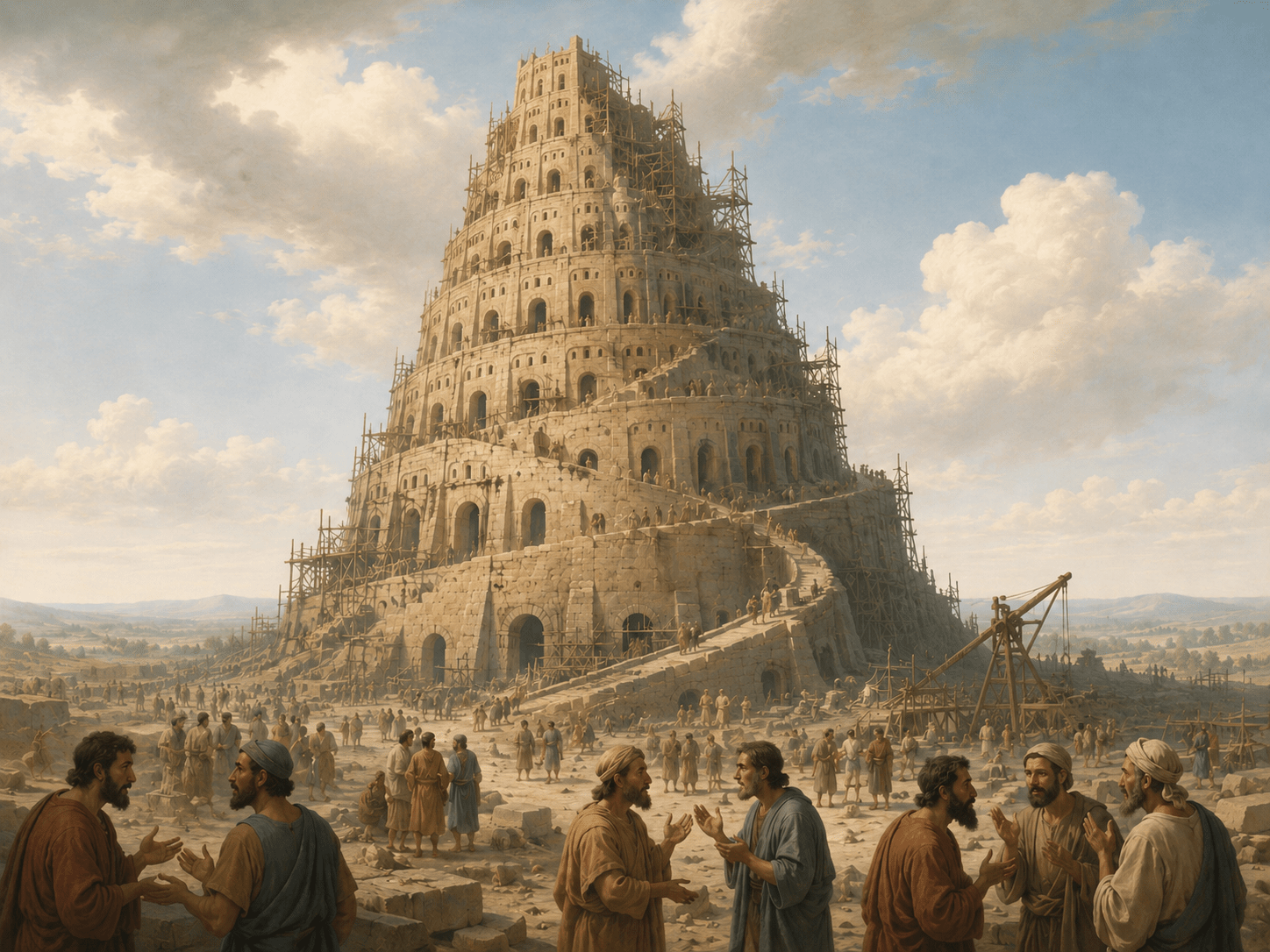
The Tower of Babel is often imagined as a ruined tower reaching toward heaven, but the heart of the story is not architecture. It is about language, pride, unity, and the danger of building greatness without humility.
The Tower of Babel appears in Genesis after the story of the flood. Humanity has survived. The earth has been renewed. Noah’s descendants spread, grow, and begin building civilization again.
But renewal does not automatically cure the human heart.
According to the story, the people share one language and gather in one place. There is comfort in unity. There is strength in cooperation. At first, nothing seems wrong. A shared language allows people to build, plan, and dream together.
Then ambition changes its tone.
They decide to build a city and a tower “with its top in the heavens.” They want to make a name for themselves. They fear being scattered. They want permanence, fame, and perhaps protection against vulnerability.
The tower rises.
Brick by brick, the people build not only a structure, but an idea of themselves. They are no longer simply surviving. They are reaching upward, not in prayer, but in self-display. Their unity becomes pride. Their skill becomes a mirror. Their shared language becomes an instrument of collective arrogance.
The divine response is unusual. The tower is not dramatically smashed by lightning in the biblical text, though later imagination often pictures it that way. Instead, language itself is confused.
People who once understood each other suddenly cannot communicate. Commands become noise. Plans dissolve. Cooperation breaks apart. The tower remains unfinished, not because stone fails, but because meaning fails.
This is what makes Babel such a profound story. It understands something deeply human: civilization depends not only on technology, but on shared meaning. When language breaks, community breaks. When words no longer connect, even the greatest project becomes impossible.
The people scatter across the earth.
In one sense, Babel explains the diversity of human languages. But symbolically, it says more. It suggests that human unity without humility can become dangerous, and that ambition without reverence may lead not to heaven, but to confusion.
Babel is not merely a story about punishment. It is a story about the fragility of communication. It asks whether we can build together without trying to become gods to one another.
These biblical stories belong to a religious tradition, yet they also function like ancient moral folklore. They use memorable images—flood, fire, plague, idol, tower—to preserve warnings about human behavior.
The flood speaks of corruption and renewal.
Sodom speaks of hospitality and moral collapse.
The plagues speak of hardened power.
The golden calf speaks of fear and false certainty.
Babel speaks of pride and broken communication.
For English-speaking readers, it may be helpful to understand that these stories have influenced not only religious thought, but also art, literature, political language, and everyday metaphors. We still use phrases like “a flood,” “Sodom and Gomorrah,” “a plague,” “a golden calf,” or “Babel” to describe chaos, moral danger, false worship, or confusion.
That is the power of symbolic stories. They outlive their original setting because they give language to repeated human experiences.
“Fear becomes wisdom when we are brave enough to ask what it is trying to teach.”
This is not a traditional proverb, but it expresses the common thread running through these stories. Fear alone can destroy. Fear reflected upon can warn, guide, and transform.
We are drawn to frightening stories because they give shape to nameless anxiety. A flood gives shape to the fear of being overwhelmed. A burning city gives shape to the fear of moral collapse. A plague gives shape to the fear of consequences spreading beyond control. An idol gives shape to the fear of waiting. A tower of confused language gives shape to the fear of no longer being understood.
Rather than proving the supernatural, these stories reveal how people live with uncertainty. They turn private fear into shared language. They allow communities to ask, again and again: What must we remember? What must we not become?
In this sense, scary stories with moral lessons are not childish relics. They are cultural tools for thinking about danger safely. They allow us to stand at the edge of catastrophe without being consumed by it.
What fear in your own life might be asking to be understood rather than avoided?
One way to read these biblical tales is as a series of warnings about imbalance.
The flood warns us about a world where appetite grows without conscience.
Sodom warns us about communities that stop protecting the vulnerable.
The plagues warn us about leaders who refuse to listen until suffering becomes unbearable.
The golden calf warns us that fear can create false certainty.
Babel warns us that ambition without humility can destroy communication.
In modern life, these lessons remain surprisingly close. We may not build literal towers to heaven, but we build identities, careers, platforms, and systems that can become monuments to pride. We may not worship golden calves, but we often cling to visible symbols of security when the future feels silent. We may not stand before Pharaoh, but we know what it means when power refuses to hear pain.
These stories may remind us that wisdom often begins before disaster, not after it. It begins when we listen early. When we question our pride. When we protect the vulnerable. When we wait without manufacturing false gods. When we use language not to dominate, but to understand.
Perhaps the real mystery is not whether ancient people feared divine punishment. Perhaps the real mystery is why these stories still recognize us.
What flood are we ignoring?
What city are we refusing to leave?
What power in us will not listen?
What golden calf are we building out of fear?
What tower are we raising without humility?
Old stories frighten us because they are not entirely old. Somewhere inside them, our own lives are still speaking.