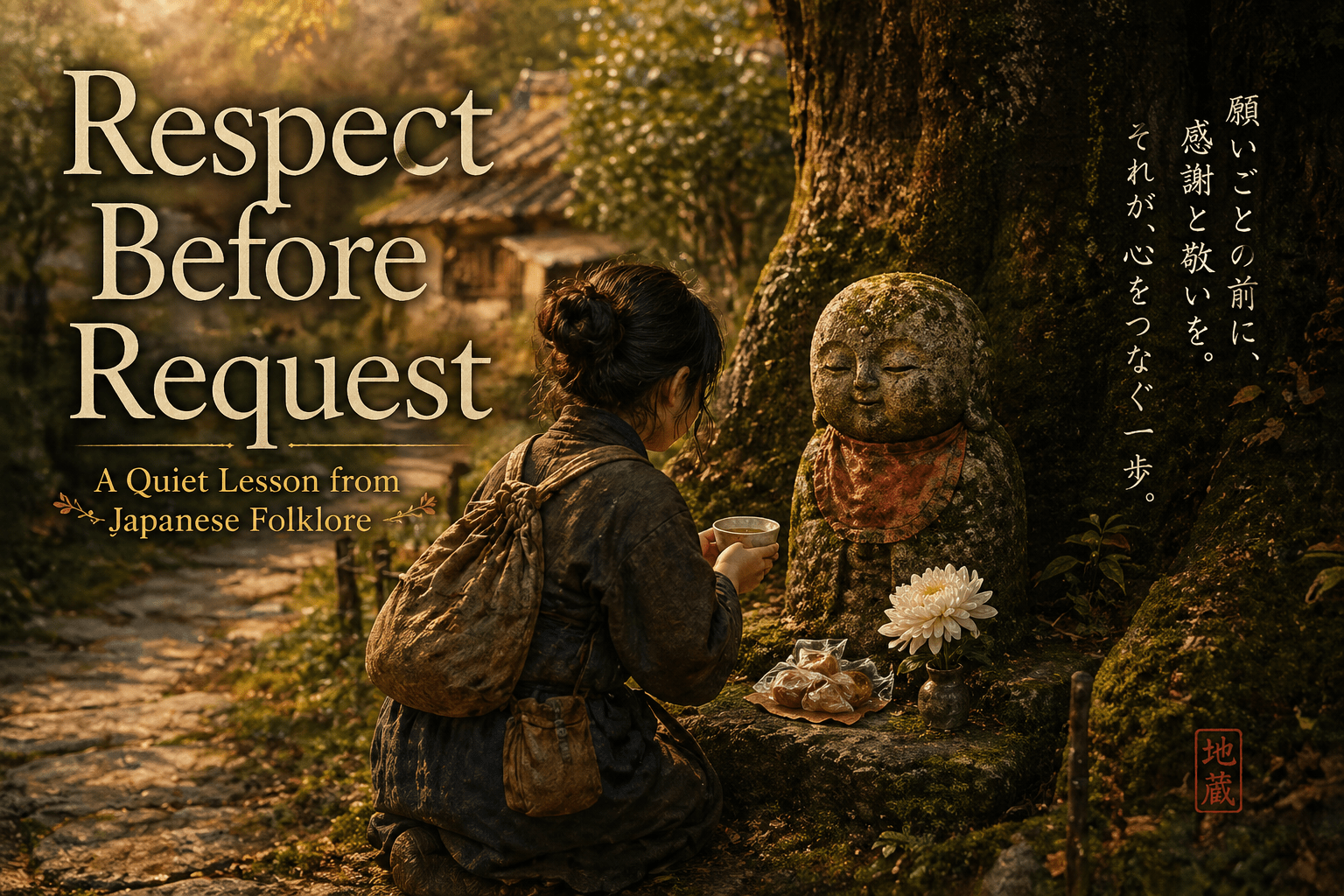
Explore two mysterious Osaka ghost stories through Japanese folklore, cultural memory, fear, and quiet wisdom for modern life.

 Wonderful Proverbs Journey
※This site uses affiliate advertising.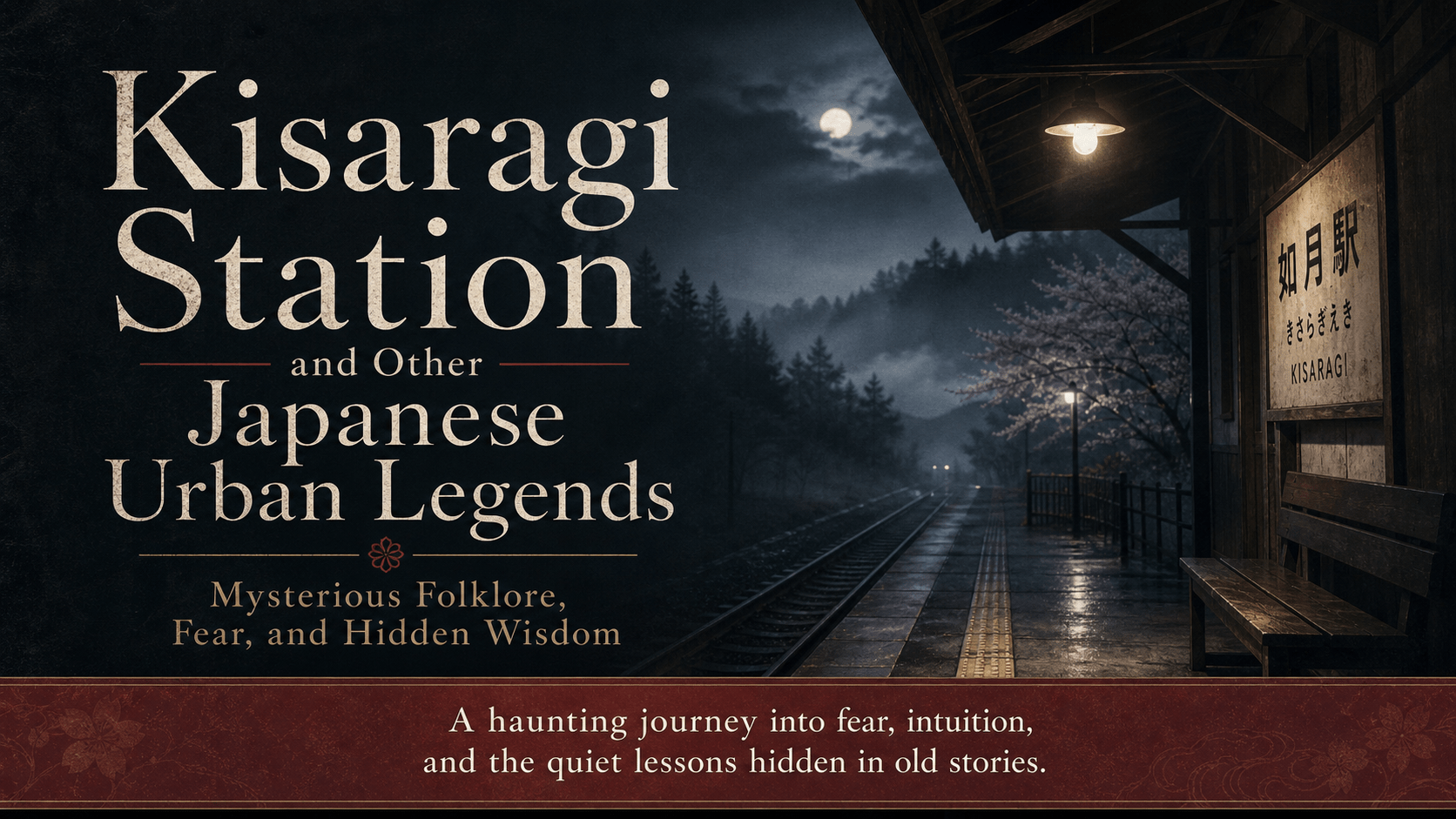
Japanese urban legends often begin in ordinary places: a train platform, a forest path, a late-night station, a quiet street after work. Their power lies not only in what appears in the dark, but in how the familiar world begins to bend. A train stops at a station that should not exist. A forest path seems to pull a person forward against their own better judgment. A scraping sound on an empty platform becomes a warning too late to ignore.
The following stories are inspired by modern Japanese folklore and internet-era ghost tales: Kisaragi Station, Aokigahara, and Teke Teke. They are not presented here as proven events, but as mysterious stories with symbolic force. Like many strange tales, they give shape to fears that are difficult to name: fear of losing control, fear of being alone, fear of ignoring one’s own intuition.
Read as folklore, these stories are more than horror. They are reflections on silence, attention, boundaries, and the fragile wisdom that often arrives as a quiet inner warning.
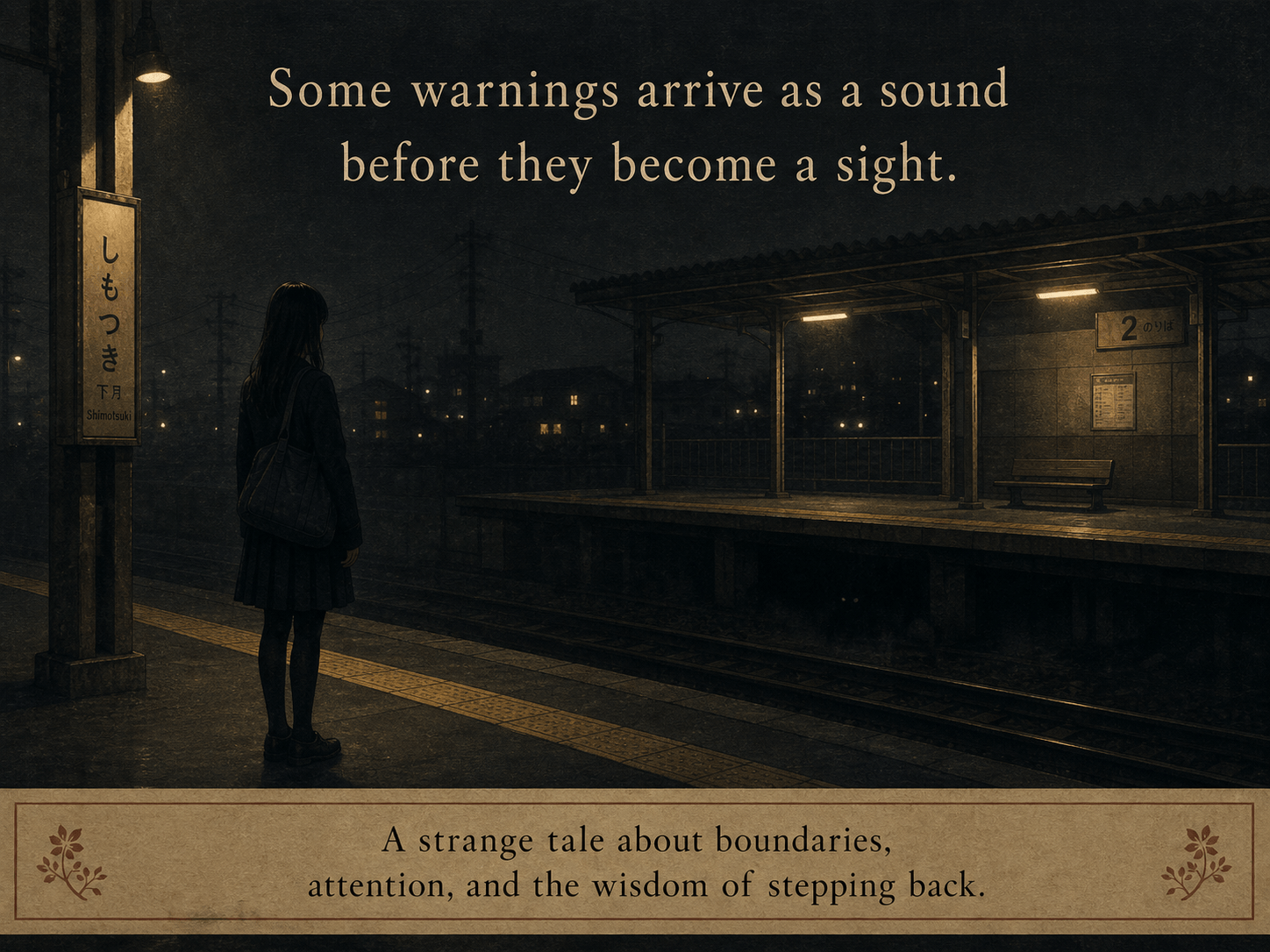
The commute from Hamamatsu was supposed to take about twenty minutes.
That was the kind of fact a person does not question. Twenty minutes from one familiar place to another. Twenty minutes of fluorescent lights, tired office workers, school uniforms, advertisements above the windows, and the soft metallic rhythm of wheels over tracks.
But that night, after an hour had passed, the train was still moving.
At first, the passenger tried to explain it away. Delays happened. Signals failed. Sometimes trains slowed without warning and no one seemed to know why. But then he looked down at his watch.
The hands were not moving.
Not slowly. Not irregularly. They were simply frozen, as if time itself had decided not to enter that train car.
He looked up.
The other passengers sat exactly as they had been sitting since he boarded. A man in a dark business suit faced him from across the aisle, briefcase balanced neatly on his knees. His eyes were open, but unfocused. His shoulders did not rise. His chest did not fall. The young woman near the door held her phone at the same angle, thumb hovering above the screen, never touching it. Even the straps hanging from the ceiling had stopped swaying.
Then the announcement came.
It was not the clear, professional voice used by the train line. It did not sound human enough to belong to a conductor, nor mechanical enough to be a recording. It came through the speakers wet and broken, like a voice trying to speak from the bottom of a river.
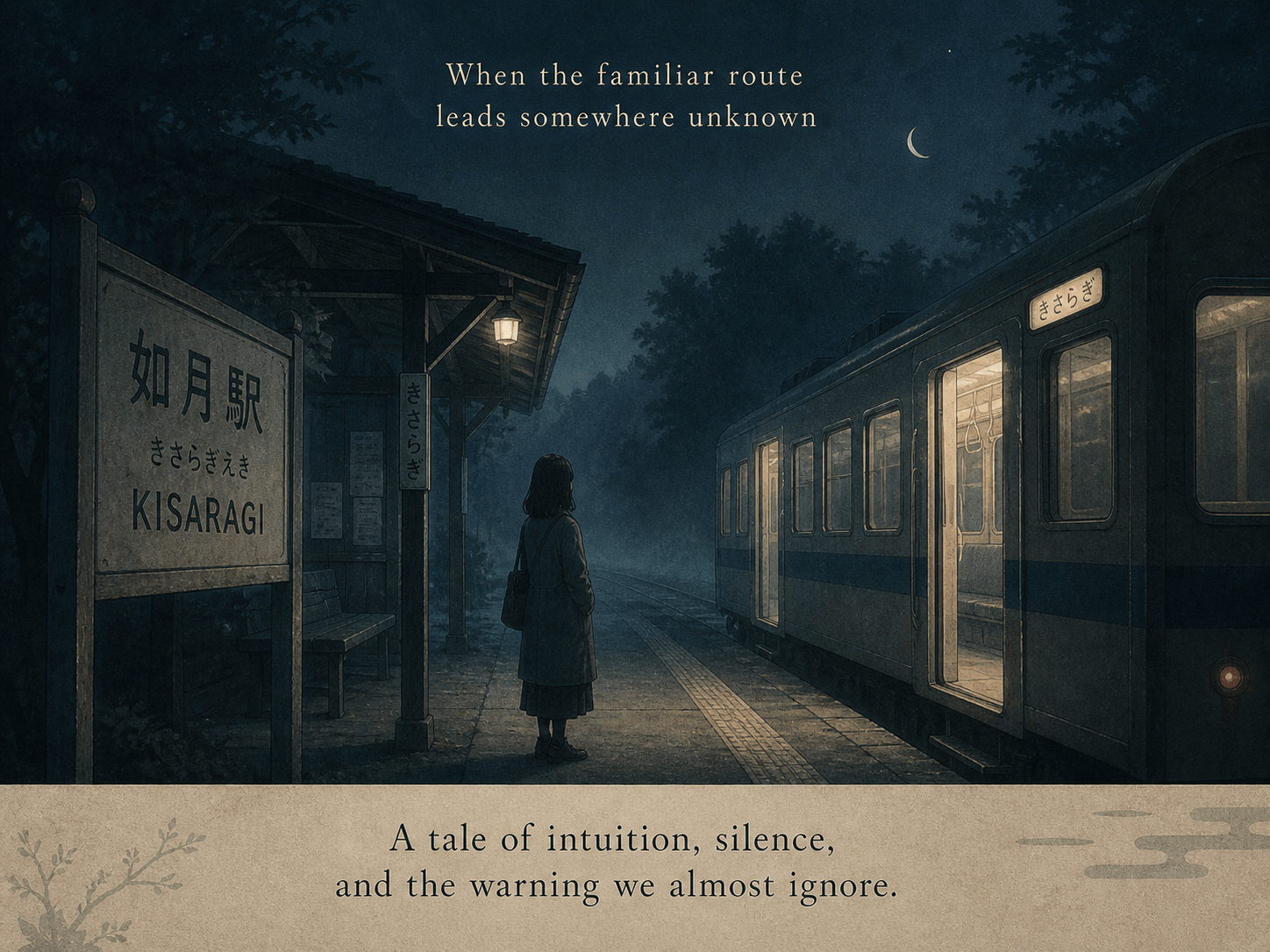
“Next stop… Kisaragi.”
The name struck him with a cold, physical force.
He had lived in the area his entire life. He knew the stations, the transfers, the small towns and factory stops. There was no Kisaragi Station.
Outside the window, the city had disappeared. There were no streetlights, no vending machines glowing in the distance, no apartment balconies, no convenience stores, no traffic signals blinking in the dark. Only trees. A wall of black trees pressed close to the glass, their shapes passing too slowly, as if the train were not moving through the forest but the forest were moving around the train.
He reached for the emergency cord.
His hand stopped inches away.
He could not explain why. Something in the air seemed to resist him. Not a voice, not a command, but a pressure. The instinct one feels before stepping into deep water. The body’s ancient refusal.
The train groaned and slowed.
When it stopped, the doors opened.
The platform outside was narrow, dim, and empty. A single sign stood under a flickering lamp.
Kisaragi.
The air did not smell like a station. No oil, no dust, no rain on concrete. It smelled of old copper and wet earth.
He did not want to leave the train. Every part of him understood that staying inside was safer. And yet the train car, with its unmoving passengers and silent hanging straps, had begun to feel less like transportation and more like a coffin.
He stepped out.
The moment his back foot touched the platform, the doors slammed shut.
Before he could turn, the train was gone.
No sound. No wind. No red tail lights shrinking into darkness. It simply vanished, as if it had never been there.
The station remained.
He stood beneath the flickering lamp and remembered an old internet story he had once read late at night: a girl who had posted online in 2004 about arriving at a station that did not exist. Some versions called her Hasumi. Some details changed in the retelling, as urban legends often do, but the warning remained the same.
Do not talk to anyone.
Do not go through the tunnel.
If you hear a bell, run.
That was when he saw the man.
He stood near the far end of the platform, dressed in a business suit. At first, the figure looked ordinary enough to be comforting.
“Excuse me!” the passenger called.
The darkness seemed to swallow the sound.
The man did not answer. He only tilted his head.
Too far.
A wet crack echoed from his neck.
Then, from the dark end of the tracks, came a bell.
It was not the bright chime of a crossing signal. It sounded like a funeral bell, but faster, impatient, as though whatever rang it had grown tired of waiting.
The passenger ran.
He took the stairs toward the underpass, slipping on concrete slick with a moisture he could not see. Behind him came footsteps. They were not hurried. They did not need to be. Heavy and wet, they struck the stairs one by one.
Slap.
Slap.
Slap.
Like bare feet on cold stone.
At the bottom, the tunnel stretched ahead beneath fluorescent lights. The lamps did not merely flicker; they screamed, giving off a thin electrical whine that burrowed into his ears. He ran until his lungs burned. He ran until his legs began to lose their shape beneath him. He ran until he saw the exit.
When he burst through it, he stopped.
He had not turned. He knew he had run straight for nearly ten minutes. He should have been deep in the woods, far from the platform.
But there it was again.
The same lamp.
The same sign.
The same smell of copper and wet earth.
And the train had returned.
It waited with its doors open, humming softly in the dark.
He looked back at the tunnel.
It was gone.
Only a flat wall of blackness remained, as if the passage had been erased.
The bell was now close behind his ear.
He did not choose the train. Choice no longer seemed to belong to him. He leapt inside.
The doors hissed shut.
He waited for the familiar jolt of departure. The pull of gravity. The rhythm of wheels.
Nothing came.
The train was still.
Then the speakers crackled again.
That same drowning voice whispered through the car:
“Next stop… Kisaragi.”
His stomach dropped.
Outside the window, the station sign slid past the glass.
Kisaragi.
Then again.
Kisaragi.
Then again.
The station itself was moving now, not the train. Concrete, platform, lamp, darkness, sign — all sliding past like a conveyor belt of memory and rot.
Across from him sat the man in the business suit.
The same man.
He had not moved, but his face had changed. His features seemed to melt toward the window, pulled by the motion outside, as if he were not a passenger at all but part of the place.
Slowly, he turned his eyes toward the passenger.
He smiled.
And in a voice as soft as paper left in the rain, he said:
“You forgot to pay your fare.”
“Fear is not always a command to run; sometimes it is an invitation to listen.”
Kisaragi Station belongs to the world of Japanese internet folklore, especially the kind of urban legend that spreads through message boards, retellings, and late-night storytelling. The idea of an impossible station is powerful because trains in Japan are associated with order, precision, and everyday routine. A train is supposed to follow a route. A timetable is supposed to hold the world in place.
When that order breaks, the fear becomes deeper than surprise. The station becomes a boundary between the known and the unknown. In folklore, liminal places — stations, bridges, tunnels, crossroads, forests — often serve as thresholds. They are not fully one place or another. They are spaces of transition, and therefore spaces where identity, time, and certainty can loosen.
The warning not to talk to anyone, not to enter the tunnel, and to run when the bell sounds reflects a common structure in folk narratives: survival depends less on strength than on attention. The person who lives is not always the bravest, but the one who notices the rule before it is too late.
The terror of Kisaragi Station is not only that it is unknown. It is that it appears inside a familiar routine. We fear monsters in abandoned houses, but we trust the train home. We trust clocks, maps, announcements, platforms, schedules. When the ordinary world quietly stops obeying its own rules, the mind has nowhere safe to stand.
Psychologically, stories like this give form to a common modern anxiety: the fear that our routines are carrying us somewhere we did not choose. Many people know the feeling of moving through life on schedule while inwardly sensing that something is wrong. The frozen watch and unmoving passengers may be read as symbols of numbness, exhaustion, or the strange loneliness of modern commuting life.
The story does not need to prove the supernatural to matter. Its meaning lies in the question it leaves behind: when something feels wrong, how long do we keep pretending the route is normal?
One way to read this tale is as a quiet lesson in intuition. Not every fear is wisdom, but not every fear is foolish either. Sometimes the body recognizes danger before the mind has language for it.
In modern life, the “bell” may not be supernatural. It may be burnout, a strained relationship, a decision made against one’s values, or a small inner discomfort ignored for too long. The story does not tell us to be afraid of trains or tunnels. It suggests something gentler and more useful: listen before the warning becomes a crisis.
I did not enter Aokigahara looking for anything.
That is what I still tell myself.
I was not there to test my courage. I was not chasing a ghost story. I was not trying to prove that the forest’s reputation was exaggerated. I had read about it, of course. Most people have, if only in fragments: the Sea of Trees at the base of Mount Fuji, a forest known for its dense growth, its silence, and its sorrowful association with people who go there at the end of hope.
But reading about a place is different from standing before it.
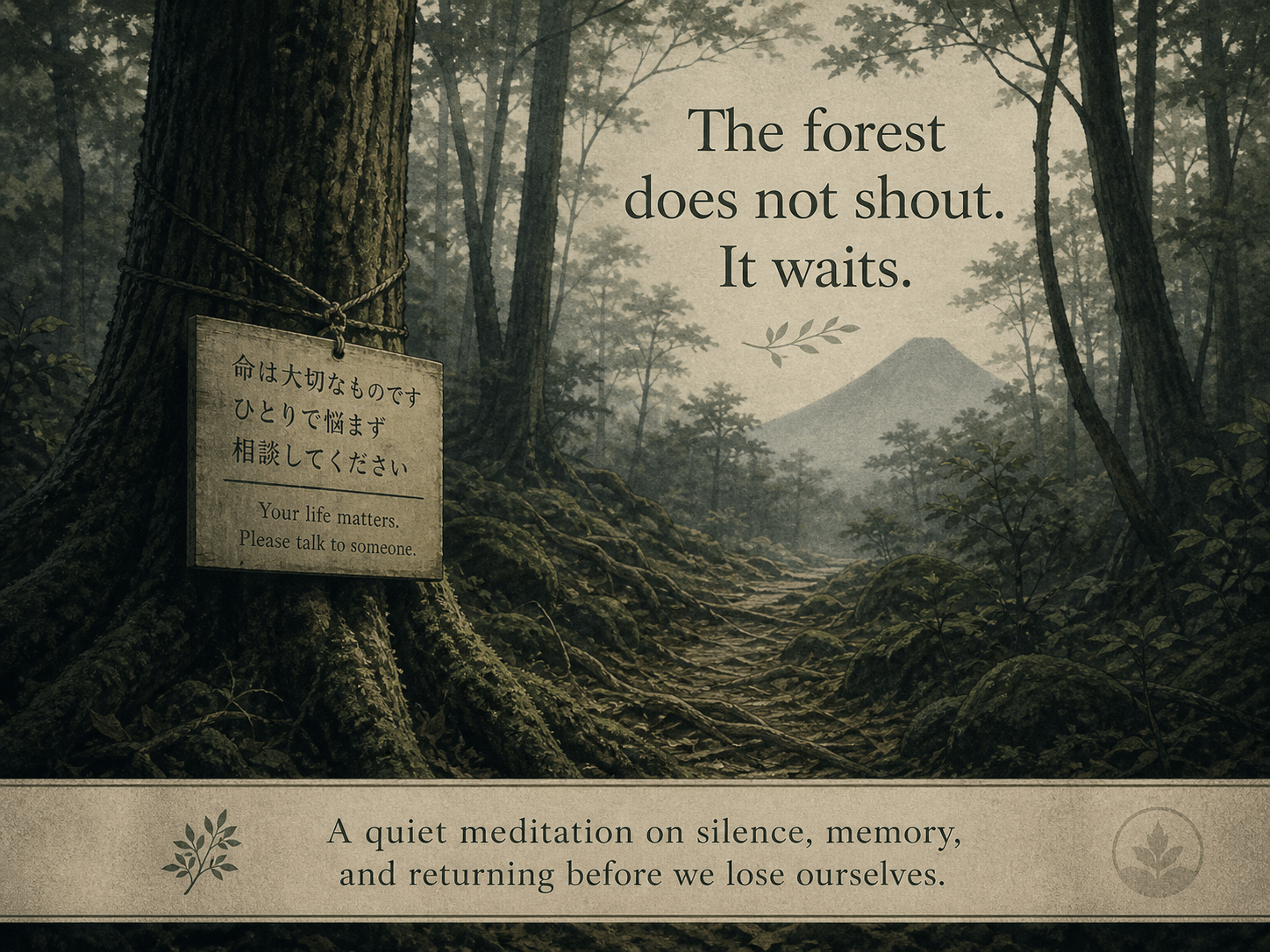
At the entrance, the path looked harmless. Beautiful, even. Moss covered the roots in soft green waves. The trees grew close together, their branches woven overhead. Sunlight entered in broken pieces. There were signs, trail markers, and warnings asking visitors not to leave the path. Some signs carried messages meant not for tourists, but for people in pain: think of your family, think of your life, please seek help.
At the time, I told myself the signs were part of the forest’s reputation.
I followed the main trail.
For a while, nothing happened.
That was the first strange thing. Not terror. Not a scream. Nothing.
The deeper I walked, the quieter the world became. There was no wind moving through the leaves, no birdsong, no insects. Even my footsteps sounded absorbed, as if the ground were swallowing them before they could become echoes.
Then a thought entered my mind.
Go a little farther.
It did not feel like my thought.
Ahead, between two trees, I noticed what might have been a side path. It was almost nothing — a break in the undergrowth, a narrow suggestion of passage. I stopped. I remember knowing, clearly, that I should not step off the marked trail.
Then I did.
That is the part that still troubles me. It did not feel like curiosity. It felt automatic, as if the decision had been made somewhere else and my body was only catching up.
A few minutes later, I checked my phone.
No signal.
I closed the screen and kept walking.
The ground in Aokigahara is uneven, shaped by old lava flows from Mount Fuji. Tree roots twist over stone. Small holes open beneath moss. A foot can slip where the surface looks solid. It is the kind of terrain that makes every step uncertain.
Apparently, it can unsettle direction too.
At some point, I turned and realized I no longer knew which way I had come from.
I took out my compass.
The needle spun.
Not slowly. Not as if adjusting. It spun in clean, useless circles, refusing north as though north had no authority here.
That was when fear finally reached me.
I remembered the warnings near the entrance. Not exactly word for word, but enough.
If you leave the path, turn back immediately.
If your thoughts begin to change, leave immediately.
If you feel you are no longer in control of yourself, get out.
I told myself I only needed to go a little farther. Find something recognizable. A ribbon. A sign. A bend in the trail. Something that would prove I was not truly lost.
Then I saw the sign.
It was tied to a tree, weathered and old, but still readable. It carried a message similar to the ones near the entrance: think of the people who love you. Do not make a permanent decision in a temporary moment.
I stood before it longer than I should have.
And something changed.
I was not sad, exactly. It was heavier than sadness and emptier than grief. It felt as if someone had placed wet wool over my thoughts. The world narrowed. The trees became less like trees and more like witnesses. I could remember my life, but from a distance, as if it belonged to someone else.
That was when the second warning became real.
If your thoughts begin to change, leave.
I wish I could say I listened.
Instead, I stepped away from the sign and kept walking.
Even now, I cannot explain that choice. I knew, logically, that I should turn back. But logic had become a voice speaking from another room. My body did not obey it. It moved forward, step after step, as if the forest had borrowed me.
Eventually, I stopped.
I do not remember deciding to stop.
There was no path. No marker. No ribbon tied to a branch. No familiar tree. Only endless trunks, twisted roots, stone, moss, and silence.
The third warning came back to me then, not as words but as terror.
If you feel you are no longer in control of yourself, get out.
I turned.
I did not know if I was going the right way. I did not care. I moved quickly, then faster, stumbling over roots, pushing through branches, trying not to think. Thinking felt dangerous. The forest seemed to offer thoughts that were not mine.
After what may have been ten minutes or an hour, I saw the main trail.
The moment my foot touched it, the world changed.
Sound returned.
A bird called somewhere above me. Leaves shifted. My phone found a signal. The compass worked. Even the air seemed lighter, as if the forest had released a hand from the back of my neck.
I left without looking back.
Nothing followed me out.
Nothing physical, at least.
But sometimes, even now, I remember standing before that sign, knowing I should turn back and not turning back. To me, the most frightening part of that forest is not the possibility of getting lost among the trees.
It is how easy it can be to stop listening to yourself.
“When the world grows quiet, listen first to the voice that still wants you to live.”
Aokigahara is a real forest near Mount Fuji, and it carries cultural, natural, and emotional significance. It is important to speak of it with care. In popular culture, the forest is often reduced to its darkest reputation, but it is also a place of volcanic landscape, ecological beauty, and deep silence.
In folklore, forests often represent the place beyond ordinary social order. They are where people lose direction, meet spirits, encounter tests, or face hidden parts of themselves. In this story, the forest does not need to be treated as evil. It may be understood as a symbol of isolation: a place where ordinary noise falls away and inner thoughts become louder than expected.
The signs asking people to think of loved ones remind us that folklore and public warning can overlap. A place may be beautiful and dangerous, sacred and sorrowful, natural and symbolic at the same time.
This story speaks to a fear more subtle than physical danger: the fear of losing inner direction. The spinning compass is frightening because it turns confusion into an image. North disappears. The body moves, but the self no longer feels fully present.
Many people know this feeling in less dramatic forms. Stress, grief, depression, exhaustion, and isolation can make a person feel as if they are walking deeper into a place they never meant to enter. The horror of the story is not only the forest. It is the moment when the narrator recognizes, “I knew I should stop, and yet I kept going.”
Folklore gives that experience a landscape. It turns an invisible struggle into trees, moss, silence, and a path that vanishes behind you.
This tale may remind us that getting lost is not always sudden. Sometimes it happens one small compromise at a time. One ignored warning. One step off the path. One moment of telling ourselves, “Just a little farther.”
The lesson is not to fear silence. Silence can heal. Solitude can restore. But when silence begins to make us smaller, when our thoughts no longer feel like our own, the wisest act may be to return — to a person, a promise, a routine, a lighted path, or simply the next breath.
People think I avoid the edge of the platform because I am afraid of being pushed.
It is easier to let them think that.
Accidents happen. Arguments happen. Drunk people stumble too close to the yellow line. Everyone understands that kind of fear. It belongs to the ordinary world.
The real reason is harder to explain.
It happened three winters ago, after a late shift at a small logistics office near the harbor. I was doing data entry then — dull work, but enough to pay rent. That night, my supervisor decided a report had to be finished before morning. By eleven, everyone else had gone home. By midnight, the office lights seemed too bright. By one, the hum of the computers felt like the only living thing in the building.
When I finally stepped outside, the cold hit like water.
The streets were empty except for a convenience store sign buzzing in the distance. The last train toward my neighborhood was scheduled for 1:22 a.m. I had time if I walked quickly.
The station was small: two platforms, an overpass, a ticket gate, and one vending machine humming to itself under white light. During rush hour, the place was ordinary. At night, it felt abandoned by the city.
There was no staff.
On the opposite platform, an old woman sat alone on a bench, holding a canned coffee between both hands. She did not look up when I entered.
I passed through the gate and sat down.
For a moment, I let myself relax. The hardest part of the night was over. Work was finished. The train would come. I would go home, sleep a few hours, and wake to another ordinary day.
Then I heard the sound.
At first it was faint.
Scrape.
I thought it was wind pushing loose gravel along the track.
Then again.
Scrape.
Closer this time.
I stood and looked down. The rails gleamed under the platform lights. Nothing moved.
Across the tracks, the old woman remained still.
Scrape.
Steady now. Rhythmic. Concrete against something hard. Or something hard dragging itself over concrete.
The smell came next.
Old blood has a smell. Metallic and sour, like iron left too long in damp air.
The cold sharpened.
I stepped toward the yellow line and leaned out, just slightly.
Something moved beneath the far platform.
At first, my mind tried to make it into an injured animal. A dog, perhaps. Something low to the ground, struggling.
Then it slid into the light.
It was a girl.
Or the upper half of one.
From the waist up, she wore a dark school uniform, the kind seen everywhere in winter: sailor-style collar, long sleeves, fabric stiff with dirt and something darker. Her hair hung over her face. Her hands pressed against the platform edge, fingers bent in ways fingers should not bend.
Then she moved.
Teke.
Her elbows struck the concrete.
Teke.
Her palms dragged her forward.
Teke teke.
The sound was not a word at first. It was movement. A body reduced to rhythm. A name born from impact.
I could not breathe.
The old woman across the tracks lifted her head at last.
Not toward the thing beneath her platform.
Toward me.
Her expression did not change, but her lips moved.
Do not run, she seemed to say.
Or perhaps:
Too late.
The girl raised her head.
Her face was young. That was the worst part. Not monstrous, not ancient, not a mask from a festival. Young. Pale. Furious with a grief so old it no longer looked like sadness.
Her mouth opened.
The sound that came out was not a scream.
It was the scrape of metal on rails.
I stepped backward.
The announcement chime played overhead, cheerful and automatic.
“Train approaching. Please stand behind the yellow line.”
The voice was calm.
The thing below the platform began to climb.
Her hands gripped the edge. One elbow rose. Then the other. Her body folded upward in a way no living body should. The station lights flickered once, twice, and in the spaces between light and dark, she seemed closer each time.
Teke.
Teke.
Teke.
I ran.
I know the old woman had warned me not to. Or maybe I imagined it. Fear does strange things to memory.
I ran toward the overpass stairs. Behind me, the scraping sound became faster, sharper, no longer slow or broken.
Teke-teke-teke-teke.
Halfway up the stairs, I looked back.
That was my mistake.
She was on the platform.
No legs. No hesitation. Her arms moved with terrible speed, her upper body snapping forward across the concrete. The yellow safety line passed beneath her like a road.
Her hair lifted from her face.
She was smiling.
The train entered the station then, lights flooding the platform. For one bright second, everything looked normal: rails, tiles, vending machine, bench, the old woman, the approaching train.
Then the lights from the train passed over the girl, and she vanished.
The train stopped.
The doors opened.
I stood on the stairs, shaking so badly I could barely hold the rail.
No one got off.
No one got on.
Across the tracks, the bench was empty.
The old woman was gone too.
I did not take that train. I walked home before dawn, keeping to the center of every sidewalk, avoiding every shadow near the curb. Since then, I stand far from the platform edge. People think I am afraid of falling.
I let them.
Some fears are easier to explain than others.
And sometimes, late at night, when a train is delayed and the station grows too quiet, I hear it again beneath the ordinary sounds of the city.
Scrape.
Teke.
Teke.
“A warning ignored does not disappear; it returns in another voice.”
Teke Teke is one of Japan’s well-known modern urban legends. In many versions, she is described as the spirit or figure of a girl who lost the lower half of her body and moves by dragging herself with her arms. The name itself imitates the sound of movement: teke teke, a sharp scraping rhythm.
Like many urban legends, the details change depending on who tells the story. Sometimes she appears near train tracks. Sometimes she chases people at night. Sometimes the tale functions as a warning to children, commuters, or anyone who lingers too long in unsafe places.
The train platform is an especially meaningful setting. It is a place of waiting, transition, and danger controlled by rules: stand behind the line, do not cross, do not lean too far. Teke Teke turns those ordinary safety warnings into folklore. The yellow line becomes not just a rule, but a boundary.
Teke Teke frightens us because she is both impossible and physical. She is not a misty ghost who floats at a distance. She scrapes, climbs, drags, and approaches. The horror is carried by sound before sight. That makes the story linger in the body.
Human beings are deeply responsive to rhythm: footsteps behind us, a knock at night, the drip of water, the sound of something moving where nothing should move. A repeated sound can become a prophecy. We begin to imagine its source before we see it.
The story also speaks to the fear of looking back. In many myths and folktales, turning around is dangerous because it breaks trust in forward motion. To look back is to invite the past, the wound, or the thing pursuing us into full reality.
This story may be read as a meditation on boundaries. Some boundaries are visible: the yellow line on a platform, the locked gate, the warning sign. Others are emotional: the limit of one’s patience, safety, dignity, or trust.
Teke Teke does not simply ask us to fear what waits in the dark. It asks us to notice the small lines we cross when we are tired, distracted, lonely, or careless. Wisdom often begins not with dramatic courage, but with the humility to step back.
Kisaragi Station, Aokigahara, and Teke Teke belong to different corners of Japanese urban legend, but they share a quiet structure. A person enters a familiar place. Something feels wrong. A warning appears. The real danger begins when that warning is ignored.
This is one reason mysterious folklore continues to matter. It does not only entertain us with the unknown. It teaches us how people across cultures imagine danger, intuition, grief, loneliness, and survival. A scary story with a moral lesson does not need to end with a lecture. Sometimes the lesson is carried by a sound, a sign, a frozen clock, or a path that suddenly feels too quiet.
Perhaps the wisdom hidden in these tales is simple:
Pay attention.
Honor the boundary.
Return before you lose yourself.
And when fear speaks softly, do not wait for it to scream.
Main affirmation:
“Fear is not always a command to run; sometimes it is an invitation to listen.”
These stories draw from Japanese urban legend, internet folklore, and symbolic places such as stations, forests, tunnels, and train platforms. In folklore, such places often function as thresholds between the ordinary world and the unknown. The stories are best understood not as proven supernatural events, but as cultural narratives that give form to anxiety, silence, danger, and intuition.
We are drawn to frightening stories because they allow us to approach fear safely. They turn invisible emotions into images: a frozen watch, a spinning compass, a scraping sound on concrete. Rather than simply shocking us, these tales help us recognize moments when we ignore our own unease.
The lesson is not to live in fear. It is to pay attention. A strange feeling, a boundary, a warning sign, or a quiet hesitation may carry wisdom. In modern life, courage sometimes means moving forward — but sometimes it means stepping back before we lose ourselves.
What quiet warning in your own life might be asking you to listen before it becomes impossible to ignore?