Explore mysterious Japanese urban legends through folklore, fear, cultural meaning, and quiet wisdom for modern life.
 Wonderful Proverbs Journey
※This site uses affiliate advertising.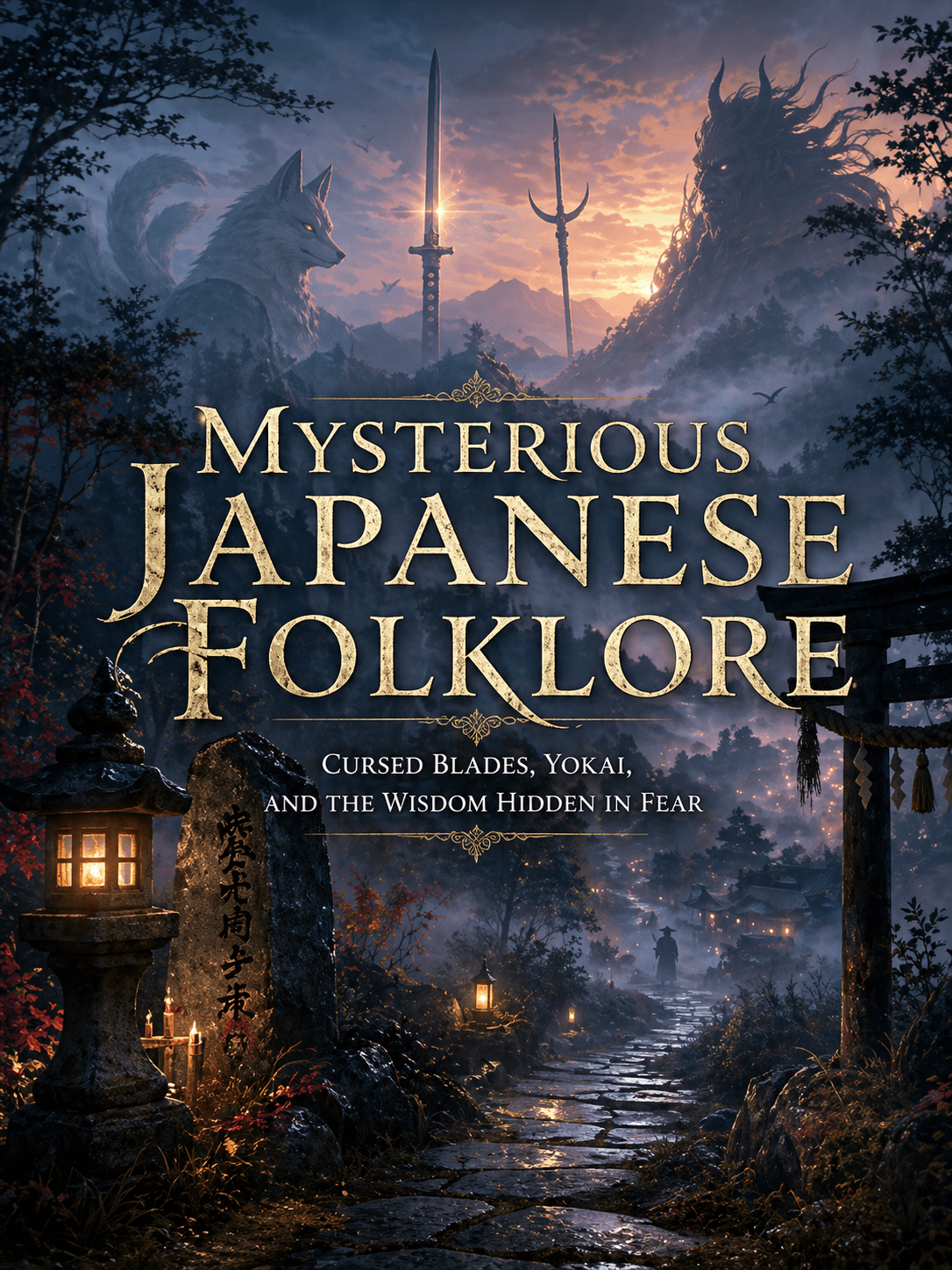
In Japanese folklore, fear often arrives quietly.
It does not always appear as a scream in the night or a shadow at the window. Sometimes it appears as an old sword no one is allowed to see. Sometimes it takes the form of a spear standing upside down on a mountain peak, weathered by wind and mist. Sometimes it is a two-faced warrior remembered as a monster by one tradition and a protector by another. Sometimes it is a fox spirit in the palace, a demon drinking wine in a mountain hall, or a dead emperor whose grief was too heavy to disappear.
These stories may sound like ghost stories, but they are more than entertainment. They are vessels of memory.
In the long history of Japan, stories of jutsu, spells, sacred tools, cursed blades, and yokai have often served as ways to speak about what could not easily be explained: illness, political defeat, natural danger, betrayal, social fear, and the uneasy feeling that some powers in life should not be handled carelessly.
This article explores several mysterious Japanese tales: Ryōmen Sukuna, the two-faced figure of Hida; Kusanagi-no-Tsurugi, the sacred sword hidden from human eyes; Ame-no-Sakahoko, the heavenly spear planted upside down in the mountain; Muramasa, the blade whose reputation became a curse; and the legendary yokai Shuten-dōji, Tamamo-no-Mae, and Emperor Sutoku.
Rather than treating these stories as proven supernatural events, we will read them as folklore: stories shaped by fear, reverence, politics, memory, and moral imagination.
A scary story may frighten us for a moment.
A meaningful folktale stays with us because it seems to know something about being human.
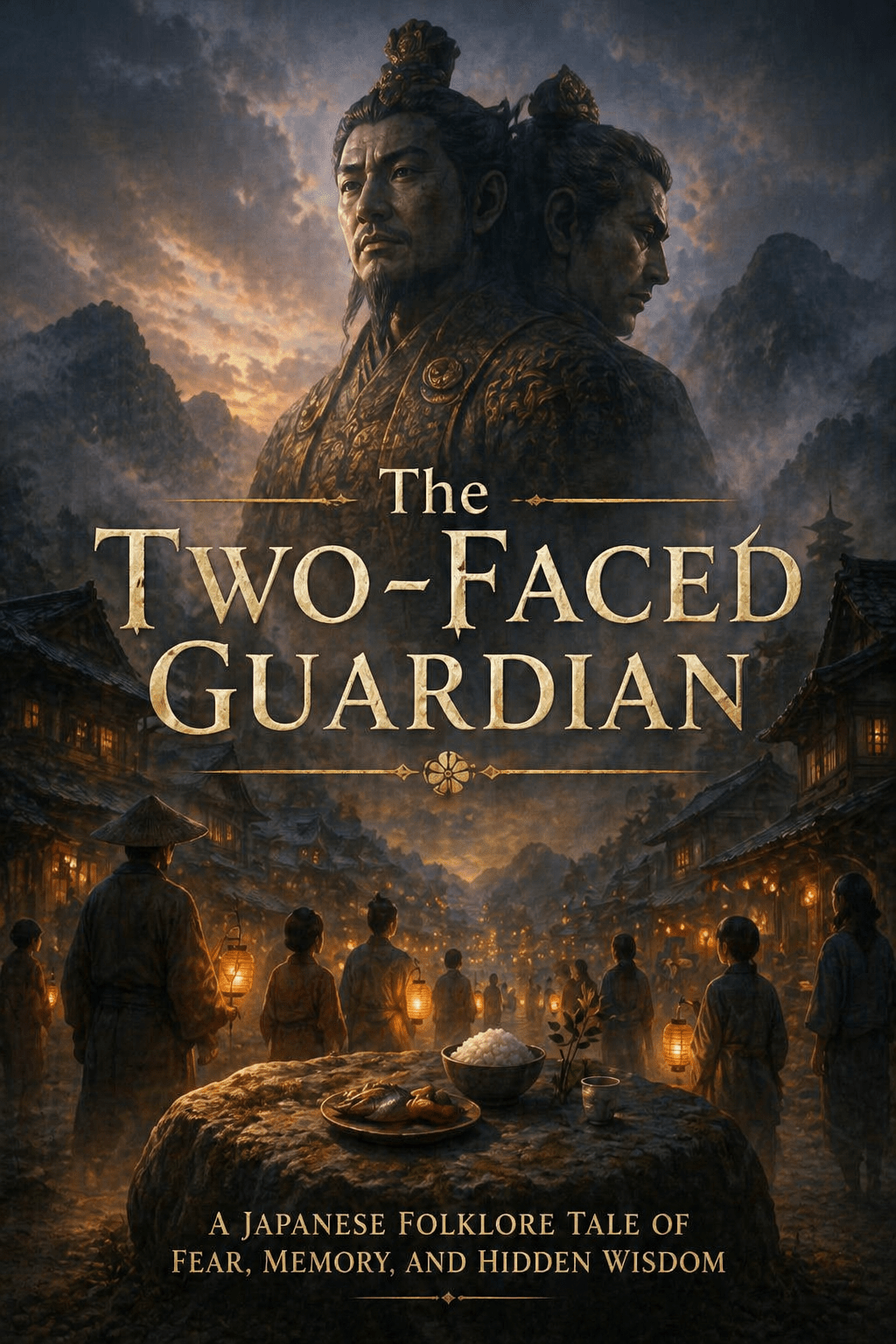
Long ago, in the mountainous region now associated with Hida in Gifu Prefecture, there was said to be a being unlike any ordinary man.
He had one body, but two faces.
One face looked forward, the other backward, as if he could see both the road ahead and the road already taken. He had four arms, and in some tellings he carried swords and bows with impossible ease. To those who feared him, he must have seemed like a creature born outside the boundaries of the human world.
His name was Ryōmen Sukuna.
In older official narratives, Sukuna is described as a rebel, a violent figure who refused to obey imperial authority. He is said to have attacked people, resisted the court, and caused disorder. Eventually, a warrior was sent to defeat him. In this version, the story is simple: the center of power confronts the monstrous outsider, and order is restored.
But folklore rarely remains simple.
In the Hida region, where his memory survived in local tradition, Sukuna is often remembered differently. He is not merely a monster there. He is sometimes a hero. A protector. A powerful being who defended the people of the mountains rather than threatening them.
One tale says he defeated a poisonous dragon that had brought suffering to the region. Another tradition connects him with temples, saying that he founded sacred places or appeared as an incarnation of Kannon, the bodhisattva of compassion. In Buddhist belief, Kannon is associated with mercy and the ability to hear the cries of suffering beings. To describe Sukuna in this way is to transform him completely: from a violent rebel into a compassionate guardian.
One of the most moving details in the local tradition concerns a stone.
Before going into battle, Sukuna was offered a meal by villagers. But instead of eating inside their home, he sat outside and ate upon a stone. The reason, the tale says, was that he did not want to bring danger upon the household. If his battle with the authorities caused trouble for the village, he wanted no one to accuse that family of sheltering him.
It is a small image, but a powerful one:
a feared warrior sitting alone on a stone, eating a meal before battle, already thinking of the safety of others.
Here, the “monster” becomes complicated.
Was Sukuna truly a demon-like enemy of the people? Or was he a local leader, later painted as a monster by those who wrote history from the side of the court? Was his two-faced body meant to mark him as unnatural, or could it symbolize a person seen in two opposite ways—villain to one world, protector to another?
The story does not give us a final answer. It gives us something more interesting: a mirror.
It asks us to consider how easily power can name someone a monster, and how memory can quietly resist.
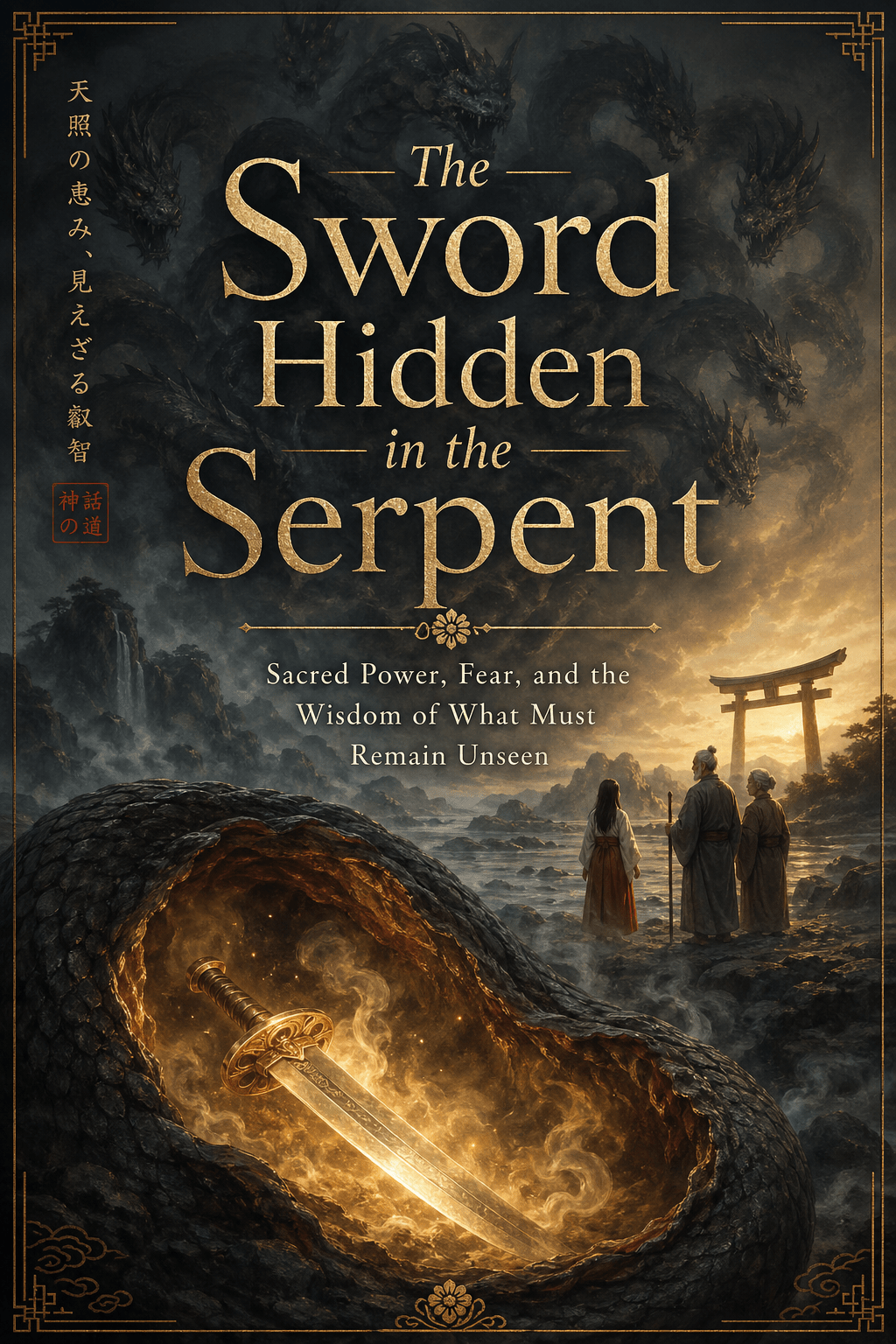
Among the most sacred objects in Japanese mythology is Kusanagi-no-Tsurugi, the Grass-Cutting Sword.
Its story begins with the storm god Susanoo.
Susanoo was not a gentle deity. In many myths, he appears wild, impulsive, and difficult to control. After causing trouble in the heavenly realm, he was cast down to the earthly land. There, in the region associated with ancient Izumo, he encountered an elderly couple and their daughter, Kushinada-hime.
They were weeping.
When Susanoo asked why, they told him of the terrible serpent Yamata-no-Orochi. It had eight heads and eight tails. Its body stretched across valleys and mountains. Trees grew upon its back, and its belly was said to be red with blood. Each year, the serpent came to devour one of their daughters. Seven had already been taken. Only Kushinada-hime remained.
And now it was her turn.
Susanoo agreed to defeat the serpent if he could marry Kushinada-hime. He prepared strong sake and placed it where the serpent would drink. When Yamata-no-Orochi arrived, enormous and dreadful, each of its eight heads drank deeply. Soon the serpent collapsed into drunken sleep.
Then Susanoo drew his sword.
He cut through the serpent’s heads and tails one after another. But as he sliced into one tail, his blade struck something hard. Surprised, he opened the flesh and discovered a sword hidden inside the serpent’s body.
This mysterious blade would later become known as Kusanagi-no-Tsurugi.
Already, the symbolism is rich. A sacred sword is found not in a palace, but inside a monster. Wisdom is hidden within danger. Protection emerges from terror. The thing that threatens the community also contains the object that will later symbolize divine authority.
The sword’s story continues through the age of gods and emperors. It becomes one of the Three Sacred Treasures of Japan, along with a mirror and a jewel. These treasures are associated with imperial legitimacy, but they are not treated like ordinary royal objects. They are surrounded by secrecy, ritual, and reverence.
Perhaps the most fascinating part of the Kusanagi legend is this: the true sword is not meant to be seen.
According to tradition, even the emperor does not simply look upon it as one might inspect a weapon in a museum. In important rites, symbolic substitutes may be used. The sword’s power is bound to its hiddenness. Its invisibility is not a weakness; it is part of what makes it sacred.
There are also stories that those who tried to view the sword improperly suffered misfortune. Whether one reads such tales literally or symbolically, their message is clear: not everything powerful should be exposed. Not everything sacred should be handled. Not every mystery becomes richer when explained.
In a modern world that often treats visibility as value, Kusanagi offers a different wisdom.
Some things are protected by being unseen.
Some truths are approached not by possession, but by reverence.
Some power must remain wrapped in silence.
High on Mount Takachiho, where clouds drift across the ridges and volcanic stone holds the memory of fire, there is a mysterious spear known as Ame-no-Sakahoko, the Heavenly Upside-Down Spear.
It is said to stand with its point driven into the mountain and its handle lifted toward the sky.
The image is unforgettable: a weapon reversed. A spear that refuses to point outward. A tool of force transformed into a sign of restraint.
For centuries, people have wondered who placed it there. Some connect it to Japan’s creation myths. In one ancient story, the deitiesIzanagi andIzanami stood upon the floating bridge of heaven and stirred the primordial sea with a heavenly spear. When drops fell from the spear’s tip, they hardened and became islands. In this way, the land itself was born from a sacred act of stirring chaos into form.
Other traditions connect Ame-no-Sakahoko with Ninigi-no-Mikoto, the heavenly grandson of the sun goddess Amaterasu. Ninigi descended from heaven to earth in an event known as tenson kōrin, the descent of the heavenly grandchild. In this interpretation, the spear was planted in the mountain as a sign that the land would be governed in peace.
One version says the spear was thrust upside down so it would never again be used for battle.
That image contains a quiet moral lesson. Human beings often imagine peace as the destruction of weapons. But this story imagines peace differently. The weapon is not erased. It remains visible. It stands in the landscape as a reminder of violence, but its direction has changed. Its point is buried. Its threat has been turned inward, into the mountain, into stillness.
A weapon becomes a prayer.
There are also stranger tales. Some say that long ago, a giant descended the mountain carrying the spear. Villagers, startled by the sight, questioned him. Then the giant vanished, and people wondered whether the spear itself had tried to leave the summit, as if it possessed its own will.
Perhaps this is why sacred objects in folklore feel so alive. They are never merely things. They remember. They move. They resist ownership. They belong partly to this world and partly to another.
Historically, parts of the original spear may have been damaged or lost through volcanic activity and time. What visitors see today may not be the first object that stood there. Yet the legend continues, because folklore does not depend only on material certainty. It depends on the power of an image.
A spear standing upside down on a mountain.
A weapon refusing war.
A reminder that the highest form of strength may be the ability to place power back into the earth.
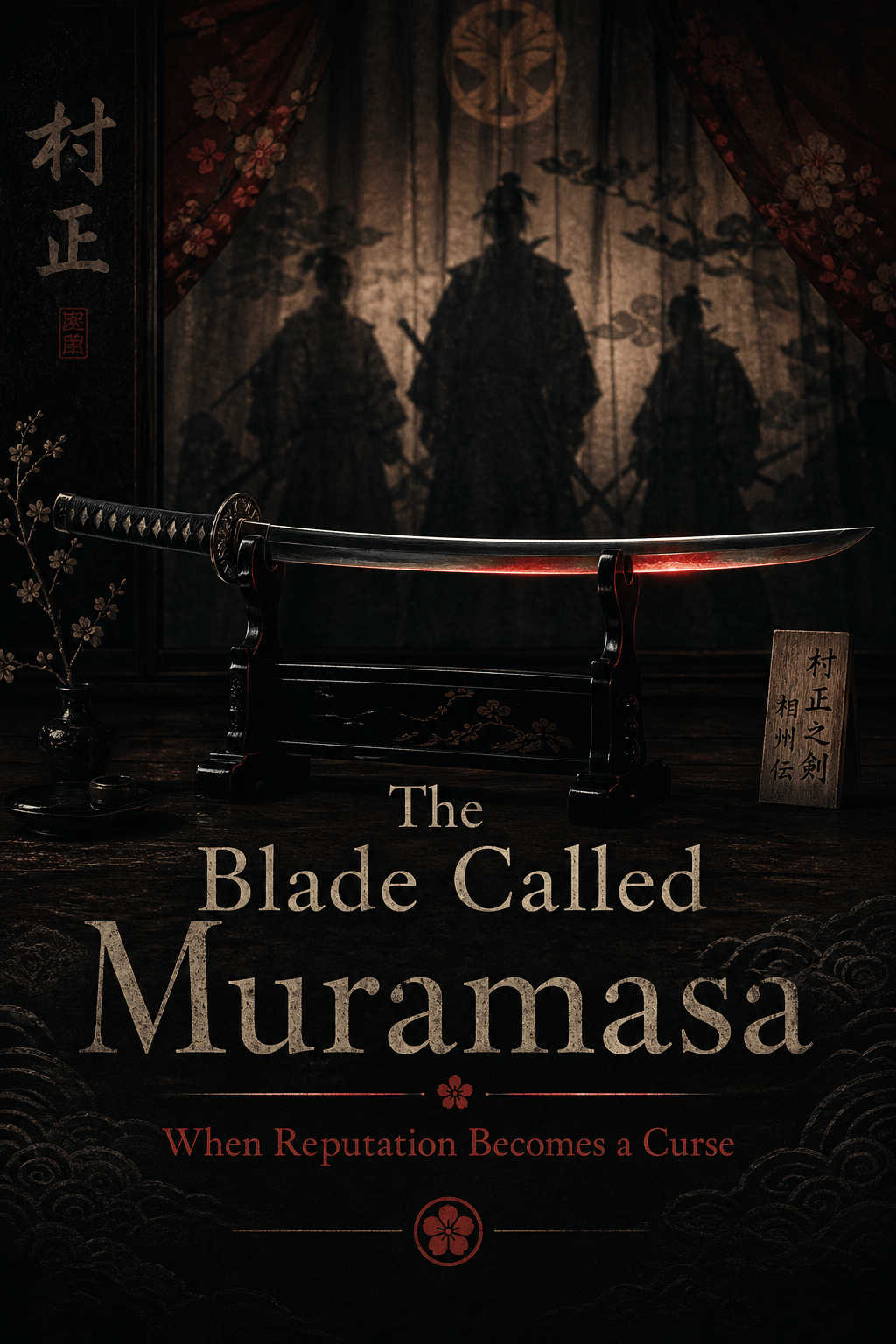
The name Muramasa carries a dark sound in Japanese sword legend.
Yet Muramasa was not originally the name of one cursed blade. It referred to a school of swordsmiths, especially associated with the region around present-day Mie Prefecture. Their swords were respected. They were sharp, practical, and highly valued by warriors.
A sword, after all, is never only an object in a warrior society. It is status, survival, discipline, violence, and identity. To carry a fine blade was to carry both protection and responsibility.
So how did Muramasa become a name of fear?
The answer lies partly in history, partly in coincidence, and partly in the human hunger for pattern.
Several misfortunes connected to the Tokugawa family were later associated with Muramasa weapons. Tokugawa Ieyasu’s relatives were injured or killed in incidents where Muramasa blades or weapons were said to have appeared. Ieyasu himself was also said to have been wounded by a Muramasa blade in youth. Over time, a pattern formed in the imagination: Muramasa meant danger to the Tokugawa house.
Once such a story begins, it grows.
A blade no longer needs to act. Its name does the work.
People whisper. Theater exaggerates. Popular stories sharpen the rumor. Kabuki plays and fiction helped transform Muramasa from a respected swordsmith name into the image of a blood-loving blade.
The sword became “cursed” because people continued to speak of it as cursed.
From a practical perspective, there may have been a simpler explanation. Muramasa blades were widely produced and widely circulated. If many warriors owned them, then naturally they would appear in many violent events. What looks like a supernatural pattern may have begun as ordinary probability.
But folklore is not born only from facts. It is born from the way facts feel.
If one family suffers again and again, and one name appears again and again, the mind connects them. The connection may not be logical, but it is emotionally powerful. The human heart is a storyteller before it is a statistician.
This is why Muramasa remains fascinating. The legend reveals how fear gathers around an object. A sword becomes more than steel. It becomes rumor, memory, suspicion, and fate.
In modern life, we may not fear cursed blades. But reputations still work like spells. A person, a family, a place, or even a word can become surrounded by stories until people stop seeing what is real and begin seeing only the legend.
Muramasa asks us to be careful with the stories we repeat.
A curse may begin not in the blade, but in the mouth.
Japanese folklore is filled with beings called yokai.
The word is difficult to translate perfectly. Yokai can be monsters, spirits, strange presences, transformed animals, haunted objects, or mysterious beings that disturb the ordinary world. Some are terrifying. Some are playful. Some are tragic. Many are not purely evil. They are more like signs that something in the world has slipped out of balance.
Among the most famous are Shuten-dōji, the demon of Mount Ōe; Tamamo-no-Mae, the beautiful woman revealed to be a nine-tailed fox; and Emperor Sutoku, a real historical ruler later feared as a powerful vengeful spirit.
Their stories are very different, but they share one thing: each gives a face to fear.
In the old capital, noble families began to whisper of disappearances.
Young women vanished. Doors that had seemed secure were suddenly useless. Families who had trusted rank, walls, and servants found that none of these could protect them from what moved beyond the city.
The cause, according to legend, was a demon living on Mount Ōe: Shuten-dōji.
His name is often translated as “the drunken boy” or “the sake-drinking child,” though he was no child in power. He was a demon king, surrounded by followers, dwelling far from the orderly world of the court. He drank, feasted, and inspired terror.
The emperor ordered heroes to defeat him. Among them was the legendary warrior Minamoto no Yorimitsu, also known as Raikō. But the heroes did not simply march into the demon’s hall with swords raised. Instead, they disguised themselves as mountain ascetics and entered Shuten-dōji’s stronghold through deception.
There, they offered him sake.
The demon drank. He became friendly. He spoke. In some versions, he even tells his own story—how he came to be called Shuten-dōji, how he became what he was. For a moment, the monster is not merely a monster. He is a host, a drinker, a speaker, almost human in his enjoyment of the feast.
Then the sake takes effect. The demon sleeps.
The heroes strike.
Even after his head is cut off, Shuten-dōji is said to bite at Yorimitsu’s helmet, enraged at the betrayal. The demon is defeated, and the captives are saved. Order returns.
Yet the story leaves a bitter aftertaste. The heroes win through trickery. The demon is dangerous, but he is also deceived while offering hospitality. In some later interpretations, Shuten-dōji is not merely evil; he is a figure of abandonment, loneliness, and resentment. A being pushed out of the human world until he becomes the monster that world expects him to be.
This does not excuse the demon’s violence. Folklore does not need to excuse in order to understand. It simply lets the fear become layered.
The story asks:
What turns a person into an oni?
And when society defeats its monsters, does it ever ask how they were made?
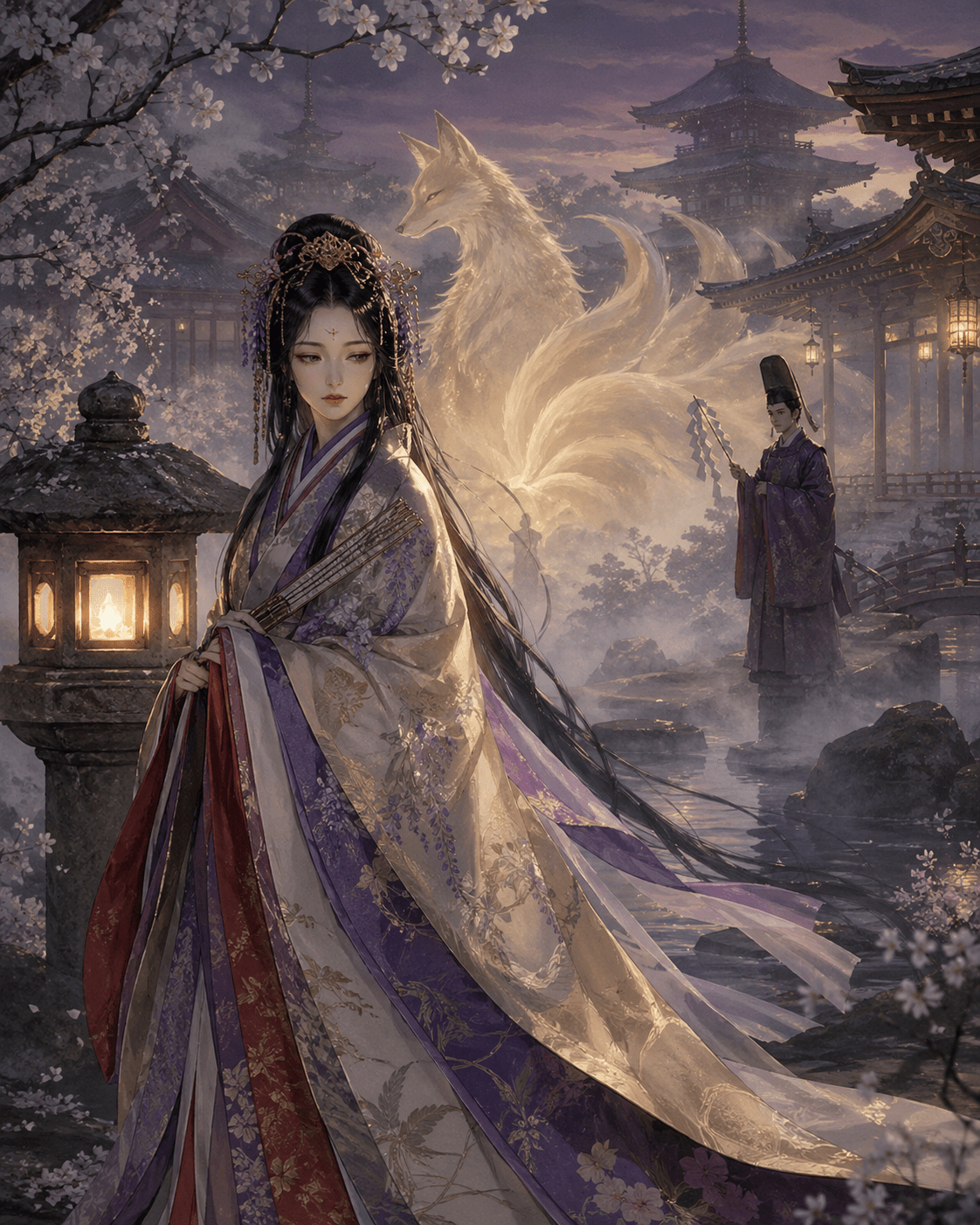
Another famous figure is Tamamo-no-Mae.
She appears in legend as a woman of extraordinary beauty and intelligence. She enters the imperial court, where refinement, poetry, politics, and ritual shape the highest levels of society. But Tamamo-no-Mae is not only beautiful. She is brilliant. She seems to know everything: literature, music, statecraft, spiritual matters. Her presence fascinates those around her.
Eventually, she gains the favor of the emperor.
Then illness comes.
The emperor grows weak, and no ordinary explanation seems enough. Diviners and spiritual specialists are consulted. At last, Tamamo-no-Mae is accused of being the cause. Her true form, it is said, is not human at all, but a kyūbi no kitsune—a nine-tailed fox.
In East Asian folklore, the nine-tailed fox is a powerful and ambiguous being. It may represent seduction, intelligence, danger, transformation, or the fear of hidden influence. The fox is not frightening because it is ugly. It is frightening because it is beautiful, clever, and impossible to read.
When Tamamo-no-Mae is exposed, she flees. Eventually she is hunted down and killed. But her story does not end with death. Her spirit is said to enter a stone known as the Sesshō-seki, or Killing Stone. Any living creature that approaches it dies.
Modern readers may recognize that places associated with poisonous gases or dangerous volcanic activity could easily give rise to such legends. A stone near which birds, animals, or people grew sick would naturally become a place of fear. Folklore gave that danger a story. The invisible poison became the lingering curse of the fox.
But symbolically, Tamamo-no-Mae is also a story about suspicion.
What happens when beauty is feared?
What happens when intelligence becomes threatening?
What happens when influence at court is explained as enchantment rather than politics?
The nine-tailed fox reminds us that societies often turn anxiety into a figure. A woman too beautiful, too knowledgeable, too influential may become, in legend, something not quite human.
Tamamo-no-Mae is frightening, but she is also revealing.
She shows us how fear often gathers around those who cannot be easily controlled.
Perhaps the most haunting of these tales is that of Emperor Sutoku.
Unlike many yokai, Sutoku was not born as a monster in legend. He was a real historical emperor, born in the late Heian period, a time of political instability and courtly conflict. He became emperor as a child, but his later life was marked by power struggles, defeat, and exile.
After losing in the Hōgen Rebellion, Sutoku was sent far from the capital. There, cut off from political power and the world he had known, he copied Buddhist scriptures by hand. The act of copying sutras was often understood as a religious practice, a way of calming the mind, accumulating merit, and praying for the dead.
Sutoku reportedly hoped to offer the completed scriptures to a temple in Kyoto.
But they were refused.
The fear was that the scriptures might contain a curse. To be rejected in this way—after years of labor, exile, grief, and prayer—must have felt like a final humiliation. Legend says that Sutoku, overcome with rage, bit his tongue, used his own blood to write words of vengeance, and died with hatred in his heart.
After his death, disasters and political troubles were interpreted by some as signs of his wrath. He came to be feared as one of Japan’s great onryō, or vengeful spirits. In some traditions, he was even said to have become a tengu, a powerful supernatural being associated with mountains, pride, and spiritual danger.
The story of Sutoku is frightening not because of a sudden apparition, but because of its emotional weight.
A person loses power.
He is exiled.
He turns to religious devotion.
Even that devotion is rejected.
His grief has nowhere to go.
So the culture gives it a form: a vengeful spirit.
From a psychological perspective, Sutoku’s legend shows how unresolved injustice can haunt a society. When political wounds are not healed, they return as stories. When grief is not acknowledged, it becomes a ghost.
The lesson is not that every misfortune is caused by a curse.
Rather, the tale suggests that what a society refuses to mourn may return in another form.
“Fear becomes wisdom when we dare to listen to what it is trying to protect.”
This affirmation does not ask us to worship fear. It asks us to listen to it carefully. In folklore, fear often guards a boundary: between the sacred and the ordinary, the remembered and the forgotten, the powerful and the powerless, the living and the dead.
To understand these legends, it helps to know that Japanese tradition has long contained ideas of jujutsu, often translated as magic, sorcery, ritual technique, or spiritual practice. In a broad sense, jujutsu refers to actions meant to influence reality through unseen forces, ritual words, gestures, objects, or spiritual assistance.
This does not always mean evil magic. A charm for healing, a prayer for safe childbirth, a lucky wedding day, or a taboo around funerals can all belong to a wide cultural field of ritual thinking. Human beings have always used symbolic actions to face uncertainty.
Another important word is tatari. It is often translated as a curse or divine punishment, but it has a more subtle feeling. Tatari may arise when something sacred, wronged, neglected, or improperly treated becomes dangerous. It is not always simple malice. It is closer to the idea that imbalance demands recognition.
The concept of goshintai is also important. A goshintai is a sacred object that serves as the dwelling place or symbol of a deity. In Japanese religious culture, a sword, mirror, stone, tree, or mountain may become a focus of reverence. It is not “just an object.” It is an object that gathers presence.
This helps explain why swords and stones in Japanese folklore often feel alive. They are not merely tools or scenery. They are containers of memory, danger, prayer, and awe.
In these stories, the boundary between object and spirit is thin.
A sword can remember.
A stone can warn.
A mountain can hold silence.
A weapon can become sacred when it is no longer used.
Why are we still drawn to stories of cursed swords, hidden treasures, demons, fox spirits, and vengeful ghosts?
One answer is that these stories allow us to look at fear from a safe distance.
A nameless anxiety is difficult to endure. But when fear becomes a demon on a mountain, a fox in the palace, a sword in a shrine, or a spirit in exile, it becomes something we can speak about. We can gather around it. We can retell it. We can ask what it means.
Folklore gives fear a body.
It also preserves the emotional history of a culture. Political losers may become spirits. Dangerous places may become cursed stones. Powerful weapons may become sacred objects. Outsiders may become monsters or heroes depending on who tells the story.
In this sense, folklore is not the opposite of truth. It is another way of storing truth—not always factual truth, but emotional, social, and symbolic truth.
A ghost story may not prove the existence of ghosts.
But it may reveal the existence of grief.
A cursed sword may not truly thirst for blood.
But it may reveal how violence clings to reputation.
A demon may not live on the mountain.
But the mountain may still hold the memory of those cast out.
This is why old stories continue to matter. They speak in images where ordinary language fails.
One way to read these mysterious Japanese tales is as a lesson in attention.
Ryōmen Sukuna reminds us to question who gets called a monster. Kusanagi-no-Tsurugi teaches that some sacred things must be approached with restraint. Ame-no-Sakahoko suggests that power becomes wisdom when it is turned away from violence. Muramasa warns that repeated stories can become a kind of curse. Yokai reveal that fear often hides loneliness, injustice, desire, or memory beneath its frightening face.
In modern life, our fears may look different. We may not speak of sacred swords or fox spirits. But we still live with rumors, inherited anxieties, family silences, misunderstood people, places we avoid, memories we do not name, and grief that has not found a language.
A strange folktale does not tell us exactly how to live.
It does something quieter.
It asks us to pause before judging.
To listen before dismissing.
To approach mystery with humility.
To remember that what frightens us may also be asking to be understood.
The lesson is not to fear the dark.
The lesson is to ask what the dark has been holding for us.
What fear in your own life might be asking not to be destroyed, but to be understood?
“Fear becomes wisdom when we dare to listen to what it is trying to protect.”
Scary folklore gives shape to nameless fear. By turning anxiety into demons, fox spirits, cursed swords, or sacred objects, people can speak about grief, danger, injustice, and uncertainty in symbolic form. These stories may not prove the supernatural, but they reveal emotional truths.
This story may remind us that fear is not always something to destroy. Sometimes fear protects a boundary, preserves a memory, or points toward something unresolved. Wisdom begins when we stop dismissing fear and begin asking what it is trying to show us.
What fear in your own life might be asking not to be destroyed, but to be understood?