Wonderful Proverbs Journey

検索結果

「 Japanese ghost story with moral lesson 」の検索結果
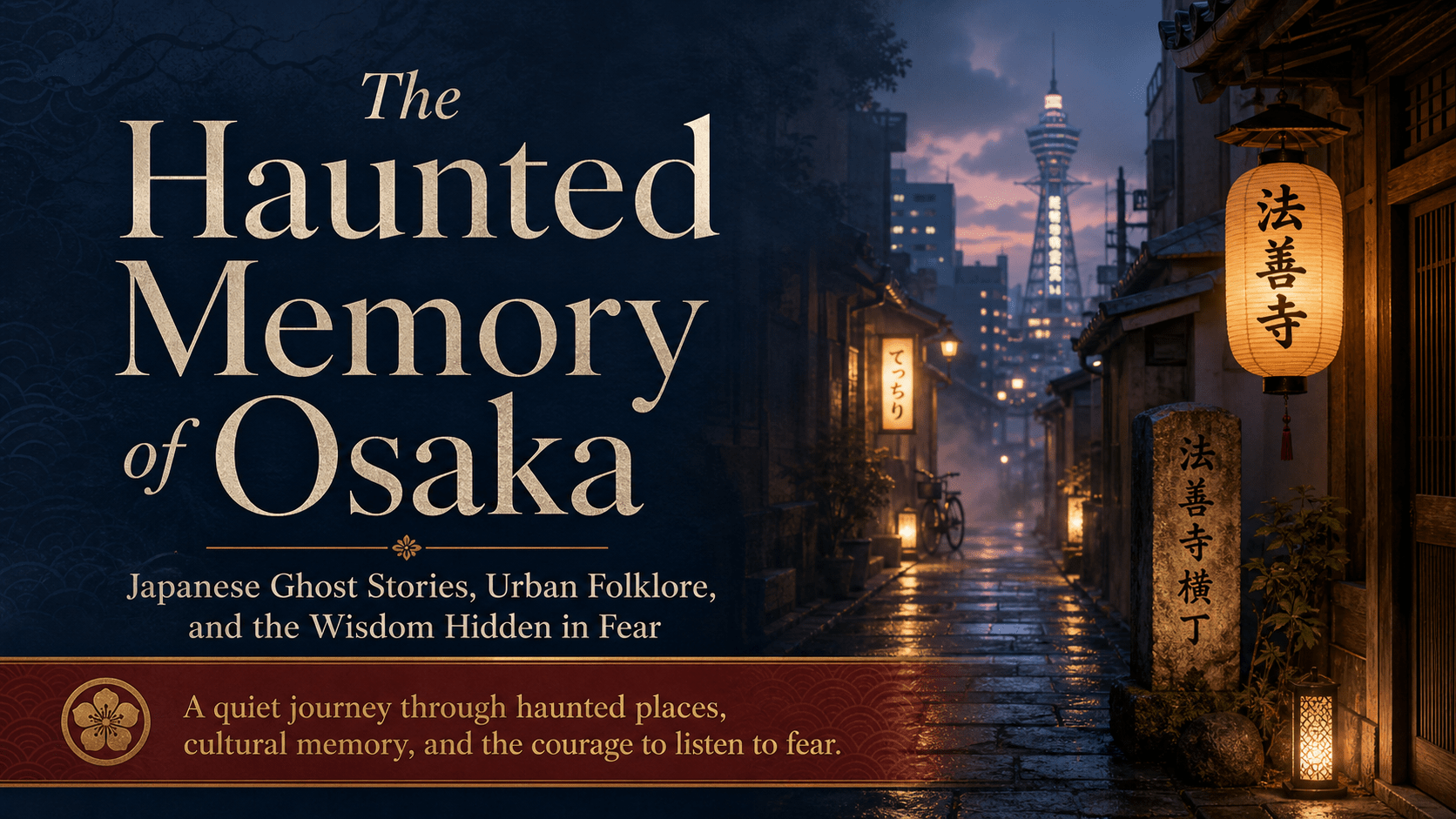
  • The Haunted Memory of Osaka A Japanese Ghost Story About Fear, Fire, and Wisdom
    ※This site uses affiliate advertising.Some ghost stories are not born from ancient castles or lonely mountain roads. Some are born in the middle of a city, beneath neon signs, train lines, department stores, and the ordinary footsteps of people going home.Osaka is often imagined as lively, humorous, and bright: a city of food stalls, comedy, shopping streets, and late-night lights. But like every old city, it has places where memory seems to gather more heavily. These are not simply “haunted spots” in the cheap sense of the word. They are places where tragedy, rumor, respect, and fear have become tangled together.Two stories from Osaka are often spoken of in this way: the former site of the Sennichi Department Store fire in Namba, and the so-called “Hanging Ruins” hidden in Shinsekai. One is connected to a documented disaster. The other belongs more to urban legend, rumor, and the uneasy silence of abandoned places.Taken only as horror, these stories may disturb us. But read more gently, they also reveal something deeper: how cities remember, how fear becomes folklore, and how human beings try to give meaning to places marked by suffering.Story Part One: The Sennichi Department Store Fire and the Voices Beneath NambaIn the busy Namba area of Osaka, there stands a large electronics store today. Shoppers pass through its doors, escalators carry people upward, and the city moves with its usual speed. Yet before this modern building, another structure stood on the same site: the Sennichi Department Store.From the late 1950s until the early 1970s, the building was a lively seven-story commercial space. There were shops, clothing floors, a game center, cafés, and on the top floor, a nightclub-like cabaret called Playtown. On the roof, there had even been amusement facilities. It was the kind of place that captured the energy of postwar urban Japan: busy, layered, crowded, and full of desire for modern entertainment.But on the night of May 13, 1972, that brightness changed.A fire broke out around 10:27 p.m. near the third floor. Reports and later accounts have discussed possible causes, including electrical work or an improperly extinguished cigarette or match; the precise origin has often been described with some uncertainty. What is clear is that the fire spread quickly through flammable materials. Smoke rose. The building’s safety problems became deadly. The site had no sprinkler system, and failures in evacuation routes and fire-prevention systems contributed to the disaster. The seventh-floor Playtown cabaret was still open, filled with customers and staff. The official record of the disaster is devastating: 118 people lost their lives.In the years afterward, the building was eventually demolished. A new department store opened there, and later, the site became the large electronics store known today. But according to urban legend, the story did not end with demolition.Employees and visitors have spoken, over the years, of strange announcements after closing time. Some stories describe voices over the loudspeakers warning of fire, though no fire existed. Others tell of elevators stopping at floors no one selected, the doors opening into a silence broken by distant cries for help. There are rumors of footsteps on stairways, women in kimono appearing near restrooms, and unseen hands pressing down on the shoulders of workers late at night.Some versions of the legend even say that when trains pass beneath the area, passengers have heard faint voices calling from somewhere below.Of course, these stories should not be treated as proven supernatural events. They are better understood as urban folklore: a way for the living to speak about a place where many people died suddenly, in fear and confusion. The ghost, in this sense, may not be only a spirit. It may be memory itself.In Japan, places of tragedy are often approached with a certain seriousness. People may leave flowers, pray, bow, or simply lower their voices. The act is not always religious in a formal sense. Sometimes it is a gesture of human respect. To remember is to say: what happened here still matters.Key Quote: A Proverb for Fear and Memory“Where there is shadow, there is also something asking to be remembered.”This is not an old proverb, but it carries the spirit of one. Fear often points toward something hidden: grief, guilt, uncertainty, or an unfinished story. A haunted place may frighten us, but it may also ask us not to look away too quickly.Story Part Two: The Hanging Ruins of ShinsekaiThe second story leads us away from the bright retail world of Namba and into the older atmosphere of Shinsekai.Shinsekai means “New World,” a name full of irony and history. Built as a modern entertainment district in the early twentieth century, it has long been associated with theaters, food stalls, cheap bars, glowing signs, and the famous Tsutenkaku Tower. It is not a forgotten village or a remote haunted forest. It is a living neighborhood.And yet, hidden in its alleyways, there is said to be a strange ruin.The place is commonly nicknamed Kubitsuri Haikyo, often translated as “the Hanging Ruins.” Kubitsuri means hanging by the neck, while haikyo refers to ruins or an abandoned place. The name is not official. It belongs to rumor, blogs, videos, and the kind of local storytelling that gathers around unsettling places.According to the stories, the ruin was once a four-story building, later damaged by fire until only a skeletal frame remained. After the fire, someone working nearby noticed something hanging from the remains of the structure. Police were reportedly called, and the object was said to have been a human body. In some tellings, shoes were found hanging nearby. Later, another hanging figure was discovered, then another. The details vary depending on who tells the story, and it is difficult to confirm every element. Some versions suggest suicide; others leave the possibility darker and more uncertain.What makes the place especially unsettling is not only the story, but the setting. Many abandoned buildings are far away, swallowed by mountains or countryside. This one, according to those who have visited, stands in the middle of the city, hidden in plain sight. Rusted metal, exposed stairways, and an unstable frame remain close to ordinary streets where people eat, drink, and walk home.That contrast gives the legend its power.A ruin in the wilderness feels separate from daily life. A ruin in the city suggests that darkness can stand beside us quietly while life continues around it. People may pass within a few meters without noticing. Laughter from a nearby bar may drift through the same air as a place associated with death.Some visitors have also mentioned a cat living around the ruin, almost like an accidental guardian. In folklore, cats often occupy the border between the ordinary and the uncanny. They move through alleys, rooftops, and thresholds. Whether or not one believes in omens, the image is memorable: a silent cat watching over a place that people approach with fear.The Hanging Ruins story is best handled carefully. It involves possible deaths, mental suffering, and urban rumor. It should not be treated as entertainment alone. If the tale has meaning, it may lie in the uncomfortable reminder that suffering can be close by, even in the busiest parts of a city, and that abandoned places often become mirrors for abandoned feelings.Cultural Insight: Ghosts, Place, and Respect in Japanese Urban FolkloreJapanese ghost stories often place great importance on location. A bridge, a tunnel, a stairway, a school, a hospital, a shrine, a train station—these are not just settings. They are containers of memory.In many Japanese traditions, the boundary between the living and the dead is not always imagined as completely sealed. This does not mean that every strange sound is treated as a ghost. Rather, it means that places associated with strong emotion may be approached with care. Grief, resentment, sudden death, and unfinished longing can become part of how a place is remembered.This is why urban legends often grow around sites of disaster. They give language to something difficult to process. A documented tragedy becomes surrounded by stories: voices, shadows, repeated warnings, elevators that stop on the wrong floor. These details may not prove the supernatural, but they reveal how people continue to feel the presence of the past.There is also a cultural lesson in the practice of paying respects. In Japan, even a small shrine, a quiet bow, or a moment of silence can express the idea that the dead should not be reduced to a spectacle. This matters especially when ghost stories are shared online. The more tragic the origin of a legend, the more carefully it should be told.Psychological Reflection: Why We Are Drawn to Scary StoriesWhy do people continue to tell stories like these?Perhaps because fear gives shape to what we cannot easily say. A ghost story lets us approach grief from a safe distance. It gives anxiety a face, memory a voice, and silence a setting.Urban legends are especially powerful because they live close to daily life. A haunted castle can feel like fantasy. A haunted elevator, restroom, stairwell, alley, or train line feels much nearer. It suggests that mystery is not far away. It may be folded into the ordinary.But the deeper purpose of such stories may not be to make us believe in ghosts. It may be to make us listen more carefully. When people say they hear voices in a building where many died, the story may be expressing a collective fear: the fear that suffering will be ignored, that the dead will become statistics, that tragedy will be paved over by commerce and routine.Folklore turns private unease into shared reflection. It allows a community to say, indirectly: something happened here, and we have not entirely forgotten.Life Lesson: Fear as a Form of AttentionOne way to read these Osaka ghost stories is not as proof of spirits, but as lessons in attention.Fear is not always an enemy. Sometimes fear is the mind’s way of saying: slow down. Notice where you are. Notice what happened before you arrived. Notice the pain that may be hidden beneath the surface of ordinary life.In modern life, we often move quickly. Buildings are demolished, businesses change, streets are renamed, and new lights cover old shadows. But memory does not always disappear at the same speed as architecture.These stories may remind us that respect is a form of wisdom. To stand in a place of tragedy without mockery, to speak of the dead without turning them into entertainment, to recognize that every city is built not only from concrete and glass but also from memory—these are quiet acts of maturity.The lesson is not simply “do not enter haunted places.” It is gentler than that.It may be this: when fear appears, ask what it is protecting. Sometimes fear guards a wound. Sometimes it guards a truth. Sometimes it guards the memory of people who should not be forgotten.Reader Reflection: The Question the Story Leaves BehindWhen an old story frightens you, what might it be asking you to remember?Perhaps the real mystery is not whether a ghost appeared in the dark. Perhaps the real mystery is why certain places continue to speak to us, long after the city has tried to move on.Key Proverb, Quote, or Affirmation Used“Where there is shadow, there is also something asking to be remembered.”Cultural Insight SummaryJapanese urban ghost stories often treat places as containers of memory. A haunted building, stairway, tunnel, or train line may symbolize grief, unfinished emotion, or collective unease. In stories connected to real tragedies, respect matters: the dead should not be reduced to entertainment.Psychological / Philosophical Reflection SummaryWe are drawn to scary stories because they give form to nameless anxiety. A ghost story allows people to approach grief, uncertainty, and memory from a safe distance. Rather than proving the supernatural, such stories often reveal how communities live with unresolved pain.Life Lesson SummaryThis story may remind us that fear is sometimes a form of attention. It asks us to slow down, respect what came before us, and listen to what ordinary places may be quietly carrying.Reader Reflection QuestionWhat fear in your own life might be asking to be understood rather than avoided?
    Read More
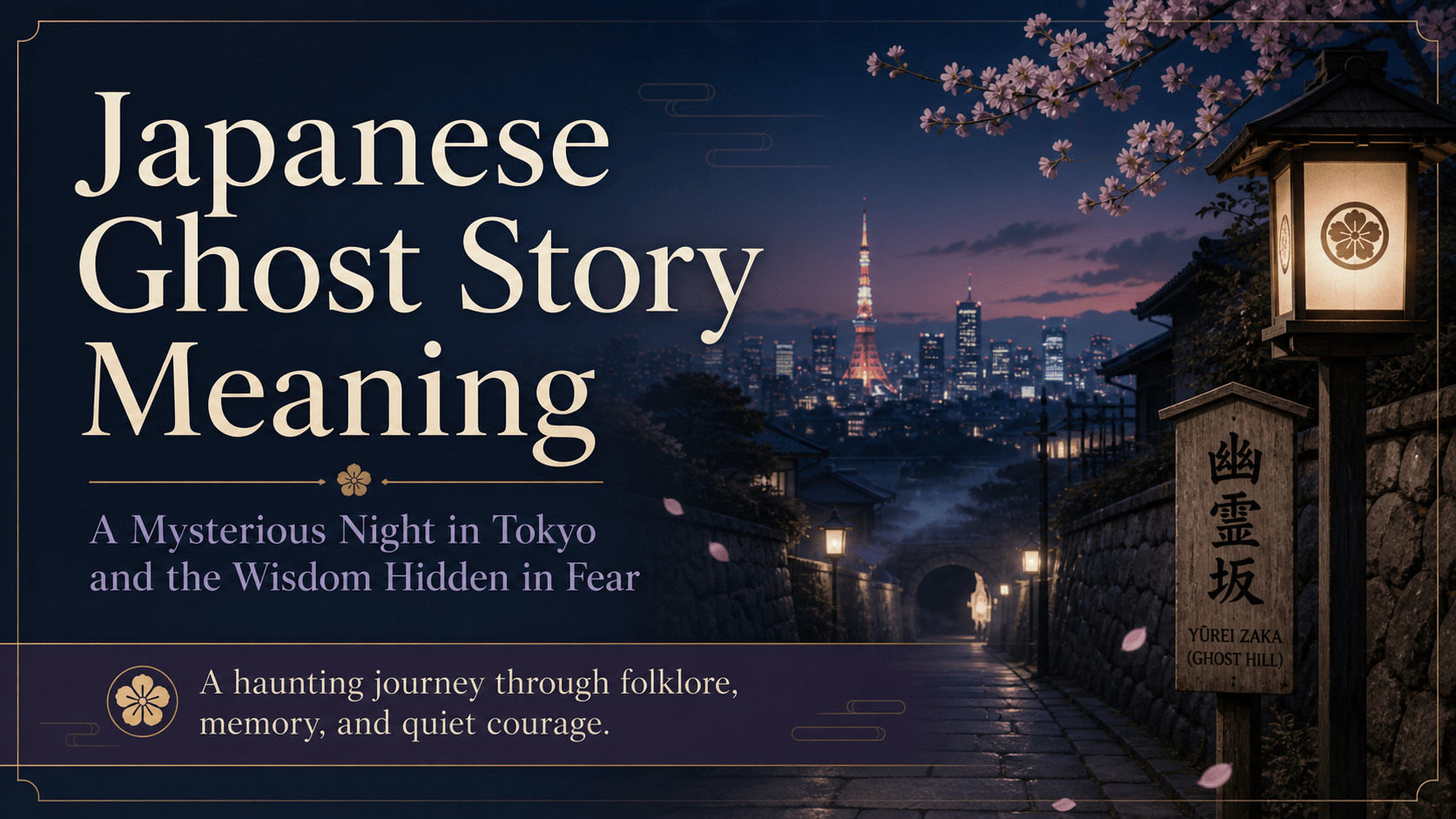
  • Japanese Ghost Story Meaning: A Mysterious Night in Tokyo and the Wisdom Hidden in Fear
    ※This site uses affiliate advertising.Tokyo is often imagined as a city of neon, trains, convenience stores, and restless movement. Yet beneath its bright surface, there are quieter places where the past seems to breathe more slowly: old cemeteries, narrow slopes with strange names, tunnels where yellow lights flicker against damp concrete.This is not a story that proves ghosts exist. It is better understood as a modern piece of mysterious folklore — a night journey through places in Tokyo where memory, fear, humor, and cultural imagination meet.The tale begins like many contemporary urban legends: with curiosity, a little fear, a friend who may or may not believe, and a phone app that claims to detect spirits. But beneath the playful ghost hunting lies something older and more human. Why do certain places feel heavy? Why do stories gather around graves, hills, and tunnels? And why do we keep walking into the dark, even when we say we are afraid?This strange Japanese ghost walk is less about finding a ghost than about listening to what fear reveals.The Story: Three Haunted Places in TokyoThe night began with a simple idea: if one wanted to look for ghosts in Tokyo, one should go after dark.There was research, of course. Lists of haunted places. Stories passed around online. A few names that appeared again and again in conversations about Tokyo’s urban legends. And because no modern ghost hunt feels complete without technology, a ghost-hunting app was downloaded — one that claimed to scan the room, measure strange frequencies, and detect unseen presences.Whether the app truly measured anything supernatural was another question. But in stories like this, belief is rarely pure. It often begins as a joke, grows into suspense, and then, somewhere in the quiet, becomes harder to dismiss.Before the hunt began, there was one important stop: food. Fear is easier to face on a full stomach.At the restaurant, the narrator met her friend, who seemed only partly aware of what the night would involve. The conversation soon turned to ghosts. Neither had seen one clearly, but both had heard stories. One friend remembered a building in Akasaka said to be haunted — a place where people whispered about sudden deaths, strange winds, doors opening by themselves, and residents waking in the night with the feeling that something had pulled them from the bed.The details were uncertain. The sources were difficult to verify. Like many urban legends, the story seemed to live somewhere between rumor, memory, and the uneasy imagination of those who had passed through the place. Yet that is often how city folklore works. It does not always need official proof to survive. It attaches itself to buildings, neighborhoods, and silences.After dinner, the ghost hunt began.Aoyama Cemetery: The Quiet of Names and BlossomsThe first destination was Aoyama Cemetery.By day, it is not only a cemetery but also a well-known place for cherry blossoms. In spring, pale petals fall over stone graves, and the boundary between beauty and sorrow becomes almost invisible. The cemetery is also known for graves connected to foreign advisors and historical figures from Japan’s modernizing years.At night, however, the atmosphere changes.The paths seemed longer in the dark. Trees leaned in strange shapes. Every small sound carried too much weight. A branch shifting in the wind could feel like a footstep. A shadow could become a figure if one looked at it too quickly.The two women walked deeper into the cemetery, half laughing, half frightened. One tried to joke about Bloody Mary, the mirror-based ghost ritual known in many Western childhood legends. The other immediately wanted nothing to do with it. There are fears we enjoy from a distance, and fears we refuse to invite closer.No ghost appeared. No dramatic sign came from the dark.Instead, they found something more tender: the grave of Hachikō, the famous loyal dog, and his owner, Professor Hidesaburō Ueno.Hachikō’s story is deeply loved in Japan. Every morning, he accompanied his owner to Shibuya Station. Every evening, he returned to wait for him. But in 1925, Professor Ueno died suddenly and never came home. Even after Hachikō was taken in by others, he continued to wait at the station, day after day, year after year.In the cemetery, offerings had been left: flowers, coins, and dog treats. The grave felt less like a place of horror than a place of devotion. In the middle of a ghost hunt, the night had offered a different kind of haunting — not fear, but loyalty.The dead are not only remembered because they frighten us. Sometimes they remain with us because they loved, waited, and were loved in return.Ghost Hill: A Name the City Could Not EraseThe second destination was a slope known as Yūrei-zaka, often translated as “Ghost Hill” or “Ghost Slope.”Tokyo has several slopes with old names connected to ghosts, temples, graves, or strange local legends. Some neighborhoods have softened or changed such names over time, perhaps because few people want to live beside a place openly called “Ghost Hill.” Yet names have a way of preserving what official maps sometimes try to smooth over.This slope remained.The street itself did not look terrifying. Houses stood nearby. Lights glowed in windows. Cars were parked. It was not the abandoned, cinematic kind of haunted place one might expect. And yet the quiet felt unusually thick.Around the area were temples and graveyards, reminders that Tokyo is not only a city of the present. It is built in layers. Under the apartment buildings, roads, cafés, and convenience stores are older patterns of belief, burial, prayer, and memory.The ghost-hunting app was opened again.At first, the reading was low. Nothing strange. Nothing to report.Then, near one graveyard, the reading rose. The screen changed. The numbers climbed. When they stepped away, the reading fell. When they returned, it rose again.Was it electromagnetic interference? A coincidence? A phone reacting to ordinary urban signals? Very possibly. But the experience changed the mood. Even the skeptic becomes quieter when a machine appears to confirm what the imagination has already begun to suspect.The women laughed, but less loudly than before.Ghost Hill did not need a visible apparition to feel haunted. Its power was in the name, the silence, and the awareness that many generations had passed through that same slope, carrying fears of their own.A place can be haunted by stories as much as by spirits.Sendagaya Tunnel: The Weight Above the RoadThe final destination was Sendagaya Tunnel.Tunnels often attract ghost stories. They are thresholds — neither here nor there, neither open sky nor fully enclosed room. To enter a tunnel at night is to pass briefly into a narrow world of echoes, headlights, stains, and strange acoustics. Every sound changes inside it.This tunnel was said to have a cemetery above it, a detail that often appears in the ghost stories told about the place. Some tales speak of figures appearing suddenly, including an elderly man who vanishes when approached. Other stories are less specific: a feeling of being watched, a coldness, a presence near the walls.Again, these are stories, not verified facts. But folklore does not always ask us to treat it as evidence. Sometimes it asks us to notice what people choose to remember.The tunnel was not empty. Cars passed through, loud and ordinary. The noise made it difficult to feel completely alone. Graffiti marked the walls. Yellow lights gave the concrete an uneasy glow. At one point, a strange symbol on the wall seemed to resemble a triangle with an eye. Someone joked about secret societies. Then, almost absurdly, the sight of a nearby McDonald’s broke the tension.That mixture — fear, laughter, superstition, modern city life — is part of what makes urban legends so enduring. A haunted tunnel does not need to be far from daily life. It can exist beside traffic lights, chain restaurants, and pedestrians on their way home.The night ended without a confirmed ghost.But perhaps that was never the true point.What the journey revealed was how easily ordinary places become mysterious when we enter them with attention. A cemetery becomes a meditation on loyalty. A slope becomes a vessel for old names. A tunnel becomes a symbol of crossing from certainty into uncertainty.The ghosts may or may not have been there.The stories certainly were.Key Proverb / Affirmation: Courage Is Not the Absence of FearAffirmation:I do not need to banish fear; I can walk with it, listen to it, and still move forward.Fear is often treated as something to defeat. But many old stories suggest a quieter wisdom: fear is not always an enemy. Sometimes it is a messenger. It tells us where memory lives, where uncertainty begins, and where we are being asked to pay attention.A proverb-like way to express the lesson might be:“The brave do not walk without fear; they walk while listening.”This does not mean we should seek danger or believe every rumor. Rather, it suggests that courage can be calm, curious, and reflective. In the ghost walk through Tokyo, fear did not lead to panic. It led to observation — of graves, names, offerings, silence, and the emotional weight of place.Cultural Insight: Why Japanese Ghost Stories Belong to PlacesIn many Japanese ghost stories, the spirit is not only a figure but also an atmosphere. A haunting may belong to a bridge, a well, a slope, a tunnel, a room, or a tree. Place matters.This reflects a broader cultural sensitivity to memory embedded in location. Temples, cemeteries, roadside shrines, and old place names often preserve traces of the past in daily life. Even in a modern city like Tokyo, the sacred and the ordinary can stand side by side.A street may be lined with homes and still carry an old ghostly name. A cemetery may be a cherry blossom spot and also a place of mourning. A tunnel may be part of a traffic route and still inspire stories about what lingers above or within it.Japanese folklore often uses such places as thresholds. They are not simply “scary.” They remind us that human life is layered: joy and grief, modernity and memory, skepticism and belief.This is why a ghost story can become a form of cultural insight. It reveals not only what people fear, but what they remember.Psychological Reflection: Why We Walk Toward What Frightens UsWhy are we drawn to scary stories?One answer is that fear becomes easier to face when it has a shape. A nameless anxiety inside the mind can feel unbearable. But when it becomes a ghost story, a haunted hill, or a tunnel legend, we can stand outside it for a moment and look at it.Folklore gives fear a language.The Tokyo ghost walk is filled with laughter, skepticism, nervous jokes, and sudden seriousness. This is psychologically familiar. People often approach fear indirectly. We joke because we are uncomfortable. We test our courage because we want to know our limits. We visit eerie places because controlled fear can make hidden emotions visible.Rather than proving the supernatural, a story like this reveals how people live with uncertainty. The ghost app may be unreliable. The rumors may be unverifiable. The shadows may simply be shadows. And yet the emotional experience is real.Fear, even when mistaken, tells us something true about the human mind.Life Lesson: Listen to the Places That Make You UneasyOne way to read this story is not as a warning against darkness, but as an invitation to listen more carefully.In modern life, we often rush past uncomfortable feelings. We rename them, distract ourselves from them, or cover them with noise. Yet the old name of Ghost Hill remains meaningful precisely because it was not fully erased. It suggests that what frightens us may still deserve a name.Fear does not always ask us to run. Sometimes it asks us to notice.What place in your life feels like a tunnel — narrow, uncertain, echoing with things you do not fully understand? What memory feels like a cemetery — quiet, painful, but also worthy of respect? What old name have you tried to replace with something easier?This story may remind us that courage is not always dramatic. Sometimes courage is walking through a quiet place with open eyes, admitting that we are afraid, and allowing that fear to deepen our understanding rather than close our hearts.The lesson is not to believe every ghost story.The lesson is to recognize that even fear can become wisdom when we are willing to listen.Reader ReflectionThe next time a place, memory, or feeling unsettles you, ask yourself gently:What is this fear trying to protect, remember, or reveal?Perhaps the real mystery is not whether something waits in the dark, but what awakens within us when we choose to keep walking.Key Proverb, Quote, or Affirmation UsedAffirmation:I do not need to banish fear; I can walk with it, listen to it, and still move forward.Proverb-like line:“The brave do not walk without fear; they walk while listening.”Cultural Insight SummaryJapanese ghost stories often connect spirits, memory, and emotion to specific places such as wells, bridges, slopes, cemeteries, tunnels, and old houses. In this article, Tokyo is presented not only as a modern city but as a layered cultural landscape where old names, graves, offerings, and urban legends preserve traces of the past.Psychological / Philosophical Reflection SummaryWe are drawn to scary stories because they give shape to vague anxiety. A ghost story allows people to approach fear safely, with humor, curiosity, and reflection. Whether or not the supernatural is real, the emotional response reveals something true about how humans live with uncertainty.Life Lesson SummaryThis story may remind readers that fear does not always need to be conquered or denied. Sometimes fear asks to be heard. It can point toward memory, intuition, grief, respect, or unresolved questions. Courage is not the absence of fear, but the willingness to keep walking with awareness.Reader Reflection QuestionWhat fear in your own life might be asking to be understood rather than avoided?
    Read More
  • A Mysterious Japanese Ghost Story: Fear, Folklore, and the Wisdom Hidden in Kyoto’s Haunted Places
    ※This site uses affiliate advertising.A Strange Tale from the Old Roads of KyotoKyoto is often imagined as a city of quiet temples, maple leaves, vermilion gates, and old wooden streets where the past still seems to breathe. For many travelers, it is the cultural heart of Japan: a former capital, home to shrines, gardens, Buddhist temples, and UNESCO World Heritage sites.Yet in Japanese folklore, places of beauty are not always free from shadow.Among the mountains and narrow roads on the edge of Kyoto, certain locations have gathered a different kind of reputation. They are not famous only for history or scenery, but for stories whispered after dark: a tunnel where drivers claim to feel unseen eyes, a pond associated with sorrowful apparitions, and a shrine whose silence at 3 a.m. feels almost too deep to enter.These are not stories to be treated as proven supernatural events. They belong more properly to the world of urban legend, local memory, and mysterious folklore. But that does not make them meaningless. In many cultures, ghost stories preserve emotions that ordinary history leaves behind: grief, fear, guilt, loneliness, and the human need to give shape to the unknown.This article retells one such journey through Kyoto’s haunted edge—not simply as a scary story, but as a strange tale with hidden wisdom about fear, silence, and the courage to face what we do not fully understand.The Tunnel, the Pond, and the Shrine at NightThe road toward the old tunnel does not announce itself dramatically. It is not a place of thunder or cinematic darkness. Its unease is quieter than that.The city thins. The lights become fewer. The road narrows as it moves toward the wooded edges of Kyoto, where the mountains press closer and the air seems to change. Even before the tunnel appears, the atmosphere suggests transition. Behind you lies the known world of convenience stores, train stations, and evening traffic. Ahead lies a narrower road, a deeper silence, and the kind of darkness that makes every sound feel intentional.The place is commonly associated with Kiyotaki Tunnel, a single-lane tunnel in the area connecting northern Arashiyama with the neighboring region of Sagakiyotaki. In local legend, the tunnel has long carried a reputation for misfortune and strange sightings. It is said to have once been part of the Atagoyama Railway, constructed in the late 1920s, and stories about its past often mention accidents, harsh labor, and deaths connected with the surrounding area.Whether these details are historically precise or shaped by retelling, the result is the same: the tunnel has become a vessel for unease.In Japanese ghost lore, places like tunnels often become symbolic thresholds. They are not merely roads through stone. They are passages between worlds: daylight and darkness, safety and uncertainty, ordinary life and the realm of rumor. To enter such a place at night is to feel, if only for a moment, that the modern world has become thin.The legends surrounding the tunnel vary. Some say that its length is unlucky, sometimes rumored to be 444 meters, a number that sounds ominous in Japanese because the number four can be read as shi, a sound associated with death. Others speak of mirrors near the tunnel entrances, warning that a driver who sees something unnatural reflected there may invite misfortune.There are also tales of traffic lights changing without warning late at night, causing fear among those who must enter the single-lane passage. Some stories mention a woman in white who appears near the tunnel or throws herself onto the hood of a waiting car. Others describe sudden dizziness, nausea, headaches, or the sound of a woman’s scream coming from the trees.A skeptical reader may see these as the natural products of darkness, road stress, echo, expectation, and suggestion. A believer may hear something else. Folklore usually lives between those two responses. It does not demand that every listener believe. It asks only that we notice what fear does to the human mind when a place becomes heavy with stories.After the tunnel, the journey continues toward another site of mystery: Midorogaike, often translated as Midoro Pond or Midori Pond in informal retellings. Located in Kyoto, it is known not only for eerie legends but also for its unusual natural environment. The pond has been described as an important habitat, with rare plants and ecological value. In daylight, such a place may seem quiet, green, and scientifically interesting. But at night, the same water can feel like a dark mirror.According to one well-known urban legend, a taxi driver in Kyoto once picked up a woman dressed in white. Her hair was long and black, and she requested to be taken to the pond. The drive was long, leading away from the bright streets toward a more desolate edge of the city. When the taxi finally arrived and the driver turned to speak to his passenger, she was gone.Only a small object remained behind—sometimes told as a bottle of water, sometimes as another quiet token, depending on the version of the story.The vanishing passenger is a familiar figure in ghost folklore around the world. In Japan, as elsewhere, taxi ghosts often represent unresolved sorrow, a life interrupted, or a soul still trying to reach a destination. What makes the Kyoto version especially haunting is the setting: a pond already surrounded by stories of drowning, disappearance, and grief.Some local tales claim that bodies lost in the pond do not easily return. Others suggest that the water has depths or hidden places that make it feel bottomless, even if practical reports describe much of it as shallow. In folklore, physical depth and emotional depth often blend together. A pond does not need to be truly bottomless to feel bottomless to the human imagination.Visitors have described sensations of sadness near the water, as if the place itself remembers. Stories speak of ghostly hands, tugged clothing, figures appearing at the center of the pond, and a sorrow so thick it seems to rise from below the surface.Whether one interprets these stories as supernatural, symbolic, or psychological, the emotional pattern is clear. The pond becomes a place where grief gathers. It is not merely frightening because something may appear. It is frightening because it suggests that some sorrows do not vanish; they remain in the landscape, waiting for language.The final part of the journey takes place at a shrine after midnight—around 3 a.m., when even familiar places can feel unfamiliar.A shrine in Japan is not simply a scenic spot. It is a sacred space, often connected with kami, the spirits or divine presences honored in Shinto tradition. During the day, shrines may be filled with visitors, prayers, camera shutters, children, bells, and the soft movement of people passing beneath torii gates. But at night, especially in rain, the same place changes.There are no tourists. No worshippers. No casual conversation. Only the sound of raindrops, the movement of wind, and the glow of lanterns against wet stone.The silence is not empty. It feels occupied.Standing there in the dark, one may not see a ghost at all. Yet the mind becomes alert. Every shadow gains weight. Every sound asks to be interpreted. The shrine’s solemnity becomes more visible precisely because the world around it has grown quiet.And perhaps this is the most meaningful part of the story. The tunnel frightens because it is a passage into uncertainty. The pond frightens because it reflects sorrow. The shrine at night frightens because it returns us to reverence.Together, these three places form a strange map of fear. The tunnel asks, “What are you afraid to enter?” The pond asks, “What grief have you not named?” The shrine asks, “Can you stand quietly before what is greater than you?”The answer does not need to be dramatic. Sometimes the bravest thing a person can do is not to conquer the dark, but to walk through it with humility.Key Quote / Proverb / Affirmation“Fear is not always a warning to run; sometimes it is an invitation to listen.”This is not a traditional proverb, but an original reflective affirmation inspired by the story. It fits the emotional pattern of the tale: the tunnel, the pond, and the shrine do not merely frighten us. They ask us to pay attention.Cultural Insight: Why Haunted Places Matter in Japanese FolkloreJapanese folklore often gives strong emotional meaning to places. A bridge, a tunnel, a mountain path, a pond, a shrine, or an abandoned road may become more than scenery. It may become a meeting point between human memory and invisible presence.In Shinto and broader Japanese cultural imagination, nature is rarely treated as spiritually empty. Mountains, forests, stones, old trees, water, and thresholds can carry sacred or mysterious associations. This does not mean every strange story should be accepted literally. Rather, it helps explain why certain places become powerful in the imagination.A tunnel is a threshold.A pond is a mirror.A shrine is a place of reverence.Together, they create a symbolic journey. The traveler moves from fear of the unknown, to sorrow beneath the surface, to quiet respect before mystery.The number four also adds cultural texture to the story. In Japanese, one reading of four is shi, which sounds like the word for death. Because of this, four is sometimes avoided in hospitals, hotels, or buildings, much as the number thirteen may carry unlucky associations in some Western cultures. When a tunnel is rumored to measure 444 meters, the number itself becomes part of the legend, whether or not the measurement is accurate.Japanese ghost stories often speak through atmosphere rather than direct explanation. They leave room for silence. This restraint is part of their power. The most haunting detail is not always the apparition itself, but the feeling that something unresolved remains.Psychological / Philosophical Reflection: Why We Are Drawn to Scary StoriesWe are drawn to scary stories because they allow us to approach fear without being destroyed by it.A haunted tunnel gives shape to the fear of entering the unknown. A dark pond gives shape to sorrow that cannot easily be spoken. A shrine at night gives shape to awe—the feeling that human life is small, brief, and surrounded by mysteries we cannot control.In this sense, folklore is not only entertainment. It is a form of emotional language. It turns private anxiety into a shared story. Once fear becomes a story, we can look at it from a safer distance. We can ask what it means. We can listen to it without obeying it completely.Modern life is full of invisible tunnels. We enter uncertain careers, difficult relationships, grief, aging, illness, change, and loneliness. We do not always know what waits on the other side. Old stories remind us that fear is not new. Human beings have always stood at thresholds, listening into the dark.The value of a ghost story is not that it proves ghosts exist. Its value may be that it reveals how people live with uncertainty.Life Lesson: Listening to Fear Without Letting It LeadOne way to read this tale is as a reminder that fear should neither be worshipped nor ignored.If we worship fear, we become trapped by it. Every shadow becomes a command. Every uncertainty becomes a wall. But if we ignore fear completely, we may lose touch with intuition, caution, memory, and humility.The wiser path lies somewhere between panic and denial.When the road grows narrow, we slow down.When the water looks dark, we do not pretend it is shallow.When silence feels sacred, we lower our voice.This story may remind us that courage is not always loud. Sometimes courage is the act of moving carefully, respectfully, and honestly through a place we do not understand. Sometimes wisdom begins when we stop trying to explain everything at once.Reader ReflectionWhat fear in your own life might be asking to be understood rather than avoided?Perhaps the real mystery is not whether something waits in the tunnel, under the water, or beyond the shrine gate. Perhaps the deeper mystery is why certain stories stay with us—and what they quietly ask us to face.In daily life, fear may appear before a difficult conversation, a major decision, a change we did not choose, or a grief we have delayed facing. The lesson is not to become fearless. A fearless person may simply be careless. The deeper lesson is to become attentive.Fear can distort reality, but it can also reveal what matters. It shows us where we feel vulnerable. It shows us what we value. It shows us where healing may be needed.The dark road, the silent pond, and the empty shrine all offer the same quiet teaching: do not rush past what unsettles you. Some fears lose their power when they are finally seen clearly.Key Proverb, Quote, or Affirmation Used“Fear is not always a warning to run; sometimes it is an invitation to listen.”Psychological / Philosophical Reflection SummaryScary stories help people give shape to fear. They allow us to approach anxiety, grief, and uncertainty from a safe distance. Rather than proving the supernatural, folklore reveals how human beings live with what they cannot fully explain.Life Lesson SummaryThe lesson is not to become fearless, but to become attentive. Fear may distort reality, but it can also reveal vulnerability, intuition, memory, and the need for healing. Some fears lose their power when they are seen clearly.Reader Reflection QuestionWhat fear in your own life might be asking to be understood rather than avoided?
    Read More
  • A Mysterious Japanese Ghost Story from Nara: The Yoshino River Tale and the Wisdom Hidden in Fear
    ※This site uses affiliate advertising.In the mountains of Nara Prefecture, the Yoshino River has long carried more than water. It carries family visits, summer heat, childhood play, and, in stories like this one, the uneasy silence that comes after a narrow escape.This strange tale is often told as a personal memory rather than a formal folktale: a boy goes camping with his family near the Yoshino River, nearly drowns in a calm-looking section of water, and later learns that another child drowned in the same place around the same time. The story does not prove the supernatural, nor should it be treated as a confirmed ghost account. But as mysterious folklore, it speaks powerfully about fear, coincidence, grief, and the way a single image—the blue sky above the water—can remain in the heart for a lifetime.The original account describes a family camping trip to Yoshino, a calm-looking pool formed along the river, the narrator’s sudden loss of strength while swimming, and the later discovery that another child had drowned there during a summer camp. The narrator’s family wonders whether it was coincidence, a physical shock caused by the river’s currents and temperature differences, or something more mysterious.The Blue Sky Beneath the WaterIt happened during the summer of his fifth-grade year, in that bright and careless season when childhood still feels larger than the world itself.His mother’s family lived in Yoshino, a mountainous part of Nara Prefecture known for its old roads, temple histories, and cherry blossoms that draw visitors in spring. But to a child, Yoshino was not a place of history. It was where relatives lived. It was where adults spoke in familiar dialects, where the air smelled different from the city, and where summer seemed to stretch across mountains, rivers, and cicada song.Usually, when the family visited, they stayed at his mother’s parents’ house. There would be meals prepared by his grandmother, newspapers opened by his grandfather, relatives dropping by, and the quiet boredom that sometimes comes with being a child in an adult household.But that year, someone suggested something different.They would bring camping gear.Instead of simply staying at the grandparents’ house, they would set up a tent near the Yoshino River and spend the day outdoors. For the boy, the idea felt exciting in the way only small departures from routine can feel exciting. It was not a grand adventure, but it was enough. A tent. A river. A swimsuit packed into a bag. The promise of sleeping outside, or at least pretending the familiar world had become wild for a little while.They left in the morning.The roads into Yoshino wound through green slopes and narrow valleys. The mountains seemed to fold over one another, and the river appeared and disappeared between trees, flashing silver in the sun. The boy watched from the car window as the landscape changed. The farther they went, the more the air seemed to loosen. Houses became fewer. The sky widened. The ordinary noises of daily life were replaced by the dull rush of water and the cries of insects.The Yoshino River was beautiful, but it was not gentle.Even as a child, he understood that much. In many places, the current ran too quickly for swimming. The water struck rocks with a force that made it look alive. Adults always warned children about rivers in a tone different from the tone they used for pools. A pool could be deep, but it was still a place made by people. A river had its own will. It moved according to mountain rain, stone, depth, and hidden channels no child could see.Yet the place near the campground looked different.There, the river seemed to pause.A section of water had been slowed, as if gathered into a broad natural basin. Whether by a low barrier, the shape of the bank, or the meeting of currents, the surface was calm enough that families had come to play. To the boy, it looked almost like a pool made by nature. It was wide—perhaps half the size of a school auditorium—and at first glance there was little current. The water reflected the summer sky, trembling only when someone swam through it.Other people were already there.A group of older children, perhaps middle school students on a summer camp trip, had gathered near the bank. Their voices carried over the water. Someone laughed. Someone shouted. Adults stood nearby, keeping watch in that half-alert, half-relaxed way adults do when many children are playing at once. From a distance, everything looked ordinary. Bright towels. Plastic sandals. Bags set down on stones. The hot smell of riverbank grass. The glitter of sunlight on water.The boy’s family chose a place to set up their tent.The adults worked with poles, ropes, and canvas while the boy waited impatiently. The whole day seemed to be leaning toward the water. Once the tent was standing, he changed into his swimsuit. The fabric clung coolly to his skin. He could feel the heat of the ground under his feet as he made his way toward the river.At the edge, he hesitated only for a moment.Then he went in.The water was colder than he expected.That is often how rivers are. On the surface, under summer light, they seem warm, almost inviting. But once the body enters, the cold reaches up from below. It wraps around the legs first, then the waist, then the chest. The boy drew in his breath and laughed, because that was what children did when cold water surprised them. Around him, other children were splashing and calling out.The bottom dropped away quickly.The water was said to be around two meters deep. Deep enough that he could not stand. Deep enough that, once away from the bank, he had to keep moving. But he could swim. There was no reason to be afraid. Not at first.He paddled out into the stiller part of the water.The world from the surface looked simple and complete: the river around him, the bank behind him, the voices of his family somewhere nearby, the mountains holding the scene like a bowl. Above everything was the sky—wide, cloudless, almost painfully blue.He swam for a while.There was no warning.No hand closed around his ankle. No voice called his name from beneath the water. No dark shape rose from below. The strange thing about the moment was precisely that it did not arrive like a scene from a ghost story. It came quietly, almost politely, as if something had simply removed him from the day.He looked up at the sky.That was the image that remained.Blue.An ordinary summer blue. The kind of blue that should have meant safety, vacation, childhood, and warmth. But as he floated there, the sky began to feel far away. The voices around him thinned. The laughter of the middle school students faded as if carried down a long corridor. The brightness did not disappear, but it lost its comfort.His body stopped obeying him.At first, he did not understand what was happening. He knew he should move his arms. He knew he should kick. The instructions were still there in his mind, simple and familiar. But between thought and movement, something had opened. His limbs felt heavy, not with pain, but with a terrible softness. His strength was leaving him without drama.Then he began to sink.The surface rose above his face.For a moment, he must have seen the world broken by water: sky wavering into pieces, sunlight scattering, shapes bending at the edge of vision. Perhaps he tried to inhale and could not. Perhaps he did not even have time to panic properly. Memory often fails at the edge of danger. It preserves the image but not the sequence, the feeling but not the mechanics.What he remembered was not a struggle.He remembered the stillness.He remembered the sensation of being separated from everyone else by only a little water—and yet by an immeasurable distance. His family was nearby. Other children were nearby. The bank was not far. The day was ordinary. And still, he was sinking out of it.Then his father saw him.There are moments in families when thought disappears and the body acts first. His father jumped into the water and reached him before the river could take him completely. The boy was pulled upward, back toward air, sound, and the rough solidity of the human world.He survived.On the bank, there must have been confusion. Wet hands. Alarmed voices. Someone asking whether he had swallowed water. Someone telling him to sit still. Someone trying to decide whether the danger had passed. The boy himself could not explain what had happened. He had not been playing recklessly. He had not felt sick. He had not gone far beyond his ability.It had simply happened.That night, inside the tent, the air was close and heavy. The excitement of camping had changed. The canvas walls no longer felt adventurous; they felt thin. Outside, the river continued to move in the darkness, making the same sound it had made before, indifferent to what had nearly occurred.His family asked him again.“What happened to you?”“You don’t have a weak heart.”“Did you swallow water?”“Did your legs cramp?”He could only answer honestly.He did not know.It had been the first time in his life he had felt anything like it. Not exactly dizziness. Not exactly fear. Not exactly sleepiness. A strange feeling, he said. Something had come over him. Something had carried him away from himself.The adults decided they should not continue there. Perhaps it was caution. Perhaps discomfort. Perhaps no one wanted to say aloud that the place no longer felt innocent. The family packed up, moved away from the campground, and eventually returned to the grandparents’ house.There, ordinary life received them as if nothing had happened.His grandmother greeted them with the familiar warmth of someone welcoming tired travelers.“You must be exhausted,” she said.The house smelled of tatami, tea, and evening. After the glare of the river, the shaded rooms felt calm. The boy may have felt safer there, surrounded by family objects, sliding doors, low voices, and the comforting habits of older people.His grandfather was reading the local newspaper.He turned a page. Then, in the casual tone people use before realizing the weight of their own words, he said that a child had drowned at a campground.The words entered the room slowly.At first, perhaps no one understood.Then his grandmother reacted. Someone asked where. Someone asked when. The newspaper was read more carefully.A child attending a summer camp had drowned while playing in the river. The child had not been noticed at once. The body was found the next morning.The place named in the article was the same campground.The water was the same water.The time was the same day.The boy, who had been pulled from the river by his father, listened as the ordinary room became strange around him. The house did not change, and yet everything in it seemed to lean toward the newspaper. The tatami. The low table. His grandfather’s hands. His grandmother’s voice. The memory of the blue sky returned—not as scenery now, but as evidence of something he could not explain.Someone in the family tried to make the fear lighter.“Maybe your legs were pulled,” they said, half joking, half not.It was the kind of remark often made in Japanese family conversations around strange events: playful on the surface, but carrying an old uneasiness underneath. A way to speak of ghosts without fully speaking of ghosts.His grandfather offered a more practical explanation.That part of the river, he said, had several flows entering it. When different streams meet, the water can vary in temperature. A sudden difference in coldness, or a hidden current, might shock a person’s body. Perhaps that was what had happened. Perhaps there was no mystery at all.This explanation was reasonable.In fact, it may have been the truest one.Rivers can be dangerous even when they appear calm. Still water can hide movement. A child can lose strength suddenly. A body can react before the mind understands. The story does not need a ghost in order to be frightening.And yet, reason did not erase the other thought.What if, beneath the same blue sky, another child had been sinking too?What if, while the boy was being pulled upward, someone else nearby was already beyond help?What if the strange feeling that came over him had not been a message, not a curse, not a haunting, but the terrible nearness of another person’s final moment?The family eventually stopped talking about it. That is how many unsettling things pass through a household. They are discussed intensely for a short time, then folded into dinner, chores, fatigue, and sleep. Adults move on because they must. Children appear to move on because they do not yet know how to hold such things openly.But memory has its own way of keeping what conversation leaves behind.Years passed.The boy grew older. The campground became a place in the past. The faces of the people there blurred. The exact arrangement of the tent, the voices on the bank, the newspaper in his grandfather’s hands—all of it softened with time.But the sky remained.Whenever he remembered that day, he did not first remember water filling his mouth or the panic of drowning. He remembered looking upward. He remembered a blue so clear it felt almost empty. He remembered how beauty, for one suspended moment, had become lonely.The thought that stayed with him was not simply, “I almost died.”It was this:Did the other child see the same sky?A child who had come to the river for summer camp. A child who may have laughed with friends that morning, changed into a swimsuit, stepped into cold water, and looked up at the same blue expanse. A child whose final view of the world may not have been darkness, but light.That is why the story lingers.Not because it proves that the dead reach for the living.Not because it tells us that every river hides a spirit.But because it reminds us that mystery sometimes enters life through coincidence, and that coincidence can feel as heavy as fate.The Yoshino River continued to flow after that day. Families still visited. Summer still returned. The sky was still blue.But for the narrator, that blue had changed forever.It had become the color of survival.And perhaps, somewhere in the quiet chamber of memory, the color of another child’s farewell.Key Quote / Proverb / Affirmation“Fear is not always a warning to run; sometimes it is an invitation to listen.”This is not a traditional proverb, but an original affirmation shaped for this story. It reflects the idea that fear, when approached carefully, may reveal memory, grief, danger, or truth.Cultural Insight: Water, Memory, and the Japanese Sense of PlaceIn Japanese folklore, water is often more than scenery. Rivers, wells, ponds, waterfalls, and shorelines frequently appear as thresholds—places where the ordinary world touches something unknown. This does not mean every water-related story is “about spirits” in a literal sense. Rather, water often becomes a symbol of transition: between life and death, childhood and adulthood, safety and danger, memory and forgetting.The Yoshino River also carries cultural weight. Yoshino is associated with mountains, old roads, temples, cherry blossoms, imperial history, and spiritual retreat. For an English-speaking reader, it may help to understand that many Japanese ghost stories are not built around loud shocks or monsters. They often arise from place: a bend in a river, an abandoned house, a mountain path, a family memory, a silence no one can explain.This tale also reflects a common pattern in Japanese strange stories: the supernatural is suggested but not proven. One family member offers a ghostly interpretation—perhaps the drowned child pulled at the boy’s legs. Another offers a natural explanation—currents and water temperature may have affected the body. The story lives in the space between those explanations.That uncertainty is part of its power.Psychological / Philosophical Reflection: Why the Story Stays With UsWe are drawn to frightening stories because they give shape to feelings we cannot easily name. The fear in this tale is not only fear of drowning. It is the fear of almost crossing a line without understanding why. It is the fear of learning, afterward, that someone else did cross that line.The most haunting image is not a hand from beneath the water. It is the blue sky.That detail changes the story. A monster can be dismissed. A ghost can be doubted. But the sky is real. Everyone has looked up at the sky in childhood. Everyone knows how beauty can become unsettling when attached to loss.One possible interpretation is that the narrator’s memory became fused with the unknown child’s fate. The near-death experience, the newspaper report, the family’s uneasy conversation, and the image of the sky all became one emotional truth: life is fragile, and sometimes we survive without knowing why another person did not.Folklore often turns private fear into shared wisdom. It gives us a way to speak about danger without reducing it to statistics, and grief without reducing it to explanation.Life Lesson: Listening to Fear Without Being Ruled by ItThis story may remind us that fear is not always foolish. Sometimes fear is the body remembering danger before the mind can explain it. Sometimes fear is a sign that we should pause, look again, and respect what we do not fully understand.In modern life, we often try to dismiss discomfort quickly. We explain it away. We laugh it off. We say, “It was probably nothing.” And often, it is nothing. But the wisdom of old stories suggests another possibility: even when fear does not reveal a ghost, it may reveal a boundary.A river can be beautiful and dangerous.A memory can be frightening and meaningful.A coincidence can be only a coincidence—and still deserve silence.The lesson is not to become superstitious. It is to become attentive. To respect water. To respect place. To respect the quiet instincts that sometimes rise before words.Reader ReflectionWhen you remember a frightening moment from your own life, what remains most clearly: the danger itself, or one small detail—the light, the sound, the sky—that made the moment unforgettable?Key Proverb, Quote, or Affirmation Used“Fear is not always a warning to run; sometimes it is an invitation to listen.”Cultural Insight SummaryThis story connects with Japanese folklore through the symbolism of water as a threshold. Rivers in Japanese strange tales often represent the boundary between safety and danger, life and death, memory and forgetting. The Yoshino setting adds cultural depth because Nara and Yoshino carry associations with mountains, temples, old roads, and spiritual atmosphere.Psychological / Philosophical Reflection SummaryThe fear in this tale comes not only from the possibility of a ghost, but from the awareness that life can change in a moment. The blue sky becomes a symbol of beauty touched by loss. The story gives shape to survivor’s unease, childhood memory, and the human need to find meaning in coincidence.Life Lesson SummaryThe story may remind us to respect fear without being controlled by it. Fear can sometimes be a signal to slow down, notice hidden risks, and listen to the quiet instincts we often ignore. The lesson is not superstition, but attentiveness.Reader Reflection QuestionWhat fear in your own life might be asking to be understood rather than avoided?
    Read More
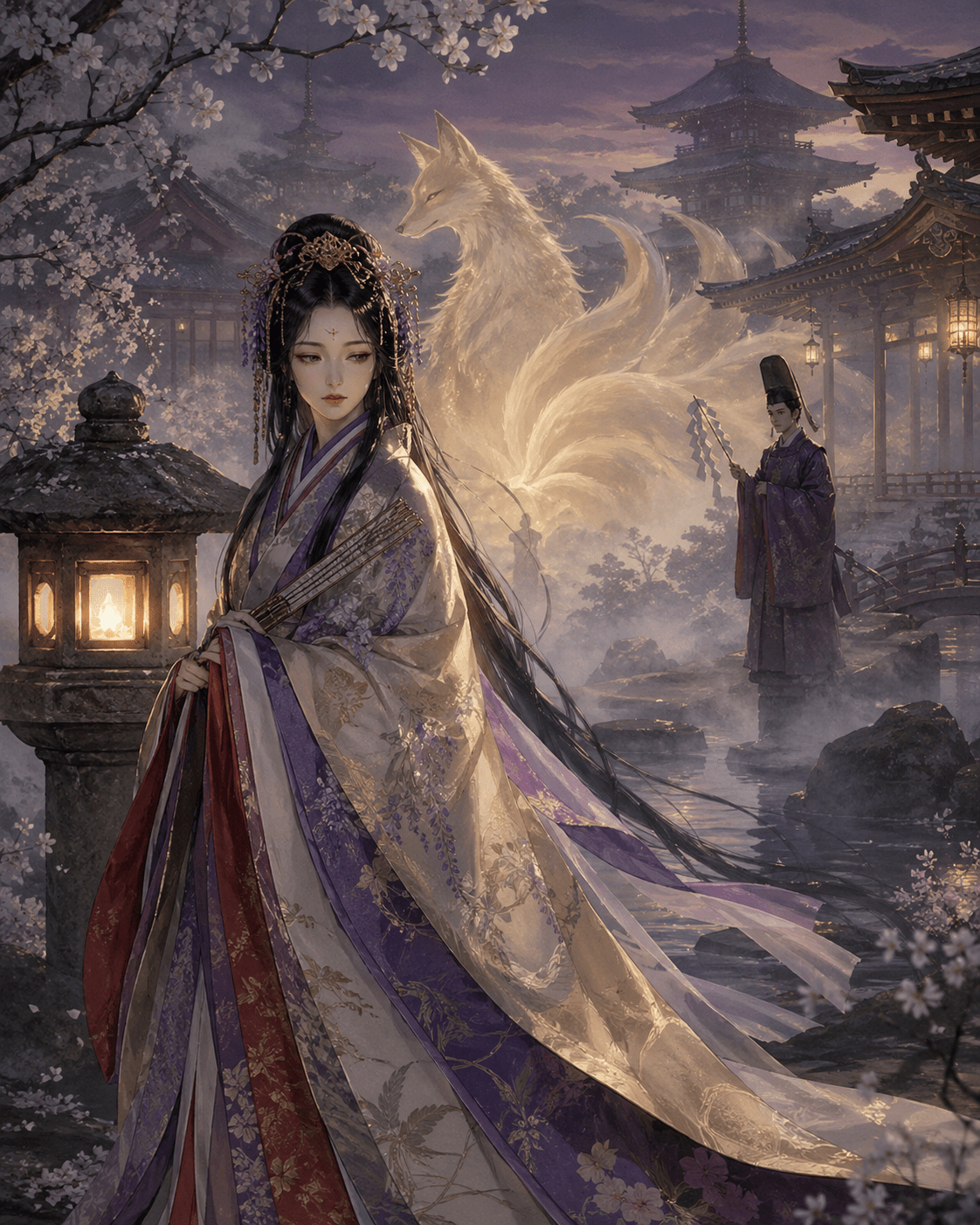
  • Tamamo-no-Mae and the Nine-Tailed Fox: A Mysterious Japanese Folklore Tale of Beauty, Fear, and Wisdom
    ※This site uses affiliate advertising.Introduction: When Beauty Becomes a MysterySome folklore begins with a monster in the dark.The legend of Tamamo-no-Mae begins with a woman of almost impossible beauty.In Japanese folklore, Tamamo-no-Mae is remembered as a mysterious court lady whose true form was said to be a kyūbi no kitsune, a nine-tailed fox. She appeared elegant, intelligent, and graceful. Yet behind her beauty, the tale says, there was an ancient spirit that had crossed countries, dynasties, and centuries.This is not only a scary story. It is a strange tale with hidden wisdom.At its heart, the legend asks several quiet questions. Why are people so easily captivated by beauty and power? How can charm become dangerous when it hides the truth? And why do old cultures so often turn fear into stories, symbols, and warnings?To understand this legend, we need to understand two important ideas in Japanese folklore: the nine-tailed fox and the onmyōji.A nine-tailed fox is not an ordinary animal. In East Asian folklore, fox spirits are often believed to grow wiser, stronger, and more mysterious with age. The more tails a fox has, the greater its supernatural power is said to be. A fox with nine tails represents extreme age, deep magic, transformation, and sometimes danger.An onmyōji was a practitioner of Onmyōdō, a traditional Japanese system that combined divination, astrology, calendar knowledge, ritual, and cosmology. In legends, onmyōji often appear as spiritual specialists who can sense what ordinary people cannot see. They do not simply fight monsters with weapons. They read signs, perform rituals, and reveal hidden truths.The story of Tamamo-no-Mae brings these two worlds together: the seductive mystery of the fox and the careful insight of the onmyōji.The Nine-Tailed Fox: A Spirit of TransformationBefore Tamamo-no-Mae appears in Japan, the legend of the nine-tailed fox already has a long shadow across Asia.In many East Asian traditions, foxes are seen as unusual creatures. They live near human settlements, appear at twilight, move silently, and seem to belong to the border between the wild and the familiar. Because of this, foxes became powerful figures in folklore.In Japan, foxes are called kitsune. They can be sacred messengers, especially in traditions connected with Inari, a deity associated with rice, fertility, prosperity, and worldly success. But kitsune can also be tricksters. They may deceive humans, transform into women, create illusions, or test a person’s heart.This is why the fox is so fascinating. It is not purely evil. It is not purely good. It is ambiguous.A fox may guide you.A fox may deceive you.A fox may protect you.A fox may reveal your weakness.The nine-tailed fox is the most powerful form of this idea. Its nine tails suggest age, magical power, and accumulated experience. In folklore, such a fox is often said to possess deep knowledge of human desire. It knows what people want to see. It knows how to appear as beauty, comfort, authority, or love.That is what makes the nine-tailed fox frightening.It does not always attack from outside.It enters through longing.The legend of Tamamo-no-Mae uses this symbolism with great force. The fox does not merely become a monster. It becomes what people desire most. It appears as beauty in a court that values beauty. It appears as intelligence in a society that respects refinement. It appears as companionship to a ruler who wants affection and admiration.In this sense, the nine-tailed fox is not only a supernatural creature. It is also a mirror of human vulnerability.It is a tale of fear, but also of perception.It is a tale of deception, but also of wisdom.Across Kingdoms: The Fox Before JapanIn some versions of the legend, the nine-tailed fox first appears in ancient China as Daji, the beautiful consort of King Zhou of the Shang dynasty. The tale says that Daji was not merely a cruel woman, but a fox spirit who had entered the palace and taken control of human desire.The stories surrounding Daji are severe. She is said to have delighted in punishment and suffering. One famous scene tells of a condemned man ordered to walk across a bronze pillar coated with oil and heated until it burned. If he crossed it, he would be declared innocent. But no human could walk such a path. He slipped, clung to the burning metal, and died.Whether read as history, myth, or moral imagination, the image is unforgettable. A ruler becomes blind. A court becomes afraid. Cruelty is made into entertainment. Judgment is replaced by spectacle.In folklore, this is where the nine-tailed fox does its work. It does not destroy a kingdom with claws alone. It weakens the mind of power. It turns pleasure into cruelty and admiration into obedience.After the fall of the Shang dynasty, the fox is said to have crossed into other lands. Some tellings place it in India, where it appears again as a beautiful woman who captivates a prince and brings suffering to the people. Other versions say it returns to China in another age, repeating the same pattern: beauty, fascination, ignored warnings, and ruin.The details shift, but the structure remains.A ruler is enchanted.Wise counsel is ignored.Cruelty spreads.The kingdom collapses from within.This repetition is important. Folklore repeats patterns because human beings repeat patterns. The fox returns again and again because the weakness it represents also returns again and again.Every age has its own illusions.Every palace has its own blind spot.Tamamo-no-Mae at the Heian CourtIn Japan, the nine-tailed fox is said to have appeared during the Heian period as Tamamo-no-Mae.The Heian court was a world of elegance and ritual. Beauty was not a simple decoration. It was a language. Poetry, music, calligraphy, fragrance, clothing, and careful conversation shaped a person’s reputation. To be refined was to possess power of a quiet kind.Into this world came Tamamo-no-Mae.She was described as a woman of extraordinary beauty. Her skin seemed to glow softly. Her black hair flowed with graceful depth. Her voice was calm, her words intelligent, and her manners flawless. She understood poetry. She knew music. She could answer difficult questions with ease.She was not only lovely. She was cultivated.The ruler, often identified in the legend with Emperor Toba or the retired emperor connected to his court, became deeply fascinated by her. She was invited closer and closer into the center of power. Courtiers admired her. Some envied her. Others felt something they could not explain.There was a strange brightness around her.But brightness can sometimes cast a shadow.Soon, the ruler’s health began to fail. Physicians could not cure him. Ritual prayers did not bring relief. The atmosphere of the palace grew heavy. People whispered in corridors. Strange winds were felt at night. Some said they heard voices when no one was there.Suspicion slowly gathered around Tamamo-no-Mae.Yet suspicion is a dangerous thing in folklore. It may reveal the truth, or it may reveal the fears of those who are suspicious. The legend leaves room for both possibilities. Perhaps she was truly a fox spirit. Perhaps she became the shape into which the court poured its anxieties.Either way, the palace needed someone who could read what others could not.So an onmyōji was called.The Onmyōji: Reader of Hidden SignsTo English-speaking readers, an onmyōji may be unfamiliar, but this figure is essential to understanding the story.An onmyōji was not simply a wizard or magician. In traditional Japanese culture, onmyōji were specialists in Onmyōdō, a system influenced by Chinese yin-yang thought, the five elements, astronomy, divination, ritual practice, and calendar science.They studied the movement of stars, the direction of travel, lucky and unlucky days, spiritual pollution, and the unseen balance between forces. In historical contexts, onmyōji sometimes served courts and aristocrats by choosing dates for ceremonies, interpreting omens, and performing protective rituals.In folklore, however, the onmyōji becomes something more dramatic: a person who can stand between the human world and the unseen world.The onmyōji does not always defeat evil through force. His power lies in perception. He notices what others overlook. He reads the hidden pattern beneath visible events. When everyone else is dazzled by appearance, he asks what lies behind it.In the legend of Tamamo-no-Mae, the onmyōji is often identified as Abe no Yasuchika or connected to the famous tradition of the Abe clan of onmyōji. Through divination and ritual, he discovers the truth: Tamamo-no-Mae is not an ordinary woman. She is the nine-tailed fox.This moment is important not only because a monster is exposed. It is important because illusion loses its power when it is named.In many wisdom traditions, naming a fear is the first step toward no longer being ruled by it.The Moment of RevelationWhen the onmyōji reveals Tamamo-no-Mae’s true nature, the palace is thrown into fear.The woman who had been admired now becomes terrifying. The same beauty that once seemed divine begins to look dangerous. Her intelligence, once praised, becomes suspicious. Her silence becomes threatening. Her presence becomes unbearable.This reversal is one of the most psychologically interesting parts of the legend.Human beings often change their interpretation of a person once fear enters the mind. The same smile may become manipulation. The same grace may become concealment. The same mystery may become a warning.The legend says that when Tamamo-no-Mae was exposed, she fled from the court. Some versions describe her as suddenly revealing her fox form. Others suggest she disappeared quietly, leaving behind confusion, illness, and fear.Either way, the court is changed.The ruler, who had been captivated by her, must confront his own blindness. The courtiers, who had admired or envied her, must confront how quickly admiration can become hatred. And the onmyōji, who reveals the truth, becomes the figure of insight in a world ruled by appearances.At this point, the story is no longer only about a fox spirit. It becomes a meditation on perception.What do we see?What do we refuse to see?And what happens when the truth finally enters the room?The Flight to Nasu and the Battle on the PlainAfter leaving the court, Tamamo-no-Mae is said to have fled east to Nasu, a region associated with open fields, mountains, and volcanic landscapes.There, according to the legend, the fox spirit no longer hid behind courtly elegance. Reports spread of animals dying and people being harmed. The air itself seemed dangerous. Fear moved through the villages.The court sent warriors to hunt the fox. This was not an ordinary military mission. The enemy was not simply a beast. It was a supernatural being of ancient power. For this reason, some tellings include ritual specialists, prayers, and protective rites. Human courage alone was not enough. The hunters needed spiritual protection and clear minds.When the warriors reached the plain, Tamamo-no-Mae appeared again.Some versions say she stood before them in the form of a beautiful woman. Even at the edge of death, her beauty had not faded. For a moment, the warriors may have felt uncertainty. Was this truly a monster? Was she a spirit? A woman? A victim? A danger?Then the moment passed.Arrows flew across the field.Tamamo-no-Mae revealed her true form: a great fox with nine tails. The creature was radiant, terrible, and filled with supernatural force. Wind rose around it. The earth seemed to tremble. The battle became not merely a fight between warriors and a beast, but a symbolic confrontation between illusion and recognition, desire and discipline, fear and courage.At last, the nine-tailed fox was struck down.But in folklore, powerful spirits rarely vanish without a trace.Her body died, but her resentment remained. That lingering force was said to enter a stone. This stone became known as the Sesshō-seki, the Killing Stone.The Killing Stone: Fear Made VisibleThe Sesshō-seki, or Killing Stone, is one of the most powerful images in the legend of Tamamo-no-Mae.The stone was said to release poison. Birds that flew above it fell. Animals that came near it died. Plants could not grow around it. People feared the place and avoided it.From a cultural perspective, this image is meaningful. A stone is silent. It does not chase anyone. It does not speak. It simply remains.And yet, in the legend, it kills.That makes the Killing Stone a symbol of lingering harm. It represents the kind of pain that remains after the visible crisis is over. The fox has been defeated, but the atmosphere is still dangerous. The court has been saved, but suspicion remains. The monster is gone, but the wound continues to speak.This is one reason the story feels psychologically modern. Many people know this feeling. A conflict ends, but the unease remains. A lie is exposed, but trust does not immediately return. A frightening period passes, but the memory continues to affect the body and mind.Later traditions say that a monk named Gennō came to the Killing Stone and performed rituals to pacify the spirit. In some versions, he broke the stone, and pieces flew to different regions of Japan. In others, the spirit was finally calmed.This part of the legend adds an important layer. It suggests that fear is not only something to defeat. Sometimes fear must be understood, named, mourned, and purified.The Killing Stone reminds us that unresolved fear becomes part of the landscape.Healing begins when someone is willing to approach it carefully.Cultural Insight: Why This Folklore Still MattersThe legend of Tamamo-no-Mae survives because it contains more than fear. It contains cultural memory.The nine-tailed fox reflects the Japanese and East Asian imagination of transformation. A being can change shape. A person may not be what they appear to be. Beauty may hide danger, but danger may also hide sorrow. The visible world is never the whole world.The onmyōji reflects another important cultural idea: the need to read signs carefully. In a world where illness, disaster, politics, and emotion often felt connected to invisible forces, the onmyōji represented order. He was the person who could interpret hidden patterns when ordinary explanation failed.Together, the fox and the onmyōji create a powerful symbolic pair.The fox represents illusion, desire, and transformation.The onmyōji represents discernment, ritual, and interpretation.This is why the story fits so naturally into a site about proverbs, affirmations, wisdom quotes, and cultural insight. It is not only about a supernatural creature. It is about the human need for wisdom when appearances become confusing.Many cultures have proverbs warning against surface appearances:“All that glitters is not gold.”This proverb fits Tamamo-no-Mae beautifully. It does not say that beauty is false. It says that brightness alone is not proof of truth.The legend invites us to admire beauty, but not surrender judgment.It invites us to listen to charm, but also to listen to unease.It invites us to recognize that wisdom often begins with a second look.Psychological Reflection: Why We Fear the Beautiful MaskPeople are drawn to stories like Tamamo-no-Mae because they turn invisible anxiety into a visible image.The nine-tailed fox gives a body to a familiar fear: the fear of being deceived by what we admire.This fear is not limited to ancient courts. In modern life, people are still drawn to beauty, confidence, status, charisma, and polished appearances. We admire people who seem certain. We trust stories that feel comforting. We follow voices that say what we want to hear.None of this is wrong in itself. Human beings need beauty and trust. But the legend reminds us that attraction can become dangerous when it silences reflection.The onmyōji, in psychological terms, represents the inner voice that asks questions.Is this true?Why am I so drawn to this?What am I ignoring?What does my unease know that my desire does not?The story is not asking us to become suspicious of everything. A life ruled by suspicion becomes cold and lonely. Instead, the legend suggests a more balanced wisdom: stay open, but stay awake.Fear, in this sense, is not always an enemy. Sometimes fear is a messenger. It tells us where attention is needed.Folklore allows us to approach this truth gently. Instead of saying, “You may be deceived,” it tells us a story about a fox in a palace. Instead of giving direct instruction, it lets an image remain in the mind.A beautiful woman.A sick ruler.An onmyōji reading hidden signs.A fox fleeing into the wilderness.A stone that still remembers.These images stay with us because they speak the language of the unconscious.Life Lesson: Let Beauty Be Joined by WisdomOne possible lesson of Tamamo-no-Mae is simple but deep:Beauty needs wisdom beside it.This does not mean beauty is dangerous. It does not mean desire is shameful. It does not mean we should reject admiration, love, art, elegance, or wonder.Rather, the story reminds us that beauty becomes safer when accompanied by discernment.In daily life, the nine-tailed fox may not appear as a supernatural being. It may appear as a flattering opportunity, a persuasive leader, a charming relationship, a perfect image online, a shortcut that seems too easy, or a promise that makes us stop asking questions.The onmyōji may also appear in modern life, though not in robes or ritual. It may appear as a friend who gently warns us. It may appear as our own intuition. It may appear as the pause before a decision. It may appear as the uncomfortable question we almost avoid.This story may remind us that courage is not always loud. Sometimes courage is the willingness to look again.To ask one more question.To listen to one small doubt.To notice when admiration becomes surrender.To remember that not every shining thing is a guide.A useful affirmation for this story might be:“I can honor beauty without abandoning my wisdom.”Closing Reflection: The Fox That Still SpeaksThe legend of Tamamo-no-Mae has survived for centuries because it is not only about the past.It still speaks because people still encounter masks.People still confuse charm with truth.People still ignore quiet warnings when desire is loud.People still need someone, or something, to help them read the signs.The nine-tailed fox remains powerful because it is mysterious, but also because it is familiar. We may never meet a supernatural fox in a palace. But we all know what it means to be dazzled. We all know what it means to sense that something beautiful has a shadow.The onmyōji remains powerful because he represents a wisdom many of us still seek: the ability to see beneath appearances without losing compassion.Perhaps the real mystery of Tamamo-no-Mae is not whether a fox once became a woman, or whether a stone once held a spirit.Perhaps the deeper mystery is why we still recognize her.What beautiful thing in your own life might be asking not for fear, but for clearer seeing?Key Proverb, Quote, or Affirmation UsedProverb“All that glitters is not gold.”MeaningSomething may look beautiful, valuable, or trustworthy on the surface, but appearance alone does not prove truth.Original Affirmation“I can honor beauty without abandoning my wisdom.”Psychological / Philosophical Reflection SummaryThis story endures because it reflects a universal fear: being deceived by what we admire. The fox symbolizes charm without truth, while the onmyōji symbolizes the inner voice that asks us to look deeper.Rather than simply frightening us, the legend gives shape to uncertainty. It suggests that fear may sometimes be a messenger, asking us to pay closer attention.Life Lesson SummaryThe tale of Tamamo-no-Mae may remind us that beauty and wisdom should walk together. We do not need to reject beauty, admiration, or desire. But we may need to keep asking gentle questions when something feels too perfect.The modern “nine-tailed fox” may be a persuasive image, a charming person, an easy promise, or a story we want too badly to believe. The modern “onmyōji” may be intuition, patience, a trusted friend, or the courage to pause before saying yes.Reader Reflection QuestionWhat beautiful thing in your own life might be asking not for fear, but for clearer seeing?
    Read More
  • Mysterious Japanese Folklore: Cursed Blades, Yokai, and the Wisdom Hidden in Fear
    ※This site uses affiliate advertising.In Japanese folklore, fear often arrives quietly.It does not always appear as a scream in the night or a shadow at the window. Sometimes it appears as an old sword no one is allowed to see. Sometimes it takes the form of a spear standing upside down on a mountain peak, weathered by wind and mist. Sometimes it is a two-faced warrior remembered as a monster by one tradition and a protector by another. Sometimes it is a fox spirit in the palace, a demon drinking wine in a mountain hall, or a dead emperor whose grief was too heavy to disappear.These stories may sound like ghost stories, but they are more than entertainment. They are vessels of memory.In the long history of Japan, stories of jutsu, spells, sacred tools, cursed blades, and yokai have often served as ways to speak about what could not easily be explained: illness, political defeat, natural danger, betrayal, social fear, and the uneasy feeling that some powers in life should not be handled carelessly.This article explores several mysterious Japanese tales: Ryōmen Sukuna, the two-faced figure of Hida; Kusanagi-no-Tsurugi, the sacred sword hidden from human eyes; Ame-no-Sakahoko, the heavenly spear planted upside down in the mountain; Muramasa, the blade whose reputation became a curse; and the legendary yokai Shuten-dōji, Tamamo-no-Mae, and Emperor Sutoku.Rather than treating these stories as proven supernatural events, we will read them as folklore: stories shaped by fear, reverence, politics, memory, and moral imagination.A scary story may frighten us for a moment.A meaningful folktale stays with us because it seems to know something about being human.Story Part 1: Ryōmen Sukuna — The Monster with Two FacesLong ago, in the mountainous region now associated with Hida in Gifu Prefecture, there was said to be a being unlike any ordinary man.He had one body, but two faces.One face looked forward, the other backward, as if he could see both the road ahead and the road already taken. He had four arms, and in some tellings he carried swords and bows with impossible ease. To those who feared him, he must have seemed like a creature born outside the boundaries of the human world.His name was Ryōmen Sukuna.In older official narratives, Sukuna is described as a rebel, a violent figure who refused to obey imperial authority. He is said to have attacked people, resisted the court, and caused disorder. Eventually, a warrior was sent to defeat him. In this version, the story is simple: the center of power confronts the monstrous outsider, and order is restored.But folklore rarely remains simple.In the Hida region, where his memory survived in local tradition, Sukuna is often remembered differently. He is not merely a monster there. He is sometimes a hero. A protector. A powerful being who defended the people of the mountains rather than threatening them.One tale says he defeated a poisonous dragon that had brought suffering to the region. Another tradition connects him with temples, saying that he founded sacred places or appeared as an incarnation of Kannon, the bodhisattva of compassion. In Buddhist belief, Kannon is associated with mercy and the ability to hear the cries of suffering beings. To describe Sukuna in this way is to transform him completely: from a violent rebel into a compassionate guardian.One of the most moving details in the local tradition concerns a stone.Before going into battle, Sukuna was offered a meal by villagers. But instead of eating inside their home, he sat outside and ate upon a stone. The reason, the tale says, was that he did not want to bring danger upon the household. If his battle with the authorities caused trouble for the village, he wanted no one to accuse that family of sheltering him.It is a small image, but a powerful one:a feared warrior sitting alone on a stone, eating a meal before battle, already thinking of the safety of others.Here, the “monster” becomes complicated.Was Sukuna truly a demon-like enemy of the people? Or was he a local leader, later painted as a monster by those who wrote history from the side of the court? Was his two-faced body meant to mark him as unnatural, or could it symbolize a person seen in two opposite ways—villain to one world, protector to another?The story does not give us a final answer. It gives us something more interesting: a mirror.It asks us to consider how easily power can name someone a monster, and how memory can quietly resist.Story Part 2: Kusanagi-no-Tsurugi — The Sword Hidden from Human EyesAmong the most sacred objects in Japanese mythology is Kusanagi-no-Tsurugi, the Grass-Cutting Sword.Its story begins with the storm god Susanoo.Susanoo was not a gentle deity. In many myths, he appears wild, impulsive, and difficult to control. After causing trouble in the heavenly realm, he was cast down to the earthly land. There, in the region associated with ancient Izumo, he encountered an elderly couple and their daughter, Kushinada-hime.They were weeping.When Susanoo asked why, they told him of the terrible serpent Yamata-no-Orochi. It had eight heads and eight tails. Its body stretched across valleys and mountains. Trees grew upon its back, and its belly was said to be red with blood. Each year, the serpent came to devour one of their daughters. Seven had already been taken. Only Kushinada-hime remained.And now it was her turn.Susanoo agreed to defeat the serpent if he could marry Kushinada-hime. He prepared strong sake and placed it where the serpent would drink. When Yamata-no-Orochi arrived, enormous and dreadful, each of its eight heads drank deeply. Soon the serpent collapsed into drunken sleep.Then Susanoo drew his sword.He cut through the serpent’s heads and tails one after another. But as he sliced into one tail, his blade struck something hard. Surprised, he opened the flesh and discovered a sword hidden inside the serpent’s body.This mysterious blade would later become known as Kusanagi-no-Tsurugi.Already, the symbolism is rich. A sacred sword is found not in a palace, but inside a monster. Wisdom is hidden within danger. Protection emerges from terror. The thing that threatens the community also contains the object that will later symbolize divine authority.The sword’s story continues through the age of gods and emperors. It becomes one of the Three Sacred Treasures of Japan, along with a mirror and a jewel. These treasures are associated with imperial legitimacy, but they are not treated like ordinary royal objects. They are surrounded by secrecy, ritual, and reverence.Perhaps the most fascinating part of the Kusanagi legend is this: the true sword is not meant to be seen.According to tradition, even the emperor does not simply look upon it as one might inspect a weapon in a museum. In important rites, symbolic substitutes may be used. The sword’s power is bound to its hiddenness. Its invisibility is not a weakness; it is part of what makes it sacred.There are also stories that those who tried to view the sword improperly suffered misfortune. Whether one reads such tales literally or symbolically, their message is clear: not everything powerful should be exposed. Not everything sacred should be handled. Not every mystery becomes richer when explained.In a modern world that often treats visibility as value, Kusanagi offers a different wisdom.Some things are protected by being unseen.Some truths are approached not by possession, but by reverence.Some power must remain wrapped in silence.Story Part 3: Ame-no-Sakahoko — The Spear That Points Toward Heaven by Turning Away from WarHigh on Mount Takachiho, where clouds drift across the ridges and volcanic stone holds the memory of fire, there is a mysterious spear known as Ame-no-Sakahoko, the Heavenly Upside-Down Spear.It is said to stand with its point driven into the mountain and its handle lifted toward the sky.The image is unforgettable: a weapon reversed. A spear that refuses to point outward. A tool of force transformed into a sign of restraint.For centuries, people have wondered who placed it there. Some connect it to Japan’s creation myths. In one ancient story, the deitiesIzanagi andIzanami stood upon the floating bridge of heaven and stirred the primordial sea with a heavenly spear. When drops fell from the spear’s tip, they hardened and became islands. In this way, the land itself was born from a sacred act of stirring chaos into form.Other traditions connect Ame-no-Sakahoko with Ninigi-no-Mikoto, the heavenly grandson of the sun goddess Amaterasu. Ninigi descended from heaven to earth in an event known as tenson kōrin, the descent of the heavenly grandchild. In this interpretation, the spear was planted in the mountain as a sign that the land would be governed in peace.One version says the spear was thrust upside down so it would never again be used for battle.That image contains a quiet moral lesson. Human beings often imagine peace as the destruction of weapons. But this story imagines peace differently. The weapon is not erased. It remains visible. It stands in the landscape as a reminder of violence, but its direction has changed. Its point is buried. Its threat has been turned inward, into the mountain, into stillness.A weapon becomes a prayer.There are also stranger tales. Some say that long ago, a giant descended the mountain carrying the spear. Villagers, startled by the sight, questioned him. Then the giant vanished, and people wondered whether the spear itself had tried to leave the summit, as if it possessed its own will.Perhaps this is why sacred objects in folklore feel so alive. They are never merely things. They remember. They move. They resist ownership. They belong partly to this world and partly to another.Historically, parts of the original spear may have been damaged or lost through volcanic activity and time. What visitors see today may not be the first object that stood there. Yet the legend continues, because folklore does not depend only on material certainty. It depends on the power of an image.A spear standing upside down on a mountain.A weapon refusing war.A reminder that the highest form of strength may be the ability to place power back into the earth.Story Part 4: Muramasa — When Reputation Becomes a CurseThe name Muramasa carries a dark sound in Japanese sword legend.Yet Muramasa was not originally the name of one cursed blade. It referred to a school of swordsmiths, especially associated with the region around present-day Mie Prefecture. Their swords were respected. They were sharp, practical, and highly valued by warriors.A sword, after all, is never only an object in a warrior society. It is status, survival, discipline, violence, and identity. To carry a fine blade was to carry both protection and responsibility.So how did Muramasa become a name of fear?The answer lies partly in history, partly in coincidence, and partly in the human hunger for pattern.Several misfortunes connected to the Tokugawa family were later associated with Muramasa weapons. Tokugawa Ieyasu’s relatives were injured or killed in incidents where Muramasa blades or weapons were said to have appeared. Ieyasu himself was also said to have been wounded by a Muramasa blade in youth. Over time, a pattern formed in the imagination: Muramasa meant danger to the Tokugawa house.Once such a story begins, it grows.A blade no longer needs to act. Its name does the work.People whisper. Theater exaggerates. Popular stories sharpen the rumor. Kabuki plays and fiction helped transform Muramasa from a respected swordsmith name into the image of a blood-loving blade.The sword became “cursed” because people continued to speak of it as cursed.From a practical perspective, there may have been a simpler explanation. Muramasa blades were widely produced and widely circulated. If many warriors owned them, then naturally they would appear in many violent events. What looks like a supernatural pattern may have begun as ordinary probability.But folklore is not born only from facts. It is born from the way facts feel.If one family suffers again and again, and one name appears again and again, the mind connects them. The connection may not be logical, but it is emotionally powerful. The human heart is a storyteller before it is a statistician.This is why Muramasa remains fascinating. The legend reveals how fear gathers around an object. A sword becomes more than steel. It becomes rumor, memory, suspicion, and fate.In modern life, we may not fear cursed blades. But reputations still work like spells. A person, a family, a place, or even a word can become surrounded by stories until people stop seeing what is real and begin seeing only the legend.Muramasa asks us to be careful with the stories we repeat.A curse may begin not in the blade, but in the mouth.Story Part 5: Yokai — The Faces We Give to FearJapanese folklore is filled with beings called yokai.The word is difficult to translate perfectly. Yokai can be monsters, spirits, strange presences, transformed animals, haunted objects, or mysterious beings that disturb the ordinary world. Some are terrifying. Some are playful. Some are tragic. Many are not purely evil. They are more like signs that something in the world has slipped out of balance.Among the most famous are Shuten-dōji, the demon of Mount Ōe; Tamamo-no-Mae, the beautiful woman revealed to be a nine-tailed fox; and Emperor Sutoku, a real historical ruler later feared as a powerful vengeful spirit.Their stories are very different, but they share one thing: each gives a face to fear.Shuten-dōji: The Demon Who Drank with HeroesIn the old capital, noble families began to whisper of disappearances.Young women vanished. Doors that had seemed secure were suddenly useless. Families who had trusted rank, walls, and servants found that none of these could protect them from what moved beyond the city.The cause, according to legend, was a demon living on Mount Ōe: Shuten-dōji.His name is often translated as “the drunken boy” or “the sake-drinking child,” though he was no child in power. He was a demon king, surrounded by followers, dwelling far from the orderly world of the court. He drank, feasted, and inspired terror.The emperor ordered heroes to defeat him. Among them was the legendary warrior Minamoto no Yorimitsu, also known as Raikō. But the heroes did not simply march into the demon’s hall with swords raised. Instead, they disguised themselves as mountain ascetics and entered Shuten-dōji’s stronghold through deception.There, they offered him sake.The demon drank. He became friendly. He spoke. In some versions, he even tells his own story—how he came to be called Shuten-dōji, how he became what he was. For a moment, the monster is not merely a monster. He is a host, a drinker, a speaker, almost human in his enjoyment of the feast.Then the sake takes effect. The demon sleeps.The heroes strike.Even after his head is cut off, Shuten-dōji is said to bite at Yorimitsu’s helmet, enraged at the betrayal. The demon is defeated, and the captives are saved. Order returns.Yet the story leaves a bitter aftertaste. The heroes win through trickery. The demon is dangerous, but he is also deceived while offering hospitality. In some later interpretations, Shuten-dōji is not merely evil; he is a figure of abandonment, loneliness, and resentment. A being pushed out of the human world until he becomes the monster that world expects him to be.This does not excuse the demon’s violence. Folklore does not need to excuse in order to understand. It simply lets the fear become layered.The story asks:What turns a person into an oni?And when society defeats its monsters, does it ever ask how they were made?Tamamo-no-Mae: Beauty, Knowledge, and the Stone of DeathAnother famous figure is Tamamo-no-Mae.She appears in legend as a woman of extraordinary beauty and intelligence. She enters the imperial court, where refinement, poetry, politics, and ritual shape the highest levels of society. But Tamamo-no-Mae is not only beautiful. She is brilliant. She seems to know everything: literature, music, statecraft, spiritual matters. Her presence fascinates those around her.Eventually, she gains the favor of the emperor.Then illness comes.The emperor grows weak, and no ordinary explanation seems enough. Diviners and spiritual specialists are consulted. At last, Tamamo-no-Mae is accused of being the cause. Her true form, it is said, is not human at all, but a kyūbi no kitsune—a nine-tailed fox.In East Asian folklore, the nine-tailed fox is a powerful and ambiguous being. It may represent seduction, intelligence, danger, transformation, or the fear of hidden influence. The fox is not frightening because it is ugly. It is frightening because it is beautiful, clever, and impossible to read.When Tamamo-no-Mae is exposed, she flees. Eventually she is hunted down and killed. But her story does not end with death. Her spirit is said to enter a stone known as the Sesshō-seki, or Killing Stone. Any living creature that approaches it dies.Modern readers may recognize that places associated with poisonous gases or dangerous volcanic activity could easily give rise to such legends. A stone near which birds, animals, or people grew sick would naturally become a place of fear. Folklore gave that danger a story. The invisible poison became the lingering curse of the fox.But symbolically, Tamamo-no-Mae is also a story about suspicion.What happens when beauty is feared?What happens when intelligence becomes threatening?What happens when influence at court is explained as enchantment rather than politics?The nine-tailed fox reminds us that societies often turn anxiety into a figure. A woman too beautiful, too knowledgeable, too influential may become, in legend, something not quite human.Tamamo-no-Mae is frightening, but she is also revealing.She shows us how fear often gathers around those who cannot be easily controlled.Emperor Sutoku: When Grief Becomes a SpiritPerhaps the most haunting of these tales is that of Emperor Sutoku.Unlike many yokai, Sutoku was not born as a monster in legend. He was a real historical emperor, born in the late Heian period, a time of political instability and courtly conflict. He became emperor as a child, but his later life was marked by power struggles, defeat, and exile.After losing in the Hōgen Rebellion, Sutoku was sent far from the capital. There, cut off from political power and the world he had known, he copied Buddhist scriptures by hand. The act of copying sutras was often understood as a religious practice, a way of calming the mind, accumulating merit, and praying for the dead.Sutoku reportedly hoped to offer the completed scriptures to a temple in Kyoto.But they were refused.The fear was that the scriptures might contain a curse. To be rejected in this way—after years of labor, exile, grief, and prayer—must have felt like a final humiliation. Legend says that Sutoku, overcome with rage, bit his tongue, used his own blood to write words of vengeance, and died with hatred in his heart.After his death, disasters and political troubles were interpreted by some as signs of his wrath. He came to be feared as one of Japan’s great onryō, or vengeful spirits. In some traditions, he was even said to have become a tengu, a powerful supernatural being associated with mountains, pride, and spiritual danger.The story of Sutoku is frightening not because of a sudden apparition, but because of its emotional weight.A person loses power.He is exiled.He turns to religious devotion.Even that devotion is rejected.His grief has nowhere to go.So the culture gives it a form: a vengeful spirit.From a psychological perspective, Sutoku’s legend shows how unresolved injustice can haunt a society. When political wounds are not healed, they return as stories. When grief is not acknowledged, it becomes a ghost.The lesson is not that every misfortune is caused by a curse.Rather, the tale suggests that what a society refuses to mourn may return in another form.Key Quote / Proverb / Affirmation“Fear becomes wisdom when we dare to listen to what it is trying to protect.”This affirmation does not ask us to worship fear. It asks us to listen to it carefully. In folklore, fear often guards a boundary: between the sacred and the ordinary, the remembered and the forgotten, the powerful and the powerless, the living and the dead.Cultural Insight: Jujutsu, Tatari, and Sacred ObjectsTo understand these legends, it helps to know that Japanese tradition has long contained ideas of jujutsu, often translated as magic, sorcery, ritual technique, or spiritual practice. In a broad sense, jujutsu refers to actions meant to influence reality through unseen forces, ritual words, gestures, objects, or spiritual assistance.This does not always mean evil magic. A charm for healing, a prayer for safe childbirth, a lucky wedding day, or a taboo around funerals can all belong to a wide cultural field of ritual thinking. Human beings have always used symbolic actions to face uncertainty.Another important word is tatari. It is often translated as a curse or divine punishment, but it has a more subtle feeling. Tatari may arise when something sacred, wronged, neglected, or improperly treated becomes dangerous. It is not always simple malice. It is closer to the idea that imbalance demands recognition.The concept of goshintai is also important. A goshintai is a sacred object that serves as the dwelling place or symbol of a deity. In Japanese religious culture, a sword, mirror, stone, tree, or mountain may become a focus of reverence. It is not “just an object.” It is an object that gathers presence.This helps explain why swords and stones in Japanese folklore often feel alive. They are not merely tools or scenery. They are containers of memory, danger, prayer, and awe.In these stories, the boundary between object and spirit is thin.A sword can remember.A stone can warn.A mountain can hold silence.A weapon can become sacred when it is no longer used.Psychological and Philosophical Reflection: Why Old Fear Still SpeaksWhy are we still drawn to stories of cursed swords, hidden treasures, demons, fox spirits, and vengeful ghosts?One answer is that these stories allow us to look at fear from a safe distance.A nameless anxiety is difficult to endure. But when fear becomes a demon on a mountain, a fox in the palace, a sword in a shrine, or a spirit in exile, it becomes something we can speak about. We can gather around it. We can retell it. We can ask what it means.Folklore gives fear a body.It also preserves the emotional history of a culture. Political losers may become spirits. Dangerous places may become cursed stones. Powerful weapons may become sacred objects. Outsiders may become monsters or heroes depending on who tells the story.In this sense, folklore is not the opposite of truth. It is another way of storing truth—not always factual truth, but emotional, social, and symbolic truth.A ghost story may not prove the existence of ghosts.But it may reveal the existence of grief.A cursed sword may not truly thirst for blood.But it may reveal how violence clings to reputation.A demon may not live on the mountain.But the mountain may still hold the memory of those cast out.This is why old stories continue to matter. They speak in images where ordinary language fails.Life Lesson: What Fear Asks Us to NoticeOne way to read these mysterious Japanese tales is as a lesson in attention.Ryōmen Sukuna reminds us to question who gets called a monster. Kusanagi-no-Tsurugi teaches that some sacred things must be approached with restraint. Ame-no-Sakahoko suggests that power becomes wisdom when it is turned away from violence. Muramasa warns that repeated stories can become a kind of curse. Yokai reveal that fear often hides loneliness, injustice, desire, or memory beneath its frightening face.In modern life, our fears may look different. We may not speak of sacred swords or fox spirits. But we still live with rumors, inherited anxieties, family silences, misunderstood people, places we avoid, memories we do not name, and grief that has not found a language.A strange folktale does not tell us exactly how to live.It does something quieter.It asks us to pause before judging.To listen before dismissing.To approach mystery with humility.To remember that what frightens us may also be asking to be understood.The lesson is not to fear the dark.The lesson is to ask what the dark has been holding for us.Reader ReflectionWhat fear in your own life might be asking not to be destroyed, but to be understood?Key Proverb, Quote, or Affirmation Used“Fear becomes wisdom when we dare to listen to what it is trying to protect.”Psychological / Philosophical Reflection SummaryScary folklore gives shape to nameless fear. By turning anxiety into demons, fox spirits, cursed swords, or sacred objects, people can speak about grief, danger, injustice, and uncertainty in symbolic form. These stories may not prove the supernatural, but they reveal emotional truths.Life Lesson SummaryThis story may remind us that fear is not always something to destroy. Sometimes fear protects a boundary, preserves a memory, or points toward something unresolved. Wisdom begins when we stop dismissing fear and begin asking what it is trying to show us.Reader Reflection QuestionWhat fear in your own life might be asking not to be destroyed, but to be understood?
    Read More