Explore mysterious Japanese urban legends through folklore, fear, cultural meaning, and quiet wisdom for modern life.

 Wonderful Proverbs Journey
※This site uses affiliate advertising.
Exorcism stories occupy a strange place between religion, folklore, psychology, and fear. They are often told as accounts of unseen forces entering the human world, but they also reveal something deeply human: the desire to give a name to suffering.
Across cultures, people have used stories of spirits, demons, curses, and possession to explain what feels unbearable or unknown. Whether one reads these tales literally, symbolically, or historically, they continue to fascinate because they ask an old question: What do we do when fear feels larger than ourselves?
The following four cases are not presented as proof of the supernatural. They are better approached as mysterious stories shaped by belief, culture, rumor, trauma, and the human need for meaning. In that sense, each one becomes more than a frightening tale. It becomes a mirror.
One of the most famous modern exorcism stories is the 1949 case often associated with a boy known by the pseudonym “Roland Doe.” Reports of this case later helped inspire William Peter Blatty’s novel The Exorcist, which became the iconic 1973 film. The boy reportedly underwent exorcism rituals in Maryland and Missouri, though many details remain debated, and later researchers have questioned how much of the story was eyewitness testimony, religious interpretation, rumor, or exaggeration.
The story usually begins in an ordinary home near Washington, D.C. At first, the signs were small: scratching sounds in the walls, strange noises in the night, household objects that seemed to move without explanation. The family reportedly searched for practical causes. Perhaps rats. Perhaps a loose board. Perhaps the house itself was settling.
But the unease grew.
The boy was said to have become the center of the disturbances. His bed shook. Objects moved. Scratches appeared. Some accounts claim that words or marks surfaced on his skin. After attempts to seek help from Protestant clergy and medical institutions, the family eventually turned to Catholic priests.
What makes this story endure is not only the possibility of possession, but the atmosphere of helplessness surrounding it. A family watched a child change in ways they could not understand. Religious authorities stepped in where medicine and ordinary explanation seemed, at least to the family, insufficient. Fear became ritual. Anxiety became prayer. The unknown was given a name.
From a wisdom perspective, the Maryland case can be read as a story about what happens when fear enters a household and no one agrees on what it means. Some saw illness. Some saw mischief. Some saw spiritual danger. Others later saw a story enlarged by rumor and cinema.
Perhaps that is why it became such powerful material for fiction. It was not only about a demon. It was about parents, faith, doubt, and the terror of not knowing how to protect someone you love.
The Loudun possessions took place in 17th-century France and remain one of the most notorious possession cases in European history. A group of Ursuline nuns claimed to be tormented by demons, and the priest Urbain Grandier was eventually accused of sorcery and burned at the stake in 1634. Historians often read the affair through the lens of politics, sexuality, religious authority, and mass hysteria rather than simple supernatural belief.
The setting was Loudun, a French town marked by religious tension and political pressure. The Ursuline convent was home to women whose lives had been narrowed by family expectations, social status, and the limited choices available to them. Within the walls of the convent, silence and discipline were expected. But silence does not always mean peace.
At the center of the story stood Jeanne des Anges, the prioress of the convent, and Urbain Grandier, a charismatic priest whose beauty, intelligence, and reputation made him both admired and hated. Grandier had enemies. He was accused of arrogance, sexual misconduct, and defiance of church expectations. In an age when accusations of witchcraft could become fatal, rumor was not merely gossip. It was a weapon.
As the story is often told, the nuns began to display convulsions, strange voices, visions, and behavior interpreted as demonic possession. Public exorcisms followed. Crowds gathered. What may have begun as private distress became spectacle. The suffering of women, the ambitions of men, the anxieties of a town, and the machinery of religious authority were all drawn into one frightening performance.
Grandier maintained his innocence. Still, he was tortured, convicted, and executed by fire.
The horror of Loudun is not only the image of possessed nuns. It is the way fear can be organized, staged, and used. In this case, possession was not merely a spiritual claim; it became social power. It allowed hidden tensions to speak, but it also allowed cruelty to disguise itself as justice.
As a moral tale, Loudun reminds us that not every demon in a story is invisible. Sometimes the most dangerous forces are accusation, ambition, shame, and the pleasure of watching another person fall.
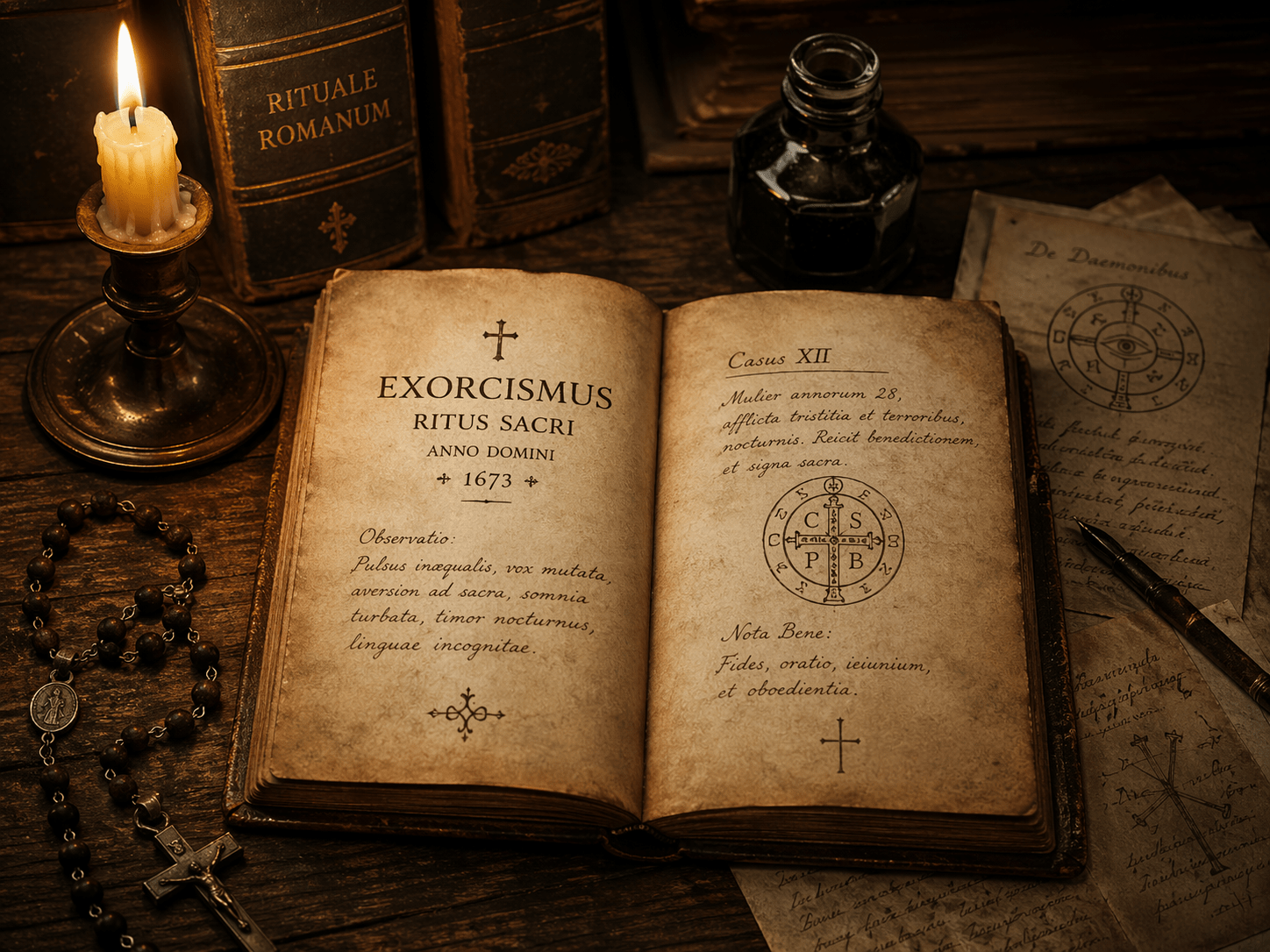
The Earling exorcism, associated with the woman often called Anna Ecklund, is one of the most discussed American exorcism stories of the 20th century. The case is usually connected with Emma Schmidt, a woman whose reported exorcism took place in Earling, Iowa, in 1928 under Father Theophilus Riesinger. The story was later popularized through religious writings, but as with many possession narratives, its details are difficult to separate from belief, memory, interpretation, and devotional literature.
In the traditional telling, the woman had shown signs of spiritual disturbance since adolescence. She was said to have recoiled from sacred objects, struggled to enter churches, and reacted violently to blessed food or holy water. By the time she arrived in Earling, the story had already become heavy with family tension, accusations of curses, and religious fear.
The exorcism reportedly lasted for weeks and involved dramatic claims: strange voices, physical contortions, aversion to sacred things, and knowledge she supposedly could not have known. Those present interpreted these signs through the Catholic framework of possession and deliverance.
For modern readers, however, this story raises a difficult and necessary question: how should we respond to suffering that appears spiritual, psychological, physical, or all three at once?
This is where wisdom matters. The Catholic Church itself has long emphasized caution in such cases. Contemporary guidance from Catholic authorities stresses that claims of possession should be carefully examined, including medical, psychological, and psychiatric evaluation, before any formal exorcism is considered.
That does not erase the power of the Earling story. It deepens it.
Rather than treating the case as simple proof of demons, we can read it as a story about human beings trying to interpret extreme distress. Faith offered one language. Fear offered another. The body offered signs. The community offered judgment. Somewhere within all of this was a suffering person.
The lesson may not be that every darkness has a supernatural cause. It may be that suffering deserves reverence, patience, and care before it is given a dramatic name.
The Italian case known as the “Beasts of Satan” is different from the older exorcism stories. It was not a tale of priests confronting an invisible force inside one suffering person. It was a modern criminal case involving a group of young people connected with occult imagery and violent crimes between the late 1990s and early 2000s. Forensic and legal discussions of the case have treated it as a matter of crime, group dynamics, deviance, and psychological vulnerability rather than literal demonic possession.
This distinction matters.
In folklore, the demon often appears as something outside the human being: a spirit at the window, a voice in the room, a shadow in the body. But in modern cases like this, the darkness seems more painfully human. Isolation, drugs, manipulation, group pressure, fascination with taboo symbols, and the hunger to belong can become a destructive ritual of their own.
The group’s use of satanic symbols shocked the public. Yet some religious figures and commentators have warned against assuming that every use of dark imagery reflects serious spiritual belief. For some troubled young people, symbols of rebellion may begin as performance, fashion, or provocation. But symbols are not harmless when they are joined to violence, coercion, and dehumanization.
This case reminds us that fear does not always arrive with supernatural signs. Sometimes it appears in neglected loneliness, in groups that reward cruelty, in the loss of moral boundaries, and in the human desire to be accepted at any cost.
A wisdom-centered reading does not excuse violence. It asks how people become vulnerable to it. It asks how communities fail to notice young people drifting toward danger. It asks what happens when emptiness is filled not with meaning, but with spectacle, domination, and fear.
The demon, in this reading, is not a horned figure from medieval art. It is what happens when human beings stop seeing one another as human.
“Name your fear, and it becomes smaller than your courage.”
This is not a traditional proverb, but an original affirmation inspired by the wisdom behind these stories. Fear grows in silence. When we name it carefully—without exaggeration, denial, or panic—we begin to stand beside it rather than beneath it.
In many cultures, possession stories serve as a language for experiences that are otherwise difficult to explain: illness, grief, trauma, forbidden desire, guilt, family conflict, or social pressure. The word “demon” may describe a religious being in one tradition, but symbolically it can also point to a force that overwhelms the self.
European exorcism stories often reflect the history of Christianity, church authority, sin, confession, and the boundary between body and soul. They also show how communities respond when private suffering becomes public anxiety.
For English-speaking readers, it is important to understand that these stories are not only “horror.” They belong to a wider tradition of folklore and wisdom: stories that transform fear into a shared image so that people can speak about what frightens them.
We are drawn to possession stories because they dramatize a fear many people quietly understand: the fear of no longer being fully oneself.
To be “possessed,” symbolically speaking, is to feel overtaken—by anger, grief, addiction, shame, obsession, or panic. A frightening story gives shape to that loss of control. It allows us to look at inner chaos from a safe distance.
These stories also reveal the danger of certainty. When people rush too quickly to name a cause—demon, witch, madness, guilt, evil—they may stop listening. Wisdom begins not with the loudest explanation, but with careful attention.
One way to read these tales is as a reminder to be careful with fear. Fear asks to be heard, but it should not always be obeyed. It can warn us, but it can also mislead us. It can protect a community, but it can also turn that community against the vulnerable.
In modern life, we may not speak of demons in the old way. Yet people still say they are “haunted” by regret, “possessed” by anger, or “fighting inner demons.” These expressions survive because they are emotionally true.
The lesson is not to deny darkness. Nor is it to surrender to it. The quieter lesson is this: before we call something evil, we should ask what pain, fear, silence, or longing may be hidden inside it.
What fear in your own life might be asking to be understood rather than simply driven away?
“Name your fear, and it becomes smaller than your courage.”
Exorcism stories are not only religious horror tales. They are cultural containers for fear, illness, guilt, family conflict, social control, and the need to explain what feels unbearable. In European Christian contexts, they also reflect the power of ritual, confession, sin, authority, and the historical boundary between medicine and religion.
Possession stories fascinate us because they symbolize the fear of losing control over the self. They give shape to invisible suffering and allow communities to discuss anxiety through story. At the same time, they warn us about the danger of naming fear too quickly.
Fear should be listened to, but not blindly obeyed. These stories remind us to look beneath frightening appearances and ask what pain, silence, longing, or confusion may be hidden there.
What fear in your own life might be asking to be understood rather than simply driven away?