Explore mysterious Japanese urban legends through folklore, fear, cultural meaning, and quiet wisdom for modern life.
 Wonderful Proverbs Journey
※This site uses affiliate advertising.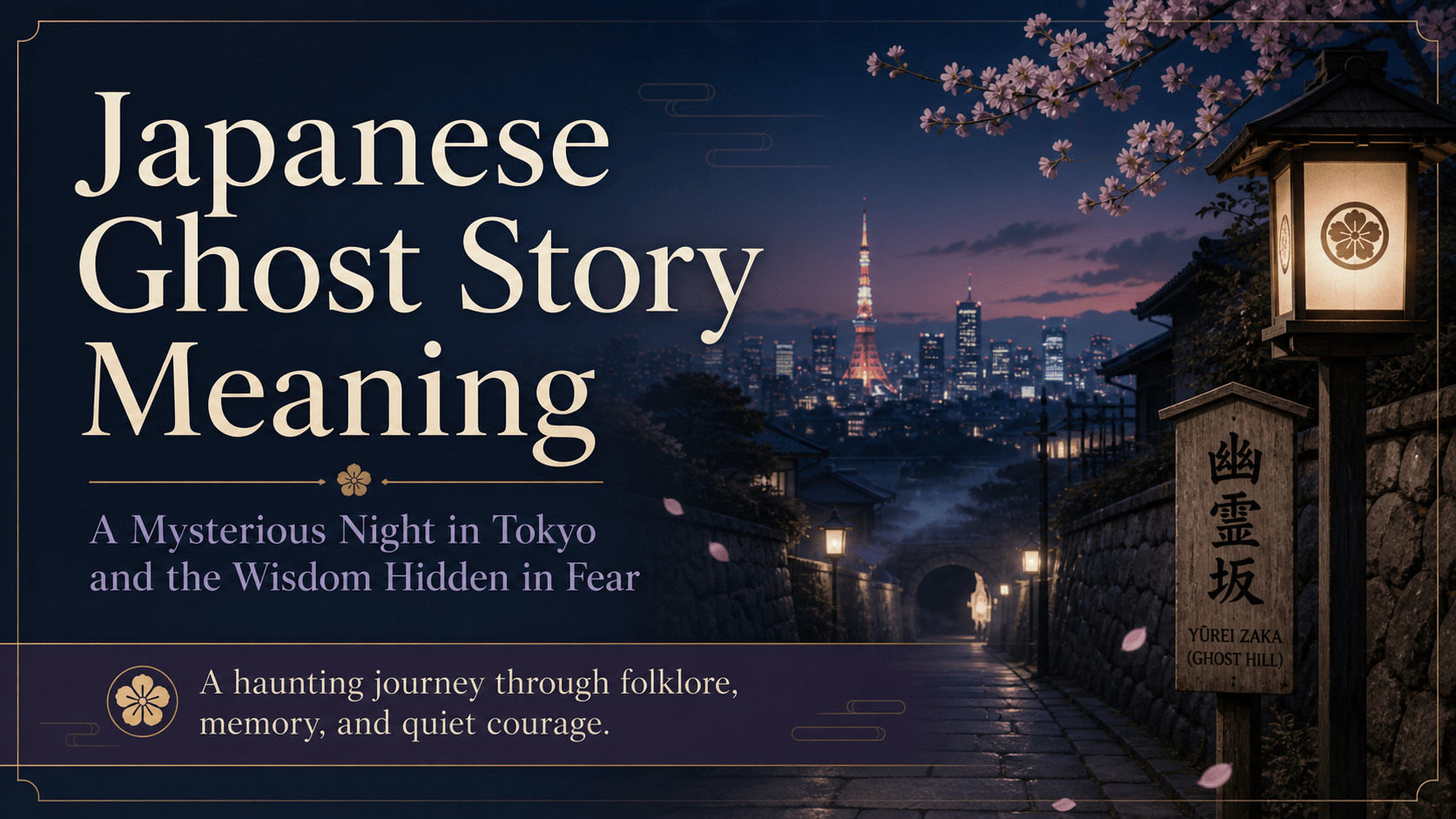
Tokyo is often imagined as a city of neon, trains, convenience stores, and restless movement. Yet beneath its bright surface, there are quieter places where the past seems to breathe more slowly: old cemeteries, narrow slopes with strange names, tunnels where yellow lights flicker against damp concrete.
This is not a story that proves ghosts exist. It is better understood as a modern piece of mysterious folklore — a night journey through places in Tokyo where memory, fear, humor, and cultural imagination meet.
The tale begins like many contemporary urban legends: with curiosity, a little fear, a friend who may or may not believe, and a phone app that claims to detect spirits. But beneath the playful ghost hunting lies something older and more human. Why do certain places feel heavy? Why do stories gather around graves, hills, and tunnels? And why do we keep walking into the dark, even when we say we are afraid?
This strange Japanese ghost walk is less about finding a ghost than about listening to what fear reveals.
The night began with a simple idea: if one wanted to look for ghosts in Tokyo, one should go after dark.
There was research, of course. Lists of haunted places. Stories passed around online. A few names that appeared again and again in conversations about Tokyo’s urban legends. And because no modern ghost hunt feels complete without technology, a ghost-hunting app was downloaded — one that claimed to scan the room, measure strange frequencies, and detect unseen presences.
Whether the app truly measured anything supernatural was another question. But in stories like this, belief is rarely pure. It often begins as a joke, grows into suspense, and then, somewhere in the quiet, becomes harder to dismiss.
Before the hunt began, there was one important stop: food. Fear is easier to face on a full stomach.
At the restaurant, the narrator met her friend, who seemed only partly aware of what the night would involve. The conversation soon turned to ghosts. Neither had seen one clearly, but both had heard stories. One friend remembered a building in Akasaka said to be haunted — a place where people whispered about sudden deaths, strange winds, doors opening by themselves, and residents waking in the night with the feeling that something had pulled them from the bed.
The details were uncertain. The sources were difficult to verify. Like many urban legends, the story seemed to live somewhere between rumor, memory, and the uneasy imagination of those who had passed through the place. Yet that is often how city folklore works. It does not always need official proof to survive. It attaches itself to buildings, neighborhoods, and silences.
After dinner, the ghost hunt began.
The first destination was Aoyama Cemetery.
By day, it is not only a cemetery but also a well-known place for cherry blossoms. In spring, pale petals fall over stone graves, and the boundary between beauty and sorrow becomes almost invisible. The cemetery is also known for graves connected to foreign advisors and historical figures from Japan’s modernizing years.
At night, however, the atmosphere changes.
The paths seemed longer in the dark. Trees leaned in strange shapes. Every small sound carried too much weight. A branch shifting in the wind could feel like a footstep. A shadow could become a figure if one looked at it too quickly.
The two women walked deeper into the cemetery, half laughing, half frightened. One tried to joke about Bloody Mary, the mirror-based ghost ritual known in many Western childhood legends. The other immediately wanted nothing to do with it. There are fears we enjoy from a distance, and fears we refuse to invite closer.
No ghost appeared. No dramatic sign came from the dark.
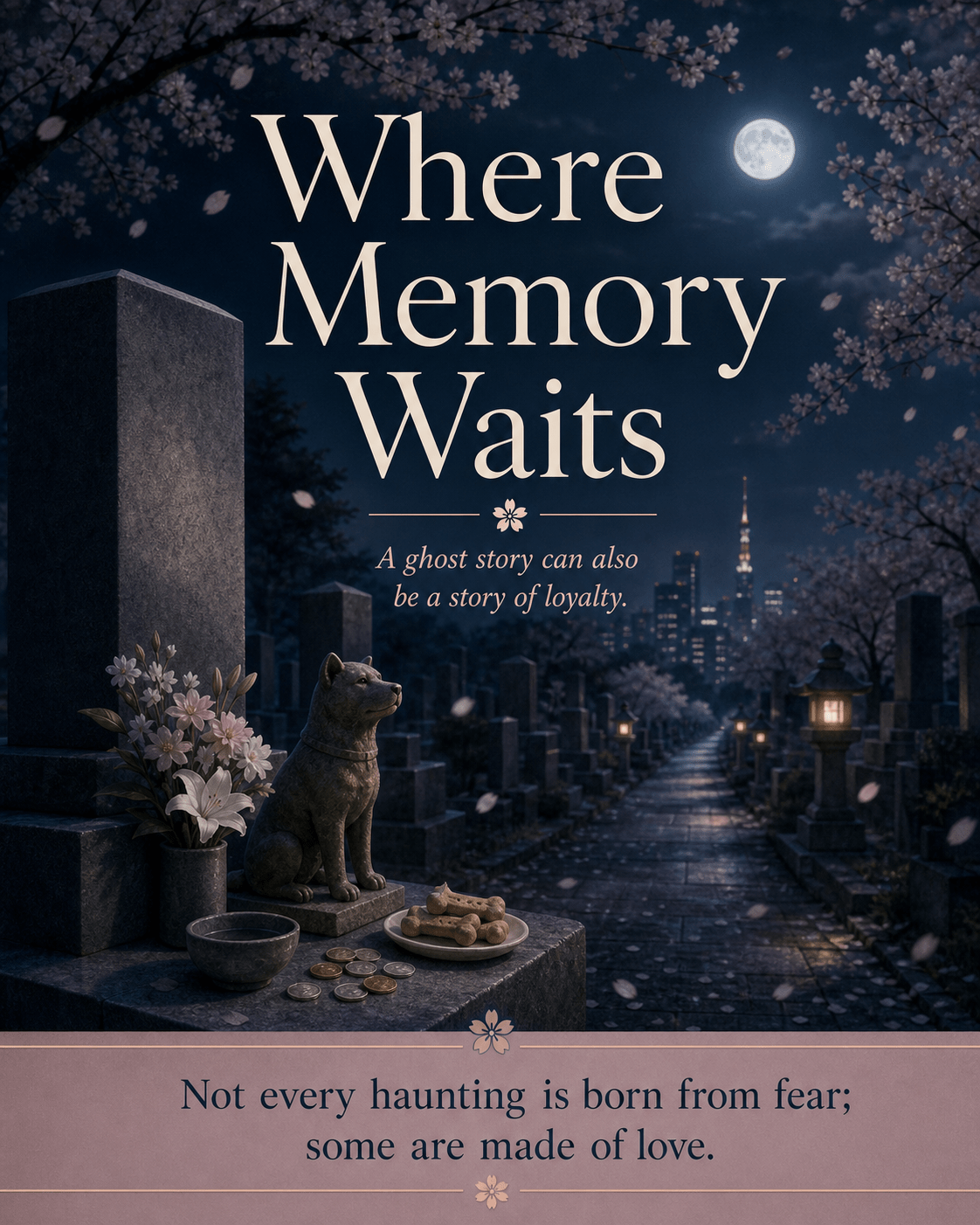
Instead, they found something more tender: the grave of Hachikō, the famous loyal dog, and his owner, Professor Hidesaburō Ueno.
Hachikō’s story is deeply loved in Japan. Every morning, he accompanied his owner to Shibuya Station. Every evening, he returned to wait for him. But in 1925, Professor Ueno died suddenly and never came home. Even after Hachikō was taken in by others, he continued to wait at the station, day after day, year after year.
In the cemetery, offerings had been left: flowers, coins, and dog treats. The grave felt less like a place of horror than a place of devotion. In the middle of a ghost hunt, the night had offered a different kind of haunting — not fear, but loyalty.
The dead are not only remembered because they frighten us. Sometimes they remain with us because they loved, waited, and were loved in return.
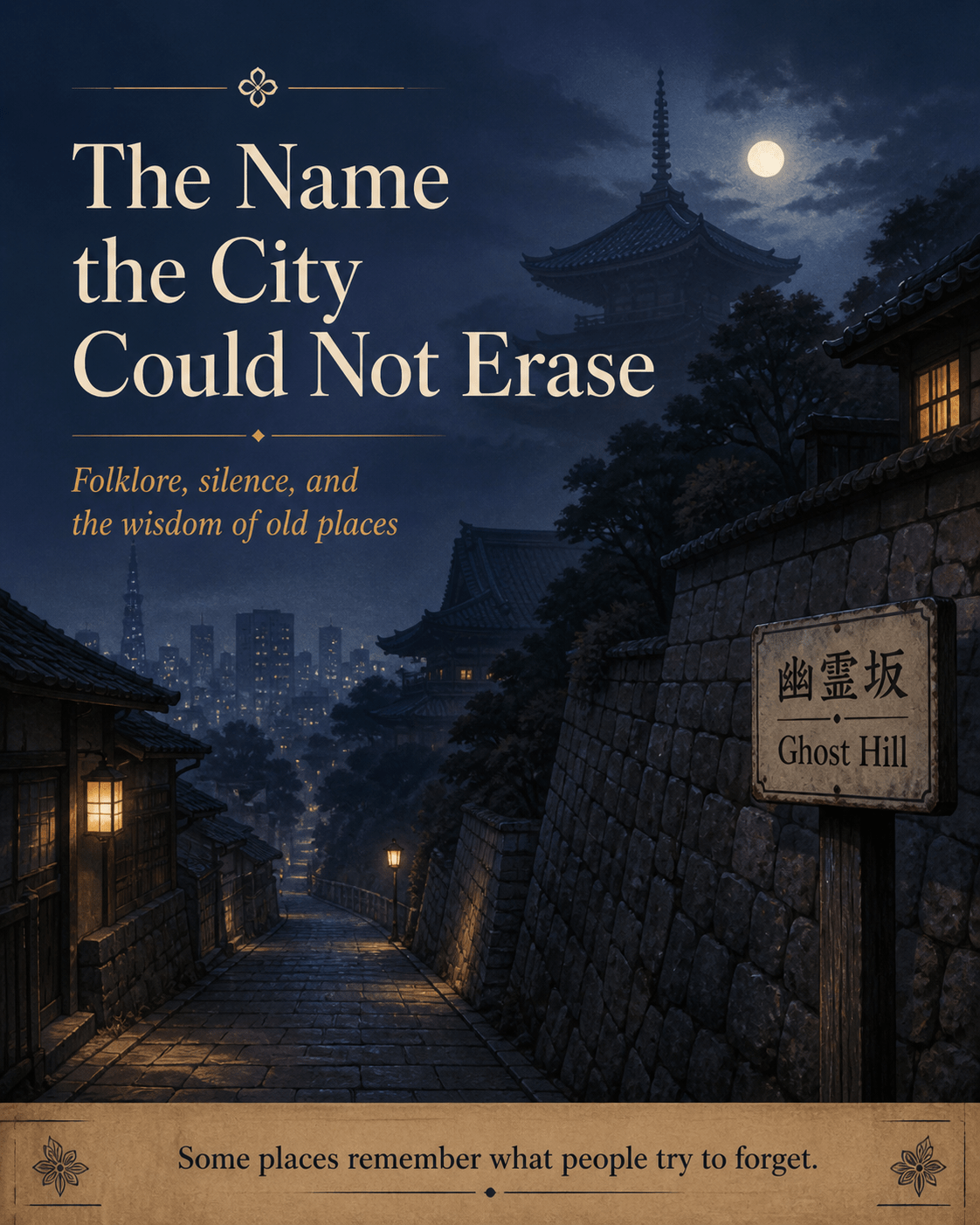
The second destination was a slope known as Yūrei-zaka, often translated as “Ghost Hill” or “Ghost Slope.”
Tokyo has several slopes with old names connected to ghosts, temples, graves, or strange local legends. Some neighborhoods have softened or changed such names over time, perhaps because few people want to live beside a place openly called “Ghost Hill.” Yet names have a way of preserving what official maps sometimes try to smooth over.
This slope remained.
The street itself did not look terrifying. Houses stood nearby. Lights glowed in windows. Cars were parked. It was not the abandoned, cinematic kind of haunted place one might expect. And yet the quiet felt unusually thick.
Around the area were temples and graveyards, reminders that Tokyo is not only a city of the present. It is built in layers. Under the apartment buildings, roads, cafés, and convenience stores are older patterns of belief, burial, prayer, and memory.
The ghost-hunting app was opened again.
At first, the reading was low. Nothing strange. Nothing to report.
Then, near one graveyard, the reading rose. The screen changed. The numbers climbed. When they stepped away, the reading fell. When they returned, it rose again.
Was it electromagnetic interference? A coincidence? A phone reacting to ordinary urban signals? Very possibly. But the experience changed the mood. Even the skeptic becomes quieter when a machine appears to confirm what the imagination has already begun to suspect.
The women laughed, but less loudly than before.
Ghost Hill did not need a visible apparition to feel haunted. Its power was in the name, the silence, and the awareness that many generations had passed through that same slope, carrying fears of their own.
A place can be haunted by stories as much as by spirits.
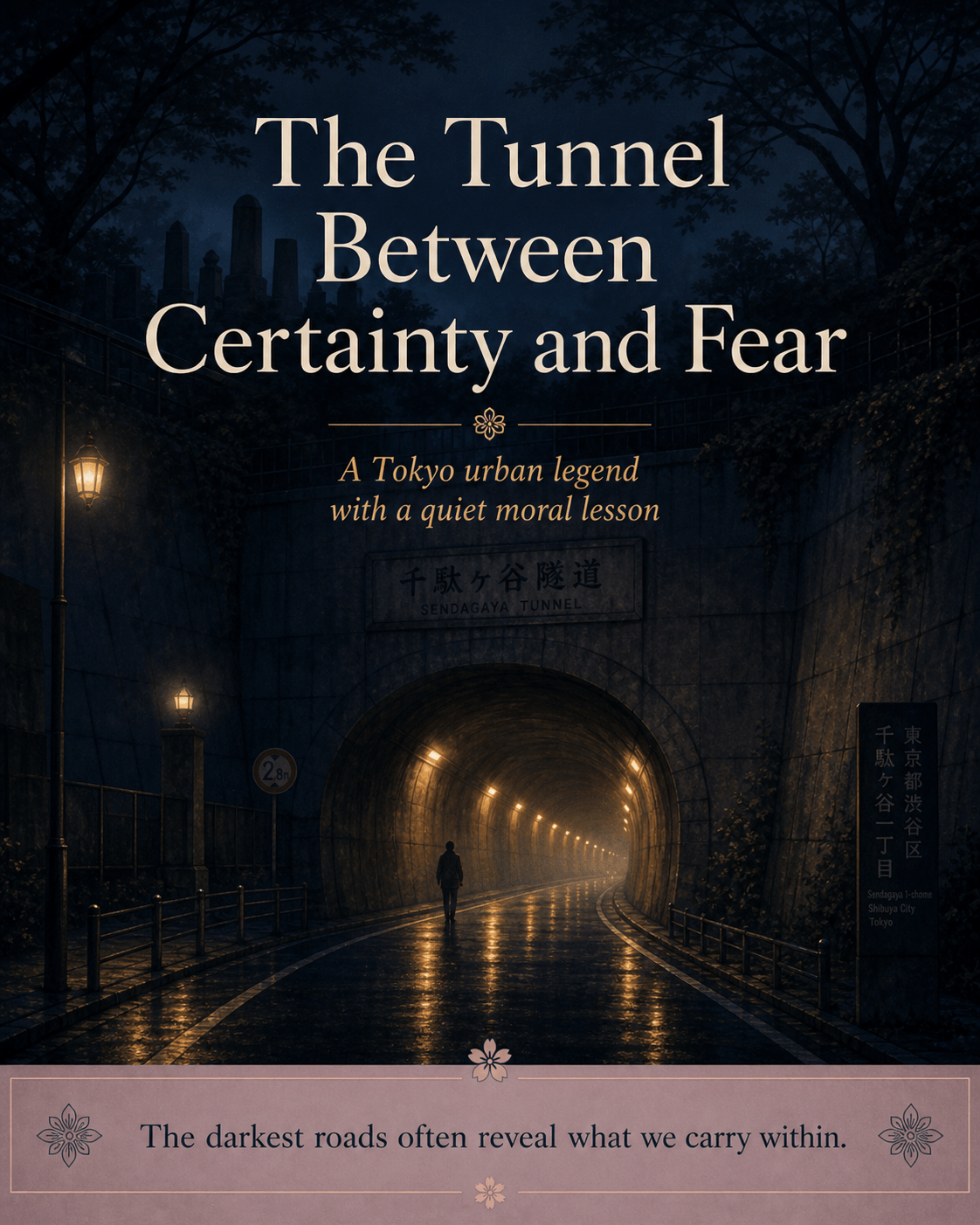
The final destination was Sendagaya Tunnel.
Tunnels often attract ghost stories. They are thresholds — neither here nor there, neither open sky nor fully enclosed room. To enter a tunnel at night is to pass briefly into a narrow world of echoes, headlights, stains, and strange acoustics. Every sound changes inside it.
This tunnel was said to have a cemetery above it, a detail that often appears in the ghost stories told about the place. Some tales speak of figures appearing suddenly, including an elderly man who vanishes when approached. Other stories are less specific: a feeling of being watched, a coldness, a presence near the walls.
Again, these are stories, not verified facts. But folklore does not always ask us to treat it as evidence. Sometimes it asks us to notice what people choose to remember.
The tunnel was not empty. Cars passed through, loud and ordinary. The noise made it difficult to feel completely alone. Graffiti marked the walls. Yellow lights gave the concrete an uneasy glow. At one point, a strange symbol on the wall seemed to resemble a triangle with an eye. Someone joked about secret societies. Then, almost absurdly, the sight of a nearby McDonald’s broke the tension.
That mixture — fear, laughter, superstition, modern city life — is part of what makes urban legends so enduring. A haunted tunnel does not need to be far from daily life. It can exist beside traffic lights, chain restaurants, and pedestrians on their way home.
The night ended without a confirmed ghost.
But perhaps that was never the true point.
What the journey revealed was how easily ordinary places become mysterious when we enter them with attention. A cemetery becomes a meditation on loyalty. A slope becomes a vessel for old names. A tunnel becomes a symbol of crossing from certainty into uncertainty.
The ghosts may or may not have been there.
The stories certainly were.
Affirmation:
I do not need to banish fear; I can walk with it, listen to it, and still move forward.
Fear is often treated as something to defeat. But many old stories suggest a quieter wisdom: fear is not always an enemy. Sometimes it is a messenger. It tells us where memory lives, where uncertainty begins, and where we are being asked to pay attention.
A proverb-like way to express the lesson might be:
“The brave do not walk without fear; they walk while listening.”
This does not mean we should seek danger or believe every rumor. Rather, it suggests that courage can be calm, curious, and reflective. In the ghost walk through Tokyo, fear did not lead to panic. It led to observation — of graves, names, offerings, silence, and the emotional weight of place.
In many Japanese ghost stories, the spirit is not only a figure but also an atmosphere. A haunting may belong to a bridge, a well, a slope, a tunnel, a room, or a tree. Place matters.
This reflects a broader cultural sensitivity to memory embedded in location. Temples, cemeteries, roadside shrines, and old place names often preserve traces of the past in daily life. Even in a modern city like Tokyo, the sacred and the ordinary can stand side by side.
A street may be lined with homes and still carry an old ghostly name. A cemetery may be a cherry blossom spot and also a place of mourning. A tunnel may be part of a traffic route and still inspire stories about what lingers above or within it.
Japanese folklore often uses such places as thresholds. They are not simply “scary.” They remind us that human life is layered: joy and grief, modernity and memory, skepticism and belief.
This is why a ghost story can become a form of cultural insight. It reveals not only what people fear, but what they remember.
Why are we drawn to scary stories?
One answer is that fear becomes easier to face when it has a shape. A nameless anxiety inside the mind can feel unbearable. But when it becomes a ghost story, a haunted hill, or a tunnel legend, we can stand outside it for a moment and look at it.
Folklore gives fear a language.
The Tokyo ghost walk is filled with laughter, skepticism, nervous jokes, and sudden seriousness. This is psychologically familiar. People often approach fear indirectly. We joke because we are uncomfortable. We test our courage because we want to know our limits. We visit eerie places because controlled fear can make hidden emotions visible.
Rather than proving the supernatural, a story like this reveals how people live with uncertainty. The ghost app may be unreliable. The rumors may be unverifiable. The shadows may simply be shadows. And yet the emotional experience is real.
Fear, even when mistaken, tells us something true about the human mind.
One way to read this story is not as a warning against darkness, but as an invitation to listen more carefully.
In modern life, we often rush past uncomfortable feelings. We rename them, distract ourselves from them, or cover them with noise. Yet the old name of Ghost Hill remains meaningful precisely because it was not fully erased. It suggests that what frightens us may still deserve a name.
Fear does not always ask us to run. Sometimes it asks us to notice.
What place in your life feels like a tunnel — narrow, uncertain, echoing with things you do not fully understand? What memory feels like a cemetery — quiet, painful, but also worthy of respect? What old name have you tried to replace with something easier?
This story may remind us that courage is not always dramatic. Sometimes courage is walking through a quiet place with open eyes, admitting that we are afraid, and allowing that fear to deepen our understanding rather than close our hearts.
The lesson is not to believe every ghost story.
The lesson is to recognize that even fear can become wisdom when we are willing to listen.
The next time a place, memory, or feeling unsettles you, ask yourself gently:
What is this fear trying to protect, remember, or reveal?
Perhaps the real mystery is not whether something waits in the dark, but what awakens within us when we choose to keep walking.
Affirmation:
I do not need to banish fear; I can walk with it, listen to it, and still move forward.
Proverb-like line:
“The brave do not walk without fear; they walk while listening.”
Japanese ghost stories often connect spirits, memory, and emotion to specific places such as wells, bridges, slopes, cemeteries, tunnels, and old houses. In this article, Tokyo is presented not only as a modern city but as a layered cultural landscape where old names, graves, offerings, and urban legends preserve traces of the past.
We are drawn to scary stories because they give shape to vague anxiety. A ghost story allows people to approach fear safely, with humor, curiosity, and reflection. Whether or not the supernatural is real, the emotional response reveals something true about how humans live with uncertainty.
This story may remind readers that fear does not always need to be conquered or denied. Sometimes fear asks to be heard. It can point toward memory, intuition, grief, respect, or unresolved questions. Courage is not the absence of fear, but the willingness to keep walking with awareness.
What fear in your own life might be asking to be understood rather than avoided?