Discover Koizumi Yakumo, the Greek-born British writer who loved Japan and its ghost stories so deeply that he became Japanese. Explore Hoichi, Yuki-Onna, Rokurokubi, and Mujina.

 Wonderful Proverbs Journey
※This site uses affiliate advertising.
Some Japanese scary stories begin with a ghost.
Others begin with a warning.
The tale known as Shinobara belongs to the second kind. Before the story even begins, the listener is asked to perform a strange little action: touch the left shin, close the eyes, and think of the name “Shinobara.” Then do the same with the left ring finger and pinky.
At first, it sounds almost childish, like a playground ritual or a strange game whispered between friends. Yet that is exactly where its unease begins. Many urban legends work this way. They invite us to participate before we fully understand what we have entered.
This story is often introduced as a “true” Japanese scary story, but it is better approached as modern folklore: a tale shaped by rumor, memory, fear, and the human need to give form to the unknown. Whether taken literally or symbolically, Shinobara is not only about terror. It is about the moment when curiosity becomes dread, when an ordinary road becomes unfamiliar, and when fear reveals what people choose to follow.
The story also belongs to a long tradition of mysterious Japanese tales in which place itself becomes dangerous. A tunnel, a shrine, a mountain road, a forgotten house, or an old village can become more than a setting. It becomes a threshold. Once crossed, the familiar world does not disappear all at once. It shifts slowly, quietly, almost politely, until the people inside it realize they have gone too far.
That is the true fear of Shinobara.
Not that something impossible appears.
But that the impossible arrives wearing the face of an ordinary villag
The story of Shinobara does not begin with a scream. It begins with boredom, youth, and the small arrogance of believing that fear can be treated as entertainment. A group of teenagers sets out for what they think will be a simple test of courage, but the village waiting for them is not merely dark or deserted. It feels old in a way no ordinary place should feel, as if the past itself has opened a narrow road and invited them in.

It was said to have happened in the spring of 2001.
By the time the narrator tells the story, many years have passed. Yet the details remain strangely clear to him: the warmth of the air, the end of cherry blossom season, the careless mood of youth, and the feeling that nothing truly serious could happen to someone like him.
He was a third-year high school student living near Tateyama in Toyama Prefecture. Tateyama is a place associated with mountains, snow, old roads, and deep rural silence. In daylight, such scenery can feel peaceful and almost sacred. But at night, the same landscape can become unfamiliar, as though the mountains have closed around the world and hidden it from ordinary time.
At that age, the narrator did not think deeply about such things.
Exams were approaching, but he was not worried. After graduation, he expected to help at his family’s bento shop. His future was not glamorous, but it was already decided. That certainty gave him a kind of laziness. He did not have to struggle too hard. He did not have to imagine too much.
He describes himself as foolish in the way young people sometimes are foolish. Not evil. Not especially cruel. Just careless. He dyed his hair light brown. He smoked cigarettes with friends. He rode bikes without a license. He and his friends were not the kind of boys who terrorized others, but they lived close enough to trouble to mistake recklessness for freedom.
His closest friends were I-kun and H.
I-kun was the kind of friend who became excited easily. If something sounded strange, dangerous, or funny, he wanted to record it, photograph it, or talk about it later. H was quieter. He had lost his right leg below the knee, an injury he once explained as the result of a bike accident. He used an artificial leg, and although he usually acted as if it did not bother him, there were moments when the narrator noticed him scratching or adjusting it with a private irritation.
One day, H approached the narrator with an idea.
“Do you want to go somewhere tomorrow?”
There was not much to do nearby. The usual places felt stale. Pachinko parlors, convenience stores, empty roads, the same faces, the same jokes. So when H mentioned a village, the narrator listened.
“A village?” he asked.
“Yeah,” H said. “There’s a place. We could do a test of courage.”
A test of courage — kimodameshi — is a familiar idea in Japan. Teenagers or young adults visit a frightening place at night: a cemetery, an abandoned building, a mountain road, a tunnel, a shrine, or a place rumored to be haunted. The goal is not always to witness something supernatural. Often, the point is to feel fear together, to laugh afterward, and to prove that one is not easily frightened.
H added one more detail.
“We’ll invite some girls too.”
That changed everything.
The narrator admits that the idea itself did not sound especially interesting. A village was just a village. A haunted rumor was just a rumor. But if girls were coming, the whole thing became different. It became an outing. A chance to show off. A chance to appear brave.
I-kun immediately grew excited.
“I’ll bring a camera,” he said.
H only nodded and said he would invite the girls.
Looking back, the narrator remembers that moment with discomfort. At the time, he thought H was simply planning a night of fun. Later, he would wonder whether H had already known exactly where he wanted to go.
The next day, the group became six people: the narrator, I-kun, H, and three girls from school.
During the train ride, nothing felt frightening. That may be one of the reasons the memory bothers the narrator so much. Fear did not announce itself at the beginning. There was no storm, no bad omen, no sudden silence. There was only the ordinary sound of the train, the chatter of teenagers, and the awkward excitement of boys trying to impress girls.
They joked about ghosts. They laughed about who would scream first. I-kun checked his camera more than once, as though afraid he might miss the perfect moment. H sat more quietly than usual, looking out the window as the scenery changed from town to countryside.
The trip took about two hours.
As the train moved farther from familiar places, the houses grew fewer. Fields opened around them. Roads narrowed. The sky felt wider. For the narrator, it still felt like an adventure. Not a dangerous one. Just something to break the boredom of ordinary life.
When they finally arrived near the village, the first impression was disappointing.
There was no dramatic entrance. No abandoned gate. No signboard with strange writing. The village looked like a small rural settlement: rice fields, scattered houses, a few dim lights, the smell of damp earth, and the quiet emptiness that comes after sunset in the countryside.
Someone laughed and said it did not look haunted at all.
That made everyone relax.
They began walking without any particular plan. There was no destination, no famous haunted house, no shrine, no old tunnel. They simply wandered, talking too loudly in the night because silence made them uncomfortable.
Then, from somewhere far away, they heard a voice.
It was not close enough to understand.
It might have been a person calling to someone. It might have been a farmer, a resident, or even one of them mishearing the wind. At first, nobody treated it seriously.
But the voice came again.
Or perhaps it only felt that way.
The girls began to grow uneasy. Their jokes became shorter. Their footsteps slowed. One of them said she did not like the place. Another said she wanted to go back.
The narrator felt annoyed. He wanted to tell them not to ruin the mood. They had come all this way. They had agreed to a test of courage. Why complain now?
But then something happened to him too.
A light dizziness came over him. At first, he thought it was nothing. Maybe he was hungry. Maybe the air felt different. Then a sharp ringing entered his ears, thin and metallic, as if something invisible had been struck beside his head.
He stopped walking.
The ground felt different.
He looked down.
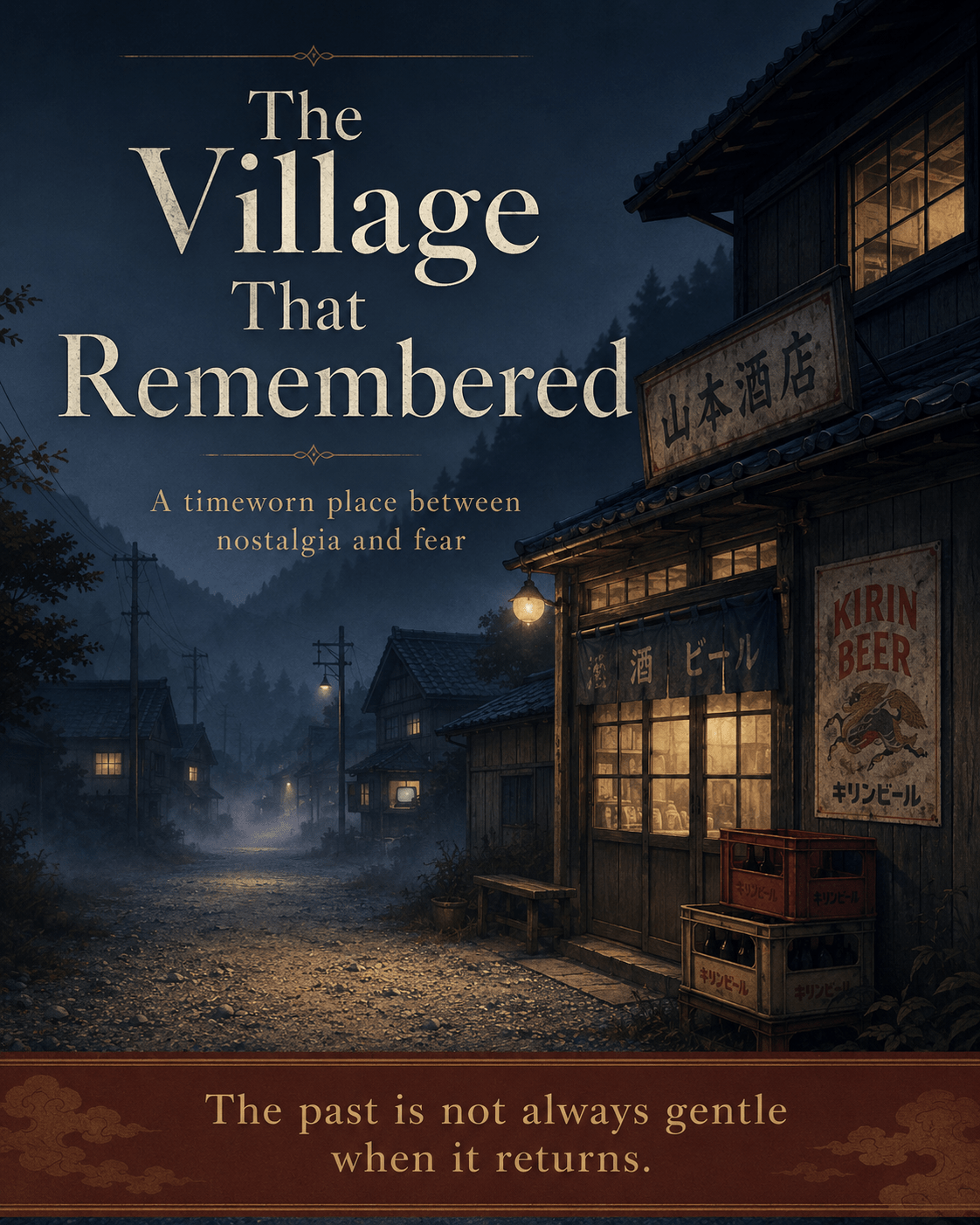
The asphalt road they had been walking on was gone.
Under his feet was gravel.
At first, no one spoke.
The narrator looked around, trying to understand what had changed. It was still the same village, or at least it seemed to be. The shape of the road was similar. The fields were still there. The houses had not vanished.
And yet everything was wrong.
The road was older. The houses looked older. The light from the windows had a dull yellow quality, unlike modern lamps. The air smelled faintly of smoke, damp wood, and something metallic. Even the silence felt different — not empty, but occupied.
It was as though the village had aged around them.
The narrator later describes it as a kind of time slip into the Showa period. The Showa period, especially in popular memory, carries images of postwar Japan: small shops, old signs, narrow streets, radio music, family businesses, and a kind of everyday life that feels nostalgic from a distance. But nostalgia becomes unsettling when it appears in the wrong place at the wrong hour.
They passed what looked like an old liquor shop. A faded Kirin beer poster hung near the entrance. Empty bottles were stacked beside a crate. The scene was ordinary, but too perfectly old, like a photograph that had somehow become three-dimensional.
From a nearby house came the sound of a television.
The sound was faint, but it did not resemble the clean sound of modern broadcasts. It was tinny, distant, and warped, as though passing through walls from another decade. Then music drifted out from somewhere deeper in the village.
I-kun tilted his head.
“Isn’t that old?” he said.
The narrator recognized the melody only after a moment. It sounded like “Tokyo Boogie-Woogie,” a famous Japanese song from the postwar era. In another setting, the tune might have seemed cheerful or nostalgic. In that village, it felt horribly out of place.
The girls stopped walking.
“This is weird,” one whispered.
Another clutched her own arms, though the night was not cold.
“Let’s go back,” someone said.
For the first time, no one laughed.
The narrator expected H to agree. H had been the one who suggested the trip, but surely even he could see that something was wrong.
Instead, H kept walking.
“Just a little farther,” he said.
His voice was low. It did not sound like someone trying to make the others laugh. It sounded like someone speaking to himself.
The narrator watched him from behind. H’s artificial leg dragged slightly as he moved over the gravel. He should have been tired. They had already walked a long way. Yet he did not slow down. If anything, he seemed pulled forward.
“H,” the narrator called. “What are you doing?”
H did not answer.
“Come on,” H said again. “Just a little farther.”
That phrase began to feel less like a suggestion and more like a spell.
Just a little farther.
Not far enough to refuse.
Not strange enough to run.
Not dangerous enough, yet, to admit fear.
So they followed.
H3: The House with No Light
The deeper they walked, the less the village felt like a place where people lived.
There were lights in some houses, but no people appeared. No curtains moved. No doors opened. No dogs barked. The village had sound — music, television, wind, gravel underfoot — but it did not have life in the ordinary sense.
Then H stopped.
He stood before one house.
It was not large. It did not look like a mansion from a horror film. It was an ordinary rural house with a gate, a garden, and a nameplate. Perhaps that was what made it worse. Terrible things in folklore often do not appear in dramatic shapes. They wait inside ordinary forms.
The house was darker than the others.
No light shone from its windows.
The nameplate at the gate read:
Shinobara.
The narrator stared at the characters.
He did not know the family. He had never heard the name before. Yet after everything that had happened — the strange instructions connected to the name, the old road, the changed village, H’s insistence — the sight of that name felt less like a coincidence than an arrival.
One of the girls whispered, “Is this the place?”
No one answered.
A faint sound came from the garden.
It was difficult to identify. Something heavy. Something wet. A dull movement, repeated at uneven intervals.
The narrator suddenly felt the absurdity of the situation. They were standing in front of someone’s house in the middle of the night. They had no right to be there. If a resident came out and yelled at them, they would deserve it.
That thought almost comforted him.
Being scolded by an angry homeowner would mean the world still worked normally. It would mean this was still a village, still the present, still a night that could be explained.
“Let’s go,” he said.
But H grabbed his arm.
“Not yet,” H said.
His hand was cold.
The narrator turned to him and saw that H’s face had changed. He was sweating. His eyes were fixed on the garden, not with curiosity, but with something closer to recognition.
“Do you know this place?” the narrator asked.
H did not answer.
I-kun tried to laugh.
“What, are there ghosts here?”
Nobody laughed with him.
Still, perhaps because no one wanted to be the first to admit terror, they entered through the gate.
The gravel in the garden made a small crushing sound beneath their feet.
They moved toward the noise.
H3: The Woman in the Garden
At first, the figure in the garden looked like a person bending over.
That was the mind’s first act of mercy: it tried to make the scene ordinary.
A person.
A resident.
Someone doing late-night work.
Someone who would turn around and shout at them for trespassing.
The group stopped several steps away.
The figure appeared to be a woman. Her clothes looked old-fashioned, not ceremonial, not theatrical, simply old. Her posture was low and intent. She raised her right arm, then brought it down sharply toward the ground.
Again.
And again.
There were several dark holes before her, roughly the size of manholes. In the weak light, the narrator could not see what was inside them. He could only hear the sound of the repeated motion.
No one spoke.
Then I-kun lifted his camera.
Perhaps he did it out of nervousness. Perhaps he thought that if he photographed the scene, it would become less frightening. A photograph turns terror into evidence, and evidence can be looked at later, discussed, laughed about, controlled.
The flash went off.
For one instant, the garden became white.
In that instant, the narrator saw too much.
The woman held a large blade in her right hand. The ground around her was dark and wet. Inside the holes were shapes that the mind did not want to arrange into meaning: pale limbs, torn cloth, hair, fingers, fragments that suggested bodies without allowing the eye to rest long enough to understand them fully.
The narrator does not describe the scene like someone admiring horror. He describes it like someone who wishes memory had failed.
The flash vanished.
Darkness returned.
But the image stayed inside him.
H ran first.
That may have saved some of them. Or it may only have shattered the fragile spell that had kept them standing still.
One of the girls screamed.
The woman turned.
The narrator remembers the movement more clearly than the face. It was not the slow turning of an ordinary person surprised by intruders. It was abrupt and wrong, a twisting motion that made the body seem almost disconnected from itself. The blade caught the light for a moment.
Panic broke the group apart.
There was no more pretending. No more test of courage. No more boys trying to look brave in front of girls. The village, the road, the song, the house — everything collapsed into one command.
Run.
They ran.
The narrator remembers the sound of everyone’s breathing more than the path itself. He remembers feet striking gravel, voices breaking, someone sobbing while running, and the terrible feeling that the village had become longer than before.
The gate should have been close.
The road should have been simple.
But fear changes distance. A few meters becomes endless. A familiar path becomes a maze. The mind, desperate to survive, stops making a map and begins counting only what is immediate: breath, step, shadow, sound.
H was ahead of them.
That alone seemed impossible. With his artificial leg, he should not have been able to move so quickly. Yet he ran as though pain no longer belonged to him. The narrator saw him only in fragments: the shape of his back, the uneven movement of his legs, the desperate swing of his arms.
Behind them came a sound.
Not footsteps exactly.
Something faster and less regular.
One of the girls cried out. The narrator turned only enough to see motion behind him. A pale shape. Hair. The impression of an arm reaching forward.
Then another scream.
He did not stop.
This is the part of the story that carries the heaviest shame. The narrator does not pretend to be noble. He does not say he tried to save everyone. He says, in effect, that fear filled his head until there was no room left for anything else.
He ran.
He left someone behind.
That honesty gives the tale its human weight. In many frightening stories, people imagine themselves as heroes. They believe they would turn back, fight, rescue, sacrifice. But Shinobara offers a colder possibility: when terror becomes absolute, a person may become smaller than their own ideals.
The remaining members of the group reached the gravel road.
One girl ran ahead toward a house with lights on. Perhaps, in that moment, light still meant safety. A lit house meant people. People meant help. Help meant the world had not entirely broken.
She pounded on the door.
“Help us!”
Her voice cracked.
“Please!”
The sliding door opened suddenly.
The girl, still pushing forward, stumbled into the entrance.
For one brief second, the narrator may have felt relief.
A door had opened.
Someone was there.
They had reached a human place.
But in stories like this, an open door is not always rescue.
Sometimes it is only another threshold.
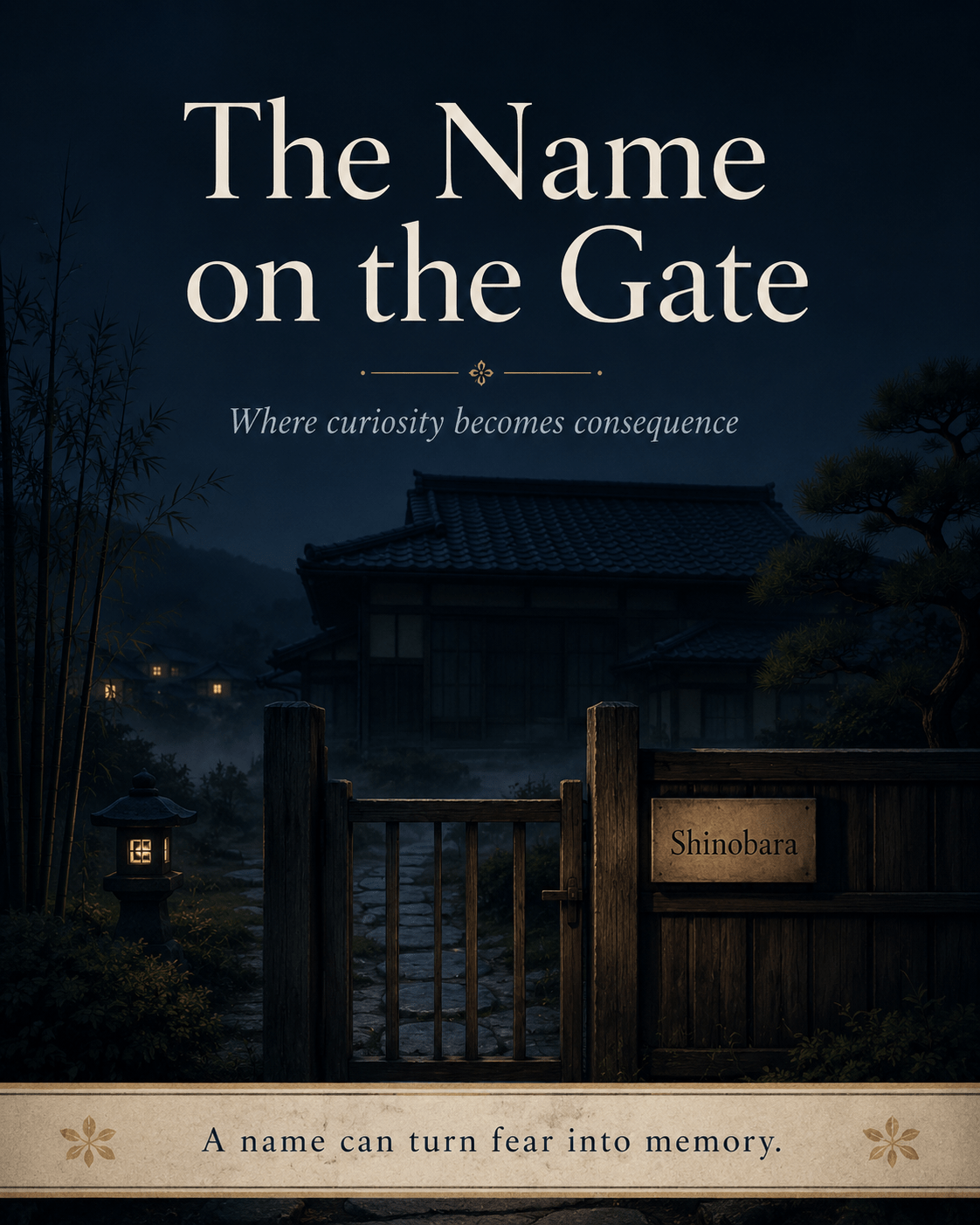
The surviving fragment of Shinobara leaves the reader at a threshold: a door sliding open, a girl falling inside, the others still trapped between the old village and the road back to the present.
That unfinished quality may be part of why the story lingers.
Not every frightening tale needs a neat ending. Sometimes, what unsettles us most is not knowing exactly what happened, or whether anyone could have explained it afterward. Did the village exist? Did the group wander into a forgotten settlement? Was it a time slip, a hallucination, a curse, or a rumor reshaped through retelling?
The story does not give us certainty.
Instead, it gives us images.
A name repeated before the story begins.
A shin touched like part of a ritual.
A village that grows older as the group walks deeper.
A cheerful postwar song floating through the dark.
A friend who insists, “Just a little farther.”
A house with no light.
A nameplate reading Shinobara.
A flash of a camera.
A door opening when help is begged for.
These images matter because they do what folklore often does best: they turn fear into memory.
Shinobara may not ask us to believe in every detail. It may not even ask us to decide whether the story is “true.” Instead, it asks us to sit with a quieter question.
When did they first know something was wrong?
And why did they continue?
That question is what makes the tale more than a simple ghost story. The terror is not only in the woman, the blade, or the village. It is in the gradual surrender of judgment. It is in the way each person waits for someone else to say stop. It is in the ease with which a group can walk deeper into danger because turning back would feel embarrassing.
Perhaps the most frightening words in the story are not “Shinobara” at all.
Perhaps they are:
“Just a little farther.”
“Not every open road is an invitation.”
This line is not a traditional proverb, but it carries the spirit of many old warnings. In folklore, the dangerous path is rarely marked with a clear sign. It often appears ordinary, even tempting. The danger begins when curiosity walks ahead of wisdom.
A more reflective affirmation inspired by the story might be:
“I honor the quiet warning within me before fear becomes regret.”
This does not mean we should avoid every unknown path. Life often asks us to step into uncertainty. But Shinobara suggests that courage and recklessness are not the same. Courage listens. Recklessness performs.
In many Japanese ghost stories and urban legends, place is never just background. A tunnel, a shrine, a mountain road, an empty house, or a forgotten village can become almost like a character.
Shinobara uses this idea powerfully. The village does not simply frighten the characters because it is dark. It frightens them because it feels displaced from time. The shift from asphalt to gravel, the old beer poster, the sound of an old television, and the song “Tokyo Boogie-Woogie” all suggest a place that belongs to memory rather than the present.
For English-speaking readers, it may help to understand the emotional weight of the Showa period in Japanese cultural memory. Showa refers to the era from 1926 to 1989, but in popular imagination, it often evokes postwar streets, old shops, family-run businesses, black-and-white television, and a kind of nostalgic everyday life. In a ghost story, however, nostalgia can become unsettling. The past is not always gentle. Sometimes it waits.
The house name “Shinobara” also matters. Japanese ghost stories often attach fear to names: the name of a tunnel, a family, a village, a room, a woman, or a place that locals avoid. A name gives fear a location. It turns vague anxiety into something one can point to, whisper, and remember.
This is one reason old stories endure. They make fear portable. They allow a place, a word, or a name to carry emotional weight across time.
In Shinobara, the village may symbolize the past. The house may symbolize a boundary. The nameplate may symbolize recognition. And H’s repeated insistence — “just a little farther” — may symbolize the dangerous pressure to continue even when the body already understands what the mind refuses to admit.
Why do people listen to frightening stories, even when they know they may feel uneasy afterward?
One answer is that scary stories give shape to nameless anxiety. In daily life, fear is often vague. We worry about the future, regret the past, sense danger in relationships, or feel that something is wrong before we can explain why. A ghost story gathers those scattered feelings and gives them a body, a road, a village, a house, a name.
Shinobara is especially unsettling because the characters enter danger gradually. There is no single moment when they clearly choose disaster. They agree to a harmless outing. They laugh. They follow a friend. They ignore discomfort. They continue a little farther.
That phrase — just a little farther — may be the most frightening part of the story.
Many bad decisions in real life do not begin with dramatic evil. They begin with small permissions. One more step. One more excuse. One more silence. One more moment of ignoring what the body already knows.
Rather than proving the supernatural, Shinobara may reveal something quieter and more human: fear often speaks before reason does.
This is why the story has psychological power. The horror is not only outside the characters. It is also inside the ordinary human tendency to delay action. The group senses something is wrong, but each person waits for someone else to confirm it. Nobody wants to be the coward. Nobody wants to ruin the mood. Nobody wants to admit that the game has stopped being a game.
And so they continue.
Fear, in this story, is not merely a reaction to danger. It is a language. The dizziness, the ringing in the ears, the changed road, the silence, the discomfort among the girls — all of these are warnings. But warnings are easy to dismiss when they arrive softly.
By the time fear becomes undeniable, it may already be too late.
One way to read Shinobara is as a story about the danger of following without reflection.
The narrator does not go to the village because he has a deep reason. He goes because his friend suggests it, because the idea sounds exciting, because girls are coming, because everyone else is going. These are ordinary reasons. That is what makes them believable.
In modern life, we may not walk into haunted villages, but we often follow invisible roads: social pressure, pride, curiosity, ambition, fear of missing out, or the desire to appear brave. Sometimes the most important wisdom is not dramatic courage, but the quiet ability to stop and say:
“This does not feel right.”
The lesson is not that we should fear every unknown place. Life requires courage. Growth often asks us to step beyond comfort. But Shinobara reminds us that courage and recklessness are not the same.
Courage listens.
Recklessness performs.
Fear, when understood carefully, is not always an enemy. Sometimes it is a form of attention. It asks us to notice what pride overlooks. It asks us to respect the small signals that come before obvious danger.
The story may also remind us that group pressure can be subtle. Nobody in the group forces the narrator to continue. Nobody gives a grand speech about bravery. The pressure is quieter than that. It is in the embarrassment of turning back. It is in the desire not to look weak. It is in the hope that someone else will make the decision first.
This is why Shinobara speaks beyond horror. It can be read as a tale about intuition, boundaries, and the courage to disappoint others before we betray ourselves.
The most memorable part of Shinobara is not only the frightening woman, the old song, or the nameplate on the gate. It is the slow transformation of the ordinary.
A normal outing becomes a test of courage.
A test of courage becomes a journey into the past.
A rural village becomes a place that should not exist.
A friend becomes someone with an unknown purpose.
A house becomes a warning.
This is how many powerful folk stories work. They do not simply say, “Be careful.” Instead, they allow us to feel what carelessness is like from the inside.
The story leaves us with a quiet question:
When did the danger begin?
Was it when they entered the village?
When the road changed?
When H said, “Just a little farther”?
When they saw the name Shinobara?
Or much earlier, when they agreed to turn fear into entertainment?
Perhaps the answer is different for every reader.
For some, the danger begins with the ritual at the start — the instruction to touch the shin and think of the name. For others, it begins when the group hears the distant voice. For others, it begins when they ignore the girls’ discomfort. For others still, the danger begins before the trip, in the careless belief that nothing serious could happen.
That is the quiet wisdom of the tale.
Fear rarely arrives as a full explanation. More often, it arrives as a small interruption: a strange sound, a change in atmosphere, an uneasy silence, a sentence that repeats itself too many times.
The question is whether we listen while the warning is still quiet.
When an old story frightens us, it may not be asking us to believe every detail.
It may be asking us to notice something.
A strange road.
A quiet warning.
A friend’s unusual insistence.
A feeling in the body before the mind can explain it.
Perhaps the real mystery of Shinobara is not whether the village existed.
Perhaps the real mystery is why people so often continue walking after fear has already told them to stop.
So the question this tale leaves behind is simple, but not easy:
What fear in your own life might be asking to be understood rather than ignored?