Explore Hyakki Yagyō, Japan’s mysterious night parade of demons, through folklore, fear, Kyoto history, and the wisdom hidden in darkness.
 Wonderful Proverbs Journey
※This site uses affiliate advertising.
There are some stories that do not feel like ordinary ghost stories. They do not begin with a scream, a haunted house, or a monster waiting in the dark. Instead, they begin with a family gathering, an old man drinking quietly, and a sentence repeated so often that no one takes it seriously anymore.
“Our ancestors were oni who lived in the mountain.”
As a child, the narrator laughs it off as a rustic family joke. But later, after learning a little history and folklore, he begins to notice strange connections: an old iron object kept like a sacred relic in the family storehouse, unusually tough soles inherited through generations, stories of iron-making people in the mountains, and legends that describe “oni” not simply as monsters, but perhaps as memories of people who lived differently from the villages below.
This article retells three connected mountain tales: the ancestor who may have been remembered as an oni, the weasel that repairs a broken boundary between worlds, and the strange white sword said to cut not flesh, but meaning itself.
Rather than treating these stories as proof of the supernatural, we can read them as folklore about memory, place, fear, and identity. In old mountain tales, the frightening thing is often not death. It is being forgotten, misplaced, or separated from the world that knows your name.
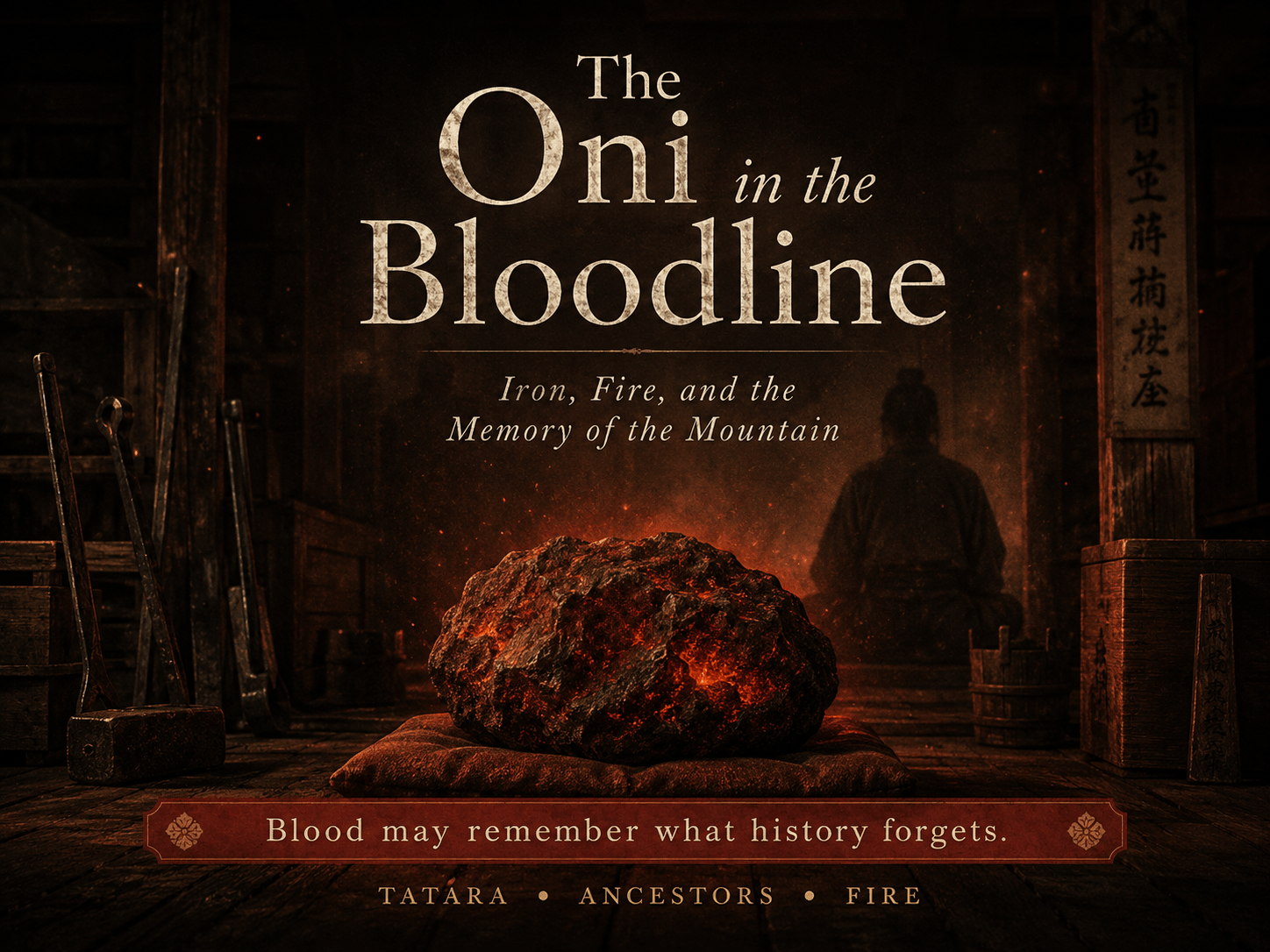
This section explores the first tale: a family legend that links oni, mountain ironworkers, and an ancestral memory preserved in the body.
The narrator’s family came from a mountainous area in the Chūgoku region of western Japan, a place once associated with tatara iron-making. Tatara is a traditional Japanese method of smelting iron sand using charcoal and intense heat. In communities shaped by this work, fire was not simply a tool. It was an environment, a danger, a livelihood, and almost a living presence.
In the old main house of the family, there was a storehouse. Inside it, half-hidden in the dimness, sat a massive rusted lump of iron. It was too large to be decorative and too solemnly kept to be ordinary scrap. The grandfather called it a treasure left by the ancestors. It was treated almost like a goshintai, a sacred object believed in Shinto contexts to house or represent a divine presence.
The narrator remembers hearing another strange detail from childhood. Men in the family, generation after generation, had unusually hard soles. Even as children, they could run barefoot over thorny mountain paths without much pain. The old explanation was simple and impossible-sounding: “The feet of the ancestral oni grew hard because they walked over hot charcoal.”
Later, at university, the narrator heard a theory that gave the family joke a darker glow. In some interpretations of Japanese folklore, mountain oni may have been symbolic memories of iron-working people. One-eyed oni could reflect workers who damaged their sight staring into furnace flames. Red-skinned oni might recall bodies reddened by heat and soot. Their strength, isolation, and frightening appearance may have turned them into figures of fear for settled agricultural communities.
That idea did not prove anything. But it made the old family stories feel less like nonsense and more like distorted history.
Then, one summer night, when the narrator was twenty, he stayed at the old family house. He woke thirsty and walked toward the kitchen. On the way, he passed the old storehouse where the iron relic was kept. From inside came a sound:
Kan. Kan.
A faint metallic tapping.
Thinking it might be a thief, he grabbed a piece of firewood and peered through a gap in the door. The storehouse should have been completely dark. Yet deep inside, around the iron lump, there was a dull red glow, like the heart of a stove.
A large man sat facing the iron.
He was broader than the narrator’s grandfather, heavy-shouldered, calm in the heat. His figure was dark, but his eyes shone red, like embers buried in ash. When he turned, the narrator did not feel hatred. The man seemed almost pleased, as if recognizing someone.
Then came a voice, low and heavy, not exactly in the ears but inside the skull:
“You carry a good fire too.”
The narrator lost consciousness. In the morning, he woke in his futon. At first he thought it had been a dream. But his palms were blackened with soot and iron dust that would not easily wash away.
At breakfast, he told his grandfather what had happened. The old man did not look surprised.
“So,” he said with a smile, “the sixth generation greeted you. He made the best iron in our line.”
According to the grandfather, when outside powers entered the mountain long ago, the family’s ancestors were not simply defeated monsters. They were skilled iron-makers who refused to submit. To those who wanted to control them, they became “oni”—dangerous, disobedient beings of the mountain. Eventually, rather than continue fighting, they offered part of their knowledge and became villagers, abandoning their oni name and taking a human surname.
The story ends quietly. There is no curse. No revenge. No disaster.
Only the suggestion that blood can remember what documents forget.
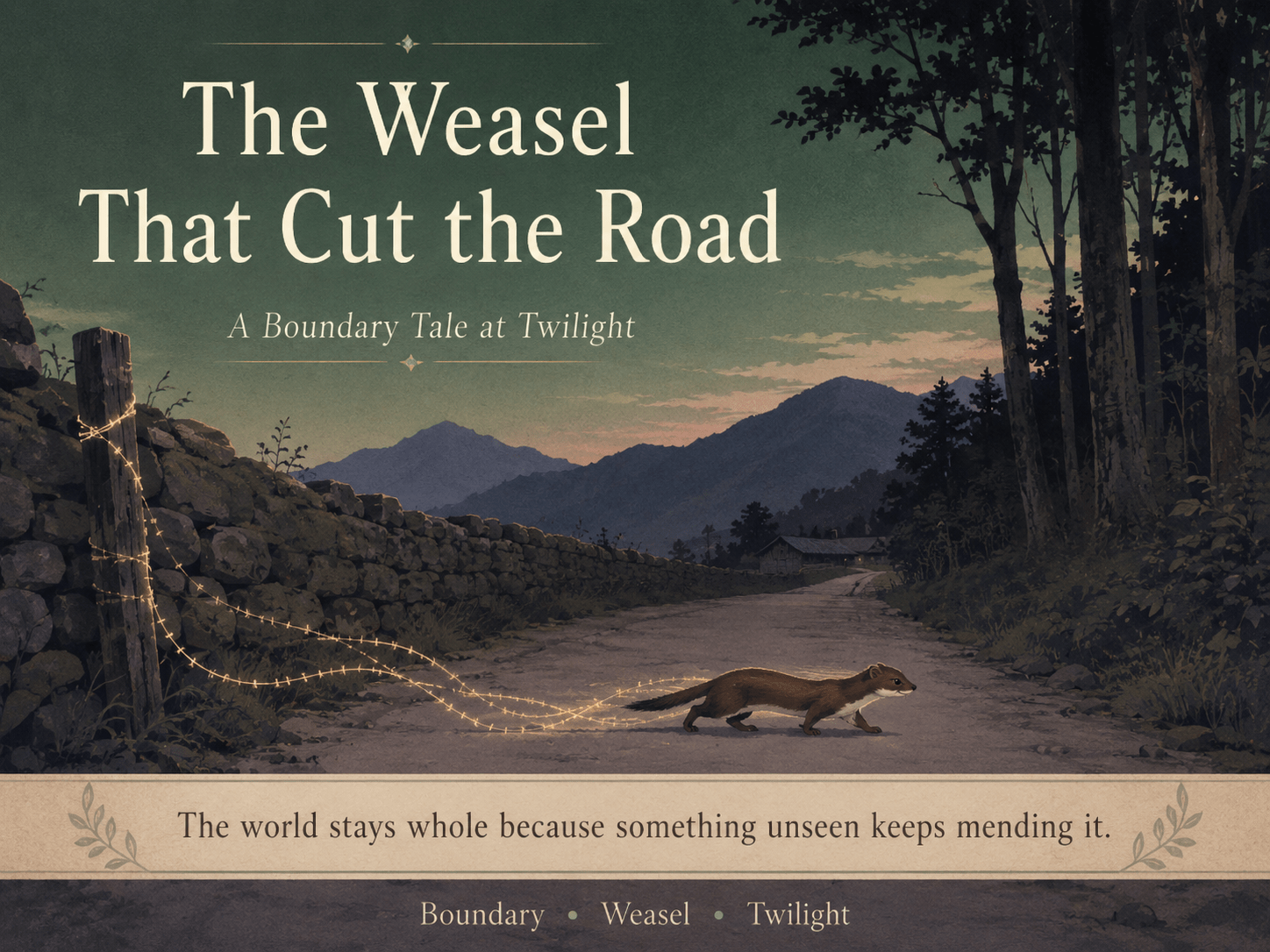
This section retells the second tale: a strange encounter with a weasel said not to curse travelers, but to repair the border between this world and somewhere else.
In rural Japanese folklore, animals often appear at boundaries. Foxes, tanuki, snakes, crows, cats, and weasels are not always “monsters.” They may act as messengers, tricksters, warnings, or guardians of places where ordinary rules become loose.
The narrator once heard of itachi no michikiri, “the weasel’s road-cutting.” In some local beliefs, if a weasel crosses in front of a person, the person may become confused, lose their way, or feel as if they have been bewitched. But his grandfather’s village had a stranger version.
One summer evening, when the narrator was a university student, he visited his grandfather’s countryside home. The house stood near the mountains. Behind it, the forest rose dark and close. Around five in the evening, the cicadas were crying, and the sky had begun to shift from red to purple—that in-between hour Japanese folklore sometimes treats as ōmagatoki, the time when strange things are more likely to appear.
His grandfather asked him to buy canned coffee from a vending machine five minutes down the road. The narrator slipped outside in sandals.
The road was simple: stone wall on one side, thick woods on the other.
Ahead, he saw a small brown animal. A weasel.
It crossed the road from right to left.
Then, instead of disappearing into the grass, it came back.
Backward.
Smoothly, impossibly, as if sliding over the road.
It crossed again. Forward. Then backward. Then forward again. It did not seem frightened. It did not seem aggressive. It was simply repeating the act of crossing the same space, as if the road itself were a seam that needed to be stitched.
Then the sound changed.
The cicadas grew distant. A dry shuffling sound began inside his ears. The road seemed wider than it should have been. The straight path ahead bent where no curve existed. When he looked up, the sky was green—not the green of leaves, but the artificial green of fluorescent light spread across the heavens.
Oddly, he was not afraid. He felt almost dreamy, watching the weasel move back and forth. Behind its small body, the air seemed to twist like tangled thread.
At that moment, the narrator thought:
“It’s sewing the space back together.”
Then his grandfather’s voice came from behind him.
“What are you doing there?”
There was a sharp popping sound, like a balloon bursting near his ear. The world snapped back. The sky returned to normal dusk. The cicadas cried loudly. The road was straight again. The weasel had vanished.
His grandfather was holding a flashlight.
“You went to buy coffee,” he said, “and never came back. It’s been an hour.”
To the narrator, only five minutes had passed.
When he explained what he had seen, the grandfather listened and nodded.
“That wasn’t ordinary weasel road-cutting,” he said. “That was tsuji no men-keshi.”
The phrase might be understood as something like “erasing a face at the crossroads” or “wiping away the surface of a boundary.” According to the old man, that road stood where the boundary between the human world and the mountain world often weakened. Sometimes, strange spaces leaked out like frayed thread. If left alone, people might vanish, or the atmosphere of the mountain might flow into the village.
The weasel, as a messenger of the mountain, crossed repeatedly to seal the tear.
Forward to stitch the boundary.
Backward to unwind the time of the wrong space.
The green sky, the old man said, was not the sky of this world. It was a place that had begun to overlap.
Then he asked if there had been anything on the road. The narrator remembered seeing small black crumbs, like eraser dust, where the weasel had passed.
“Shavings of the leaked space,” the grandfather said. “Good thing you didn’t step on them. Part of you might have been carried away.”
The story is not frightening in a simple way. The weasel is not evil. It is working. It is maintaining a border most people never notice.
And perhaps that is what makes the tale linger. The world remains ordinary because something small, quick, and unnoticed is constantly repairing it.
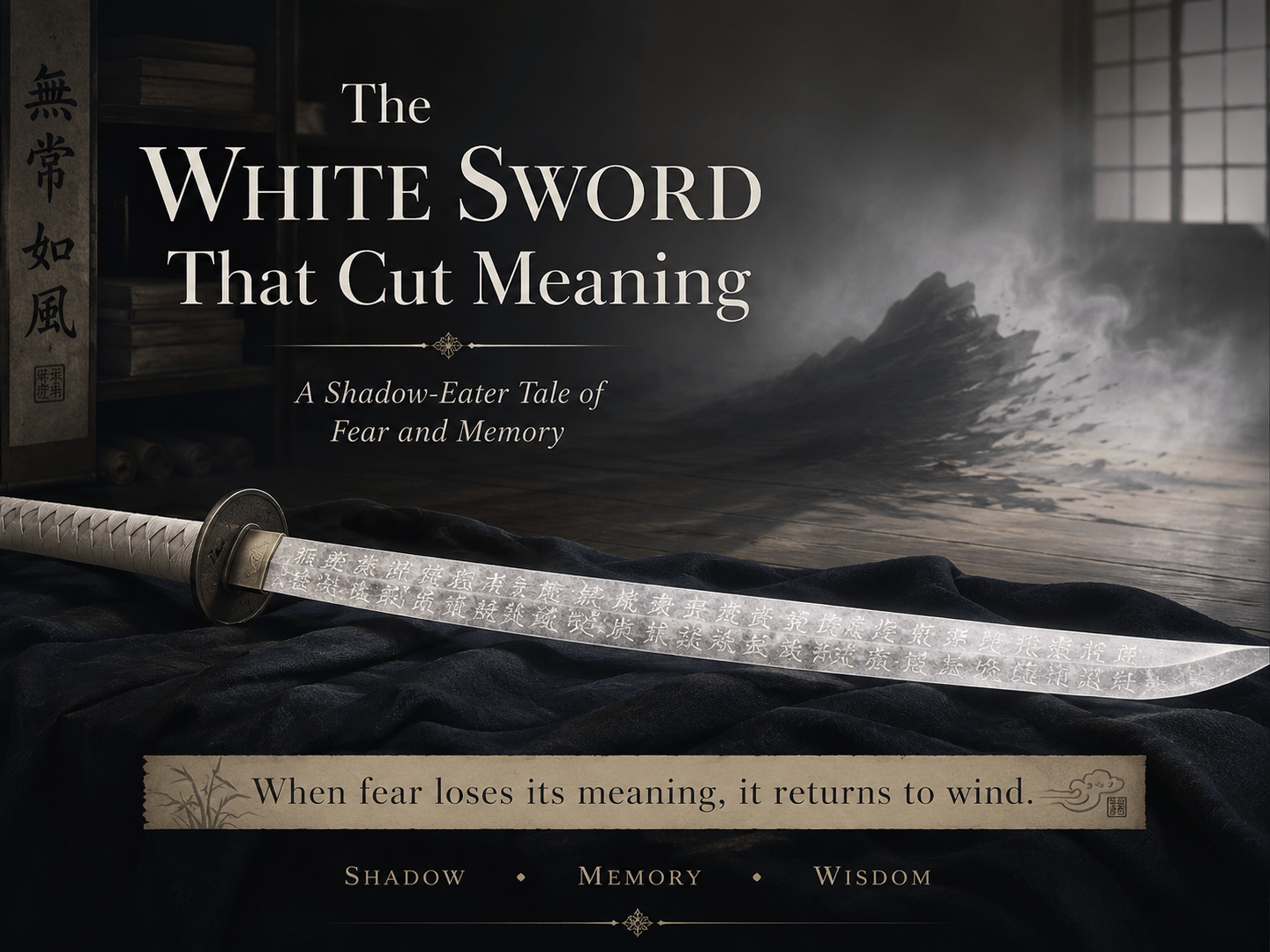
This section retells the third tale: a strange heirloom sword made not to cut bodies, but to cut the meaning that allowed a mountain apparition to exist.
In stories, haunted swords are often hungry for blood. They drive people mad, curse their owners, or demand violence. But the sword kept in the narrator’s grandfather’s old storage room was not that kind of object.
It was found wrapped in rags behind dusty tools and old furniture. It looked like a Japanese sword, but a plain one: black scabbard, no decoration, no elegance meant for display. When the narrator drew it slightly from the sheath, he noticed something wrong.
The blade did not shine.
It was cloudy white, like frosted glass. It had no proper edge. It would not cut skin. It seemed less like a weapon than a thin iron ruler or a heavy butter knife.
His grandfather explained:
“That was made to cut mountain apparitions.”
But not by slicing them.
Long ago, in the early Meiji period, one of the narrator’s ancestors worked in the mountains. At that time, a strange being called Kage-kui, the Shadow-Eater, was said to appear on the mountain road at dusk.
The encounter began with sound. From behind came a dragging noise:
Zuzuzu.
If a person turned around, nothing was there. But if they kept walking, they would begin to feel something crawling from the tip of their own shadow, following the dark outline back toward the body.
If it traced the shadow all the way to the person, the person’s outline as a human being would blur.
The story says the victim might return home and be met with confused faces: “Who are you again?” Their reflection might fade from mirrors. Their place in other people’s memory might weaken. Eventually, they would vanish—not through injury, but through loss of recognition.
It was not the body that was attacked. It was existence as understood by others.
The ancestor once encountered this thing and tried to cut toward the dragging sound with an ordinary blade. Nothing happened. It was like cutting air.
So he went to an unusual blacksmith. The blacksmith listened and said:
“Things of the mountain cannot be cut with ordinary iron.”
He forged the white sword.
The blade was not sharpened. Instead, it was engraved with countless tiny characters, so densely that the surface looked pale and clouded. They resembled sutras or ritual writing. The grandfather explained that the sword did not cut flesh. It cut away the meaning that bound a strange presence to the world.
When the ancestor next encountered the Shadow-Eater, he waited. The dragging sound came from behind. The crawling sensation rose from the edge of his shadow. Calmly, he drew the white sword and swept it in a single horizontal line between his own shadow and the empty space where the sound lived.
There was no resistance.
But the crawling stopped.
The unnatural presence dissolved into cold wind.
The grandfather described it this way: once the meaning of the apparition was cut away, it returned to being only a natural phenomenon. The “monster” lost the story that made it a monster.
The sword was used several times over the years when strange mountain presences appeared. But it had a limit. Each use stained part of the blade black, beginning near the base. Eventually, the darkening spread, and the sword lost its power. It was wrapped again and placed in storage.
What makes this tale beautiful is not the idea of defeating a monster. It is the idea that some fears live because meaning holds them together. Change the meaning, and the apparition becomes wind.
“Not every shadow must be fought; some shadows lose their power when we understand what gives them shape.”
This is an original reflective affirmation rather than an old proverb. It connects the three tales: the oni who may have been a forgotten ancestor, the weasel that repairs a boundary, and the white sword that cuts meaning instead of flesh.
Japanese mountain folklore often preserves memories of people, places, and occupations that existed at the edges of settled society. Ironworkers, hunters, charcoal burners, ascetics, and remote mountain communities sometimes appear in legends not as ordinary villagers, but as strange beings. They lived close to fire, darkness, animals, cliffs, and unpredictable weather. To people in the plains, they may have seemed almost otherworldly.
The oni in this tale can be read through that lens. Instead of a simple demon, the oni may symbolize a people whose skills were feared and needed at the same time. Iron was power. Whoever controlled iron controlled tools, weapons, agriculture, and authority.
The weasel story reflects another important idea: the mountain as a borderland. In Japanese folklore, mountains are often places where the ordinary world thins. A traveler may meet a spirit, lose time, encounter an animal messenger, or cross into a place that does not obey human maps.
The white sword adds a philosophical layer. It suggests that some supernatural fear may be understood as a problem of meaning. A thing becomes a monster because people recognize it as one. Remove that meaning, and it may become wind, sound, shadow, or memory again.
We are drawn to stories like these because they make invisible fears visible.
The oni ancestor expresses a fear of origin: What if our family history contains something older, stranger, or less civilized than we were told? The weasel expresses a fear of dislocation: What if reality can shift while we are still standing on the same road? The Shadow-Eater expresses a fear of erasure: What if we disappear not by dying, but by no longer being remembered?
These are not childish fears. They are deeply human.
Everyone has wondered, in some form, where they come from. Everyone has felt reality become strange for a moment: in grief, illness, loneliness, travel, or memory. And everyone fears being forgotten.
Folklore gives these anxieties a body. It lets an old fear become an oni, a weasel, a sword, a green sky, a shadow crawling up from the ground. By giving fear a shape, the story also gives us a way to stand before it.
One way to read these mountain tales is this: fear does not always ask to be destroyed. Sometimes it asks to be understood.
The narrator’s family does not defeat the oni ancestor; it recognizes him. The weasel does not attack the strange space; it patiently repairs the boundary. The white sword does not kill the Shadow-Eater; it separates the meaning that allows fear to become a monster.
In modern life, our fears often work in similar ways. A vague anxiety can become huge when we do not name it. A painful memory can haunt us when we do not understand where it belongs. A family story can feel like a burden until we see it as inheritance.
This story may remind us that courage is not only the act of confronting danger. Sometimes courage is the quiet willingness to ask: What is this fear made of? What memory feeds it? What meaning keeps it alive?
When a shadow follows you, do you need a sharper weapon—or a deeper understanding of what gives the shadow its shape?
“Not every shadow must be fought; some shadows lose their power when we understand what gives them shape.”
The three tales speak to fears of origin, dislocation, and erasure. The oni ancestor asks what our blood remembers. The weasel asks whether the world is as stable as it appears. The Shadow-Eater asks whether existence depends on being recognized by others. These are not merely supernatural fears, but human fears expressed through folklore.
The lesson is not simply to avoid mountains or fear strange things. One way to read the story is that fear becomes less destructive when we understand its origin, boundary, and meaning. Sometimes wisdom is not a sharper blade, but a clearer way of seeing.
What shadow in your life might lose its power if you understood the memory, fear, or meaning that gives it shape?