Explore Hyakki Yagyō, Japan’s mysterious night parade of demons, through folklore, fear, Kyoto history, and the wisdom hidden in darkness.
 Wonderful Proverbs Journey
※This site uses affiliate advertising.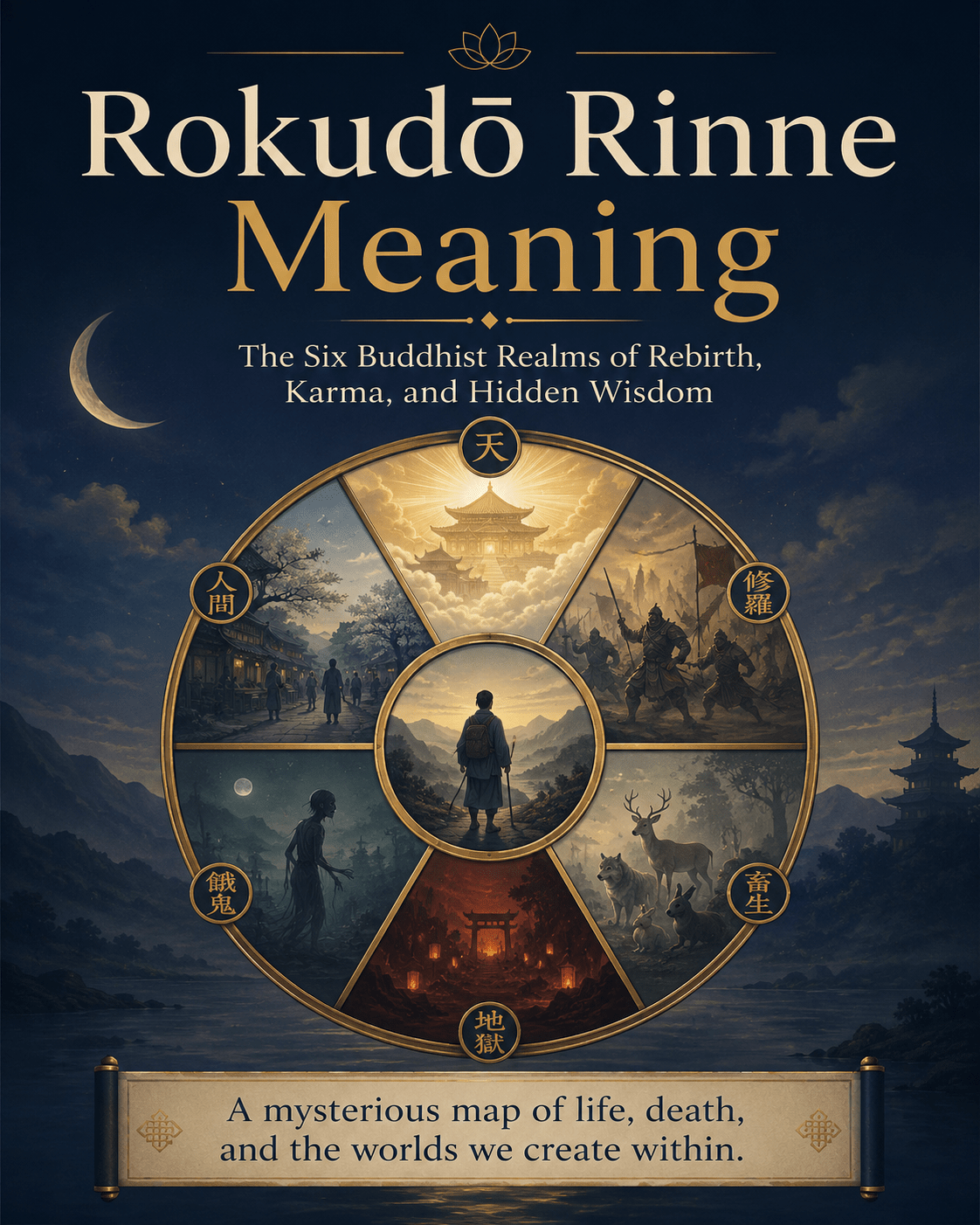
What happens after death?
Every culture has tried to answer this question in its own language. Some imagine a final judgment. Some speak of heaven and hell. Some describe a shadowy underworld, a paradise, or a place where the soul waits for peace.
In Buddhism, one of the most haunting and meaningful answers is found in the idea of Rokudō Rinne—the cycle of rebirth through the Six Realms.
These six realms are not merely “places” in a simple physical sense. They are also symbolic worlds of suffering, desire, pride, hunger, ignorance, and hope. In Japanese Buddhist imagination, they form a vast spiritual landscape: the realm of heavenly beings, the human realm, the realm of fighting spirits, the animal realm, the hungry ghost realm, and the hell realm.
At first, this may sound like a frightening vision of the afterlife. Yet Rokudō Rinne is not designed only to scare people. Like many old spiritual stories, it gives shape to invisible truths. It asks a quiet question:
If our actions shape our future, what kind of world are we creating with each thought, word, and deed?
This article explores the Six Realms as Buddhist folklore, moral symbolism, and a reflection on human life. Rather than treating the realms as mere horror, we will read them as a mysterious map of the mind—a map where fear becomes insight, karma becomes responsibility, and the hope of liberation remains quietly present.
Before we enter each realm, we must first understand the wheel itself.
Rokudō means “six paths” or “six realms.”
Rinne means the cycle of rebirth, often translated as samsara.
Together, Rokudō Rinne refers to the Buddhist idea that living beings are born, die, and are reborn again and again according to karma—the moral force created by actions, intentions, and states of mind.
In this worldview, death is not an absolute ending. It is a turning point. A person’s next birth is shaped by the life they have lived: their kindness, cruelty, greed, anger, wisdom, ignorance, and attachment.
The six realms are often divided into two broad groups.
The first three are sometimes called the more fortunate realms:
the Realm of Heavenly Beings
the Human Realm
the Realm of Asura, or fighting spirits
The lower three are often called the more painful realms:
the Animal Realm
the Hungry Ghost Realm
the Hell Realm
But there is an important twist. Even the highest realm is not ultimate salvation. Even heavenly beings eventually die. Even pleasure fades. Even power collapses.
The goal of Buddhism is not simply to be reborn in a better realm. The deeper goal is to awaken from the cycle itself. This liberation is called gedatsu in Japanese, often translated as liberation, and the state beyond suffering is called nirvana.
In this sense, the Six Realms are not only about “where we go after death.” They are also about the mental worlds we enter while still alive. Anger can feel like the Asura Realm. Greed can feel like the Hungry Ghost Realm. Ignorance can feel like the Animal Realm. Compassion and awareness can open the human path toward wisdom.
The highest of the Six Realms is the realm of heavenly beings, often called Tendō in Japanese.
At first, it appears to be the most desirable destination. Beings born here enjoy beauty, long life, comfort, and pleasures beyond ordinary human imagination. They may possess powers that seem miraculous. They may live for ages. Their world shines with ease compared with the suffering below.
Yet Buddhism offers a subtle warning: pleasure is not the same as liberation.
The heavenly realm is still part of samsara. It is still inside the wheel. The beings who dwell there may be blessed by good karma, but they have not awakened beyond attachment. Their joy may be refined, but it is still impermanent.
Tradition speaks of signs that appear before a heavenly being’s death. Their garments may lose their purity. Their body may lose its fragrance. Their happiness may fade. What once felt effortless begins to decay.
This image is quietly powerful. Even heaven, if it is temporary, carries the seed of sorrow.
The heavenly realm reminds us that comfort alone cannot answer the deepest human question. A beautiful life may still be fragile. A successful life may still be impermanent. A pleasant life may still avoid the work of wisdom.
In this sense, Tendō is not merely a reward. It is also a gentle warning: even the brightest world cannot free us if we remain asleep within it.
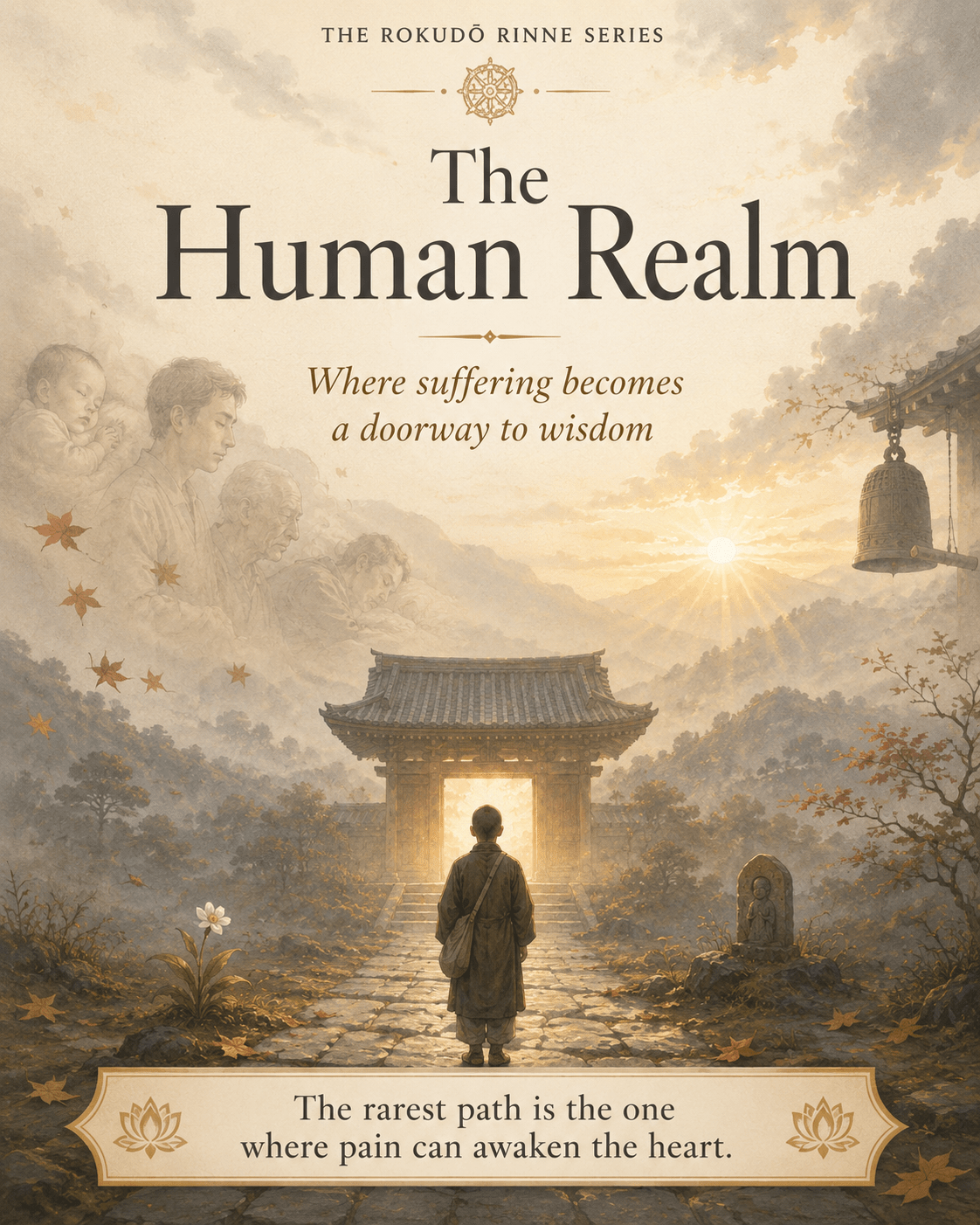
The Human Realm, or Ningendō, is the world we know.
It is not the easiest realm. Human life contains birth, aging, illness, death, separation from loved ones, encounters with what we dislike, frustration over what we cannot obtain, and the restless burden of body and mind. In Buddhism, these are often connected with the classic understanding of suffering.
And yet, the Human Realm is considered precious.
Why?
Because it is the realm where suffering and awareness meet.
In the heavenly realm, pleasure may be too strong. In the lower realms, suffering may be too overwhelming. But in the human realm, there is both pain and possibility. We suffer, but not always so completely that we cannot reflect. We enjoy life, but not so endlessly that we forget impermanence.
This balance makes human life spiritually significant.
It is said that the human realm is the realm where one can hear the Dharma—the teachings of Buddhism. Here, people can question, practice, regret, forgive, learn, and awaken. Human life is fragile, but that fragility becomes the very reason it matters.
A flower is beautiful because it does not last forever. A human life is meaningful because every choice carries weight.
The Human Realm teaches that suffering is not only punishment. Sometimes it is also a doorway. It can make us ask deeper questions. It can soften pride. It can reveal the need for compassion.
To be human, in this view, is not merely to suffer. It is to stand at the rare threshold where suffering can become wisdom.
Below the Human Realm lies the realm of Asura, often called Shuradō in Japanese.
The Asura are fighting spirits. Their world is filled with rivalry, anger, pride, jealousy, ambition, and endless struggle. They may possess power, intelligence, and even splendor, but peace escapes them.
This realm is frightening not because it is dark in the ordinary sense, but because it resembles a familiar state of mind.
We know the Asura Realm whenever we cannot stop comparing ourselves with others. We enter it when pride turns every conversation into a contest. We taste it when anger feels more satisfying than peace.
In stories, Asura beings are often linked to conflict with heavenly beings. They are strong, passionate, and difficult to defeat, but their strength is bound to resentment. They may fight for what they believe is justice, yet become consumed by the fire of their own anger.
That is the tragedy of Shuradō.
It is not the realm of simple evil. It is the realm where wounded pride becomes identity. It is the place where one cannot let go, even when holding on becomes suffering.
The Asura Realm reminds us that victory is not always freedom. A person may win every argument and still lose peace. A person may gain status and still be ruled by envy. A person may be powerful and still be trapped.
In modern life, Shuradō appears wherever ambition loses compassion, where competition replaces meaning, and where the heart mistakes conflict for strength.
The Animal Realm, or Chikushōdō, is often described as a world ruled by instinct, fear, appetite, and survival.
At first, the idea of being reborn as an animal may not seem as terrible as hell or the hungry ghost realm. Animals can be beautiful. They can be loyal, graceful, strong, and free.
But in Buddhist symbolism, the Animal Realm represents a life governed mainly by immediate desire and fear. It is a world of being hunted and hunting, eating and being eaten, reacting without reflection.
This does not mean Buddhism despises animals. Rather, the realm functions as a moral and psychological image. It warns against living only by impulse.
When wisdom is forgotten, when we chase only what is directly in front of us, when we stop asking what is true or meaningful, the mind becomes narrow. It becomes trapped in the moment—not in the mindful sense, but in the blind sense.
The Animal Realm is associated with ignorance, especially the inability or refusal to seek deeper truth. It is the realm of “I want this now,” “I fear that now,” “I will take this now,” without reflection on consequence.
In modern life, this realm may appear when consumption replaces awareness, when habit replaces choice, and when convenience silences conscience.
The lesson is not that instinct is evil. Instinct keeps life alive. But when instinct becomes the whole of life, wisdom has no room to breathe.
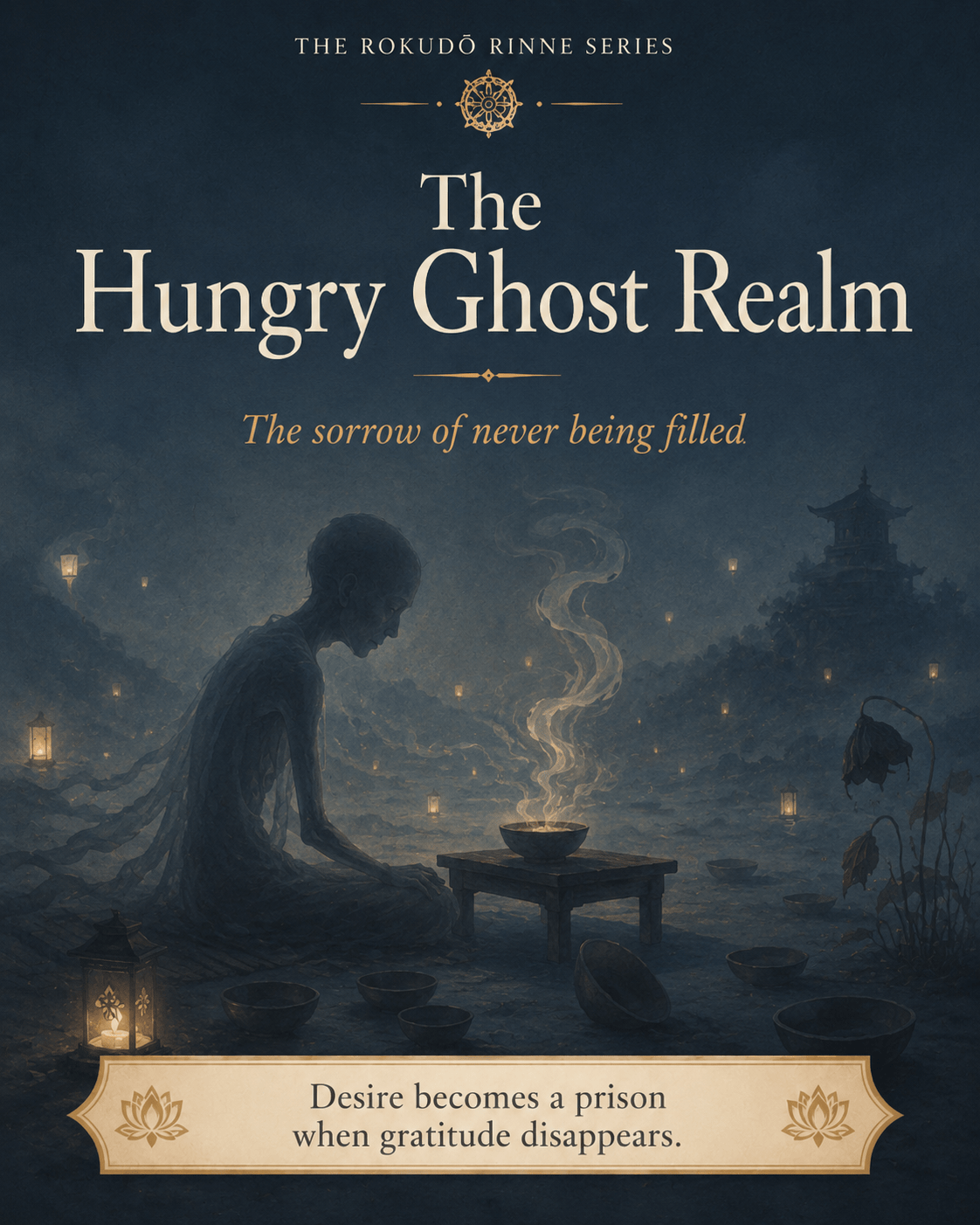
The Hungry Ghost Realm, or Gakidō, may be one of the most psychologically powerful of all the Six Realms.
Hungry ghosts are beings tormented by endless hunger and thirst. In many depictions, they have swollen bellies, thin necks, and mouths too small to receive what they crave. Even when food or drink appears before them, it may turn to fire, ash, or something impossible to consume.
This realm is terrifying because it speaks to a very human suffering: the pain of wanting without being satisfied.
The hungry ghost is not hungry only for food. It can symbolize greed, envy, addiction, emotional emptiness, and the endless pursuit of “more.” More recognition. More wealth. More attention. More control. More reassurance.
But the more the hungry ghost seeks, the less it feels filled.
That is the sorrow of Gakidō. Desire has lost its natural limit. Need has become a prison.
In Buddhist thought, beings may fall into this realm through greed, jealousy, and attachment. Yet Japanese tradition also contains rituals such as Segaki, offerings made to relieve the suffering of hungry ghosts. This is important. Even the hungry ghost is not abandoned.
The realm of hungry ghosts teaches that desire becomes painful when it is cut off from gratitude. The human heart can become a bottomless bowl if it forgets how to receive what is already present.
In modern terms, Gakidō may be the realm of endless scrolling, endless comparison, endless craving, and endless dissatisfaction. It is the world where abundance exists, yet nothing feels enough.
The lowest of the Six Realms is the Hell Realm, or Jigokudō.
In Buddhist and Japanese religious imagination, hell is a place of severe suffering, judgment, and consequence. It is associated with King Enma, judges of the dead, punishments, and vast periods of time that almost exceed human imagination.
Descriptions of Buddhist hells can be intensely frightening. There are hot hells, cold hells, punishments for violence, theft, falsehood, cruelty, and actions that bring harm to others.
Yet again, the deeper meaning is not simple horror.
The Hell Realm is the symbolic weight of harm. It is the place where actions return with terrible clarity. The suffering described in hell stories gives form to a moral truth: what we do matters.
In many Western traditions, hell is often imagined as a final destination after divine judgment. In Buddhist traditions, however, hell is usually not eternal in the same absolute sense. It may last for unimaginably long periods, but it is still within samsara. When the karma that caused that birth is exhausted, rebirth continues.
This difference matters. Buddhist hell is terrifying, but it is not necessarily a final cosmic prison. It is part of a moral cycle. Even there, the possibility of future liberation is not entirely erased.
In Japanese folk belief, Jizō Bodhisattva is often associated with compassionate rescue, especially for children and beings suffering in difficult realms. This softens the vision of hell with compassion. Even in the darkest realm, the imagination of mercy remains.
Jigokudō reminds us that cruelty is never weightless. Harm leaves traces. But it also suggests that no being should be reduced forever to their worst moment.
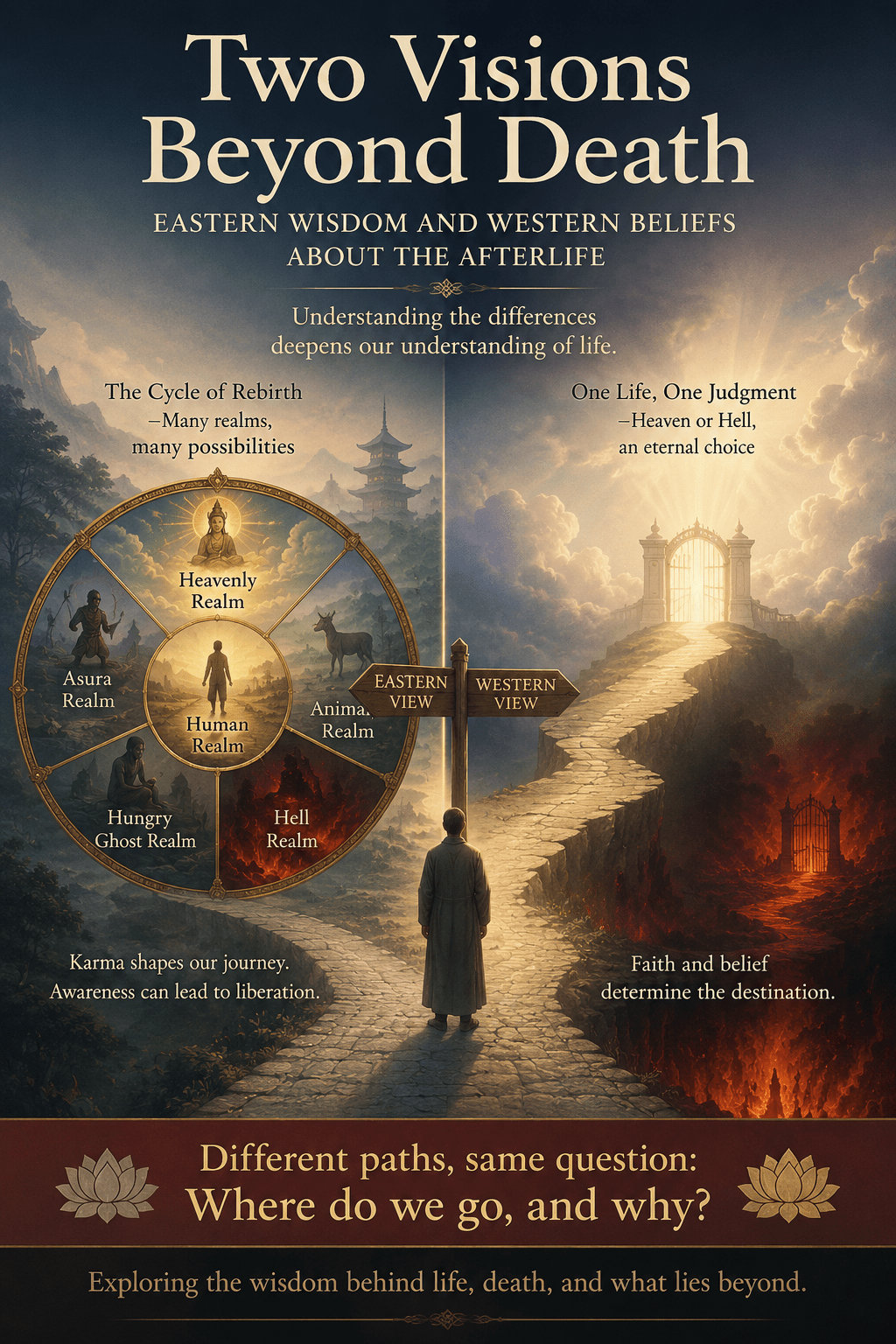
The Six Realms become even more interesting when compared with Western ideas of the afterlife.
In many Western religious traditions, especially those shaped by Christianity, the afterlife is often imagined through a more linear structure: one life, death, judgment, and then heaven, hell, or another final spiritual state.
Of course, Western traditions are diverse. Ancient Greek thought included Hades, Elysium, and Tartarus. Christianity contains complex teachings about salvation, judgment, heaven, hell, and in some traditions purgatory. But compared with Buddhist samsara, many Western models tend to emphasize a decisive transition after one earthly life.
Buddhist Rokudō Rinne is different. It is cyclical.
The soul—or more accurately, the stream of consciousness and karma—does not simply move once from life to final destination. Instead, beings continue to be reborn according to karmic conditions. The afterlife is not only reward or punishment; it is continuation.
This creates a different moral atmosphere.
In a linear worldview, the question may be:
Where will I go after this life?
In the Buddhist cyclical worldview, the question becomes:
What kind of becoming am I creating right now?
Western heaven often represents eternal communion, peace, and salvation. Buddhist heavenly realms, by contrast, may be joyful but are not ultimate liberation. Western hell is often imagined as final separation from God. Buddhist hell, though terrifying, remains part of the cycle and therefore part of impermanence.
This does not make one worldview “better” than the other. Rather, it reveals how cultures shape moral imagination differently.
The Western afterlife often emphasizes final judgment.
Rokudō Rinne emphasizes ongoing consequence.
Both ask us to live carefully.
Both suggest that actions matter.
Both give symbolic language to the human intuition that life is morally meaningful.
“Every action plants a seed; every seed becomes a world.”
This is not presented as an ancient proverb, but as a reflective affirmation inspired by the meaning of Rokudō Rinne.
The Six Realms are, in one sense, worlds after death. But they are also worlds planted by intention. Anger plants one world. Compassion plants another. Greed, patience, envy, gratitude, cruelty, and kindness all shape the inner landscape.
If we read Rokudō Rinne symbolically, it reminds us that the future is not born suddenly. It grows quietly from the seeds we plant now.
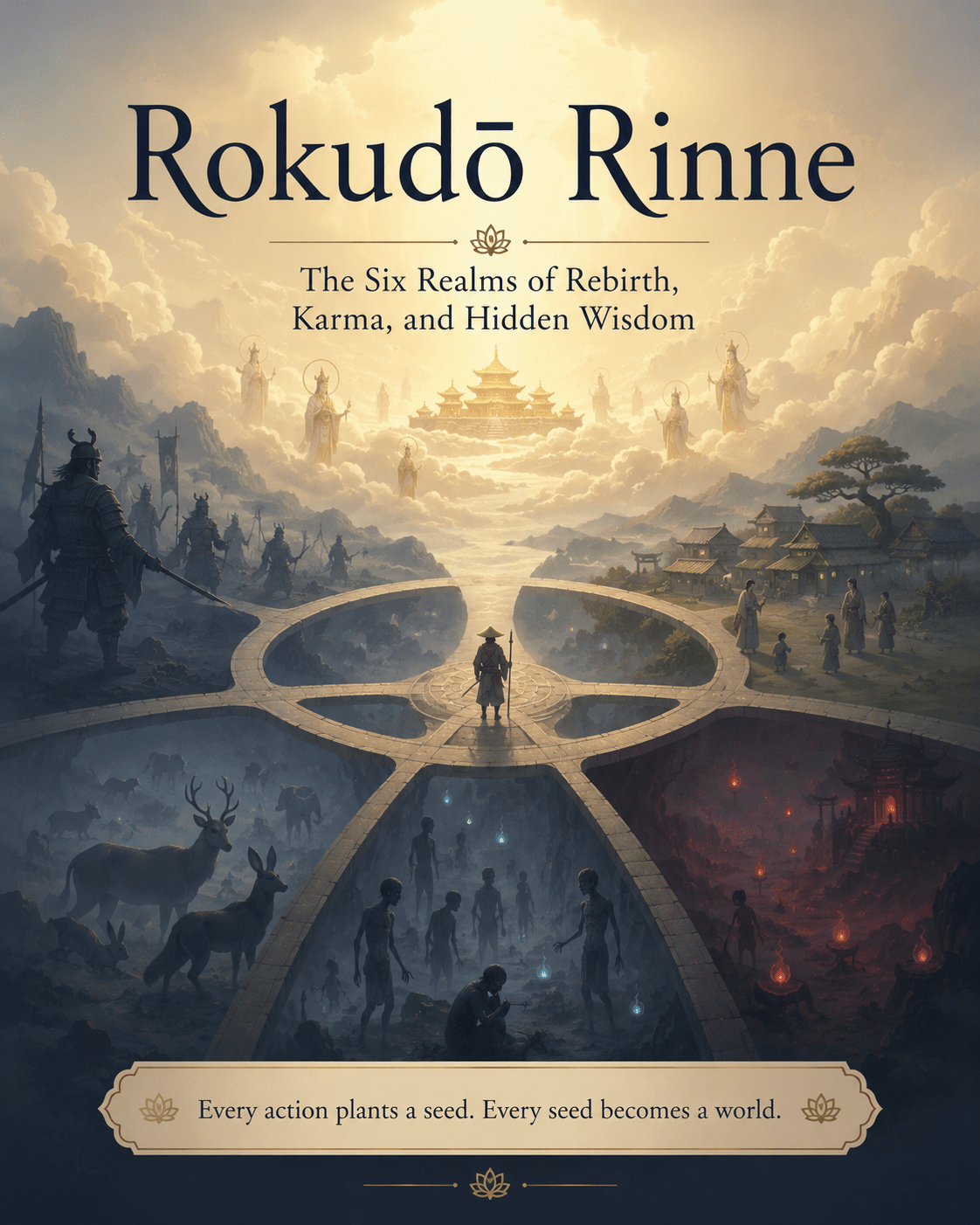
The Six Realms have shaped Buddhist art, temple culture, funerary imagination, and moral storytelling throughout East Asia, including Japan.
They appear in paintings, mandalas, temple teachings, folk stories, and devotional practices. The image of six Jizō statues, often seen near temples or roadside paths in Japan, is sometimes associated with the compassionate idea that Jizō travels through the Six Realms to help suffering beings.
This is one reason the Six Realms remain culturally powerful. They are not only abstract doctrine. They became visible in art, ritual, stone statues, stories, and everyday religious feeling.
For English-speaking readers, Rokudō Rinne offers a window into a different way of imagining morality. Instead of separating psychology, ethics, and cosmology, it weaves them together.
A realm is a place.
A realm is a consequence.
A realm is a state of mind.
A realm is a mirror.
That layered meaning is why the Six Realms continue to speak beyond religious boundaries.
Why are we drawn to stories of afterlife realms?
Perhaps because they give shape to fears we already carry.
We fear wasting our lives. We fear being judged. We fear becoming ruled by anger, hunger, ignorance, or regret. We fear that our choices may matter more than we admit.
The Six Realms turn these invisible anxieties into images.
The angry become warriors who cannot stop fighting.
The greedy become hungry ghosts who cannot be filled.
The cruel face the weight of harm.
The distracted fall into instinct.
The comfortable discover that pleasure is not enough.
The human being stands between suffering and awakening.
Rather than proving a supernatural geography, Rokudō Rinne can be read as a philosophical map of moral psychology.
It tells us that the afterlife begins, in a symbolic sense, before death. We are already practicing the worlds we may enter. We are already shaping the atmosphere of our minds.
One way to read Rokudō Rinne is not as a threat, but as a quiet invitation to awareness.
The teaching does not simply say, “Be good or be punished.” Its deeper message is more subtle:
Be careful, because your inner world is being shaped every day.
Every time we choose anger, we make conflict more familiar.
Every time we feed greed, hunger becomes stronger.
Every time we practice compassion, another path opens.
Every time we pause before harming, we step away from a darker realm.
The Six Realms remind us that life is not made only by grand decisions. It is made by repeated movements of the heart.
In modern life, this may be the most useful reading of Rokudō Rinne. We may not know what happens after death. But we can see how resentment creates one kind of life, gratitude another, and awareness another.
The next world may not be only somewhere far beyond us.
It may begin in the way we speak today.
If every action plants a seed, what kind of world are you quietly growing within yourself?
And if the Six Realms are not only places after death, but mirrors of the human heart, which realm do you most want to step away from—and which path do you want to walk toward?
Every action plants a seed; every seed becomes a world.