Explore Hyakki Yagyō, Japan’s mysterious night parade of demons, through folklore, fear, Kyoto history, and the wisdom hidden in darkness.
 Wonderful Proverbs Journey
※This site uses affiliate advertising.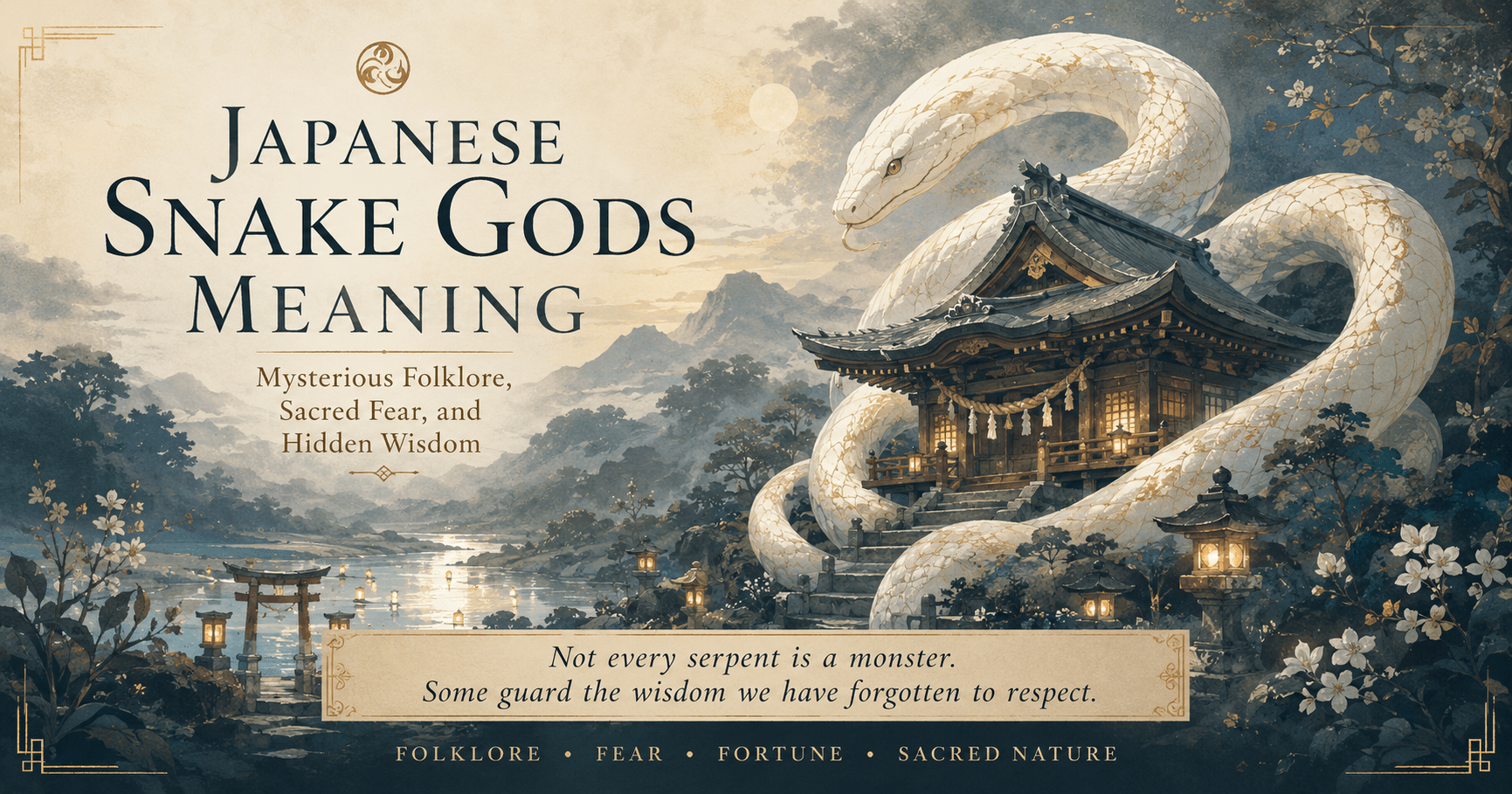
In Japanese folklore, the snake is rarely just a snake.
It may appear as a monster with eight heads, a hidden god inside a small box, a white serpent that brings fortune, a dragon-snake that guides deities, or a mysterious local spirit that punishes those who cross sacred boundaries. Sometimes the serpent is feared. Sometimes it is worshiped. Sometimes it is both.
This is what makes Japanese snake gods so fascinating. They live between blessing and danger, nature and divinity, protection and taboo. They are not merely creatures of horror. They are symbols of water, fertility, renewal, hidden knowledge, and the uneasy relationship between human ambition and the natural world.
This article explores several Japanese serpent legends as mysterious folklore with cultural meaning. Rather than asking whether these stories are literally true, we can read them as old ways of speaking about fear, respect, desire, gratitude, and the limits of human control.
Before the serpent became a bringer of fortune, it appeared in Japanese myth as a creature of terror.
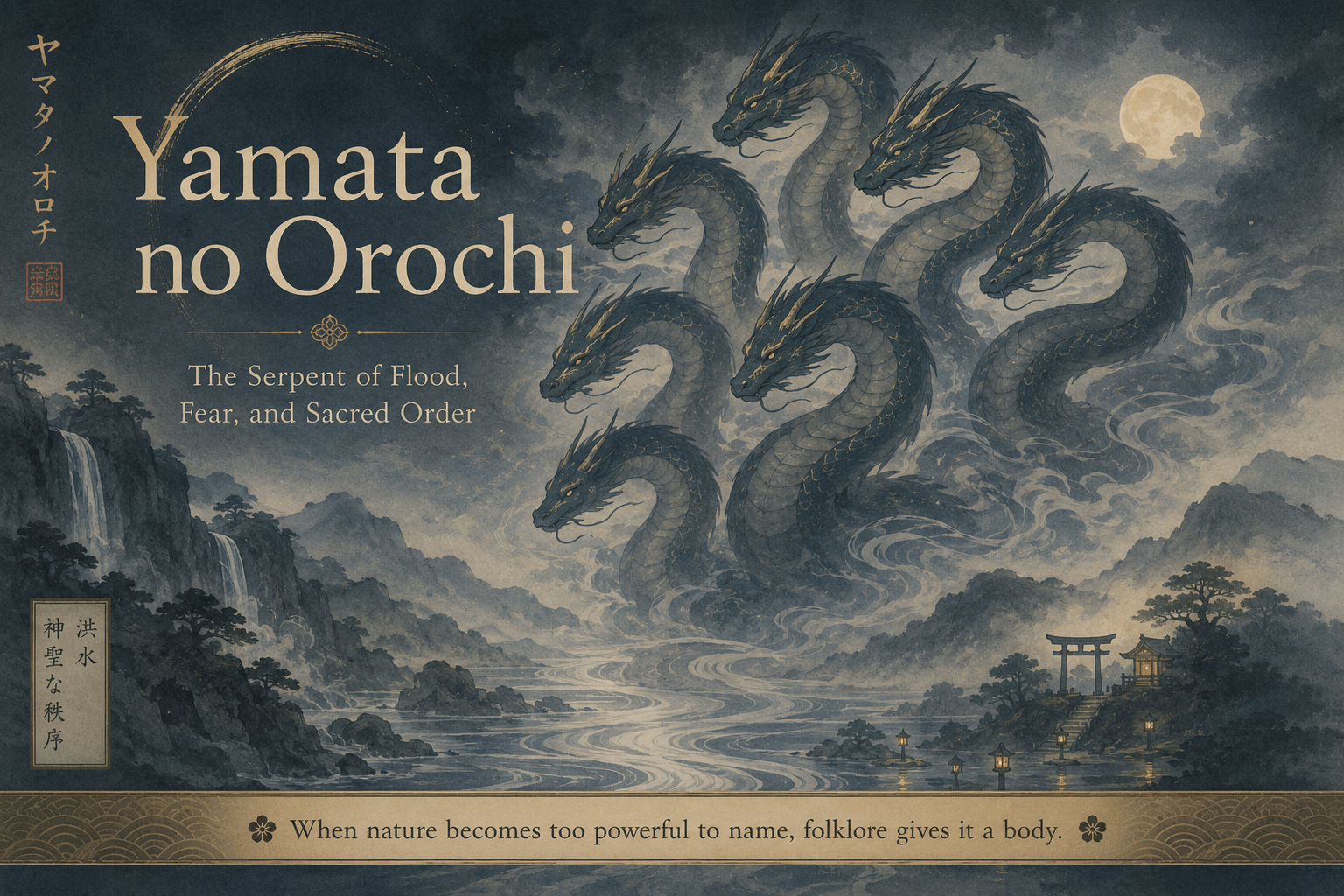
Yamata no Orochi is one of the most famous serpent beings in Japanese mythology. In the old stories, it is described as a monstrous serpent with eight heads and eight tails, so enormous that its body stretches across valleys and mountains. Its eyes are said to shine red, like winter cherries or glowing embers. Wherever it moves, the landscape itself seems to tremble.
The tale is often connected with the god Susanoo, a stormy and powerful deity who had been cast down from the heavenly realm. Wandering on earth, Susanoo encounters an elderly couple in deep grief. They once had eight daughters, but the serpent had devoured them one by one. Only the youngest, Kushinada-hime, remains.
The scene is simple but emotionally powerful: an old couple waiting for the last child to be taken, a young woman facing a fate she cannot escape, and a monstrous force descending from the mountains like a living flood.
Susanoo offers to defeat the serpent. His method is not brute strength alone. He prepares strong sake and places it in eight vessels. When Yamata no Orochi arrives, each head drinks deeply. The serpent, enormous and terrifying, becomes vulnerable through its own appetite. Once it is drunk, Susanoo strikes.
From the tail of the slain serpent, he discovers a sacred sword, later known as Kusanagi no Tsurugi, one of the Three Imperial Regalia of Japan.
One interpretation sees Yamata no Orochi as more than a monster. It may symbolize floodwaters, violent rivers, or the destructive power of nature before human settlement and order. The many-headed serpent becomes a poetic image of disaster: water that comes from many directions, devours human life, and cannot be reasoned with.
In this reading, Susanoo’s victory is not only the defeat of evil. It is the transformation of fear into order, chaos into culture, and danger into sacred authority.
Not all Japanese serpent gods appear as enemies.
Ōmononushi, worshiped at Mount Miwa in Nara, is a powerful deity associated with nation-building, agriculture, sake brewing, commerce, and matchmaking. In some traditions, the mountain itself is treated as sacred, not merely as a place where the god resides, but as the god’s dwelling in a deeper sense.
Yet Ōmononushi also carries one of the most haunting serpent legends in Japanese mythology.
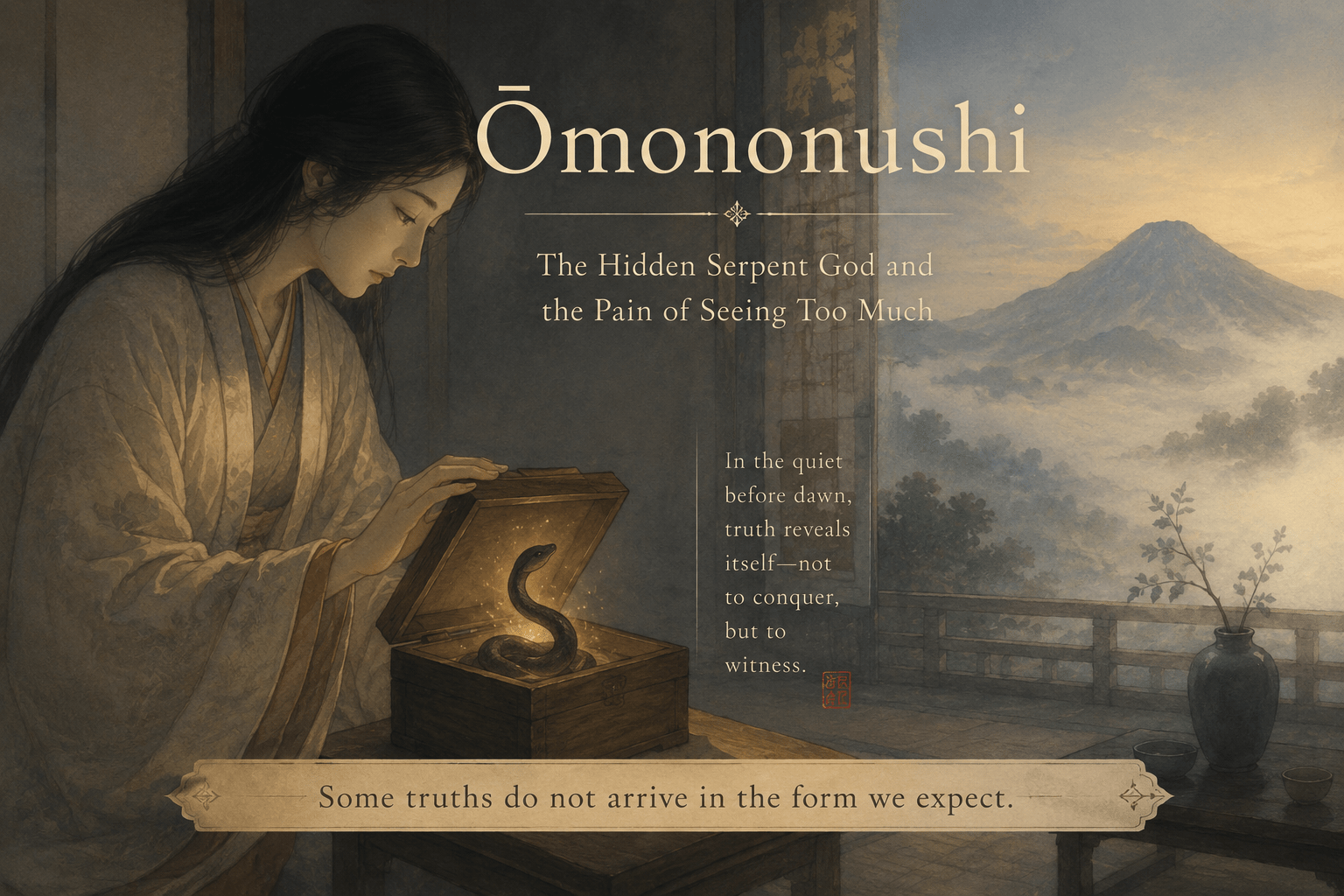
The story is often connected with Yamato Totohi Momoso-hime. She becomes the wife of the god, but he visits her only at night. Like many human beings faced with mystery, she longs to see the one she loves. She asks him to reveal his true form.
The god agrees, but only under one condition: she must not be surprised.
In the morning, she looks into a small container, as instructed. Inside, she finds a small black serpent.
For a moment, the sacred becomes intimate and terrifying. The god has not appeared in a glorious form, nor as a majestic dragon, but as something small, dark, alive, and unexpected. The princess is startled. The promise is broken. Ōmononushi takes human form, reproaches her, and leaves for Mount Miwa, never to return.
The tale ends in tragedy. In some versions, the princess collapses in shame and dies in a shocking accident, and her tomb becomes associated with the name Hashihaka, “the chopstick tomb.”
This story may feel strange to modern readers, but its emotional structure is very human. We want to know what is hidden. We ask mystery to show itself. Yet when truth appears in a form we did not expect, we may not be ready to receive it.
Ōmononushi’s serpent form suggests that the divine is not always beautiful in the way humans imagine. Sacred reality may be small, frightening, humble, or difficult to understand.
The story is not simply warning us not to look. It may be asking whether we can look without trying to control what we see.
At Izumo Taisha, one of Japan’s most important shrines, there is a serpent-related being known as Ryūjajin, a dragon-snake deity connected with Ōkuninushi and the gathering of the gods.
In Japanese belief, the tenth lunar month is traditionally called Kannazuki, “the month without gods,” because the gods are said to leave their local shrines and gather in Izumo. In Izumo, however, the same period is called Kamiarizuki, “the month when the gods are present.”
During this sacred gathering, the gods are believed to discuss human relationships and connections. Marriage, bonds, meetings, partings, and unseen threads of fate are imagined as matters discussed among divine beings.
Ryūjajin plays the role of welcoming and guiding the gods toward Izumo.
This figure combines the imagery of dragon and serpent. In East Asian symbolism, dragons and snakes often overlap. Both are connected with water, rain, earth, transformation, and unseen power. A dragon moves through clouds and water; a snake moves close to the ground, through grass, stones, and soil. Together, the dragon-serpent becomes a being that connects heaven, water, and earth.
Ryūjajin is not frightening in the same way as Yamata no Orochi. Its mystery is ceremonial. It suggests that even divine meetings need a guide, and that spiritual order depends on unseen messengers.
In a symbolic sense, Ryūjajin reminds us that connection is not always accidental. Sometimes, in folklore, relationships are imagined as something carefully guided through invisible paths.
The Suwa region in Nagano carries some of Japan’s most mysterious serpent traditions.
Takeminakata, the main deity of Suwa Taisha, is known in myth as a powerful god who challenged Takemikazuchi during the transfer of the land to the heavenly gods. Defeated, he fled to Suwa and vowed not to leave that place. Yet in local Suwa traditions, he appears not merely as a defeated god, but as a powerful deity who established himself in the region.
In some medieval tales, Takeminakata becomes connected with serpent imagery. One story tells of Kōga Saburō, a man who descends into an underground world while searching for his wife. After wandering through hidden realms and returning to the surface, he discovers that he has become a serpent. Through divine help, he regains human form and is later connected with Suwa Myōjin.
Such stories blur the boundary between human, serpent, and god. The underground world is not only a place beneath the earth; it is a realm of transformation. To go below is to lose one identity and return with another.
Even more mysterious is Mishaguji, a local spirit deeply associated with Suwa. Mishaguji does not appear in the major classical myths such as the Kojiki or Nihon Shoki, yet traces of its worship are found across parts of central and eastern Japan. It has been linked with stones, pillars, boundaries, fertility, impurity, punishment, and ancient ritual.
Some interpretations see Mishaguji as a boundary deity, a spirit connected with old forms of worship that may predate later shrine structures. Unlike polished myths centered on imperial gods, Mishaguji feels older, rougher, more rooted in earth, stone, and taboo.
That roughness is part of its power.
In many cultures, the oldest gods are not always gentle. They guard borders. They punish disrespect. They remind humans that a place is not empty simply because we cannot see who belongs to it.
Yato no Kami is one of the most striking serpent spirits in Japanese regional folklore.
In the Hitachi no Kuni Fudoki, an old geographical and cultural record, Yato no Kami is described as a horned serpent-like deity. It is said that seeing this being could bring ruin not only to the viewer, but to the viewer’s family line. Whether taken literally or symbolically, this is a powerful image: some forces are so dangerous that even looking at them means crossing a boundary.
The legend tells of humans trying to cultivate land and create rice fields. The serpent gods interfere. A local leader then drives them away and marks the boundary between divine land and human land. From that point onward, the deity is worshiped so that it will not curse the people.
This is not a simple story of humans defeating evil.
It may also be read as a memory of conflict between development and nature. Rice cultivation required land, water control, and the reshaping of wetlands. From a human perspective, this meant progress and survival. From the perspective of the land, it may have meant disturbance.
Yato no Kami stands at that uneasy border. It is a deity who obstructs development, but perhaps also a guardian of the old landscape. The story does not simply erase the serpent. Even after being driven back, it is worshiped.
That detail matters.
The tale suggests that when humans transform nature, they must still acknowledge what came before. The old spirit may be defeated, but it should not be mocked. It must be given a place, a name, and a ritual.
In modern language, we might say this is a story about ecological humility. It reminds us that progress without reverence can become a kind of blindness.
Among Japan’s mysterious serpent deities, Ugajin is especially strange and compelling.
Ugajin is often depicted with the body of a coiled snake and the head of an elderly human. In some images, this being appears above the head of Benzaiten, the Buddhist goddess associated with music, eloquence, water, wisdom, and fortune. This combination reflects Japan’s long history of shinbutsu shūgō, the blending of Shinto and Buddhist beliefs.
Ugajin’s origins are not entirely clear, which only deepens the mystery. The deity does not appear in the oldest central mythological texts, yet became associated with wealth, protection, and blessings.
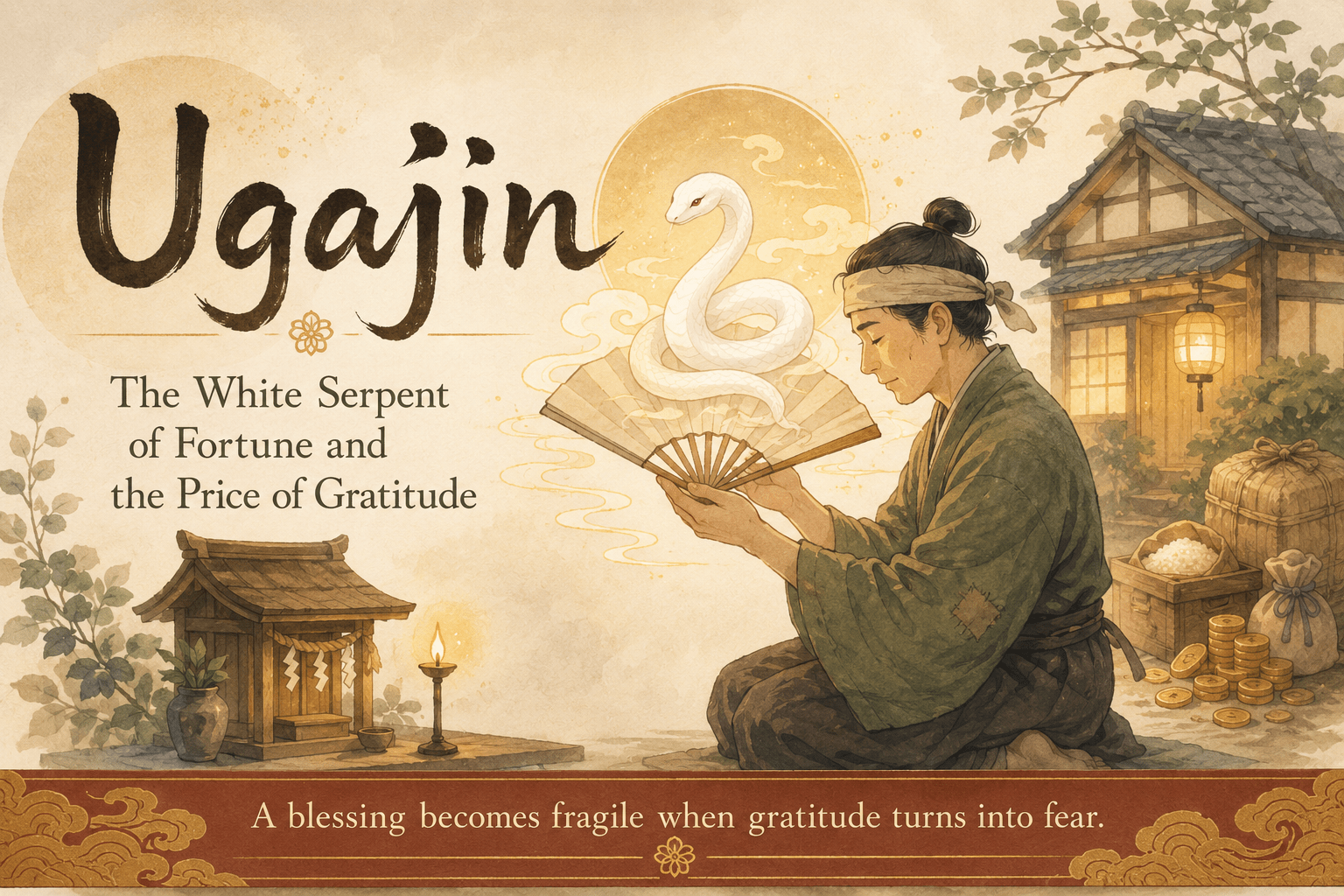
One medieval tale tells of a poor man who finds a white serpent during a shrine visit. Suspecting that it may be Ugajin, he respectfully invites it onto a fan. The serpent accepts. The man takes it home, builds a small shrine, and worships it.
Soon, his life changes. Fortune comes. Poverty retreats.
But the white serpent grows larger over time. What once seemed miraculous begins to feel frightening. The man considers abandoning it, but his wife objects, warning that if the serpent is truly divine, it must not be treated carelessly.
Then the story takes a darker turn. A neighbor tells the man that while he is away, a large serpent coils upon his sleeping wife. Suspicious and disturbed, the man pretends to leave and secretly watches the house. When he sees the serpent near his wife, he draws his sword.
But before he can strike, the serpent takes the wife and disappears.
The man searches, but finds neither the serpent nor his wife. His fortune vanishes, and he returns to poverty.
Like many folktales, this story resists a simple moral. Is it a warning against ingratitude? Against fear? Against treating the sacred as a tool for personal gain? Perhaps all of these.
Ugajin brings fortune, but not as a possession. Blessing requires relationship. The moment the man sees the divine only as useful when it enriches him and intolerable when it frightens him, the blessing withdraws.
The white serpent asks a quiet question: Can we remain grateful when the source of blessing becomes difficult to understand?
Japanese serpent folklore does not belong only to Shinto tradition. It also appears through Buddhism, especially in the figures known as the Hachidai Ryūō, the Eight Great Dragon Kings.
The word “dragon king” is connected to the Sanskrit term Nāgarāja, meaning serpent king. In Indian tradition, nāga are serpent beings often associated with water, rain, fertility, and hidden treasures. As Buddhist ideas traveled through Asia, these serpent kings were translated into Chinese and Japanese religious imagination as dragon kings.
This is a beautiful example of cultural transformation. A cobra-like serpent deity from India becomes a dragon guardian in East Asia. The form changes, but the symbolism remains: water, protection, depth, and spiritual power.
The Eight Great Dragon Kings are said to have heard the Buddha’s teaching and become protectors of the Dharma. They are not merely monsters of the deep. They are beings whose wild, watery power has been turned toward guardianship.
The serpent, once feared, becomes a protector.
In this transformation, we can see one of the recurring patterns of folklore: what is dangerous is not always destroyed. Sometimes it is converted, honored, and given a sacred role.
“Respect what you do not yet understand.”
This simple affirmation may be the thread connecting these serpent legends.
The serpent appears when humans meet something older than themselves: rivers, mountains, hidden gods, fertility, wealth, death, rebirth, taboo, and the unseen laws of place. The lesson is not to be afraid of every mystery. It is to approach mystery without arrogance.
Snakes are naturally powerful symbols. They shed their skin, so they suggest renewal. They move silently through grass and water, so they suggest hidden knowledge. They live close to the earth, so they are linked with land, fertility, and boundaries. Because many snakes appear near water sources, rice fields, and wetlands, they easily became associated with rain, rivers, agriculture, and prosperity.
In Japan, where mountains, rivers, and fields have long been felt as spiritually alive, the snake became a natural image of sacred presence. It could be terrifying like a flood, protective like a guardian, or generous like a fortune-bringing white serpent.
This complexity is important. Japanese snake gods are not simply “good” or “evil.” They are closer to nature itself: life-giving, dangerous, mysterious, and worthy of respect.
We are drawn to serpent stories because they give shape to a very old human feeling: the sense that the world is alive in ways we cannot fully control.
A snake appears suddenly. It slips between visible and invisible spaces. It can be beautiful and frightening at the same time. This makes it a perfect symbol for anxiety, intuition, danger, and transformation.
Folklore allows people to speak about these feelings safely. Instead of saying, “Nature is unpredictable,” a story says, “There is a serpent god in the valley.” Instead of saying, “We fear what we cannot understand,” a tale says, “Do not look carelessly into the box.”
The supernatural image becomes a language for psychological truth.
One way to read these Japanese serpent legends is as a quiet lesson in reverence.
Modern life often teaches us to explain, use, measure, and control everything. But old stories remind us that not everything valuable can be approached that way. A mountain, a river, a relationship, a tradition, or even a blessing may lose its meaning when treated only as a tool.
The serpent asks us to pause.
Before we develop the land, have we listened to it?
Before we seek fortune, have we understood gratitude?
Before we uncover the hidden truth, are we ready to receive it?
Before we call something frightening, have we asked what it protects?
The lesson is not to live in fear. It is to live with attention.
One way to read these Japanese serpent legends is as a quiet lesson in reverence.
Modern life often teaches us to explain, use, measure, and control everything. But old stories remind us that not everything valuable can be approached that way. A mountain, a river, a relationship, a tradition, or even a blessing may lose its meaning when treated only as a tool.
The serpent asks us to pause.
Before we develop the land, have we listened to it?
Before we seek fortune, have we understood gratitude?
Before we uncover the hidden truth, are we ready to receive it?
Before we call something frightening, have we asked what it protects?
The lesson is not to live in fear. It is to live with attention.
What fear in your own life might be asking for respect rather than avoidance?