Explore a mysterious skinwalker folklore tale about fear, suspicion, and cultural wisdom, told with reflection rather than sensational horror.
 Wonderful Proverbs Journey
※This site uses affiliate advertising.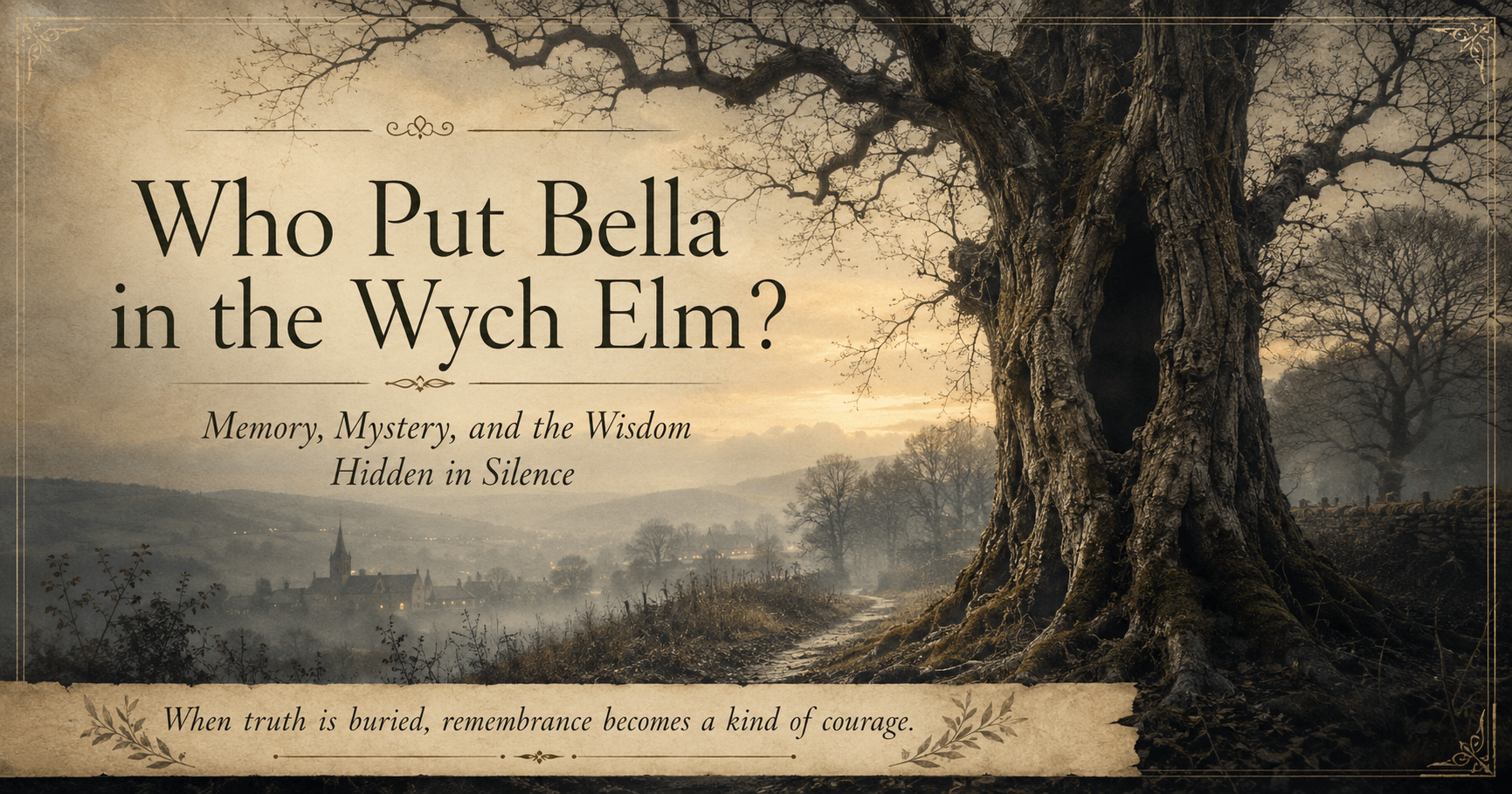
Some mysteries remain alive not because they offer answers, but because they leave behind a question that refuses to fade. “Who put Bella in the Wych Elm?” is more than a chilling line of graffiti from wartime England. It is a story about a woman without a name, a tree that became a tomb, a community shaped by rumor, and the uneasy wisdom hidden in silence. Read as folklore as much as true crime, the tale reminds us that the unknown does not only frighten us—it asks what kind of truth we are willing to seek, and what kind of memory we are willing to preserve.
This is not simply a story about a body in a tree. It is a strange British mystery where wartime secrecy, rural folklore, public fear, and the human need for answers all meet in one haunting question.
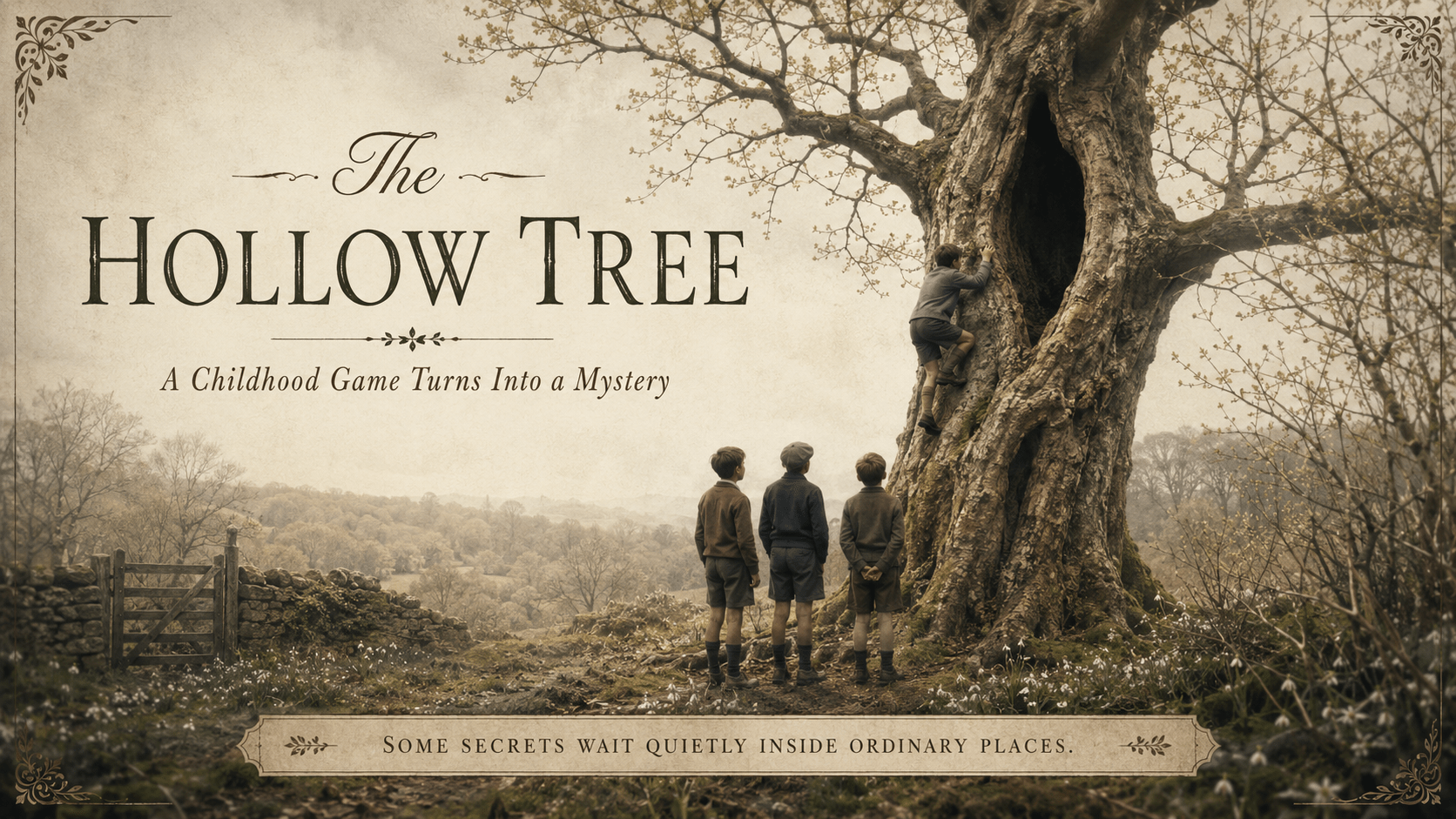
In the spring of 1943, while Britain was still living under the long shadow of the Second World War, four boys wandered into Hagley Wood near Worcestershire. They were not looking for a mystery. They were doing what boys of that time sometimes did: climbing trees, searching for birds’ nests, collecting eggs, and testing the boundaries of land they were not supposed to enter.
Then one of them climbed a large wych elm.
The word “wych” here refers to a type of elm tree, not necessarily to witchcraft. Yet language has a way of folding coincidence into meaning. In later retellings, “wych elm” would almost inevitably sound like “witch elm,” and the tree itself would become part of the legend.
Inside the hollow trunk, the boy saw something that no child should have had to understand at first glance: a human skull, with hair and teeth still visible.
The boys ran. At first, they tried to keep silent, afraid of admitting they had trespassed. But silence is not always shelter. That night, one of the boys reportedly became too frightened to keep the secret, and the police were eventually told.
When investigators returned to the tree, they found more than a skull. They found the remains of a woman, hidden inside the hollow elm. She wore, or had been buried with, fragments of clothing and a wedding ring. A piece of cloth was found in her mouth. One hand was discovered separately near the tree.
Her identity was not known.
Later, graffiti appeared asking a question that would outlive witnesses, theories, investigations, and generations:
Who put Bella in the Wych Elm?
No one knows for certain who wrote it. No one knows for certain who Bella was. And no one knows who placed her in the tree.
That is why the story remains.

To retell this story well, we must resist turning Bella into a mere object of horror. She was not only a mystery. She was a person, and the power of the tale begins there.
The woods must have felt different in wartime.
Even the countryside was not free from the war’s pressure. Rationing, news from Europe, fear of bombing, missing persons, military secrecy, and the ordinary shortages of daily life formed a background to every conversation. Adults carried worry in their faces. Children, as children do, still found ways to play.
So the boys entered the wood.
They climbed, laughed, searched branches, and looked for the small treasures of birds’ nests. To them, the trees were not symbols. They were ladders, hiding places, challenges.
Then the wych elm changed.
Its trunk was hollow, deeper than expected. A boy climbed high enough to peer inside, perhaps expecting eggs, perhaps a nest, perhaps nothing at all. Instead, from within the darkness of the tree, a human skull looked back.
There are moments when childhood ends abruptly. Not through age, but through knowledge.
The boys had found something that belonged to the adult world: death, secrecy, crime, and the terrible weight of telling the truth. They ran home, but the image ran with them.
A skull in a tree is not easily forgotten.

When the authorities examined the tree, the mystery became more disturbing. The body was that of a woman, and it had been concealed within the hollow trunk. The fact that she had been placed there at all suggested intention. This was not a shallow grave, not a body left in the open, not something easily discovered by accident.
A tree is a strange hiding place.
It is alive, but silent. It grows around what it holds. It stands in the same place while people pass by, season after season, never knowing what rests inside. A hollow elm can become a cabinet of secrets, and Hagley Wood had kept its secret for many months.
The woman’s mouth reportedly contained cloth, which suggested that suffocation may have been involved. Her hand had been separated from the body and found nearby. There were fragments of clothing. There was a wedding ring. There were teeth that investigators hoped might identify her.
But wartime Britain was full of absence.
People had vanished under bombs. Records were scattered. Families were displaced. Some names were never properly written down, and some losses were absorbed into the larger catastrophe of war. Against that vast background of missing people, one unidentified woman could disappear twice: first from life, and then from the certainty of history.
Police tried to identify her. Dentists were contacted. Missing-person reports were compared. The details did not lead to a name.
So the public gave her one.
Bella.
Whether that name came from knowledge, rumor, local invention, or the hand of someone who knew more than they admitted remains uncertain. But once the name appeared, the woman in the tree was no longer only “the body.” She became Bella, and the question became personal.
Who put Bella in the Wych Elm?
Graffiti is often treated as damage, but in this story it became a form of memory.
The words appeared on walls and public surfaces: Who put Bella in the Wych Elm? The phrasing changed in some accounts, but the heart of it remained the same. Someone was asking a question in public that the investigation could not answer.
That question did several things at once.
It accused.
It remembered.
It unsettled.
It refused silence.
Perhaps the writer knew something. Perhaps the writer knew nothing at all. Perhaps “Bella” was a local nickname that had already begun to circulate. Perhaps the graffiti was less a clue than a spell of remembrance, a way of forcing the village and the wider public to keep looking at what they preferred to forget.
During war, many private tragedies are asked to stand aside for the larger emergency. A murdered woman in a tree may horrify a community, but nations at war are trained to move forward. The graffiti resisted that movement. It made a dead woman’s anonymity visible again.
It turned absence into a sentence.
A mystery like this does not give us a neat proverb, so we must listen for the sentence hidden inside it.
When truth is buried, remembrance becomes a kind of courage.
This sentence captures the moral atmosphere of Bella’s story. The case does not invite us to invent certainty where none exists. Instead, it invites us to remember carefully. To say: a person was here. A life was taken. A name was lost. And even if we cannot solve the mystery, we can refuse to let the person become merely a curiosity.
The cultural power of this mystery comes from the meeting of two worlds: modern police investigation and older rural imagination.
Bella’s story sits at a crossroads of true crime, British folklore, wartime anxiety, and rural superstition.
The tree itself matters. A hollow tree has long been a powerful image in folklore: a threshold, a hiding place, a body of wood that can conceal what people cannot speak aloud. Forests, too, carry symbolic weight. They are places outside ordinary social order, places where children wander, secrets are hidden, and the boundary between the known and unknown becomes thin.
Then there is the word “wych.” Historically, it refers to the wych elm tree. But to the ear, especially in a mystery involving a woman, a severed hand, and occult theories, it easily becomes “witch.” The pun may be accidental, but folklore often grows from such accidents.
Several theories have surrounded the case. Some suggested an ordinary murder. Others imagined espionage, because wartime Britain was full of spy fears and secrecy. Still others pointed toward occult explanations, including the old European legend of the “Hand of Glory,” a supposed magical object made from a severed hand. Such theories should be treated carefully. They may reveal more about the fears and prejudices of the time than about the actual crime.
From a cultural perspective, the most important fact may be this: where evidence ends, imagination begins.
And imagination, once awakened, does not always serve truth. Sometimes it protects memory. Sometimes it distorts it. Sometimes it does both at once.
We are drawn to unsolved mysteries because they give shape to a fear we all know: the fear that something important may remain forever unknown.
Why does this story still disturb people?
Not only because of the tree. Not only because of the hand, the cloth, or the strange graffiti. Those details unsettle us, but the deeper unease comes from the missing center: the woman’s identity.
A name is one of the simplest forms of dignity. When a person loses their name in death, the living feel an obligation to restore it. That may be why “Bella” matters, even if it may not have been her real name. The name gives the mind something to hold. It transforms a set of remains into a remembered presence.
Unsolved mysteries also expose the limits of knowledge. We like to believe that truth, with enough effort, can always be recovered. But old cases remind us that time is not neutral. It erases. It scatters evidence. It outlives witnesses. It turns facts into rumors, and rumors into folklore.
This is why Bella’s story belongs not only to crime history, but to the philosophy of fear. The supernatural may or may not be involved; that is not the deepest question. The deeper question is how human beings live beside uncertainty.
Do we invent answers?
Do we turn away?
Do we keep asking?
Do we remember without pretending to know?
Perhaps the wisdom of the story lies in that last possibility.
The lesson of Bella in the Wych Elm is not that every mystery must be solved by imagination. It is that curiosity should be guided by care.
Modern readers encounter old mysteries in a very different way. We read articles, watch videos, compare theories, and search for hidden clues. Curiosity is natural. It can even be honorable. Many forgotten people have been remembered because someone refused to stop asking questions.
But curiosity can become careless when it treats a human tragedy as a puzzle for entertainment only.
Bella’s story may remind us that the unknown deserves humility. We can explore theories without pretending they are facts. We can discuss folklore without blaming communities or repeating old prejudices. We can feel the thrill of mystery while still remembering that, at the center of the story, there was a woman whose life ended violently and whose name was lost.
In daily life, this lesson reaches beyond crime and folklore. We often meet situations where we do not know the whole story: a rumor about a neighbor, a silence from a friend, a family secret, a public accusation, a fragment of information that tempts us to complete the picture too quickly.
This tale quietly asks us to slow down.
A question can be powerful. But a question can also wound if asked without care. The better question is not only “Who did this?” but also “How do we remember rightly?”
The most haunting mysteries do not only ask us to look into the past. They ask us to notice how we look.
The boys looked into a hollow tree and saw death.
The public looked at a nameless woman and wrote a question.
Generations later, we look at the question and still feel it looking back.
Perhaps that is why “Who put Bella in the Wych Elm?” remains so powerful. It is not only a demand for a murderer’s name. It is a plea against disappearance. It asks us not to let fear swallow compassion, not to let mystery erase personhood, and not to let silence become the final word.
When you encounter an unanswered story, do you seek only the thrill of the mystery—or do you also listen for the life that may have been forgotten inside it?
When you encounter an unanswered story, do you seek only the thrill of the mystery—or do you also listen for the life that may have been forgotten inside it?