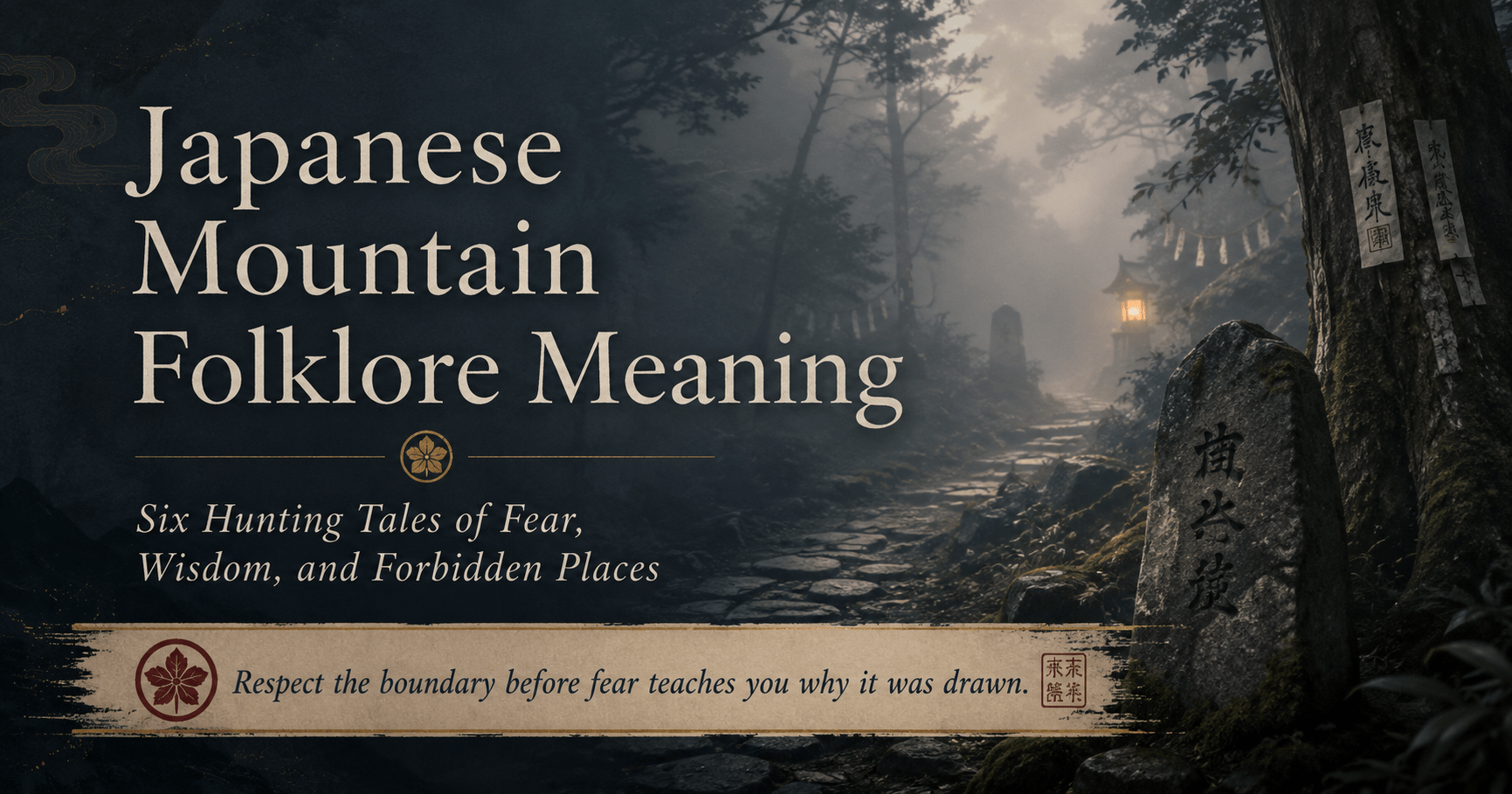
※This site uses affiliate advertising.In Japanese folklore, mountains are rarely just mountains.They are places of food and danger, silence and memory, livelihood and taboo. For hunters, especially those who enter deep forests before dawn, the mountain is not a scenic background. It is a living borderland where human skill meets weather, animals, darkness, and sometimes something that cannot be easily named.The following article rewrites a set of strange Japanese hunting tales as folklore rather than verified fact. These stories are not presented as proof of the supernatural. Instead, they are best read as mysterious folklore with moral and psychological meaning: stories about caution, pride, gratitude, grief, ancestral protection, and the old belief that some places should not be entered lightly.In Japan, the word kami can refer to a deity, spirit, sacred presence, or mysterious force. Mountains have long been associated with kami, ancestors, and unseen powers. For that reason, a hunter’s fear is not always fear of an animal. Sometimes it is fear of crossing a boundary.And in old stories, boundaries remember.Before retelling the stories, it is important to understand the cultural landscape behind them.Japan has a long tradition of mountain worship. Mountains were seen not only as physical places but as spiritual territories. Some were associated with kami. Others were linked to the dead, ascetic training, hidden villages, or dangerous beings. Even today, certain mountain paths, old shrines, abandoned settlements, and fenced-off places carry an atmosphere of warning.Hunters have always known this better than most.A hunter may be skilled with a rifle, experienced in reading tracks, and familiar with animal behavior. But the mountain can still undo confidence. Fog can erase direction. A single animal charge can break a body. A wrong step can send a person into a valley. And loneliness can make every sound feel like a message.That is why mountain hunting folklore often speaks in two voices. One voice warns of practical danger: bears, boars, cliffs, cold, getting lost. The other voice whispers of spiritual danger: mountain gods, forbidden places, strange figures in the fog, and scents or sounds that do not belong to ordinary animals.These tales live between those two voices.Six Strange Hunting Tales from the Japanese MountainsThis section retells six mountain tales as folklore. They should be read as stories passed through fear, memory, and warning, not as confirmed records.1. The Beast SmellThe first tale concerns an elderly hunter who lived in a remote mountain village.Though he was already past sixty, people in the area still regarded him as one of the finest hunters around. He knew the ridges, the animal trails, the timing of the wind, and the silence that comes just before something moves.One day, a nearby village asked him for help. A bear had reportedly been seen several times near the settlement. People were frightened. Fields and homes no longer felt safe. Bear control is dangerous work, and not the kind of job anyone accepts lightly. But the old hunter agreed. It was partly duty, partly pride, and partly the old belief that a hunter’s skill exists for the community, not only for himself.He entered the mountain with other hunters and searched for days.Yet no bear appeared.On the third day, deep in the forest, he noticed a dark shape moving through the trees. At first, he thought it must be the bear. It was large, covered in thick dark hair, and moving quietly through the undergrowth.Then it stood upright.The hunter froze.From a distance, the thing looked almost human in posture, but not human in shape. Its body was wrapped in coarse fur. Its movement was heavy and wrong. At the same time, a powerful animal odor spread through the air—so strong that the hunter later described it as almost unbearable. It was not the ordinary scent of a bear, deer, or boar. It was a thick, suffocating stench that seemed to announce the creature before the creature itself arrived.The hunter’s instinct, sharpened by decades in the mountains, told him one thing: this was not something to pursue.He tried to retreat without sound.But the creature turned.It began moving toward him.As it came closer, the smell grew worse. Nausea rose in his throat. The forest seemed to shrink around him. In that moment, whether from fear or survival instinct, he raised his gun and fired.The shot missed.But the sound broke the spell. The creature recoiled and vanished into the trees.The hunter survived. Yet the story did not end there. It is said that even years later, when he entered certain parts of the mountain, he would sometimes catch that same impossible beast smell in the wind.Perhaps it was only memory.Perhaps it was a warning.Or perhaps something in the mountain remembered him too.2. The Mountain GoddessThe second tale is gentler, though no less strange.A hunter had entered the mountain with members of a local hunting association to help control wild boars. In rural Japan, boars can damage fields and sometimes injure people. For the hunter, this was familiar work. Perhaps too familiar.While tracking an animal, he became separated from the others.By the time he realized his mistake, it was too late. A boar charged. The impact sent him tumbling down into a ravine. He survived the fall, but one of his legs was broken. His emergency whistle had been lost with his pack. He could not climb. He could not walk. He could only wait.The season was turning from autumn toward winter. The air grew colder as the afternoon faded. Cold is not dramatic at first. It does not roar. It simply enters the body little by little, taking strength, then clarity, then hope.The hunter waited and shouted until his voice failed. No one answered.As darkness approached, he began to accept that he might not return.Then, just before his awareness disappeared, he saw light.Not the sharp beam of a flashlight. Not lightning. The story describes it as warm, soft light, surrounding him as if the mountain itself had opened a hidden hand. Wrapped in that warmth, he lost consciousness.When he awoke, he was in a hospital bed.His companions later told him that they had found him because they heard the sound of an emergency whistle coming from the ravine. They followed the sound and discovered him at the bottom.But the hunter had no whistle. His own had been found elsewhere, lost during the fall.In the village, people remembered an old belief: the mountain had a goddess, a protective presence said to help those in true danger.Did she save him?Was the whistle a strange echo?Was it coincidence, imagination, or grace?The tale does not answer. It simply leaves us with the image of a freezing man wrapped in light, and a sound no one can explain leading rescuers through the trees.3. The White Shape Behind the ManThe third tale begins like a crime story and ends like a ghost story.A hunter was walking through a deep mountain area when he heard movement in the brush. Believing it might be an animal, he raised his gun.Then a human voice cried out.“Wait!”A young man emerged from the trees. He looked to be in his twenties. He claimed he had lost his way.But something was wrong.This was not a mountain where ordinary hikers wandered. It was a deep hunting area, far from casual paths. The hunter also noticed dark stains on the young man’s clothing. They looked like blood.The hunter understood, or believed he understood, why the young man was there.He did not confront him directly. Instead, he calmly explained the way back to the road and tried to contact his companions by radio. But the young man sensed the movement and attacked.The hunter was knocked to the ground. The young man raised a knife.In that moment, the air changed.A coldness spread through the trees—not ordinary weather cold, but the kind of cold that belongs in ghost stories. The young man suddenly looked terrified. He screamed, pulled away, and ran as if something had seized his mind.As he fled, the hunter saw something behind him.A pale shape clung to his back like a shadow made of fog. From somewhere in the trees came a woman’s low moan.The rest of the tale is told in grim fragments. The hunter contacted the authorities. Later, the young man was reportedly found dead in the mountain, and near him was the body of a woman, her hand or presence associated with his ankle, as if the dead had not allowed him to escape.This story should not be read as a confirmed crime report. As folklore, however, it is powerful. It gives form to an old fear: that the mountain sees what human eyes miss. A crime hidden among trees may still be witnessed by the dead, the land, or conscience itself.4. The Grandfather’s WatchThe fourth story is about inheritance.A young hunter had learned his craft from his grandfather. The older man had taught him how to walk quietly, how to read tracks, how to wait, and above all, how to respect the mountain.After the grandfather died, the hunter received his pocket watch as a keepsake. From then on, whenever he entered the mountain, he carried it close to his body. It became more than an object. It became a charm, a memory, a quiet companion.One day, while hunting, a dense fog surrounded him.Mountain fog is dangerous because it erases the world gently. A path disappears. A tree looks like another tree. Sound changes shape. The safe choice is often to stop and wait.The hunter did exactly that.Then he heard a voice.“Hey.”The voice came from somewhere in the fog. When he looked, he saw a figure standing in the white distance. He thought it might be another hunter, also trapped by the weather.He almost walked toward it.Then the pocket watch rang.At the same moment, a crack appeared across its face.The hunter stopped.Something felt wrong. The figure had said only one word. It did not give a name. It did not come closer. It only waited.The hunter called out, “Who are you? Say your name.”No answer.He raised his gun toward the shape.Then, according to the tale, the figure made a small clicking sound with its tongue—as if annoyed—and vanished. Soon after, the fog began to clear.The hunter believed that the watch had warned him. Perhaps his grandfather’s spirit had protected him. Perhaps the sound simply startled him into caution at the right moment. Either way, the lesson is quiet and moving: sometimes what saves us is not force, but remembered wisdom.An heirloom is never only an object.It is a voice from someone who once knew the road.5. The One-Eyed Mountain SpiritThe fifth tale is about a being described as a tatari-gami—a wrathful or vengeful spirit in Japanese belief.Two men from a hunting association entered the mountain not for hunting, but for wildlife conservation. Hunting associations in rural Japan are often involved not only in pest control but also in maintaining balance in local ecosystems. On that day, they were checking the habitat of wild birds.As they walked, they saw something ahead.At first, it looked like a bear.But as they looked more carefully, they realized it was not a bear. Its body was covered in thick fur, and most of its face seemed to be taken up by one enormous eye. It made a strange cry—something like “ki, ki, ki”—sharp, unpleasant, and difficult to forget.The men knew they should leave quietly.But fear can move faster than judgment. One of them panicked and fired at the creature.The sound echoed through the trees.The being shrieked and vanished.At first, the men thought they had escaped. But soon after, one of them became severely ill with fever. The man who had fired the shot later died in the mountain, according to the tale.The survivor’s relatives recognized the story. They said the creature was a mountain tatari-gami, a spirit that should never have been disturbed. Ritual purification or prayer was performed, and the survivor eventually recovered.Whether taken literally or symbolically, this tale is not only about punishment. It reflects a deep mountain ethic: not every strange thing is an enemy, and not every fear should be answered with violence.In older folklore, a mountain is not empty land waiting to be used. It is inhabited by presences. Some are protective. Some are dangerous. All demand respect.6. The Place No One Was Allowed to EnterThe final tale is the darkest, and perhaps the most clearly shaped as a warning.In a remote mountain village lived a young hunter, only twenty-one years old. He had an old friend of the same age who had once hunted with him before moving away to the city. During a summer break, the friend returned, and the two decided to go into the mountain together.Both had hunting licenses, but neither had the experience of an elder. They were young, curious, and eager to test the mountain as if it were a place that would forgive them.There was a fenced-off area in the mountain that adults had always warned them never to enter.No one explained why.That silence made the place more tempting. Since childhood, the two had wondered what lay beyond the fence. On that day, curiosity overcame caution.They climbed over.At first, there was only forest. Then the air changed.The silence became heavy. The warmth of the day turned strangely damp. Around them, they noticed paper talismans—ofuda, protective or ritual papers often placed to mark sacred, dangerous, or spiritually sealed spaces.They understood at once that they had made a mistake.They turned back toward the fence.Then something seized them.The tale says countless hands gripped their bodies from the unseen air or from the ground itself. The hands pulled them deeper into the forbidden space. The young men struggled, but the more they resisted, the stronger the pull became.Just when they believed they would vanish into the place entirely, adults from the village climbed over the fence and dragged them out.How did the villagers know they were there?No one explained.What was beyond the fence?No one told them.The rescued youths saw only the villagers’ faces: not anger, but pity.Then pain came.One discovered that he had lost a leg. The other had lost an arm. In later tellings, people said the forbidden place had taken payment for their trespass.This story is severe, and it should not be read as literal advice about punishment. As folklore, it dramatizes one of the oldest social lessons: some boundaries exist because someone before us learned, painfully, that they were needed.Curiosity is not evil.But curiosity without humility can become a door that does not open both ways.Key Quote / Proverb / Affirmation“Respect the boundary before fear teaches you why it was drawn.”This is not an ancient proverb, but a proverb-style affirmation shaped for these tales. It speaks to hunters, travelers, and modern readers alike. Boundaries are not always meant to limit life. Sometimes they are the wisdom left behind by those who survived.Cultural Insight: Mountain Kami, Taboo, and the Ethics of the WildIn Japanese folklore, mountains are often liminal spaces. A liminal space is a threshold—neither fully human nor fully otherworldly. Villages belong to the world of people. Deep mountains belong to something older and less predictable.This is why many Japanese mountain tales include rules: do not enter certain places, do not answer certain voices, do not mock the mountain, do not take more than needed, do not fire at what you do not understand.These rules may sound supernatural, but they also preserve practical wisdom. In the mountains, arrogance can kill. Panic can kill. Curiosity can kill. Disrespect for land, weather, animals, and elders can kill.The concept of a mountain kami gives symbolic language to this truth. It says: the mountain is not empty. You are a guest.Hunters in these stories are not always punished because they are bad people. Sometimes they suffer because they forget that skill is not the same as mastery. A rifle does not make a human stronger than the mountain. Experience does not remove mystery. Youth does not cancel taboo.In that sense, these stories function like cultural memory. They turn danger into narrative, and narrative into caution.Psychological and Philosophical Reflection: Why Mountain Horror Stays With UsMountain horror has a special psychological power because it combines isolation with uncertainty.In the city, fear often has witnesses. In the mountain, fear becomes private. If you hear a voice in the fog, no one else may hear it. If you smell something impossible, no one else may believe you. If you step into a forbidden place and return changed, the village may understand more than it says.These tales also reflect the human fear of losing orientation. In the mountains, a person can lose direction, time, identity, and confidence. Fog hides the path. Darkness changes familiar trees into strangers. A cry in the distance can become either rescue or temptation.Folklore gives language to this anxiety.The beast smell becomes the fear of encountering something outside human categories.The mountain goddess becomes hope when the body has reached its limit.The white shape becomes guilt that cannot be buried.The grandfather’s watch becomes ancestral memory.The one-eyed spirit becomes the danger of panic.The forbidden place becomes curiosity without humility.Rather than proving the supernatural, these stories reveal how people live with uncertainty. They teach us that fear is not always meaningless. Sometimes fear is the mind’s way of noticing a boundary before reason catches up.Life Lesson: Fear as a Form of RespectOne way to read these mountain tales is that fear can become wisdom when it teaches respect.Modern life often treats fear as something to defeat. We are told to be fearless, to push through, to ignore hesitation. But old folklore is more subtle. It does not always praise the person who enters anyway. Sometimes it honors the one who stops at the fence, waits in the fog, lowers the gun, or listens to the uneasiness in the body.This does not mean we should live timidly. It means courage and humility must walk together.A hunter without courage cannot enter the mountain.A hunter without humility may not return.In everyday life, the mountain may be a relationship, a decision, a secret, a temptation, or a place in the heart we do not yet understand. These tales may remind us that not every door must be opened immediately. Not every voice deserves an answer. Not every mystery is meant to be challenged.Sometimes the wiser act is to pause.To ask who is calling.To respect the old warning.To remember the people who walked before us.To leave the unknown its dignity.Reader Reflection: What Boundary Are You Ignoring?The most haunting part of these stories is not the creature, the ghost, or the forbidden place.It is the moment before the mistake.The moment when the hunter smells something wrong and almost stays.The moment when a young person sees the talismans and still wants to know more.The moment when fear offers wisdom, but pride, panic, or curiosity interrupts.Perhaps that is why mountain folklore survives. It gives us a safe way to look at the dangerous moment before we cross a line.The old tales may not be asking us to believe every shadow.They may be asking us to listen when the world grows strangely silent.Reader Reflection Question:What boundary in your own life might be asking for respect before fear has to teach you why it exists?