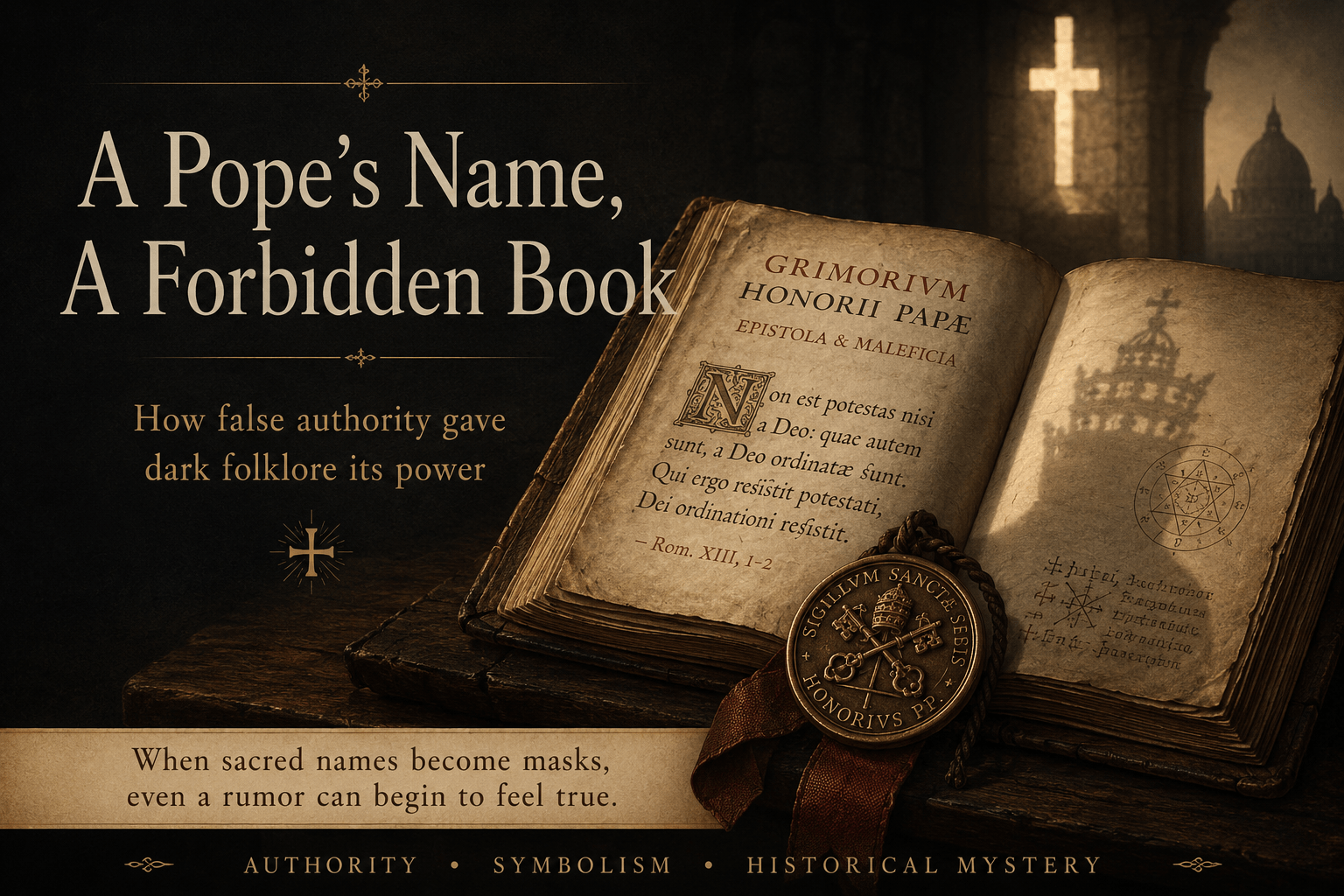
※This site uses affiliate advertising.A Forbidden Book, a Pope’s Name, and the Fear of KnowledgeSome books frighten us because of what they say. Others frighten us because of the name written on the cover.The Grimoire of Pope Honorius belongs to the second kind. It is often described in occult history as a forbidden magical book falsely attributed to a pope, a text that claims to turn sacred authority into a tool for commanding demons. Historically, the work is generally treated not as an authentic papal writing, but as a later grimoire falsely linked to Pope Honorius III, a medieval pope who lived centuries before the text circulated in its known form. The grimoire is commonly dated to the 17th–18th century tradition of European magical books, not to the 13th century papacy itself.That gap between fact and legend is exactly what makes the story so powerful.This is not simply a tale about a “cursed book.” It is a story about authority, fear, forbidden curiosity, and the human temptation to believe that hidden power must exist somewhere behind locked doors. Whether one reads it as occult folklore, religious satire, psychological warning, or historical curiosity, the Grimoire of Pope Honorius remains disturbing because it asks a quiet question:What happens when sacred language is used to serve dark desire?The Story of a Book That Borrowed a Pope’s AuthorityThe most unsettling part of the Grimoire of Pope Honorius is not only its alleged magic, but the way it uses authority itself as a mask.The legend begins with a name: Honorius.Pope Honorius III was a real historical figure, associated with the early 13th century and known for his role in formally approving major religious orders such as the Franciscans and Dominicans. But the grimoire that bears his name appears much later. Its power does not come from historical authenticity. It comes from the shock of contradiction.A pope is supposed to represent spiritual order.A grimoire is supposed to open a door toward forbidden power.By combining the two, the book creates a disturbing paradox: a sacred name placed on a profane object.In the imagination of later readers, this made the book feel far more dangerous than an ordinary magical manual. If an unknown sorcerer wrote a book of forbidden rites, it might seem suspicious. But if the book claimed the authority of a pope, even falsely, it gained a sinister kind of credibility.This is the psychology of false authority. A name can turn paper into relic, rumor into doctrine, and fiction into fear.Some occult commentators have noted that the Grimoire of Pope Honorius was unusual because it appeared to be designed for use by a priest, even including elements that imitate or distort Christian liturgical forms. That detail is important. The fear does not come only from demons. It comes from inversion—the turning of sacred structure toward forbidden ends.The book’s imagined horror lies in this reversal:Prayer becomes command.Holy names become weapons.Ritual becomes coercion.Faith becomes technique.In that sense, the Grimoire of Pope Honorius is less frightening as a supernatural object than as a moral image. It shows what happens when a person wants spiritual power without spiritual humility.Forbidden Rituals and the Shape of FearOld grimoires often frighten us not because we believe every detail, but because they reveal how fear can be organized into ritual.The original tale surrounding the Grimoire of Pope Honorius often describes severe preparations: isolation, fasting, prayers, circles, signs, celestial timing, and frightening invocations. These details should not be treated as instructions or verified practices. They are better understood as part of the folklore of forbidden books.In stories of cursed grimoires, ritual details serve a literary purpose. They make fear feel structured. They turn vague anxiety into steps, diagrams, names, and hours of the night.This is one reason such books were so persuasive in the imagination of earlier readers. The more precise the rule, the more powerful the mystery seemed. If something failed, the fault could always be blamed on an incorrect hour, an impure intention, a flawed sign, or a broken concentration.The human mind is deeply vulnerable to systems that explain failure while preserving belief.The Grimoire of Pope Honorius is often described as using divine names to compel infernal beings. Symbolically, this is one of its most disturbing ideas. It suggests a person trying to stand in the place of sacred authority, not to serve goodness, but to force the unseen world into obedience.That is the true horror of the book. It is not merely the presence of demons. It is the arrogance of the operator.The story suggests that the most dangerous circle is not the one drawn on the floor.It is the circle of obsession drawn inside the mind.Demons, Planets, and the Desire to Control FateThe grimoire’s world is not random. It imagines the invisible realm as a hierarchy, a calendar, and a system of power.One of the most fascinating aspects of the Grimoire of Pope Honorius is its structured view of infernal forces. Like many European magical traditions, it links spirits, names, timing, and cosmic influence into an ordered system.This reflects an old human desire: to believe that fate can be negotiated if only one knows the proper names, hours, and symbols.In older occult imagination, planets were not merely physical bodies in space. They were symbols of influence. Mars could be associated with conflict and force. Venus with attraction. Saturn with limitation, endurance, or heaviness. By linking demonic figures to celestial timing, magical systems gave private desire a cosmic costume.A person who wanted wealth, revenge, love, influence, or protection could imagine that the universe itself had a hidden schedule. If one could read it, perhaps one could bend life.That idea is still psychologically powerful today.Modern people may not believe in planetary demons, but many still look for secret formulas: the perfect timing, the hidden method, the forbidden shortcut, the password behind reality. The grimoire becomes a mirror of that old hunger.The danger is not curiosity itself. Curiosity can lead to learning, humility, and wisdom. The danger begins when curiosity becomes a refusal to accept limits.The Grimoire of Pope Honorius is frightening because it presents desire as a sacred technology. It implies that with enough ritual, enough authority, and enough will, a person can command what should never be commanded.But old folklore often whispers the opposite:Power without wisdom does not free the soul.It imprisons it.The Curse of the Book: Legend, Psychology, and the Nocebo of FearA cursed book becomes more frightening when people believe that merely owning it can change their fate.Many stories claim that those who handled the Grimoire of Pope Honorius suffered madness, misfortune, visions, or death. Such stories should be read cautiously. They belong to the folklore surrounding forbidden books, where rumor often grows larger than evidence.Yet even if the legends are not historically reliable, they reveal something true about fear.A person who believes they are cursed may begin to interpret ordinary events as signs. A bad dream becomes a warning. A creaking floor becomes a presence. Illness becomes punishment. Coincidence becomes fate.Psychology gives us a useful word for this: the nocebo effect. Just as belief in healing may sometimes influence how people experience symptoms, belief in harm can intensify fear, stress, and bodily distress. The curse may not need supernatural force to feel real. The mind can become its own haunted room.This is why cursed-book legends endure.They dramatize the terror of suggestion. Once a person believes that a book has opened a door, every shadow seems to move. Every silence seems to listen. Every misfortune seems connected.The Grimoire of Pope Honorius became powerful not only because of what it contained, but because of what people imagined it contained. The more it was feared, the more it seemed worthy of fear.In folklore, fear can become self-feeding.A rumor creates dread.Dread creates stories.Stories create reputation.Reputation creates more dread.And so a book becomes “cursed” not only by ink, but by imagination.The Vatican Archive and the Myth of the Hidden OriginalEvery forbidden-book legend needs a locked door. For this story, that door is often imagined inside the Vatican.A persistent rumor claims that the “true” version of the Grimoire of Pope Honorius is hidden somewhere in the Vatican archives. This idea is not unusual. The Vatican Apostolic Archive is real, immense, and historically significant. Its official description notes more than 600 archival fonds and over 85 linear kilometers of shelving, and Pope Leo XIII opened the archive to scholars in 1881.Such facts can easily feed the imagination.A real archive becomes a symbolic labyrinth.Restricted access becomes proof of deeper secrecy.Incomplete manuscripts become clues.Contradictions become evidence of suppression.But from a historical perspective, it is more likely that the grimoire developed as a “living text”—copied, altered, expanded, localized, and reshaped over time—rather than descending from one perfect original hidden in a vault.This is common in manuscript culture. Before modern printing stabilized texts, books changed as they moved. Copyists made mistakes. Editors added material. Local traditions influenced names and diagrams. A book could become many books while keeping one title.The myth of the hidden original is powerful because humans dislike uncertainty. We want the final version, the secret key, the forbidden truth behind the veil.But sometimes the absence is the mystery.Perhaps the most haunting thing about the Grimoire of Pope Honorius is not that a perfect original is hidden somewhere. Perhaps it is that there may be no perfect original at all—only copies, rumors, fears, and the human desire to believe that somewhere, someone knows the truth.A story about forbidden knowledge needs a sentence that does not simply condemn curiosity, but teaches discernment.“Not every locked door hides wisdom; some hide only the echo of our own desire.”This line captures the quiet lesson of the Grimoire of Pope Honorius. The problem is not that humans seek knowledge. Knowledge can heal, illuminate, and liberate. The danger lies in the kind of knowledge we seek when we are driven by fear, pride, obsession, or the wish to control others.Cultural InsightForbidden books are not only occult objects. They are cultural symbols of mistrust, power, and secrecy.The Grimoire of Pope Honorius reflects a recurring pattern in folklore: the suspicion that institutions hide dangerous knowledge. Whether the institution is a church, a palace, a library, or a secret archive, the story works because it turns authority into mystery.For English-speaking readers, it may be helpful to understand that European grimoires were often shaped by a mixture of Christian language, folk magic, astrology, ritual symbolism, and bookish authority. They were not always separate from religious culture; sometimes they borrowed its vocabulary, hierarchy, and solemn tone.That borrowing is what makes this grimoire so uncomfortable. It does not simply reject sacred forms. It imitates them.The cultural fear behind the tale is not just “demons exist.”It is “what if the language of holiness can be used without holiness?”That fear is timeless. It applies not only to religion, but to politics, science, business, and personal life. Any powerful language can be misused when it is separated from conscience.Psychological and Philosophical ReflectionThe story of a cursed grimoire is ultimately a story about what the mind does with secrecy.We are drawn to forbidden-book stories because they give shape to a very old anxiety: the fear that knowledge may change us before we are ready for it.There is a strange comfort in believing that danger lives in a book. If evil is contained in an object, then perhaps we can lock it away. But the deeper reading is more unsettling. The true danger may not be the book. It may be what the book awakens in the reader.A forbidden book asks:What do you want badly enough to risk your peace?What secret do you believe would save you?What authority would you misuse if no one could stop you?This is why the Grimoire of Pope Honorius still matters as mysterious folklore. It does not prove that demons appear when summoned. Rather, it reveals how easily human beings can summon something dark from within themselves when fear, pride, and desire are dressed in sacred language.Life LessonThe quiet lesson of this tale is not “never seek knowledge.” It is “seek knowledge with humility.”One way to read the Grimoire of Pope Honorius is as a warning about the misuse of names.A pope’s name.God’s name.The names of angels.The names of demons.In the story, names become tools of control. But in wiser traditions, names are also reminders of responsibility. To speak a name is to acknowledge a relationship. To use a powerful name carelessly is to forget the weight of words.In modern life, we may not deal with grimoires, but we still deal with authority, persuasion, titles, credentials, and impressive language. We still encounter people who use sacred words, moral words, scientific words, or spiritual words to gain influence.This tale may remind us to listen not only to the words being used, but to the intention behind them.A beautiful word can hide a selfish purpose.A holy phrase can be used without a holy heart.A promise of secret power can become a path away from wisdom.The lesson is not to fear every mystery.It is to ask what kind of person a mystery is making us become.A strange tale is most powerful when it leaves a quiet question behind.Perhaps the real mystery of the Grimoire of Pope Honorius is not whether a hidden book sleeps in an archive, or whether its legends are true.Perhaps the real mystery is simpler and closer:When we search for forbidden knowledge, are we seeking wisdom—or only power?Reader Reflection QuestionWhen you seek hidden knowledge, are you looking for wisdom—or for power over what you fear?