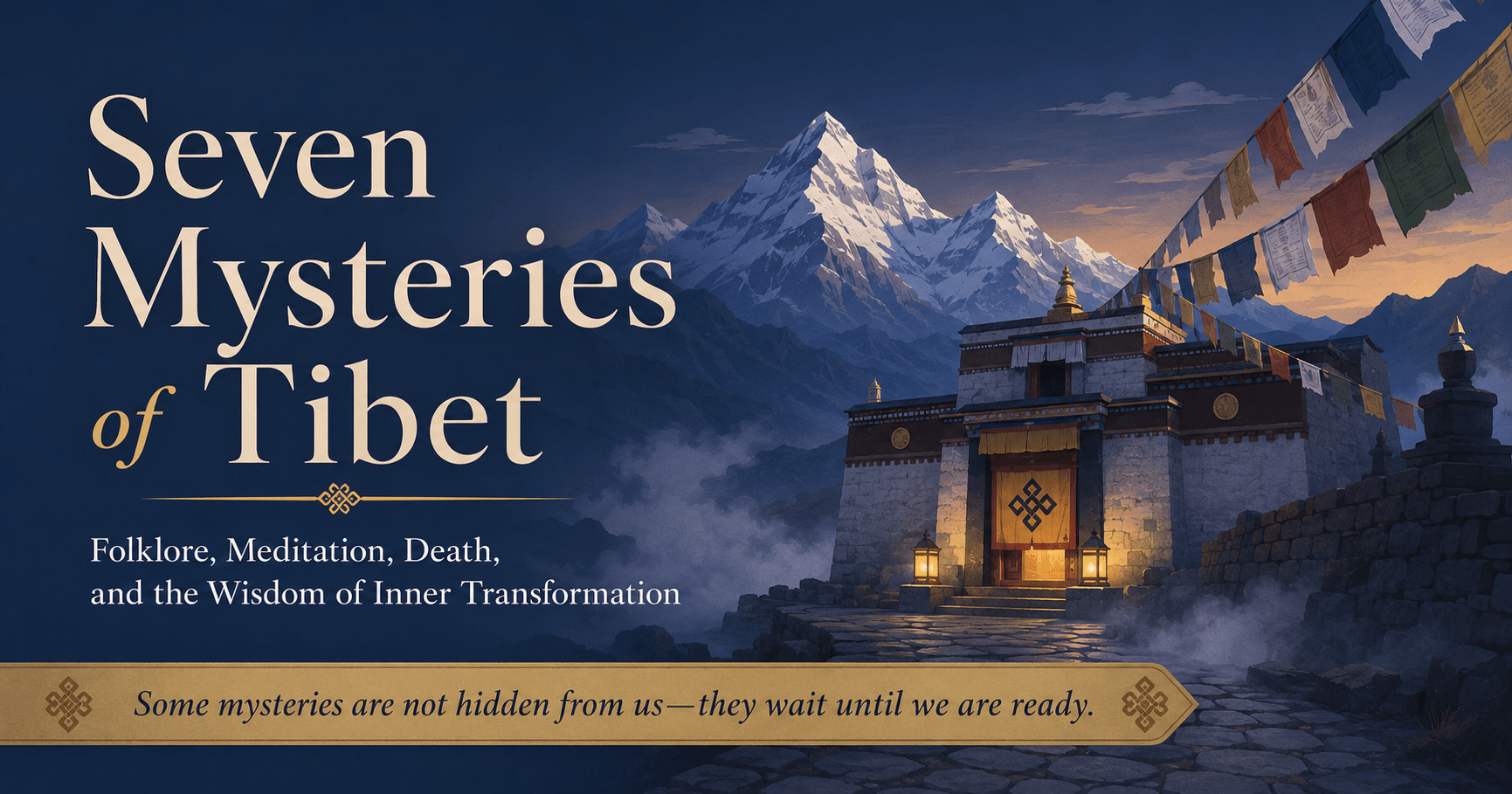
※This site uses affiliate advertising.High in the Himalayas, where thin air, stone, ice, and silence shape daily life, Tibet has long been imagined by outsiders as a land of secrets. Yet many of these “secrets” are not hidden in the ordinary sense. Some are spiritual practices that require decades of discipline. Some are cultural customs misunderstood by those who see only the surface. Others are legends—part history, part symbol, part mirror of the human desire to believe that wisdom may still exist beyond the noise of the modern world.This article explores seven mysterious traditions and stories associated with Tibet: the inner fire meditation known as tummo, sky burial, the Bardo Thodol, the rainbow body, hidden treasure texts, the legend of Shangri-La, and the reported slowing of metabolism through deep meditation.Rather than treating them as mere supernatural claims, we will read them as strange tales with hidden wisdom. Each one reveals something about fear, death, patience, discipline, impermanence, and the question that sits quietly beneath all spiritual traditions:What is the human being capable of becoming when mind, body, and meaning are trained together?Seven Mysteries Told on the Roof of the WorldBefore we enter each mystery, it helps to remember the landscape itself. The Tibetan Plateau is often called the “Roof of the World.” Much of it lies at an altitude where breathing becomes difficult for those who are not accustomed to it. Winters can be severe, forests are scarce in many regions, and daily survival has historically required discipline, adaptation, and an intimate relationship with the land.In such a place, spirituality is not an ornament added to life. It becomes a way of living with cold, death, distance, uncertainty, and silence.1. Tummo — The Inner Fire MeditationOne of the most widely discussed Tibetan practices is tummo, often translated as “inner fire.” In Tibetan Buddhist tradition, it is associated with advanced tantric meditation, especially within the system known as the Six Yogas of Naropa.The image is powerful: a practitioner sits in meditation, visualizing a flame at the navel. Breath is drawn deep, held, and shaped through a technique sometimes described as “vase breathing.” The imagined flame is not treated as fantasy but as a disciplined object of concentration. In the tradition, this inner fire rises through the subtle channels of the body, warming the practitioner from within.Reports of monks drying wet sheets with body heat in freezing conditions have fascinated scientists and readers alike. Some studies have suggested that experienced practitioners may raise peripheral or core body temperature under controlled conditions. Yet even where physiological explanations are proposed—breath control, brown fat activation, focused attention—the full relationship between imagination, nervous system, and bodily heat remains difficult to reduce to a simple formula.The deeper meaning of tummo is not merely that the body can produce heat. It is that the boundary between thought and flesh may be more flexible than modern life usually assumes.In a symbolic sense, tummo asks us: What inner flame keeps a person alive when the outer world becomes cold?Sky Burial — The Final Gift of the BodyTo many outside observers, Tibetan sky burial may seem shocking at first. In this funerary practice, the body of the deceased is offered to vultures in the mountains. The ritual can appear severe to those raised in cultures where burial or cremation is the norm.But within its cultural and Buddhist context, sky burial is not an act of cruelty. It is often understood as an expression of generosity and non-attachment.The body, after death, is regarded as an empty vessel. The consciousness has moved on, and the remaining flesh can nourish other living beings. What may appear disturbing from the outside becomes, from within the tradition, a final act of compassion.There are also practical reasons behind the custom. In high-altitude regions where the ground is frozen or rocky and wood for cremation may be scarce, burial and cremation are not always simple choices. Tibetan culture developed practices that were both spiritually meaningful and environmentally practical.Sky burial reminds us that culture shapes how we see death. What one society treats with solemn distance, another may treat with practical tenderness. The ritual’s unsettling power comes from the fact that it refuses to hide the body from nature. It returns the human form to the cycle of life with startling honesty.3. The Bardo Thodol — A Book Read to the DeadKnown in the West as The Tibetan Book of the Dead, the Bardo Thodol is more accurately understood as a guide to the intermediate state between death and rebirth. The title is often translated as “Liberation Through Hearing in the Intermediate State.”In the tradition, the text is read aloud near the deceased, not because the body can hear in an ordinary biological sense, but because consciousness is believed to pass through a series of visions, fears, lights, and encounters after death.The teaching is profound and psychologically rich: the terrifying figures that appear are not external enemies. They are projections of the mind. The flames, demons, thunder, and radiant lights symbolize inner states—fear, anger, attachment, confusion, and the possibility of awakening.Again and again, the text tells the consciousness not to be afraid.Do not run from the light.Do not mistake your own mind for an enemy.Do not cling to fear as if it were truth.Whether one reads the Bardo Thodol religiously, symbolically, or psychologically, its wisdom is striking. It suggests that the greatest journey after death may resemble the greatest journey in life: learning to recognize our own fear without being ruled by it.4. The Rainbow Body — A Legend of Dissolving LightAmong the most mysterious claims in Tibetan spiritual tradition is the “rainbow body.” According to certain Dzogchen teachings, a highly realized practitioner may, at death, dissolve the physical body into light. In some accounts, the body is said to shrink over several days, leaving only hair and nails behind.From a scientific point of view, such stories cannot be treated as verified fact. They belong to the realm of religious testimony, oral tradition, and sacred biography. Skeptics may interpret them as symbolic legend, misreporting, devotion, ritual concealment, or collective expectation.Yet even if read symbolically, the rainbow body carries great power.It expresses the hope that a human life can become so transparent to wisdom that even the body no longer feels like a prison. The story does not merely say, “A saint vanished.” It says, “A lifetime of practice can transform the way a person belongs to the world.”In this sense, the rainbow body is less important as a physical claim than as a spiritual image. It is a vision of complete release—matter becoming light, fear becoming openness, the self becoming less solid.5. Hidden Texts — Teachings Waiting for the Right TimeAnother fascinating Tibetan tradition is the idea of terma, or hidden treasure teachings. According to tradition, Padmasambhava, the Indian master who played a central role in bringing Buddhism to Tibet, concealed certain teachings for future generations. These teachings were said to be hidden in rocks, lakes, temples, caves, or even within the mindstreams of future practitioners.Those who discover them are called tertöns, or treasure revealers.To a skeptical reader, this may sound like a convenient way to authorize new teachings. If a text appears centuries later, claiming ancient origin, how can one verify it? Tibetan tradition itself has not been naïve about this. False treasure revealers and contested revelations have existed.Yet the cultural function of terma is remarkable. It allows a tradition to renew itself without appearing to abandon its roots. New teachings can emerge as “old wisdom rediscovered.” The past is not discarded. It is re-opened.This is a beautiful metaphor for personal growth as well. Sometimes the wisdom we need does not feel new. It feels as if it had been hidden inside us, waiting for the right moment to be understood.6. Shangri-La — The Lost Valley We Still Want to FindFew Tibetan-related myths have captured the Western imagination as powerfully as Shangri-La, the hidden valley of peace, youth, and wisdom. Yet the famous name itself comes not from ancient Tibetan scripture but from James Hilton’s 1933 novel Lost Horizon.Still, Shangri-La did not arise from nothing. It echoes older Himalayan ideas of hidden valleys, sometimes called beyul—places of refuge said to be accessible only to those who are spiritually prepared. In these traditions, a hidden valley is not merely a geographical location. It is a state of readiness.This is why the legend has endured. People do not search for Shangri-La only because they want a place on a map. They search for it because the modern world makes many people long for a sanctuary untouched by noise, speed, cynicism, and exhaustion.Perhaps Shangri-La is powerful because it is always almost reachable, but never fully possessed. It represents the human longing for a place where wisdom is not lost, where life is slower, and where the soul can breathe.If such a valley exists, it may not be a paradise of immortality. It may simply be a place quiet enough for a person to remember what matters.7. Slowing the Body — Meditation at the Edge of the PossibleThe final mystery returns us to the meeting point of science and contemplation. Reports associated with advanced Tibetan meditation describe practitioners lowering oxygen consumption and entering states that do not neatly fit ordinary categories such as sleep, coma, or rest.Such claims should be approached carefully. Extraordinary reports require careful measurement, context, and humility. At the same time, meditation research has shown that attention, breathing, and training can influence the nervous system in ways once underestimated.The most important lesson is not that ordinary people should imitate extreme practices. In fact, that would be dangerous. These disciplines belong to long traditions, guided by teachers, ethics, preparation, and years of gradual training.The wisdom lies elsewhere: the body is not merely a machine, and the mind is not merely a passenger. Breath, attention, emotion, and belief form a living network. Tibetan meditation traditions remind us that self-mastery is not achieved through force, but through patience.Key Quote / Proverb / Affirmation“The fire we seek outside may already be waiting within.”This is not an ancient proverb, but an original reflective affirmation inspired by the themes of inner fire, courage, patience, and spiritual readiness.Cultural Insight — Why These Stories MatterThe seven mysteries of Tibet are not simply a collection of exotic tales. They reflect a culture shaped by altitude, isolation, Buddhist philosophy, environmental limits, and disciplined spiritual practice.Tummo speaks to the relationship between mind and body.Sky burial reveals a view of death rooted in non-attachment and generosity.The Bardo Thodol turns death into a journey of recognition.The rainbow body expresses the hope of complete spiritual transformation.Hidden texts show how tradition can renew itself.Shangri-La reveals the world’s longing for sanctuary.Metabolic meditation reminds us that patience may unlock dimensions of human capacity.For English-speaking readers, these stories are most meaningful when approached with respect. They should not be reduced to fantasy, nor accepted uncritically as proven fact. They are best read as folklore, spiritual testimony, cultural symbolism, and windows into how human beings seek meaning in the face of death, fear, and uncertainty.Psychological and Philosophical ReflectionWhy are we drawn to stories like these?Perhaps because they give shape to questions that modern life often avoids. What is death? What is the body? Can fear be transformed? Can discipline change the limits of the self? Is there a wisdom that cannot be gained quickly?The strange power of Tibetan mystery stories lies in their refusal to separate the practical from the spiritual. A burial custom can be both ecological and sacred. A meditation practice can be both physiological and symbolic. A hidden valley can be both a place in the mountains and a state of inward readiness.Folklore often survives because it speaks in images where ordinary language fails. A body becoming light, a flame rising inside the belly, a book whispering to the dead, a valley hidden from the unready—these images stay with us because they describe inner experiences that are difficult to explain directly.They are not only stories about Tibet. They are stories about the human longing to become less afraid.Life Lesson — The Wisdom of ReadinessOne way to read these seven mysteries is through the idea of readiness.The monks who practice tummo are not performing tricks. They are the result of long discipline.The sky burial teaches that letting go is not a slogan but a cultural and spiritual act.The Bardo Thodol reminds us that fear becomes less powerful when recognized as part of the mind.The rainbow body, whether literal or symbolic, points toward transformation.The hidden texts suggest that wisdom appears when the time is right.Shangri-La teaches that not every paradise is found by searching harder.Deep meditation warns us that power without preparation can become danger.In modern life, we often want quick access to deep things: peace in ten minutes, courage in one quote, healing in one technique, wisdom without waiting. These stories gently resist that impulse.They suggest that the deepest doors do not open merely because we demand them to open. They open when we have become the kind of person who can enter without losing ourselves.Reader ReflectionThe true mystery may not be whether every legend can be proven. It may be this:What hidden discipline, fear, or wisdom within you is waiting for the right moment to be understood?