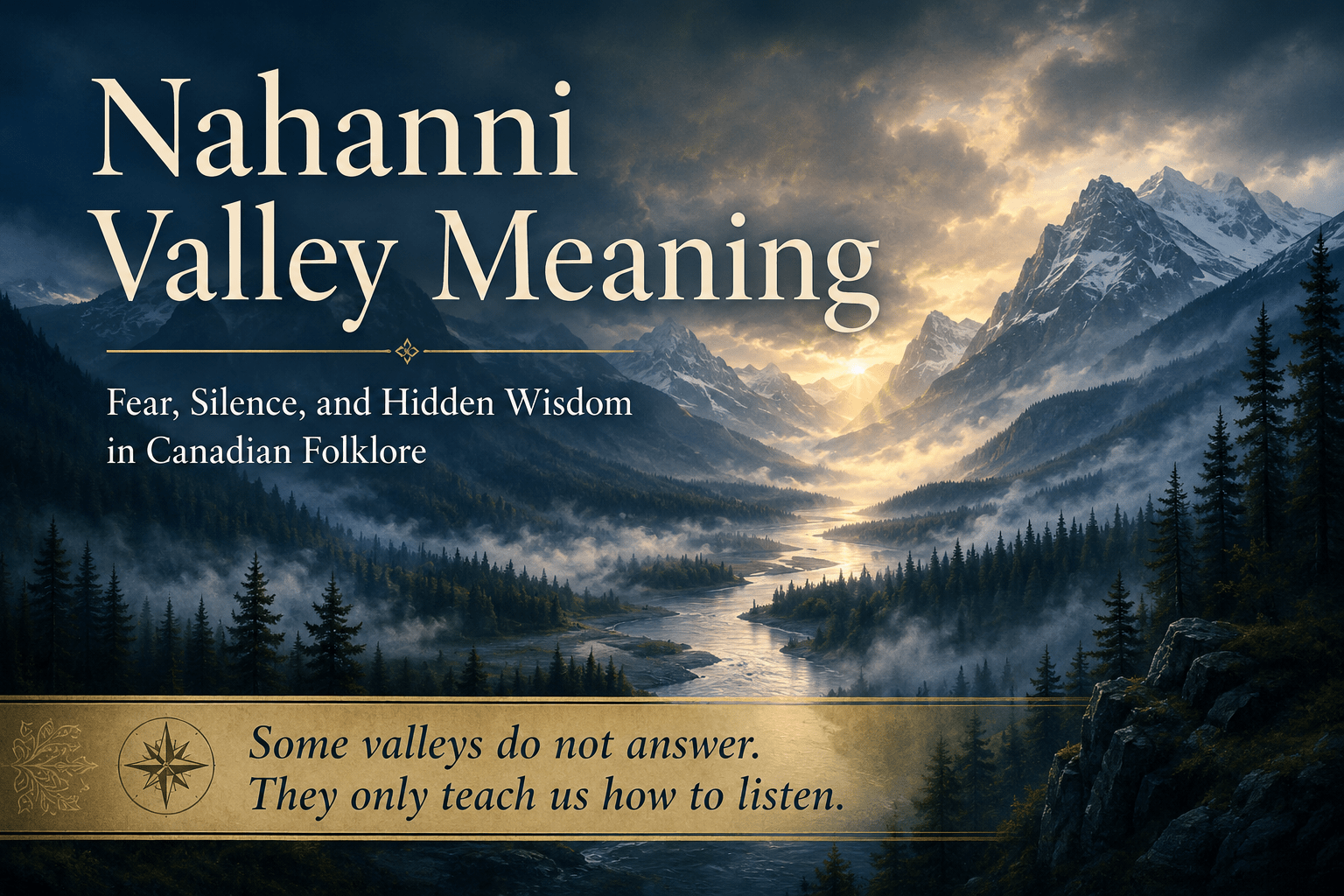
※This site uses affiliate advertising.Far in the wild northwestern reaches of Canada, where mountains rise like ancient walls and rivers cut through stone, there is a place often spoken of with both awe and unease: Nahanni National Park Reserve.To many, it is a landscape of breathtaking beauty—snow-covered peaks, deep canyons, wild rivers, and waterfalls that seem untouched by time. Yet alongside its natural majesty, Nahanni has also gathered darker stories: tales of abandoned camps, vanished prospectors, headless bodies, strange sounds in the wind, and a valley whose silence seems to remember more than it reveals.This is not simply a ghost story. It is a wilderness legend about fear, courage, greed, silence, and the human need to give meaning to the unknown. Whether read as folklore, cautionary tale, or psychological reflection, the mystery of Nahanni invites us to ask a deeper question:What happens when a place becomes so powerful in the imagination that it begins to feel alive?The Wilderness Behind the LegendNahanni National Park Reserve lies in a remote region of Canada’s Northwest Territories. Its scenery is dramatic even before one knows the stories attached to it. There are mountain ranges, hot springs, limestone caves, canyons, and the powerful Virginia Falls. The land is vast enough to humble anyone who enters it.In places like this, beauty and danger often stand close together. A river can look silver and peaceful from a distance, yet become deadly in its current. A mountain slope can appear calm under moonlight, yet conceal cold, hunger, injury, and disorientation. In the wilderness, silence is never empty. It can feel protective, watchful, or hostile depending on the heart of the traveler.This may be one reason Nahanni became fertile ground for strange tales. The deeper one travels into such a landscape, the thinner the boundary seems to become between geography and imagination. A valley is no longer only a valley. It becomes memory. It becomes warning. It becomes a story.The Vanishing of the NahaLong before prospectors came searching for gold, Indigenous peoples had lived around the Nahanni region for generations. Among the stories associated with the area is a tale involving the Dene people and a neighboring group often called the Naha in later retellings.According to the legend, the Dene and the Naha were once caught in a bitter conflict. The Naha were said to live higher in the mountain foothills, while the Dene lived in the valley below. This gave the Naha an advantage. From above, they could strike quickly and disappear into the slopes before retaliation could reach them.After years of hardship, the Dene warriors prepared an attack. They waited for a moonless night, hoping darkness would hide their movement. They climbed quietly through the black hills, ready to silence any patrol before an alarm could be raised.But as they drew close to the enemy camp, something felt wrong.There were no guards.No movement.No voices.When the warriors entered the camp, they found fires still smoldering and supplies still in place. It did not look like a camp that had been carefully abandoned. It looked as though life had simply stopped in the middle of itself.No Naha people were found.In the legend, this disappearance frightened the warriors more deeply than battle itself. An enemy can be fought. A mystery cannot. From that night onward, the mountains were said to carry a shadow that could not be explained.Whether this story preserves a historical memory, a symbolic warning, or a later imaginative retelling, its emotional power is clear. The most frightening thing in the tale is not violence. It is absence.A silent camp. A missing people. A question with no answer.Gold, Silence, and Dead Men’s ValleyCenturies later, a different kind of hunger brought outsiders into the Nahanni region: the hunger for gold.In the early twentieth century, prospectors came north carrying tools, hope, and the dangerous belief that fortune might be waiting just beyond the next ridge. Among the most famous figures in the legend are two brothers often identified as Frank and Willie McLeod.The story says the brothers entered the harsh wilderness and found gold near a creek. Encouraged by their discovery, they returned the following spring with others. The weather was better. The group was larger. They were experienced enough, it seemed, to survive the cold and distance.Yet they vanished.Years later, searchers reportedly found skeletal remains near a creekside camp. The detail that turned the story into legend was gruesome: the bodies were said to have been discovered without heads.From that point on, the area became associated with names that sound almost too stark to be real: Dead Men’s Valley and Headless Creek.It is important to treat such stories carefully. Wilderness deaths can be caused by many ordinary dangers—accidents, exposure, animals, conflict, illness, or simple misfortune. Folklore often gathers around real fear and reshapes it into memorable symbols. A missing person becomes a warning. A violent death becomes a legend. A remote valley becomes a place people speak of in lower voices.And yet, even when we explain the practical dangers, the story continues to disturb us.Perhaps it is because gold itself carries symbolic weight. In folklore, gold often represents desire. It shines like promise, but it also leads people into places they might not otherwise go. In the Nahanni legend, the search for treasure becomes a journey into uncertainty. What the prospectors hoped to find was wealth. What the story remembers is vulnerability.The Engineer Who Never ReturnedThe tales did not end with the McLeod brothers.In another story from the early twentieth century, a mining engineer was sent into the Nahanni region to survey a possible site. He was expected to return, report his findings, and collect his pay. But he never came back.A search party entered the area with Indigenous guides who knew the land far better than the outsiders did. Yet when the searchers asked to be led into certain mountain regions, the guides reportedly refused. They were said to be deeply uneasy, especially about traveling after dark.The most unsettling part of this tale is not what the guides explained, but what they did not explain.Silence can be a powerful element in folklore. Sometimes a warning becomes stronger when it is incomplete. When people refuse to speak of something, the imagination rushes to fill the empty space. Was their fear based on old stories? Dangerous terrain? A remembered tragedy? A spiritual taboo? Or simply practical knowledge outsiders failed to understand?The legend leaves the question open.And that openness is part of its force.A fully explained danger belongs to the world of survival. An unexplained danger belongs to the world of myth.The Engineer Who Never ReturnedEnglishThe tales did not end with the McLeod brothers.In another story from the early twentieth century, a mining engineer was sent into the Nahanni region to survey a possible site. He was expected to return, report his findings, and collect his pay. But he never came back.A search party entered the area with Indigenous guides who knew the land far better than the outsiders did. Yet when the searchers asked to be led into certain mountain regions, the guides reportedly refused. They were said to be deeply uneasy, especially about traveling after dark.The most unsettling part of this tale is not what the guides explained, but what they did not explain.Silence can be a powerful element in folklore. Sometimes a warning becomes stronger when it is incomplete. When people refuse to speak of something, the imagination rushes to fill the empty space. Was their fear based on old stories? Dangerous terrain? A remembered tragedy? A spiritual taboo? Or simply practical knowledge outsiders failed to understand?The legend leaves the question open.And that openness is part of its force.A fully explained danger belongs to the world of survival. An unexplained danger belongs to the world of myth.Martin Jorgensson and the Price of DiscoveryAnother figure often woven into the Nahanni legend is Martin Jorgensson, a prospector said to have entered the region in search of a life-changing discovery.In the story, Jorgensson wrote to his family that he had found an extraordinary gold vein. His words carried the excitement of a man who believed hardship was about to be transformed into prosperity. Perhaps he imagined returning home with proof that the cold, hunger, and isolation had all been worth it.But the letter was the last his family heard from him.Searchers later found him near the remains of a burned cabin. As with other Nahanni stories, the account says his body had been violently mutilated. Some suggested murder by those who wanted his claim. Others allowed darker rumors to grow.Here again, the story works on two levels.On the surface, it is a frightening mystery. Beneath that, it is a meditation on the fragile line between ambition and danger. The wilderness does not care what a person hopes to gain. A mountain does not become kinder because someone has a dream. A river does not soften because someone believes destiny is near.This does not mean ambition is wrong. But folklore often reminds us that desire becomes dangerous when it blinds us to warning signs.Jorgensson’s tale is not only about what he may have found. It is about what he may have ignored.The Wind, the Valley, and the Feeling of Being WatchedBy the mid-twentieth century, stories of Nahanni had become quieter but not forgotten. In one later account, a mining expert and his partner entered the region to survey possible sites. They separated during the day and agreed to meet near a distinctive tree. One man returned. The other did not.The surviving partner searched briefly but was overcome by fear and disorientation. Familiar patches of forest began to feel strange. The landscape seemed to turn against his sense of direction. He fled, then later returned with a larger search party.Even with more men around him, the unease remained.One of the most memorable details in this part of the legend is the atmosphere: the wailing wind, the sense of being surrounded by something unseen, the feeling that the valley itself had a presence.Such descriptions are common in wilderness folklore. People who spend time in remote places often speak of sound differently. Wind through stone can resemble voices. Moving branches can seem like footsteps. A valley can echo in ways that confuse the mind. Isolation sharpens the senses until ordinary things become charged with meaning.But folklore is not only interested in whether a sound has a natural cause. It is interested in what the sound does to the human heart.A strange cry in the wind can become a reminder that we are not fully in control. A dark valley can reveal how quickly confidence turns into humility. A familiar forest can become unfamiliar when fear changes the way we see.Key Proverb / Affirmation“Courage is not the absence of fear, but the willingness to listen before moving forward.”This affirmation fits the Nahanni legend because the story is not simply about terror. It is about what people do when they sense danger, uncertainty, and silence. Some rush forward. Some turn back. Some listen. Some ignore what the land seems to be telling them.In this way, the legend becomes more than a strange tale. It becomes a reflection on discernment—the quiet wisdom of knowing when courage means continuing and when courage means stoCultural Insight: When a Place Becomes a StoryMany cultures have places that are more than locations. A forest, mountain, cave, river, or valley may become a container for memory. People attach warnings to it, grief to it, sacredness to it, or fear to it.Nahanni belongs to this kind of folklore.In many Indigenous and traditional worldviews, land is not treated merely as empty space. It is relational. It carries memory, responsibility, and presence. Even when later retellings mix fact, rumor, settler imagination, and sensational detail, the deeper theme remains powerful: human beings do not enter wild places as masters. They enter as guests.This is one reason the Nahanni legend should be read respectfully. It is not simply a spooky story to consume. It touches on Indigenous memory, colonial expansion, gold rush ambition, wilderness danger, and the way outsiders often misunderstand places that local communities know more deeply.The cultural meaning of the tale lies in this tension. To one person, the valley may be a route to wealth. To another, it may be a place of warning. To another, it may be home. Folklore often begins when these meanings collide.Psychological Reflection: Why We Fear the UnexplainedWhy are we drawn to stories like Nahanni?Perhaps because they give shape to fear that is otherwise difficult to name.Modern life often teaches us to explain everything. We want causes, evidence, timelines, motives, and conclusions. But older stories often leave something unresolved. They preserve mystery not because they lack intelligence, but because uncertainty itself is part of human experience.A headless body in a remote valley is frightening. But the deeper fear is not only death. It is the collapse of explanation. It is the thought that a person can enter a place with a plan, a purpose, and confidence—then disappear into a silence that refuses to answer.Scary folklore allows us to approach that fear indirectly. We do not have to stand alone in the valley. We can encounter the fear through story, from a distance, with language as a lantern.In this sense, the Nahanni legend is not only about ghosts, vanishings, or violence. It is about the mind’s relationship with the unknown. It reminds us that fear often begins where certainty ends.Life Lesson: Listening Before Crossing the ThresholdOne way to read the Nahanni legend is as a quiet reminder about thresholds.A threshold is a boundary: between safety and danger, knowledge and ignorance, confidence and humility. In the story, many people cross thresholds. Warriors climb toward an enemy camp. Prospectors enter the wilderness for gold. Searchers push into mountains they do not fully understand.Some return changed.Some do not return at all.In modern life, our thresholds may not be mountain passes or remote valleys. They may be decisions, relationships, ambitions, risks, or dreams. We may feel the pull of something shining ahead—success, wealth, recognition, escape. Yet the story reminds us that desire should not make us deaf to unease.Fear is not always an enemy. Sometimes fear is a crude but honest messenger. It may be asking us to prepare better, move more slowly, seek guidance, respect limits, or admit that we do not yet understand the landscape before us.The lesson is not to avoid every dark valley. Life would become too small if we did. The lesson may be to enter with humility, to listen before advancing, and to remember that wisdom is often quieter than ambition.Reader ReflectionWhen old stories frighten us, they may also be asking us to listen more deeply.Perhaps the real mystery of Nahanni is not only what happened in the valley, but why the valley still speaks to the human imagination. It reminds us that some places are powerful because they remain unresolved. Some fears stay with us because they carry a message we have not yet understood.So the next time you feel drawn toward something unknown, ask yourself:Am I being called by courage, by curiosity, or by a desire that has stopped listening?Reader Reflection QuestionWhat unknown valley in your own life might be asking you to move forward with courage—but also with humility?