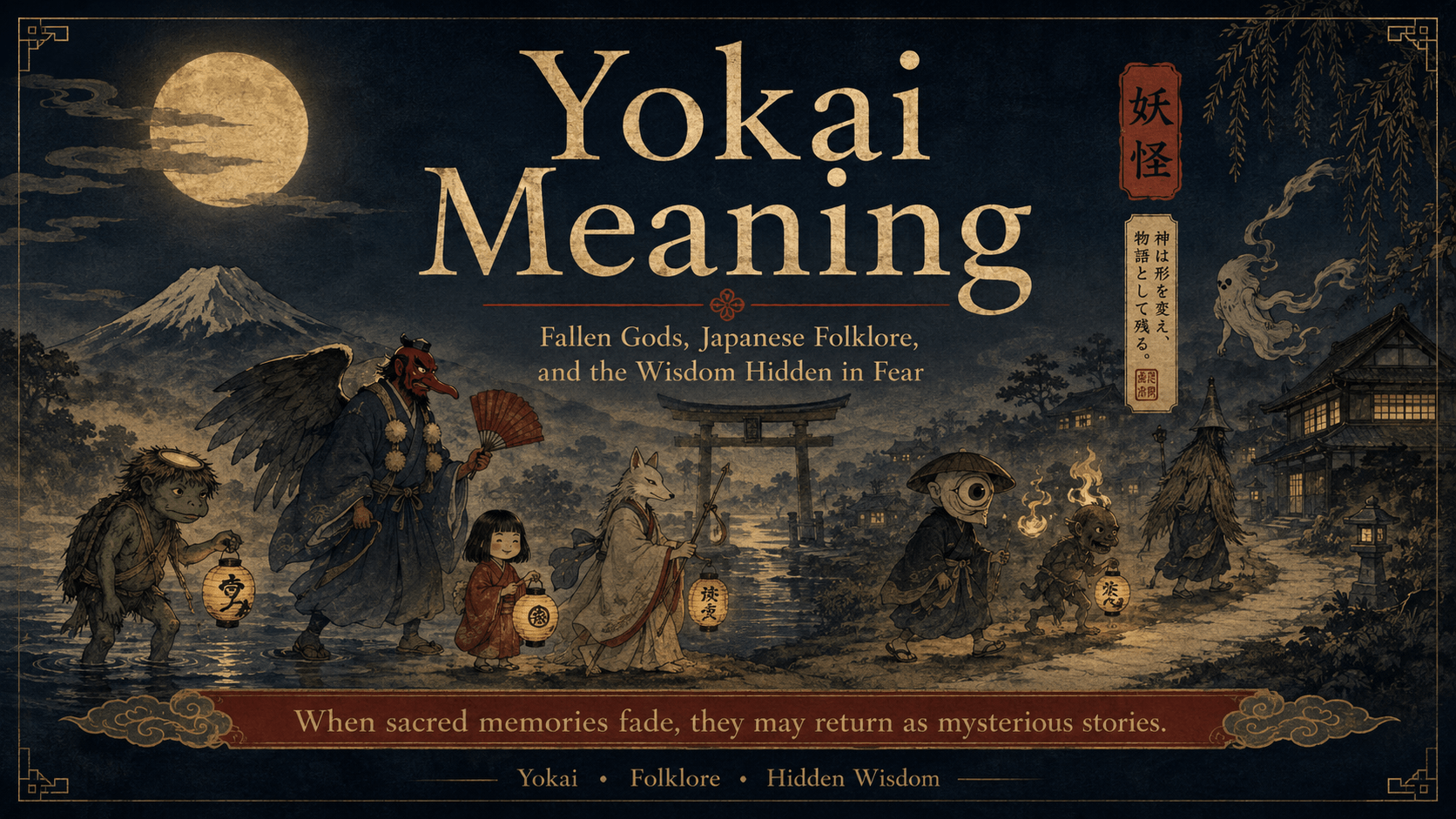
※This site uses affiliate advertising.In Japan, yokai have never been only monsters.They have been feared in the dark, laughed at in children’s stories, painted on scrolls, whispered about in villages, turned into manga characters, and quietly preserved in the memories of rivers, mountains, houses, and roads. Some appear as mischievous creatures. Some bring luck. Some lure people away. Some are nothing more than a sound in the woods, a light on a road, or a strange feeling at dusk.But to the folklorist Kunio Yanagita, yokai were not simply imaginary beings. They were cultural traces—fragments of old beliefs, forgotten rituals, and once-sacred powers that had lost their place in the modern world.One of Yanagita’s most haunting ideas was that yokai may be understood as “fallen gods.” Not evil gods, and not fake gods, but sacred presences that had declined, transformed, or slipped from worship into folklore.This article explores that idea not as a rigid theory, but as a mysterious and reflective way of reading Japanese folklore. Through kappa, zashiki-warashi, tengu, giant legends, and strange shared visions, we will see how yokai reveal not only fear, but memory, reverence, loss, and hidden wisdom.Yokai as More Than MonstersYokai are often translated into English as monsters, spirits, goblins, or supernatural creatures. None of these words is completely wrong, yet none is enough.A yokai may be frightening, but it may also be humorous. It may be dangerous, but it may also protect a place. It may appear as a child, an animal, a sound, a light, a shadow, or an unexplained event. In Japanese folklore, yokai are not always enemies of human beings. They are often signs that the world is deeper than ordinary language can explain.Kunio Yanagita, widely known as a founding figure of Japanese folklore studies, treated such beings seriously—not because he wanted to prove the supernatural, but because he believed old stories could reveal how ordinary people understood nature, death, family, community, and the invisible world. He was born in 1875 and later became both a government official and a scholar who helped shape modern Japanese folklore studies.In his work on yokai, Yanagita suggested that these strange beings were valuable cultural materials. They could show how beliefs changed, how sacred things lost their authority, and how people continued to speak with the unknown even after modernity tried to silence it.Kunio Yanagita and the Disappearing Sacred WorldThe scene begins in a changing Japan.By the early twentieth century, Japan was moving rapidly through modernization. Railways, schools, factories, newspapers, science, and state institutions were reshaping the country. Old village customs were often dismissed as superstition. Strange sounds in the mountains, lights on lonely roads, stories of spirits near rivers—many educated people were beginning to see such things as relics to be erased.Yet Yanagita looked at them differently.He had once been drawn to poetry. He studied law at Tokyo Imperial University and entered government service, working in agricultural administration. Through travel and research, he encountered the lives of ordinary people in rural communities. Over time, his attention moved away from official history—the history of rulers, wars, and documents—and toward the hidden history of common people: their words, customs, fears, songs, rituals, and stories.For Yanagita, yokai were not childish nonsense. They were clues.A village that told stories of a water creature might be preserving a memory of river worship. A house that feared or welcomed a mysterious child might be expressing an older belief about household spirits. A mountain that echoed with impossible sounds might be keeping alive a sense of awe toward wilderness.In this way, yokai became a kind of folk archive. They were not written in government records. They were written in fear, place-names, local customs, children’s warnings, seasonal rituals, and the trembling memory of people who had stood at dusk and felt that something was there.Yanagita’s Famous Idea — Yokai as “Fallen Gods”The phrase “fallen gods” can sound dramatic in English, so it needs careful explanation.Yanagita was not simply saying that all yokai were once gods in a literal and uniform sense. His idea is better understood as a folklore framework: some yokai may preserve traces of beings, powers, or places that were once treated with religious reverence, but later lost that sacred status.A god worshiped at a river may become a water monster.A mountain presence may become a tengu.A household spirit may become a strange child in the tatami room.A local creator deity may survive as a giant who failed to move a mountain.The Tokyo National Museum’s English exhibition commentary summarizes Yanagita’s view by saying that he defined yokai as the form taken by “fallen gods,” while later folklorist Komatsu Kazuhiko described yokai as beings imagined at the border between this world and the other world.This idea is powerful because it turns yokai from “monsters” into memories.A yokai is not only something that frightens people. It may be what remains when reverence fades. It may be a sacred presence after people have forgotten how to worship it. It may be a god no longer seated at the altar, but still lingering near the river, the mountain path, the old house, or the edge of the field.Ghosts and Yokai — Three Boundaries in Yanagita’s ViewOne of Yanagita’s memorable distinctions is between yurei, often translated as ghosts, and yokai.In simplified form, his distinction can be described through three boundaries.First, place. A ghost may appear wherever its attachment or resentment leads it, but a yokai is often tied to a specific location: a river, bridge, pass, house, pond, road, mountain, or field.Second, target. A ghost often appears to a particular person connected with its story. A yokai, by contrast, may appear to anyone who enters its domain.Third, time. Ghosts are often associated with the deep night, while yokai may appear in liminal hours—especially dusk, dawn, or strange moments when the ordinary world feels less certain.This classification is not perfect. Japanese folklore is too rich and fluid for strict boxes. Yet it reveals something important: yokai are often connected not only to personal emotion, but to place. They belong to landscapes.A ghost may say, “Remember me.”A yokai may say, “Remember this place.”Kappa — The Water God Who Became a Mischievous CreatureAmong all yokai, the kappa is one of the most familiar.Today, it appears in mascots, manga, local festivals, product designs, and even the name of cucumber sushi rolls. It is often imagined as a small water creature with a dish of water on its head, fond of cucumbers and sumo wrestling, mischievous but strangely charming.Yet Yanagita saw beneath this comic image something older.He interpreted the kappa as a possible remnant of water worship—a water deity or water spirit that had declined into a yokai. Many local names for kappa vary by region, but the association with water and childlike form appears again and again. The source transcript also notes Yanagita’s attention to regional water-child figures and the idea that kappa in some regions were said to return to the mountains in winter.This seasonal movement is meaningful. In Japanese agricultural belief, mountain and field were not separate worlds. In some traditions, a deity descends from the mountain in spring to become a field god and returns to the mountain after harvest. Read in this light, the kappa is not merely a river prankster. It may be a memory of the sacred movement between mountain, water, field, and village life.Then there is sumo.Why would a water creature love wrestling? Yanagita noticed how widely kappa stories include sumo, despite Japan’s regional differences. Sumo, before becoming a modern sport, had ritual associations. It could be performed in relation to shrines, harvests, and the testing of sacred power.A kappa challenging a human to wrestle may therefore echo an older relationship between human beings and the divine. At first, perhaps, the struggle was not comic. It may have been a ritual meeting with power. Later, when belief changed, the god became a small yokai, and the sacred contest became a folktale in which the human wins.The story becomes charming, but beneath the charm is a quiet transformation: the god of the water has become something children can laugh at.Giants, Footprints, and the Memory of Older GodsAcross Japan, there are legends of giants who shaped the land.A giant steps on the earth and leaves a pond. A giant tries to move a mountain but fails. A giant searches for a rope, breaks a tool, loses patience, or disappears after one final frustration.These legends may seem like simple explanations for unusual landscapes. Yet Yanagita saw something deeper. In some of these tales, the giant does not triumph. He fails at the last moment and leaves. That pattern may preserve the memory of older local powers pushed aside by newer religious or cultural orders.The defeated giant becomes a trace of a former world.This does not mean every giant legend has the same origin. Folklore is rarely so simple. But symbolically, the pattern is powerful. A huge being once belonged to the land. He was strong enough to shape mountains and ponds. Yet in the end, he could not remain.The land keeps his footprint, but not his worship.In this sense, the giant is another kind of fallen god—not fallen into evil, but fallen into memory. He no longer receives offerings. He no longer rules the place. But his sadness, anger, or failure remains attached to the landscape.Zashiki-Warashi — The Child Spirit Who Brings Fortune and UneaseZashiki-warashi is often described as a childlike yokai of the house, especially associated with the Tohoku region. It is said that a home visited by such a spirit may prosper, while those who encounter it may receive good fortune.This image is gentle: a laughing child, a small presence in the tatami room, a sign that the household is blessed.Yet Yanagita’s interpretation complicates this warmth.In his discussions, zashiki-warashi may be connected to older beliefs about child spirits, household spirits, or ritual beings. The source transcript highlights Yanagita’s unsettling speculation that the figure may be related to spiritual entities produced or handled by wandering folk religious women, and that the childlike form matters because divine messages were often associated with young beings.Whether one accepts this theory fully or not, it changes the emotional color of the story.The zashiki-warashi is no longer only lucky. It becomes a sign of something unresolved. Why is the spirit a child? Why does it remain in the house? Why does prosperity depend on a presence that cannot fully join the human world?The charm of the zashiki-warashi may hide a melancholy question: what kind of forgotten soul becomes a household blessing?A house, in folklore, is never just a building. It is a vessel of memory. It holds births, meals, deaths, quarrels, prayers, and secrets. A child spirit in such a house may symbolize not only fortune, but the fragile bond between prosperity and the unseen.Tengu and the Mountains — When Fear Needs a NameTengu are among the most powerful mountain yokai. They are proud, fierce, martial, mysterious, and deeply connected with mountains, ascetic practice, and strange phenomena.In folklore, when something inexplicable happened in the mountains, people might say it was the work of a tengu. A tree seemed to fall with a great crash, but no fallen tree could be found. Music or festival sounds echoed from nowhere. A person vanished into the mountains and returned changed—or did not return at all.Yanagita did not simply dismiss these stories. But he also did not reduce everything to tengu. In some cases, he explored the possibility that tales of disappearance, or kamikakushi, might preserve memories of marginalized mountain people or older communities living outside the ordinary village world.This is one of the most interesting parts of Yanagita’s method. He did not treat folklore only as fantasy. He asked what social memory might be hidden behind it.The tengu, then, is not merely a monster. It is a name given to mountain fear. It is also a boundary marker between village and wilderness, known and unknown, human order and powers beyond it.When people said “tengu,” they may have been saying:Something happened in the mountain that our ordinary language cannot hold.Shared Visions — When a Community Hears the Same Strange SoundSome yokai stories are not about a single witness. They are communal.Several people hear a sound in the mountain. Several people see a mysterious light. A whole area knows that a certain road, pond, forest, or slope has “something.” These stories may not be private hallucinations in the modern medical sense. They are shared cultural experiences.Yanagita used the idea of shared visions or collective apparitions to think about such phenomena. The source transcript describes his interest in cases where multiple people reported strange sounds, voices, fires, or presences, and how such accounts could become important materials for understanding belief.This is where folklore becomes especially subtle.A community does not need every individual story to be literally true in order for the folklore to matter. What matters is that people recognized a pattern. They knew where fear gathered. They knew which sounds belonged to the mountain, which lights belonged to the road, which places required caution.In this sense, yokai are also social maps. They teach where to be careful, where to be respectful, where the boundary of ordinary life grows thin.Affirmation — Listening to What Fear RemembersAffirmation:I listen to fear not as an enemy, but as a messenger from forgotten places within me.This affirmation fits Yanagita’s way of reading yokai. Fear is not always a thing to destroy. Sometimes it is a signal. It may point toward memory, neglected places, broken relationships, or parts of life that modern language has made invisible.Cultural Insight — Yokai as Japan’s Memory of Sacred PlacesFrom a cultural perspective, yokai reveal how Japanese folklore often connects spiritual imagination with place.A river is not just water.A mountain is not just land.A house is not just architecture.A road is not just a route.Each can hold stories, obligations, dangers, blessings, and memories. This is one reason yokai remain so flexible. As society changes, new yokai-like stories appear around new places and technologies. Today, strange tales may gather around elevators, tunnels, smartphones, computers, or artificial intelligence. The form changes, but the need remains.Human beings still create stories at the edge of understanding.This is why Yanagita’s perspective has not become obsolete. Even if we do not accept every detail of his theories, his larger insight remains valuable: monsters are not only about fear. They are about how a culture remembers what it cannot fully explain.Psychological and Philosophical Reflection — Why We Still Need YokaiWhy are we still drawn to yokai?Perhaps because modern life explains many things, but not everything.Science can explain sounds, weather, illness, psychology, and light. Technology can map mountains, track rivers, and illuminate roads. Yet even in a brightly lit world, human beings still feel unease, longing, loneliness, reverence, and awe.Yokai give shape to those feelings.A kappa gives a face to the danger and blessing of water.A tengu gives a name to the terror of mountains.A zashiki-warashi gives form to the mysterious luck of a household.A giant gives memory to land that feels older than human history.Rather than proving supernatural beings, yokai stories reveal how people live with uncertainty. They allow fear to become narrative, and narrative to become wisdom.Life Lesson — When Something Is Forgotten, It Does Not Always DisappearOne way to read Yanagita’s yokai is this: when something sacred is forgotten, it does not always vanish. Sometimes it returns in a smaller, stranger, humbler form.This may also be true in personal life.A neglected memory may return as anxiety.A forgotten value may return as dissatisfaction.A lost relationship may return as a dream.A part of ourselves we dismiss may return as fear.The lesson is not to believe every strange story literally. Nor is it to dismiss every strange feeling as meaningless. The quieter lesson is to ask what has been forgotten, and why it keeps returning.Yokai remind us that the past does not always speak in clear sentences. Sometimes it speaks as a sound in the woods, a child in an old room, a creature by the river, or a feeling we cannot easily name.Reader Reflection — The Yokai at the Edge of Modern LifePerhaps the yokai never truly disappeared.They changed their clothes.Once they lived in rivers, mountains, fields, old houses, and village roads. Now they may live in screens, algorithms, empty stations, late-night messages, and the uneasy silence after a notification disappears.Yanagita saw yokai as traces of changing belief. In our own age, perhaps new yokai gather wherever human beings feel that the world has become powerful, mysterious, and slightly beyond our control.So the question is not only, “Do yokai exist?”A deeper question may be:What forgotten fear, place, or sacred feeling is asking to be remembered through the stories we still tell?Reader Reflection QuestionWhat forgotten fear, place, or sacred memory might be asking to be understood in your own life?