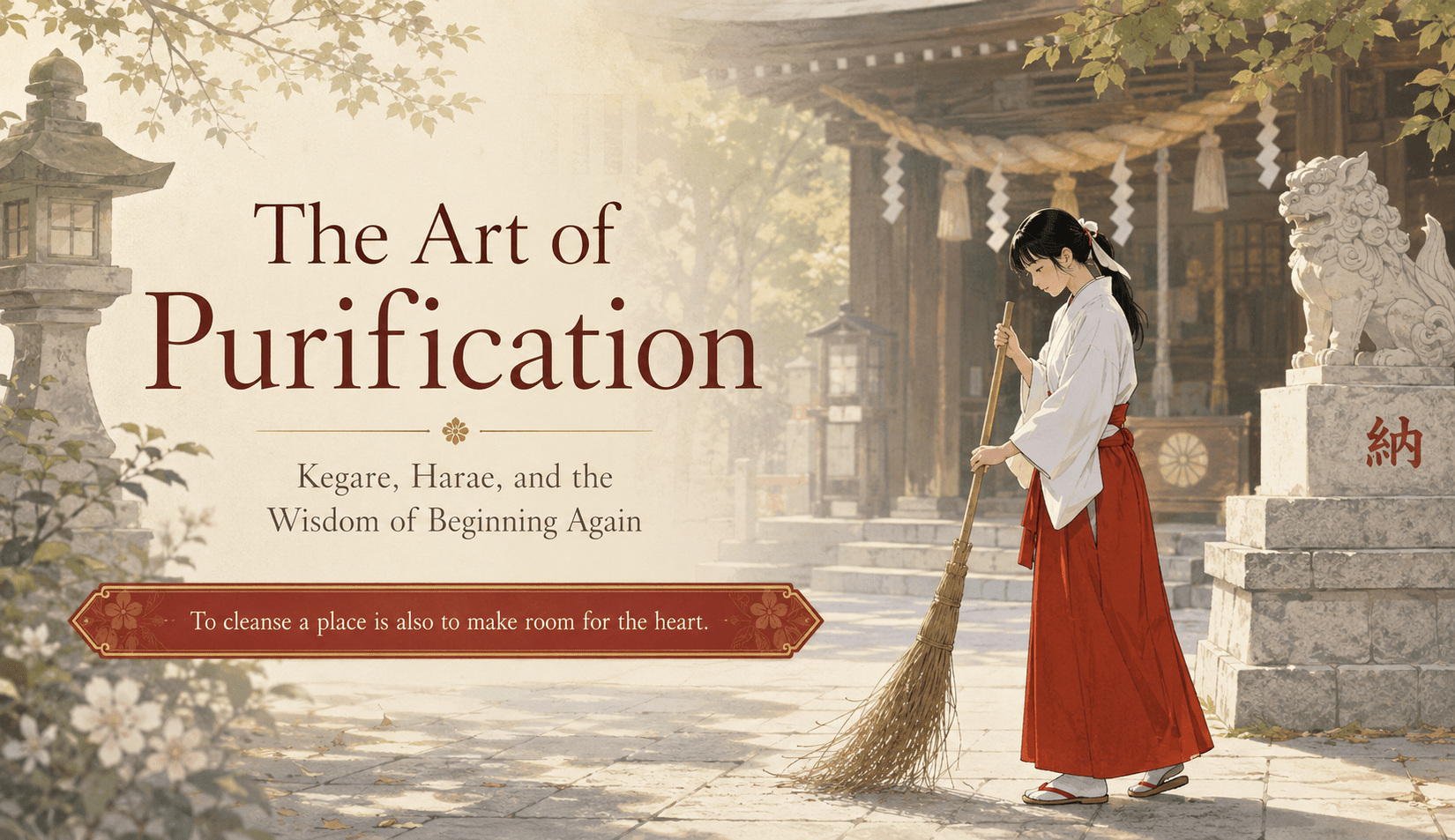
※This site uses affiliate advertising.Shinto is one of Japan’s oldest spiritual traditions, yet its mystery lies not in darkness, but in its quiet refusal to fit neatly into the categories many people expect from religion.Shinto is often described as the indigenous religious tradition of Japan, but that simple phrase only opens the door to a much deeper mystery. Unlike many world religions, Shinto has no single founder, no one central scripture equivalent to the Bible or Quran, and no fixed universal doctrine that explains everything in systematic form. Instead, it lives through shrines, seasonal festivals, purification rituals, reverence for nature, family customs, and the unseen presence of kami—sacred beings, powers, or presences that may dwell in mountains, rivers, trees, ancestors, heroes, and even ordinary things made meaningful by time. Encyclopaedia Britannica describes ancient Shinto as polytheistic and notes that people found kami in nature, as well as in remarkable human beings and ideas such as growth or creation.This is why Shinto can feel mysterious to readers outside Japan. It is not a religion that always asks to be “believed” in the same way a creed is believed. It is often encountered through practice: bowing before a torii gate, rinsing hands at a shrine basin, standing quietly before a sacred tree, joining a local matsuri, or sensing that the world is not empty matter but a living field of gratitude, fear, memory, and respect.One way to understand Shinto is this: it teaches that the sacred is not far away. It may already be here—in the mountain behind the village, in the rice harvest, in the household altar, in the festival drum, in the silence before a prayer.The Mystery of a Religion Without a Single FounderLead: Shinto’s first mystery is that it spread not through one prophet or one book, but through countless local customs, landscapes, rituals, and memories.Many religions begin their story with a founder. Christianity has Jesus. Buddhism has the Buddha. Islam has the Prophet Muhammad. Shinto is different. It did not begin as the teaching of one historical person. It emerged gradually from ancient Japanese ways of honoring nature, ancestors, clan deities, agriculture, and the invisible forces believed to move through the world.This makes Shinto difficult to define, but not weak. In fact, its flexibility may be one reason it became so deeply woven into Japanese life. Before it was organized into later forms, Shinto was closer to a way of sensing the world. A mountain was not merely a mountain. A storm was not merely weather. A harvest was not merely food. Each could be a sign of relationship between human beings and powers larger than themselves.Texts such as the Kojiki and Nihon Shoki preserve early myths of Japan and the kami, but they are not “scriptures” in the same sense as doctrinal religious books. They are mythic records, cultural memory, and sacred storytelling. Through them, the Japanese islands, gods, rituals, and imperial mythology were given narrative shape.Shinto’s mystery, then, is not that it lacks structure. Rather, it is that its structure grew like a forest rather than being built like a temple from a single blueprint.Kami and Animism — When the World Is AliveAt the heart of Shinto is the sense that the world is not spiritually empty; it is filled with presences worthy of respect.A key to understanding Shinto is the word kami. In English, kami is often translated as “god,” but that translation is imperfect. Kami may be deities, spirits, sacred forces, ancestral presences, natural powers, or beings that inspire awe. A waterfall, a mountain, a great tree, the sun, the wind, a legendary person, or a local guardian may all be understood as kami.This is close to what English speakers might call animism, the belief or intuition that natural things are alive with spiritual presence. But Shinto’s view is not simply “everything is a god” in a cartoonish way. It is more subtle. Certain places, beings, or phenomena are experienced as especially powerful, pure, dangerous, generous, or worthy of ritual attention.This idea is often expressed through the phrase yaoyorozu no kami, commonly understood as “the countless kami.” The number does not literally mean exactly eight million. It suggests abundance beyond counting. The sacred world is not narrow. It is overflowing.In this worldview, gratitude becomes natural. One gives thanks to the field, the rain, the sun, the ancestors, the tools, the house, and the local guardian. To live well is not merely to take from the world, but to remain in relationship with it.Kegare and Purification — The Wisdom of Returning to ClarityShinto’s rituals of purification are not merely about physical cleanliness; they express a deeper desire to restore balance, vitality, and inner clarity.Another essential concept in Shinto is kegare, often translated as impurity or pollution. But in a cultural and spiritual sense, kegare does not simply mean dirt. It can refer to a loss of vitality, a disruption of harmony, or a condition associated with death, misfortune, blood, grief, or disorder.This is why purification matters. Rituals such as misogi and harae are ways of returning from disturbance to clarity. Misogi traditionally involves purification with water, while harae refers more broadly to ritual purification or cleansing. At shrines, visitors often rinse their hands and mouth before approaching the sacred space. This is not just etiquette. It is a symbolic act: before meeting the sacred, one sets down the dust of ordinary life.There is deep psychological wisdom here. Human beings carry invisible burdens—stress, regret, anger, exhaustion, confusion. We may not call these things “impurity” today, but we still understand the need to reset. A quiet walk, a bath, a prayer, a mindful breath, a moment of apology—each can become a small act of purification.Shinto gives this inner movement an outward form. It says: begin again, but begin with respect.Shrines as Thresholds Between the Ordinary and the SacredA Shinto shrine is not only a building; it is a threshold where everyday life becomes attentive to invisible presence.For many visitors, the most visible face of Shinto is the jinja, or shrine. A shrine is often described as a place where kami are enshrined or invited to dwell. Some shrines have grand buildings, while others may be small, quiet, and local. In older forms of worship, sacred mountains, rocks, trees, or natural spaces themselves could function as places of reverence before elaborate shrine architecture developed.The torii gate at the entrance expresses a powerful idea: there is a boundary between the ordinary and the sacred. Passing through it does not mean leaving the world behind. It means entering the world more carefully.The path through a shrine encourages attention. Bow before entering. Walk respectfully. Purify your hands. Stand before the offering box. Bow, clap, pray, and bow again. Customs vary by shrine, but the deeper pattern is clear: the body teaches the mind how to become humble.This is why shrines remain meaningful even to people who do not think of themselves as deeply religious. A shrine offers a pause. It gives shape to gratitude. It creates a space where one may whisper a hope, remember an ancestor, mark a new year, celebrate a birth, or seek courage before an exam.In a rushed world, a shrine says: slow down; cross the threshold consciously.Shinbutsu-Shūgō — When Kami and Buddhas MetOne of the most fascinating chapters in Japanese religious history is the long blending of Shinto and Buddhism.When Buddhism entered Japan, it did not simply erase older beliefs. Instead, Japanese religious life developed a complex relationship between kami and Buddhas. This blending is known as shinbutsu-shūgō, often translated as the syncretism of kami and Buddhas. Kokugakuin University’s Encyclopedia of Shinto describes shinbutsu-shūgō as a complex “combinatory” interaction between Japanese kami beliefs and Buddhism.Over time, some kami were interpreted as local manifestations of Buddhist deities. This idea became known as honji suijaku: the Buddhist deity as the original ground, and the kami as a trace or manifestation appearing in Japan. The Japanese Architecture and Art Net Users System explains honji suijaku as a philosophical basis for kami-Buddha syncretism, in which kami were understood as manifestations of Buddhist deities.To modern readers, this may sound confusing. Are they gods? Buddhas? Spirits? Symbols? But the confusion itself reveals something important about Japanese religious culture. Rather than always forcing one belief to destroy another, Japan often allowed religious meanings to overlap, reinterpret, and coexist.This does not mean there was never conflict. History is more complicated than that. But the long presence of shinbutsu-shūgō shows a cultural habit of layering meaning. A shrine could stand near a temple. A deity could be read through Buddhist thought. A ritual could carry older and newer elements at once.The result is not a simple system. It is a spiritual palimpsest—a page written, erased, and written again, where older traces still shine beneath the surface.Goryō Faith — Turning Fear Into ProtectionAmong Shinto-related beliefs, one of the most mysterious is the idea that even a feared spirit may become a guardian when properly honored.Japanese religious imagination has long included the idea of onryō, resentful spirits believed in folklore to cause misfortune when wronged or neglected. Related to this is goryō shinkō, a form of belief in which powerful spirits of the dead were pacified, honored, and transformed into protective deities.One of the best-known examples is Sugawara no Michizane, a brilliant Heian-period scholar and statesman who died in exile after political misfortune. Later disasters at court were interpreted by some as signs of his angry spirit. Over time, he came to be venerated as Tenjin, a deity associated especially with scholarship and learning.Whether one reads this literally or symbolically, the psychological meaning is profound. A wounded memory does not disappear simply because people ignore it. A wronged figure, a social trauma, a buried grief—these may return in symbolic form. Goryō faith suggests that what is feared must sometimes be acknowledged before it can become protective.This is not unlike personal healing. A painful memory may haunt us when denied, but when recognized, named, and integrated, it can become a source of wisdom.In this way, Shinto-related folklore does not always divide the world into pure good and pure evil. It often asks a subtler question: what happens when fear is treated with respect?Matsuri and Kagura — Sacred Joy in Public LifeFestivals in Japan may look festive and playful today, but many began as sacred acts of prayer, gratitude, and renewal.For many people, the most joyful encounter with Shinto is the matsuri, or festival. Lanterns glow. Drums sound. People gather in streets. Food stalls appear. Children laugh. At first glance, a matsuri may look like entertainment, and it is indeed a celebration. But at its heart, it is also an offering.Britannica notes that a matsuri often includes a solemn ritual of worship followed by joyful celebration. This combination is important. Joy is not separate from reverence. Celebration becomes a way of renewing the bond between community and kami.Many festivals historically related to agricultural cycles: praying for a good harvest in spring, giving thanks in autumn, or seeking protection from illness during the summer. In such rituals, community life, nature, food, weather, and faith are not separate topics. They belong to one living rhythm.Another sacred performance tradition is kagura, music and dance offered to the kami. Its mythic origin is often connected to the story of Amaterasu, the sun goddess, who hid in a heavenly rock cave after the violent behavior of her brother Susanoo. When the world was plunged into darkness, the goddess Ame-no-Uzume danced before the cave, causing laughter among the gods. Curious, Amaterasu looked out, and light returned to the world.This myth gives kagura a beautiful meaning. Dance is not only performance. Laughter is not only amusement. Art itself can become a way of calling light back.The Life Lesson of Shinto — Gratitude Before ControlLead: Shinto may not offer one universal doctrine, but it offers a quiet attitude toward life: gratitude before control, reverence before possession.One way to read Shinto is as a wisdom tradition of attention. It asks us to notice the world before using it. It asks us to purify ourselves before requesting blessings. It asks us to bow before crossing thresholds. It asks us to remember that we live among forces we do not completely command.This does not mean modern people must accept every ancient belief literally. Rather, Shinto can be read as a cultural language for humility. It reminds us that a healthy life is not built only on ambition and efficiency. It also requires gratitude, rhythm, cleansing, memory, and respect.In modern life, we often rush from task to task, treating places as backgrounds and objects as tools. Shinto offers a different imagination. A place can be honored. A tool can be thanked. A meal can be received with awareness. A season can be marked. A grief can be purified. A fear can be listened to.The lesson is not that everything must be mystical. The lesson may be that nothing is merely empty.Reader Reflection — What Do You Bow To?The mystery of Shinto is not only found in ancient myths; it may also be found in the small gestures that teach us how to live with reverence.Perhaps the most meaningful question Shinto leaves us with is not, “Do you believe in kami exactly as ancient people did?” The deeper question may be:What in your life deserves more reverence than you have been giving it?A place. A relationship. A memory. A daily meal. A tool that supports your work. A tree you pass every morning. A fear you keep trying to ignore. A grief that has not yet been purified.Shinto’s quiet wisdom is that respect changes perception. When we bow, we do not make the world sacred. We remember that it may have been sacred before we noticed.Reader Reflection — What Do You Bow To?The mystery of Shinto is not only found in ancient myths; it may also be found in the small gestures that teach us how to live with reverence.Perhaps the most meaningful question Shinto leaves us with is not, “Do you believe in kami exactly as ancient people did?” The deeper question may be:What in your life deserves more reverence than you have been giving it?A place. A relationship. A memory. A daily meal. A tool that supports your work. A tree you pass every morning. A fear you keep trying to ignore. A grief that has not yet been purified.Shinto’s quiet wisdom is that respect changes perception. When we bow, we do not make the world sacred. We remember that it may have been sacred before we noticed.Reader Reflection QuestionWhat ordinary place, object, memory, or relationship in your life might become sacred if you approached it with more reverence?