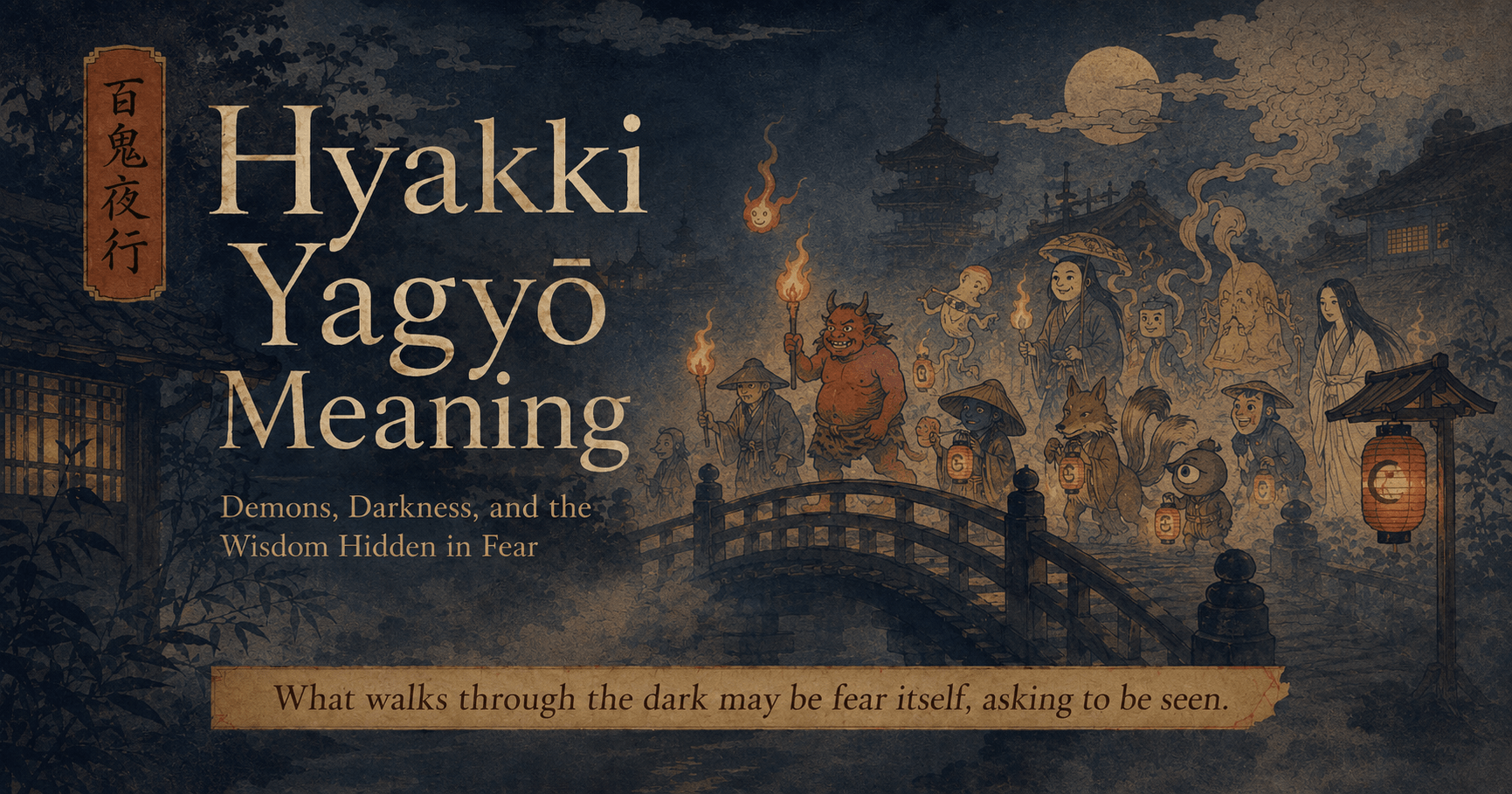
※This site uses affiliate advertising.Hyakki Yagyō is not only a frightening legend of demons walking through the night. It is also a mirror of how people give shape to fear, disease, political memory, forgotten objects, and the darkness of the city itself.In Japanese folklore, there is an image both terrifying and strangely beautiful: a procession of demons, spirits, and strange beings moving through the streets at night.This is Hyakki Yagyō, often translated as “The Night Parade of One Hundred Demons.” The word “one hundred” does not necessarily mean exactly one hundred creatures. Like many traditional Japanese expressions, it suggests an overwhelming multitude — a number too large to count calmly in the dark.To modern readers, Hyakki Yagyō may sound like fantasy: a parade of oni, yokai, transformed tools, ghosts, and shadowy presences drifting across old Kyoto. But in earlier periods, this idea was not simply treated as entertainment. It was feared as a real danger, recorded in stories, tied to calendars, linked to protective spells, and associated with sacred boundaries in the city.According to classical collections and later folklore, nobles, monks, warriors, and legendary figures such as Abe no Seimei were said to have encountered or avoided these strange nocturnal processions. Whether taken literally or symbolically, Hyakki Yagyō reveals something deep about Japanese culture: the night was never empty. It was filled with memory, danger, ritual, and imagination.This is a story about demons. But it is also a story about the human mind standing before the unknown.What Was Hyakki Yagyō?To understand Hyakki Yagyō, we must first understand that it was not merely a monster story. It belonged to a world where calendars, taboos, rituals, and fear shaped everyday life.Hyakki Yagyō refers to the belief or tale that countless demons and supernatural beings wandered through the streets at night. In later visual culture, it became famous through illustrated scrolls showing odd, comic, and eerie creatures: musical instruments with limbs, kitchen tools with faces, animals dressed like humans, and monsters that seem more mischievous than deadly.But the older image was far more frightening.In the Heian period, the night was not the softly lit darkness modern people know. There were no streetlights. When the moon disappeared behind clouds, the city could become almost completely black. Wide avenues, abandoned buildings, marshy ground, decaying gates, and empty districts created a psychological landscape where ordinary fear could easily become supernatural fear.People believed there were certain dangerous nights when Hyakki Yagyō might appear. Some texts and later compilations describe Hyakki Yagyō days, dates when nobles were advised to avoid going out. The idea may sound strange today, but in that world, it functioned almost like a spiritual weather forecast. Just as people now check rain, wind, or typhoon warnings, people of the courtly world paid attention to unlucky directions, forbidden days, and ritual dangers.If one encountered the parade, it was said to be fatal. That is why protective words, Buddhist spells, talismans, and esoteric rituals became part of the tradition. Fear did not remain vague. It was organized. It entered calendars, clothing, ceremonies, and daily decisions.This is one of the most fascinating aspects of Hyakki Yagyō. It was not only a story about monsters in the street. It was a system for living with the fear of the unseen.A Night Encounter in the Old CapitalClassical tales of Hyakki Yagyō often begin in a familiar way: a noble person travels at night, the city falls silent, and suddenly the darkness ahead begins to move.One of the most memorable types of Hyakki Yagyō stories involves a nobleman traveling through Kyoto late at night. He may be on his way to visit someone in secret. He may have attendants with him. The road may seem ordinary at first. Then, in the distance, lights appear.Not calm lanterns. Not the gentle glow of a festival.Torches.Voices.Movement.A procession approaches from the darkness.The figures are described as oni or strange beings, sometimes numbering around a hundred. They move together as if the night itself has become organized into a crowd. The attendants panic. The nobleman freezes. In some tales, he survives not because of his own courage, but because a protective Buddhist charm or spell has been secretly sewn into his clothing by someone who loves him — often his mother.This detail is striking.The story is frightening, but its emotional center is not only terror. It is also care. A mother’s hidden protection stands between her child and the demons of the night. The supernatural danger becomes a way to express a deeply human truth: we are often protected by love we do not even know is there.In another famous kind of story, a spiritually gifted figure recognizes the approach of the demon parade before others do. In tales involving Abe no Seimei, the legendary onmyōji, he perceives what ordinary people cannot. His ability to see hidden danger becomes the beginning of his reputation as someone who can read the unseen structure of the world.Here, Hyakki Yagyō is not only a threat. It is a test of perception.Some people see only darkness.Some sense what moves within it.Why Did People Imagine Demons Walking Through Kyoto?The demons of Hyakki Yagyō may be read in many ways: as disease, political resentment, abandoned objects, or the city’s own fear taking visible form.What was the Night Parade really?Folklore rarely has only one answer. Hyakki Yagyō may have gathered many different fears into one unforgettable image.One interpretation sees the parade as a visualization of epidemic disease. In old Japan, illness was often imagined as something carried by spirits, demons, or invisible forces. When disease moved through a city, unseen and uncontrollable, people needed an image for it. A procession of demons in the night may have given shape to the terror of contagion.Another interpretation sees Hyakki Yagyō as a procession of resentful spirits. Political life in the Heian court was full of rivalry, exile, downfall, and resentment. Those who died with anger or injustice could be imagined as returning in ghostly form. A demon parade, then, might symbolize the memory of those destroyed by power — the defeated returning through the language of fear.A third interpretation connects Hyakki Yagyō with tsukumogami, old tools and objects believed in later folklore to acquire spirits after many years of use. In illustrated scrolls, many yokai are not bloody monsters but transformed objects: instruments, pots, umbrellas, household items. These images suggest a different fear — not of death or disease, but of neglect. What happens to the things we use, discard, and forget?These interpretations do not cancel each other out. They may all be part of the same cultural imagination. Disease, political resentment, abandoned objects, urban darkness, religious ritual, and human anxiety all gathered under one image:A parade in the night.Ichijō Modoribashi — The Bridge Where Worlds TouchIn Kyoto folklore, certain places become more than geography. Ichijō Modoribashi was remembered as a boundary where the human world and the otherworld seemed to meet.Many Hyakki Yagyō traditions are connected with specific areas of old Kyoto, especially places near the northern edge of the city. One of the most symbolic locations is Ichijō Modoribashi, the “Returning Bridge.”A bridge is never just a bridge in folklore. It connects two sides. It crosses water. It marks a threshold. In many cultures, rivers divide the world of the living from the world of the dead, and bridges become places where ordinary boundaries feel unstable.Ichijō Modoribashi carried exactly this kind of atmosphere. It stood near the edge of the ancient capital, in a direction often associated in onmyōdō cosmology with danger and spiritual intrusion. Its very name, “Returning Bridge,” is linked to legends of someone returning from death or crossing back from the other side.This made it a natural stage for stories about demons, spirits, and Abe no Seimei’s shikigami — spirit-like servants said in legend to have been hidden beneath the bridge. Whether or not one believes such tales literally, the symbolism is powerful. If there were a place where invisible beings might wait, a bridge at the edge of the capital would be the perfect location.A bridge is a question made of stone and water.Where does the human world end?Where does the other world begin?From Terror to Art — How the Demon Parade ChangedOver time, Hyakki Yagyō changed from a deadly fear into a visual tradition, an artistic subject, and eventually a cultural celebration of yokai imagination.In early tales, Hyakki Yagyō was terrifying. To encounter it was to risk death. The demons were not cute, funny, or collectible. They represented danger moving through the dark.But folklore changes as society changes.By the medieval period, and especially through illustrated scrolls, Hyakki Yagyō began to take on a different character. The parade became something people could look at from a safe distance. The creatures became strange, humorous, grotesque, and artistic. Instead of only fearing the unseen, people began to draw it.This transformation is important. When fear becomes image, it becomes manageable. When demons are painted on a scroll, they can be studied, laughed at, admired, and remembered. The terror does not disappear, but it changes form.This may explain why yokai remain so beloved in Japanese culture. They are not simply monsters. They are vessels for ambiguity. They allow people to think about illness, death, neglect, loneliness, memory, and social disorder without speaking of them too directly.A demon in the street becomes a figure in art.A warning becomes a story.A fear becomes culture.Key Quote / AffirmationHyakki Yagyō reminds us that fear becomes less overwhelming when we learn to name it, draw it, and listen to what it reveals.“What walks through the dark may be fear itself, asking to be seen.”This line captures the deeper meaning of Hyakki Yagyō. The parade may be demons, disease, spirits, abandoned objects, or imagination. But symbolically, it is also the movement of hidden fears through the mind.The night parade teaches that the unknown becomes more powerful when it remains unnamed. Once fear is given a shape, it can become story. Once it becomes story, it can become wisdom.Cultural Insight — Why Japanese Folklore Gives Form to the InvisibleJapanese yokai folklore often turns invisible anxiety into visible characters, allowing people to face fear through imagination rather than silence.Hyakki Yagyō belongs to a broader Japanese tradition of giving form to invisible forces. Yokai may represent strange weather, illness, abandoned places, neglected tools, social anxiety, or moral unease. Instead of leaving fear abstract, folklore makes it visible.This does not mean people in the past were simply “superstitious.” It means they used story as a way to think about what could not easily be explained. Disease was invisible, so it became a demon. Political resentment was dangerous to speak of directly, so it became a ghost. Discarded objects carried guilt, so they became tsukumogami.Folklore is not failed science. It is emotional language.Hyakki Yagyō shows how a society imagines its own shadows.Psychological Reflection — Why We Are Drawn to the Demon ParadeWe are drawn to Hyakki Yagyō because it turns fear into movement, image, rhythm, and story.Why does the image of a demon parade still fascinate us?Perhaps because it is not a single monster. A single monster can be defeated. A parade is different. A parade suggests that fear is collective, layered, and difficult to stop. One anxiety follows another. One memory follows another. One shadow walks behind the next.This feels surprisingly modern.Many people today do not fear demon processions in the literal sense. But they know what it feels like when worries march through the mind at night: one thought, then another, then another. Regret, uncertainty, illness, money, loneliness, the future. The parade continues.Hyakki Yagyō gives this experience a mythic image. It says: yes, fear sometimes comes as a procession. But if it can be seen, perhaps it can also be understood.Life Lesson — Do Not Fear the Dark Before You Listen to ItHyakki Yagyō may remind us that the darkness we fear often contains messages about what a society, or a soul, has neglected.One way to read Hyakki Yagyō is not as a command to fear the night, but as an invitation to listen to what appears in it.The demons may represent neglected grief. The spirits may represent unresolved resentment. The transformed tools may represent forgotten gratitude. The abandoned streets may represent the parts of life society prefers not to see.In modern life, we also create shadows by ignoring things. We ignore exhaustion until it becomes illness. We ignore grief until it becomes bitterness. We ignore objects, places, relationships, and memories until they return in uncomfortable ways.The lesson is not that every darkness hides a monster. Rather, it may be that every darkness asks for attention.Hyakki Yagyō does not only say, “Beware of demons.”It quietly asks, “What have you allowed to become a demon by refusing to see it?”Reader Reflection — The Parade WithinThe old night parade may no longer be feared as it once was, but its symbolism still walks quietly through modern life.Today, Hyakki Yagyō survives in art, festivals, manga, anime, folklore studies, and the imagination of anyone drawn to the strange side of Japanese culture. What was once a deadly fear became a painted scroll. What became a scroll became a cultural symbol. What became a symbol still speaks.Perhaps the real power of Hyakki Yagyō is not that demons once walked through Kyoto, but that human fear always seeks a form.When you next feel an unnamed anxiety moving through your mind, imagine it not as a shapeless darkness, but as a procession. Look carefully. What leads it? What follows it? What old memory is carrying a torch?Maybe wisdom begins when we stop running from the parade and begin to ask what each figure has come to reveal.Reader Reflection QuestionWhat fear in your own life might be walking through the dark, waiting not to frighten you, but to be understood?