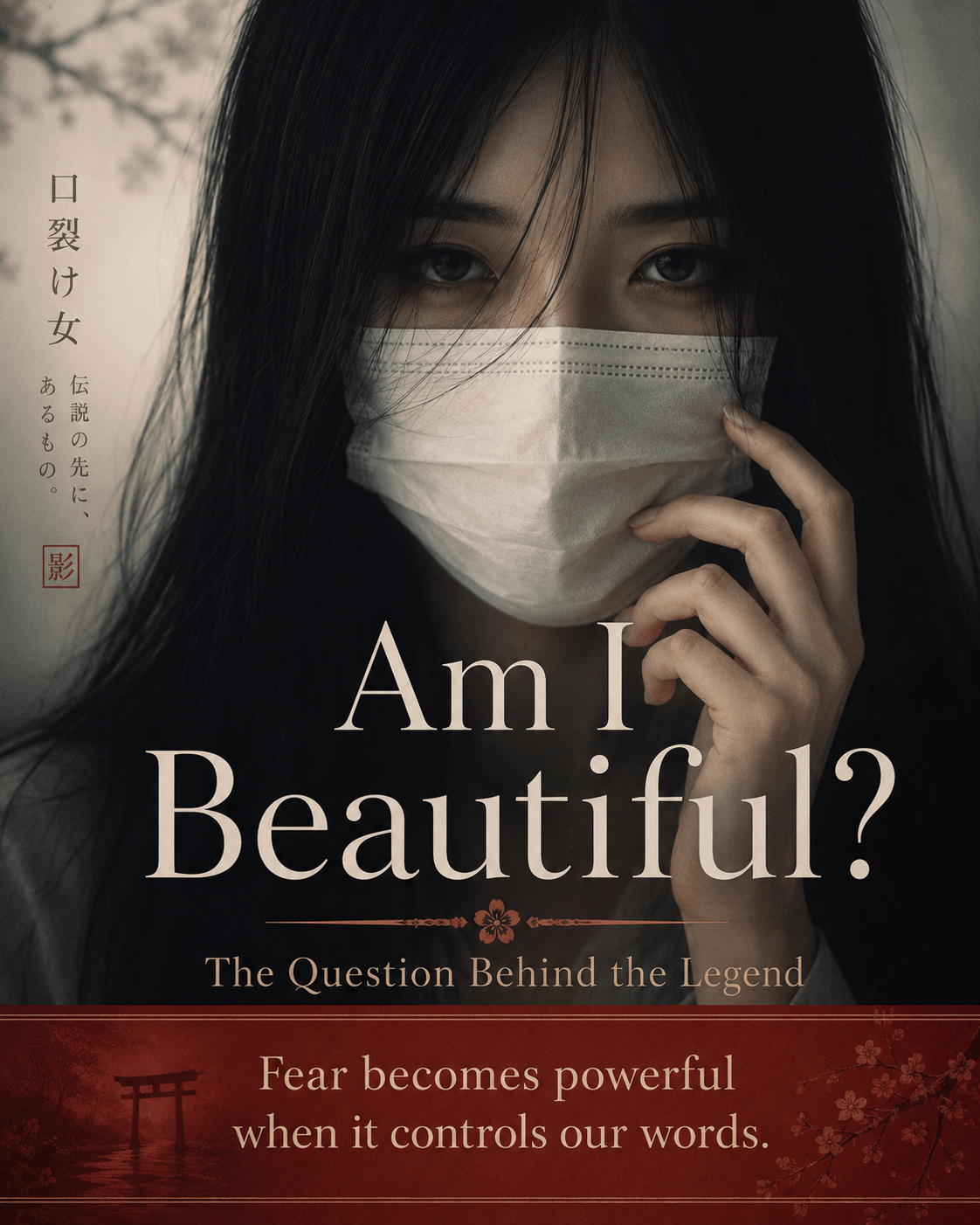
※This site uses affiliate advertising.The Woman Who Asked in the RainIt is said that Kuchisake-onna appears most often when the streets are neither fully crowded nor completely empty.Not midnight, perhaps. Not the dramatic hour of ghosts and graveyards. Rather, she belongs to that quieter, more ordinary time of evening when shops are closing, station lights are still bright, and people are hurrying home with their eyes lowered. The hour when the city is tired.Imagine a small Japanese neighborhood after rain.The pavement is dark and glossy, reflecting the weak gold of vending machines and the pale green glow of a traffic signal. Water drips from the edge of tiled roofs. A bicycle, left beside a narrow wall, has gathered beads of rain along its handlebars. Somewhere nearby, a train passes over an elevated track, its sound spreading through the evening like a long metallic breath.You are walking alone.There is nothing unusual about this at first. In Japan, many streets remain orderly and quiet even late in the day. Curtains are drawn in apartment windows. A convenience store hums at the corner. The smell of damp asphalt mixes with something warm and familiar—perhaps rice from a nearby kitchen, perhaps miso soup, perhaps the faint sweetness of a bakery closing for the night.You tell yourself there is no reason to feel uneasy.And yet, you do.It begins with the feeling of being observed.Not watched openly. Not followed closely. Just noticed.You glance across the road and see a woman standing beneath a streetlamp.She is not dressed like a monster from a nightmare. That is what makes her difficult to understand. She wears a long coat, neat and dark, the kind anyone might wear on a cold evening. Her hair falls straight around her face. Her posture is still, almost polite. A white surgical mask covers the lower half of her face.In Japan, a mask is not strange. People wear masks for colds, allergies, pollen season, crowded trains, or simple consideration for others. A mask can be a sign of care. A sign of privacy. A sign of ordinary life.So at first, you almost look away.Almost.But something about her stillness keeps your eyes there.She is standing too quietly. Her hands hang at her sides. Her face is turned slightly downward, but you feel, with the certainty one sometimes feels before understanding why, that she has already seen you.You continue walking.Across the street, she begins to walk too.Your first thought is reasonable: she is simply going the same way. The human mind is quick to comfort itself. A stranger walking in the same direction is not a sign. A woman wearing a mask is not a warning. A quiet street is not a stage prepared for a legend.Still, you cross to the other side.Not because you are afraid, you tell yourself. Only because your route is there. Only because the sidewalk is wider. Only because the light is better.Behind you, footsteps cross the road.Slowly.Not hurried. Not clumsy. Certain.You do not turn around immediately. Turning around would mean admitting that the footsteps matter. Instead, you listen.One step.Then another.The sound is soft, but the wet pavement carries it clearly. A faint tap. A pause. A faint tap. It seems impossible that a person walking so calmly could make your heart beat so hard.You pass a shuttered flower shop. Buckets have been turned upside down near the entrance. The smell of wet leaves rises from them. Ahead, the street narrows beside a small shrine tucked between two buildings. A stone fox watches from the shadows. A red bib around its neck has darkened with rain.You try to think of ordinary things.Tomorrow’s errands. The message you forgot to answer. The sound of the train. The umbrella you should have brought.But the footsteps remain.Finally, at the corner where the streetlamp flickers once and steadies, you turn.She is closer now.Much closer.The woman stands only a few steps away. Her eyes are visible above the mask. They are not empty. They are not wild. They are clear, patient, almost sorrowful. In one hand, partly hidden in the fold of her coat, something catches the light.Metal.Long blades.Scissors.Your breath catches before your mind forms the word.For a moment, neither of you moves. The city continues around you with cruel normality. A car passes at the far end of the street. Somewhere, a door slides shut. A television laughs behind a thin apartment wall.Then the woman tilts her head.Her voice, when it comes, is softer than expected.“Am I beautiful?”The question is so simple that it almost feels absurd. If a stranger asked it in daylight, perhaps you would think she was unwell, or lonely, or playing some strange joke. But here, under the weak streetlight, with rain dripping from power lines and scissors shining in her hand, the words become a trap.Am I beautiful?You remember stories.Perhaps you heard them as a child. Perhaps someone told them at school, half laughing and half afraid. Perhaps you read them online and smiled because old legends are easier to enjoy when they remain safely on a screen. A masked woman. A question. A wrong answer. A second question.You remember enough to know that “no” is dangerous.But “yes” is not safe either.Your mouth goes dry.The woman waits.There is something terrible about her patience. She does not rush you. She does not threaten you. She simply allows the silence to grow until it feels like another person standing between you.You think of politeness.In Japanese culture, as in many cultures, direct refusal can feel harsh. Words are often chosen carefully, softened by context, shaped by the need to preserve harmony. But this question has no harmony inside it. It demands judgment. It demands that you name her worth.You look at her eyes again.They are beautiful.That is the frightening part.They are not the eyes of a corpse or a demon as one might imagine from a ghost story. They are human eyes, or close enough to human that your fear becomes tangled with pity. Something wounded looks out through them. Something that has asked this question too many times and never once been healed by the answer.“Yes,” you whisper.The woman’s eyes narrow, not in anger, but in a kind of satisfaction.Slowly, she lifts her free hand to her face.The mask is hooked behind one ear. Her fingers are pale. For a brief second you notice how ordinary the gesture is. People remove masks every day. At home. In restaurants. Outside convenience stores after buying tea or coffee. It is a small human motion.Then the mask comes away.The street seems to lose sound.Her mouth has been cut wide from both corners, stretching toward her ears in a red, impossible smile. The wound is not fresh in every version of the legend, nor always bloody; sometimes it is scarred, sometimes raw, sometimes exaggerated by rumor until it becomes less a human injury than a symbol. But in that moment, what you see is not merely a face.You see pain made visible.You see beauty and violence forced to occupy the same expression.You see a question that has become a wound.The woman leans closer.Her breath touches the air between you.“How about now?”The second question is colder.It is not asking what you think. It is asking who you are when kindness becomes difficult. It is asking whether beauty disappears when the face is damaged. It is asking whether honesty is cruelty, whether pity is insult, whether fear can disguise itself as politeness.Your mind races.If you say no, the scissors may rise.If you say yes, she may smile wider and say she will make you like her.That is how the story goes.And stories, when remembered at the wrong moment, can feel like fate.Your feet refuse to move. The wall of a closed shop presses behind you. A row of paper notices flutters in the window. One advertises a lost cat. Another announces a neighborhood cleanup. Such ordinary things. Such small proofs that life was normal only a minute ago.The woman waits.Again, that terrible patience.Then, from somewhere deep in memory, another rumor returns.A third answer.Children, it is said, once whispered to one another that Kuchisake-onna could be confused. Not defeated by strength, not destroyed by prayer, not argued into mercy—but confused. The trick was not to flatter her, nor reject her. The trick was to step outside the question.You swallow.Your voice trembles, but it comes.“You are… average.”For the first time, her expression changes.Not rage. Not relief.Confusion.The word hangs in the damp air between you. Average. Ordinary. Neither beautiful nor ugly. Neither praised nor condemned. A word too small for the violence of the moment, and perhaps that is why it works.Her scissors lower by the width of a breath.You take one step sideways.Her eyes follow you.Another step.The wet pavement nearly slips beneath your shoe. You do not run yet. Running too soon feels like waking a sleeping animal. You move carefully, as if leaving a room where someone is ill.The woman’s head tilts again.“Average?” she repeats.There is something almost childlike in the way she says it, as though the word has no place in the world she comes from. Perhaps she understands beauty and ugliness, devotion and rejection, worship and disgust. But average—ordinary, human, unfinished—has no sharp edge for her to grasp.You step back again.Your hand brushes your coat pocket.Inside, by coincidence or fate, your fingers touch a small wrapped candy. A piece of hard sugar bought earlier without thought. In some versions of the tale, people speak of bekkō ame, a traditional Japanese amber-colored candy made by heating sugar until it shines like polished tortoiseshell. Children in the legend sometimes carry it like a charm, not because candy is powerful, but because even fear can be interrupted by something simple.You pull it from your pocket.The wrapper crackles loudly.The woman’s eyes drop toward the sound.You place the candy gently on the ground between you—not thrown, not offered with mockery, but set down almost like a small apology to the night.For a moment, nothing happens.Then she looks at it.Only for a second.But a second is enough.You run.The street blurs. Your shoes strike water from the pavement. The shrine, the flower shop, the vending machine, the bicycle—all pass in broken flashes. Behind you there is no scream, no thunderous chase, only the sudden certainty that if you look back, the distance will vanish.So you do not look back.You run until the street opens near the station. People are there. Not many, but enough. A man with a folded newspaper. A student with earphones. An elderly woman carrying groceries. The ticket gates glow. The ordinary world gathers around you again, thin but real.Only then do you stop.Your lungs burn. Your hands shake. In the reflection of the station window, your own face looks unfamiliar.No wound.No blood.Only fear.And yet something has changed.For days afterward, you may find yourself thinking not of the scissors, nor even of the mouth behind the mask, but of the question.Am I beautiful?At first, it seems like a question about appearance. But the longer it stays with you, the more it becomes something else.Am I acceptable?Am I still worthy if I have been wounded?Will you look away from what frightens you?Will you answer me as a person, or only as a face?Perhaps that is why Kuchisake-onna endures.She is not only a figure of horror. She is a figure of judgment turned inside out. A wound that asks to be named. A fear that speaks in the language of beauty. A legend that reminds us how dangerous it can be to reduce a person to a single answer.And perhaps the most haunting part of the story is not the woman’s question, but our own hesitation before it.Because somewhere in every life, fear comes to us wearing an ordinary mask.And when it asks us who we are, what we value, or what we truly see, we may need more than yes or no.We may need the wisdom to find a third answer.Reader ReflectionWhen fear asks you a question that feels impossible to answer, what would it mean to pause long enough to find your third answer?Key Proverb, Quote, or Affirmation Used“Courage is not the absence of fear, but the quiet decision not to let fear speak for you.”Cultural Insight SummaryKuchisake-onna can be read as a Japanese urban legend shaped by fears around beauty, social judgment, shame, public space, and hidden suffering. Her mask turns something ordinary in Japanese life into a symbol of concealment and uncertainty. Her question reflects the danger of judging people only by appearance.Psychological / Philosophical Reflection SummaryThe legend remains powerful because it gives form to nameless anxiety. It dramatizes the fear of impossible choices and suggests that wisdom may lie in refusing the trap of a forced yes-or-no answer.Life Lesson SummaryThis story may remind us that fear often demands immediate answers, while wisdom allows us to pause. In daily life, the “third answer” can mean choosing a calmer, more humane response instead of reacting from panic.Reader Reflection QuestionWhat fear in your own life might be asking to be understood rather than answered too quickly?