

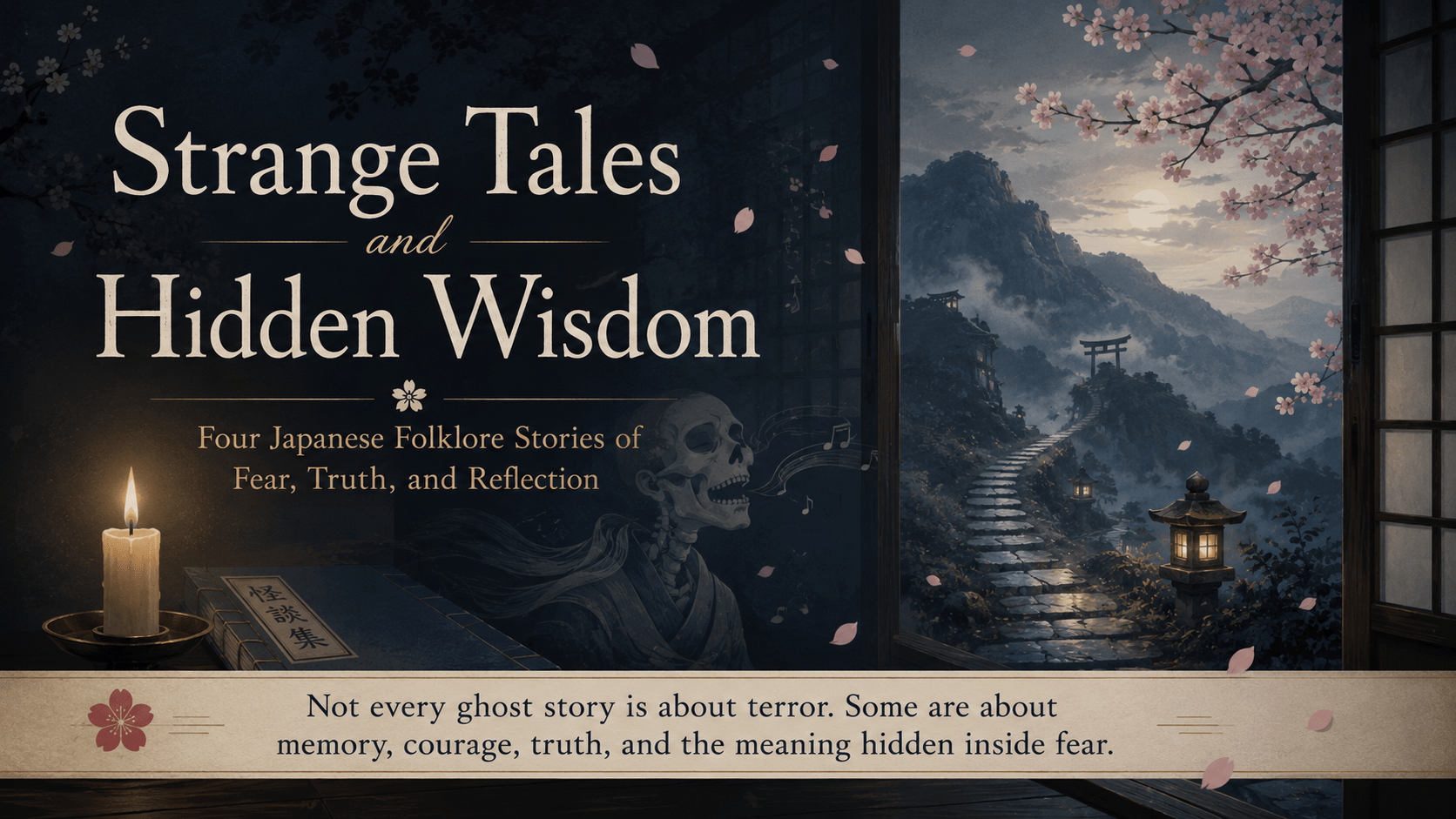
Japanese Ghost Stories with Moral Lessons: Four Mysterious Folklore Tales of Fear, Truth, and Wisdom
※This site uses affiliate advertising.Japanese folklore is filled with stories that are frightening on the surface but strangely thoughtful underneath.A room darkened by one hundred candles.A person who vanishes into the mountains and returns changed.A skull that sings the truth.A cherry blossom tree that seems to hold a spirit.These are not simply scary stories. They are strange mirrors. They reflect the human fear of darkness, disappearance, guilt, silence, beauty, and the unknown.In old tales, fear often becomes a language. It gives shape to what people could not easily explain.This article explores four mysterious Japanese folklore stories:Hyakumonogatari, the ritual of one hundred ghost storiesKamikakushi, the mystery of being spirited awayThe Singing Skull, a tale of truth rising from silenceThe Spirit of the Cherry Blossom, a story of beauty and impermanenceWhether taken as folklore, symbolism, or psychological reflection, these tales suggest one quiet truth:Fear is not always something to escape.Sometimes it is something asking to be understood.Hyakumonogatari: The Hundredth Story That Should Not Be ToldThere is an old Japanese custom that begins not with a scream, but with preparation.On a moonless night, when even the garden stones seem to lose their shape, a group of people gathers inside a dimly lit house. The doors are closed. The outside world is left behind.In one room, people sit together and speak in lowered voices. In another, one hundred candles wait in silence.Some versions of the custom describe blue paper placed around lamps or lanterns, giving the light a pale, unnatural color. In that glow, faces no longer look fully alive. Cheeks become hollow. Eyes seem deeper. Even a familiar friend begins to resemble a stranger seen through water.At first, the gathering still feels like entertainment.Someone clears his throat.Someone smiles too loudly.Someone says, perhaps with forced confidence, that he has heard far worse tales before.Then the first story begins.It may be about a woman seen on a bridge at night.Or a voice calling from an empty well.Or a traveler who followed a lantern into a field and never returned.When the story ends, one participant rises.He walks to the room where the candles are kept. The others hear his footsteps through the wooden floor.A pause.A breath.Then one flame disappears.The room becomes slightly darker.That is all.And yet, everyone feels it.One candle has gone out. One story has been released into the night. One small piece of safety has been removed.The second story begins.Then the third.Then the fourth.The listeners begin by pretending to be calm. They nod. They laugh softly. They comment on the skill of the storyteller.But as the candles continue to disappear, the space around them changes.The shadows lengthen along the walls. The corners of the room seem to grow deeper. The ceiling beams, once ordinary, begin to look like dark ribs above their heads.By the twentieth story, no one laughs quite as easily.By the fiftieth, every small sound has meaning.A board creaks.A sleeve brushes against the tatami.Wind touches the shutters.Someone turns around too quickly.No one says what everyone is thinking:The room no longer feels entirely occupied by the living.The stories grow heavier. Perhaps this is because the storytellers choose darker tales as the night deepens. Or perhaps the same story simply sounds different in a room that has lost half its light.A tale of footsteps in an empty corridor feels more convincing when the corridor outside is dark.A story about a face at the window becomes harder to dismiss when the windows themselves have turned into black mirrors.By the ninetieth story, the gathering has become something else.It is no longer merely a game.It is no longer simply a test of courage.The people in the room have created a world made of words, darkness, and expectation. Each story has opened a door in the mind. Each extinguished candle has made that door a little harder to close.Then comes the ninety-ninth story.The storyteller speaks more slowly than the others. Perhaps he knows that everyone is listening too closely now. Perhaps he enjoys the power of the silence.His story may be about a samurai who saw a black figure in the corner of a room.Or a woman whose hair brushed the floor though she had no feet.Or a dead child calling from behind a sliding door.When the ninety-ninth story ends, someone must go to extinguish the ninety-ninth candle.The walk is short.But in that moment, it feels like crossing into another country.The person who rises may feel every eye on his back. He opens the door. The candle room waits.Ninety-eight flames have already died. Only two remain. Their light trembles against the walls like the last thoughts of the living.He blows one out.Only one candle remains.Now the choice appears.Should they tell the hundredth story?Should they stop?Tradition says that when the hundredth story is completed, and the final light is extinguished, something may appear.Not always a ghost with a face.Not always a figure that can be named.Sometimes a shadow.Sometimes a wind.Sometimes only the certainty that the room has gained one more presence than it had before.In some tales, reckless participants continued. They told the final story. When it ended, the last candle went out, and a dark shape appeared in the corner of the room. The men drew their swords and struck at it, but by morning there was nothing there except sword marks on the wall.In another version, the final story ends and a sudden gust of wind blows through the room, though every door had been closed. All the remaining lights die at once. One participant collapses. When he opens his eyes again, his hair has turned white.Whether such stories are history, embellishment, or the memory of fear retold over generations, they reveal something important.Hyakumonogatari was not frightening only because people believed a ghost might appear.It was frightening because everyone present helped create the conditions for one.A hundred stories.A hundred candles.A hundred steps away from ordinary life.That is the true power of Hyakumonogatari.The ghost may or may not appear. But by the time the final candle remains, fear has already entered the room.And perhaps that is why the wisest participants stopped at ninety-nine.They understood that some doors should be approached, but not opened.Key Quote“A light left burning may be wisdom, not cowardice.”Cultural MeaningHyakumonogatari is powerful because it turns fear into ritual. Darkness does not arrive all at once. It is created gradually.Every story removes one layer of safety.Every extinguished candle teaches the body to listen more closely.This tradition reflects a cultural awareness of boundaries: between play and ritual, courage and recklessness, the visible world and the unseen one.Psychological ReflectionFrom a psychological point of view, Hyakumonogatari shows how fear grows through attention.In darkness, imagination becomes louder.In a group, fear spreads more easily.A small sound can become a sign.A shadow can become a story before anyone can stop it.The tale reminds us that fear is not only found. Sometimes it is made.Life LessonHyakumonogatari may remind us that courage is not always the act of going all the way.Sometimes courage is knowing where the edge is.Sometimes wisdom is stopping at ninety-nine.Kamikakushi: The Mystery of Being Spirited AwayIn the old villages of Japan, there were places children were told not to enter.A grove behind the shrine.A narrow path leading into the mountain.A field where the grass grew too high.A bamboo thicket that looked small from outside but strangely deep once you stood before it.Adults rarely explained these warnings clearly.They did not always say, “There is a cliff.”Or, “There are snakes.”Or, “You may lose your way.”Sometimes they simply said:Do not go there. People disappear.This was the world of kamikakushi.The word suggests being hidden by the gods, but in folklore it can mean many things: taken by spirits, lured by mountain beings, hidden by tengu, swallowed by an unseen realm, or simply removed from ordinary human understanding.The frightening thing about kamikakushi is not only that a person vanishes.It is that the disappearance often leaves behind an unfinished shape of life.A pair of sandals at the edge of a path.A basket beneath a tree.A half-cut bundle of grass.A meal that never gets eaten.A family calling a name into the evening until the voice grows hoarse.One of the most haunting kinds of kamikakushi tale is the story of someone who returns.Not immediately.Not safely.But after years.Sometimes after decades.A person who should have grown older in an ordinary way comes back changed beyond recognition.The face is aged.The body seems exhausted by a journey no one can see.The eyes may recognize home, but not time.In one famous type of tale from the folklore of Tōno, a young woman disappears near a tree, leaving behind an ordinary trace of daily life.Her family searches. Neighbors join. Paths are checked. The river is watched. The mountain is entered and called into.At first, people expect to find her before nightfall.Then they expect to find her the next morning.Then they expect to find some clue.But days pass.Then seasons.Then years.Eventually, her absence becomes part of the house.Her family does not forget her, but they learn how to live around the empty space. The place where she once sat remains remembered. Her name is spoken less often, not because love has faded, but because pain needs silence in order to survive.Then, one day, many years later, an old woman appears.She stands before the house as though she has walked a long way, though no one saw her come down the road.Her clothes may be strange.Her voice may be thin.Her face is deeply lined, far older than the missing woman should be.At first, no one understands.Then she speaks.She says she wanted to see them once more.The house freezes.A name from thirty years ago returns to everyone’s lips.The old woman is the missing daughter.But how can this be?If she had merely lived elsewhere, she should not look so old.If she had been lost in the mountains, how did she survive?If she remembers home, why can she not explain where she has been?If she has returned at last, why does she not stay?She speaks only a little.Perhaps she says that she came because she missed them.Perhaps she seems confused by questions.Perhaps she looks toward the wind, as if something is calling her back.Then she leaves again.This time, the family knows they are losing her.But they still cannot stop it.After that, people in the region may say that on wild, windy days, she might return again.Not because they expect it literally every time, but because folklore often keeps grief alive through weather, places, and repeated phrases.Wind becomes memory.A path becomes a question.A tree becomes a witness.Kamikakushi stories do not always need to show a monster.Their power lies in not showing one.No one sees the god.No one sees the doorway.No one sees the exact moment when the ordinary world opens and someone slips through.That is why the story remains unsettling.It suggests that the unknown does not always roar.Sometimes it waits at the edge of a familiar road.Sometimes it wears the shape of a quiet grove.Sometimes it enters life through a single missing person and never fully leaves.From a modern viewpoint, we may speak of accidents, trauma, memory loss, disorientation, or survival in dangerous terrain. These explanations matter. They help protect real people in real places.But folklore is not only about explaining events.It is also about holding the feelings that remain after explanation fails.Kamikakushi is the name people gave to the fear that someone can be here in the morning and gone by evening.It is the shape of a family’s unanswered question.It is the sound of a name called into the mountains and returned only by echo.Key Quote“Not every disappearance is solved by finding a path; some are carried in memory.”Cultural MeaningKamikakushi reflects an old Japanese sense of sacred boundaries.Mountains, forests, dusk, and lonely roads were not merely natural settings. They were places where ordinary certainty weakened.In this worldview, nature was not empty. It had presence. It could protect, warn, confuse, or take away.Psychological ReflectionKamikakushi gives language to one of the deepest human fears: unexplained absence.The horror is not only losing someone.It is not knowing what happened.Folklore transforms uncertainty into story. It gives grief a shape that people can speak about, even when they cannot solve it.Life LessonThis tale may remind us to respect thresholds.Not every path should be entered carelessly.Not every silence is empty.Not every question receives an answer.In modern life, kamikakushi can be read as a quiet reminder to move carefully through unknown places, both in the outer world and within the heart.The Singing Skull: When Buried Truth Finds Its VoiceThere are crimes that end in silence.A body is hidden.A secret is buried.The murderer returns to ordinary life, speaking politely, eating meals, earning money, greeting neighbors, and perhaps even telling himself that the past has disappeared.But in folktales, the past is rarely so obedient.The story of The Singing Skull often begins with two travelers.They may be merchants walking from one province to another. They share the road, the dust, the weather, and perhaps a small bag of money.They talk as companions do.One speaks of profit.The other speaks of home.At night they sleep near the same fire. By day they walk beneath the same sky.But greed travels quietly.It does not always announce itself as evil.Sometimes it begins as a glance at another person’s purse.Sometimes as a thought quickly dismissed.Sometimes as a calculation made during a long, lonely walk.One day, when the two men reach a deserted mountain path, the thought becomes action.The murderer strikes.The victim falls.The mountain receives the secret.The murderer takes the money and hides the body.Perhaps he covers it with soil.Perhaps he leaves it beneath leaves and stones.Perhaps he whispers nothing at all.He walks away with heavier pockets and lighter loyalty.Years pass.The murderer prospers.Or perhaps he only survives.Either way, the world seems to have accepted his lie.Then, one day, he returns to the mountain.Maybe business brings him there.Maybe chance.Maybe, in the strange logic of folklore, guilt has its own road and eventually leads every sinner back to the place he tried to forget.As he walks, he hears singing.At first, he thinks it is a traveler hidden among the trees.Then he stops.The voice is too thin.Too hollow.It seems to come not from a throat, but from the earth itself.He follows it.The song grows clearer.It is not a cheerful song.It is not simply a mourning song either.It is a song that remembers.There, near the place where he buried his companion, lies a skull.White.Still.Impossible.And singing.The murderer should fall to his knees.He should confess.He should run.He should beg forgiveness from the dead and the living alike.But greed, once fed, often asks to be fed again.Instead of hearing judgment, he hears opportunity.A singing skull.A marvel.People would pay to see such a thing.So he takes the skull.This is the second crime.The first was murder.The second is desecration.He carries the remains of the person he betrayed and turns them into entertainment.At markets, inns, and gatherings, he displays the skull.People gasp.Children hide behind adults.The bold move closer.Coins fall into his hand.The skull sings.Again and again.The murderer becomes known as the man with the singing skull.Perhaps he begins to believe he has won.He not only escaped punishment; he has profited from the dead.He has taken a life, stolen money, hidden the body, and now earns more by making the victim sing.But the skull is waiting.It has not forgotten.It has not forgiven.It has only chosen its moment.One day, the murderer is summoned before a lord.This is the highest stage he has ever reached.The room is formal. Officials sit in order. The lord watches with restrained curiosity.The murderer bows deeply, perhaps with pride hidden beneath humility.He places the skull before them.He expects the usual song.The skull begins.But the melody is different.The murderer stiffens.The words are different.The room grows still.The skull sings not as a spectacle, but as a witness.It sings of the road.It sings of the mountain.It sings of two companions who walked together.It sings of greed.It sings of blood.It sings of the hand that struck.It names the murderer.No one laughs now.The murderer may try to deny it.He may tremble.He may reach for the skull as if to silence it.But the truth has already crossed the room.Once spoken before those who can judge, it cannot be buried again.In the end, the murderer is punished.The victim, who had no voice in life’s final moment, receives one after death.This is why The Singing Skull remains such a powerful folktale.Its horror does not come from the skull alone.It comes from the idea that truth has memory.That guilt leaves traces.That the dead, the wronged, and the silenced may not always stay silent.The skull does not scream.It sings.And that is more frightening.A scream can be dismissed as pain.But a song remembers rhythm, words, and meaning.A song can travel.A song can be repeated.A song can make the hidden unforgettable.Key Quote“What is hidden in darkness may return one day—not as a scream, but as a song.”Cultural MeaningThe Singing Skull belongs to a wide family of folktales in which bones, instruments, or the dead reveal a hidden crime.The tale reflects a moral belief found across many cultures:Truth may be delayed, but it does not disappear.In the Japanese context, the story also carries ideas of respect for the dead, karmic consequence, and the danger of greed.Psychological ReflectionThe skull represents the voice of conscience.The murderer tries to turn guilt into profit, but the very thing he exploits becomes the source of judgment.Psychologically, the tale suggests that hidden wrongdoing continues to live inside the person who committed it.Silence is not always peace.Sometimes silence is only truth waiting for a voice.Life LessonThis story may remind us that truth has patience.It may be buried.It may be mocked.It may be used by those who think they control it.But the tale suggests that truth has a way of choosing its moment.The Spirit of the Cherry Blossom: Beauty, Impermanence, and WonderNot all mysterious Japanese tales are dark in the same way.Some are frightening because something appears.Some are frightening because someone disappears.And some are mysterious because beauty itself feels almost too brief to belong to this world.The tales of the cherry blossom spirit belong to this last kind.In Japan, cherry blossoms are beloved not only because they are beautiful, but because they do not last.Their season is brief.A tree that was bare becomes clouded with pale flowers.For a few days, the world softens.Roads, riversides, temple grounds, and schoolyards are touched by pink and white light.Then the petals fall.That is the whole miracle.If they stayed for months, they would not mean the same thing.The old stories understand this.They say that some cherry trees are more than trees.They are vessels.They hold a presence.A spirit.A memory of the land.In agricultural communities, blossoms once helped mark the rhythms of the year. When the sakura bloomed, people watched the season carefully. The tree was not simply decoration; it was a sign.Imagine a traveler walking through a mountain village in spring.The road is narrow.The air is cool.The last light of afternoon lies gently across the fields.Ahead, there is a grove of wild cherry trees.Their blossoms are not arranged like those in a city park. They are uneven, natural, half-hidden among the slopes.Some branches lean over the path. Others rise pale against the darkening mountain.The traveler stops.Not because he hears something.Because the place feels occupied.Beneath one of the trees stands a woman.She is beautiful in a way that makes the traveler forget to greet her.Not glamorous.Not richly dressed.Rather, she seems perfectly suited to the hour, as if dusk, mountain air, and falling petals had gathered themselves into human form.Her sleeves move slightly in the wind.Petals fall around her, but none seem to touch the ground at her feet.The traveler asks whether she lives nearby.She smiles.Perhaps she answers.Perhaps she does not.In tales like this, the exact words often matter less than the feeling they leave behind.Her voice, if she speaks, is quiet enough to be mistaken for leaves.The traveler feels no immediate fear.Only wonder.And perhaps a faint sadness he cannot explain.The woman looks toward the blossoms.A breeze passes through the grove.For a moment, the world becomes petals.They cross the traveler’s face, his sleeves, his hands.He closes his eyes against the brightness of them.When he opens them again, the woman is gone.There are no footsteps.No path where she might have gone.Only the cherry tree, standing as before.When the traveler tells the villagers, they are not surprised in the way he expects.They do not laugh.They do not rush to investigate.They exchange glances, and one of them says quietly that he may have seen the spirit of the sakura.That is all.No dramatic curse.No punishment.No terrifying revelation.Only a meeting that cannot be kept.This is what makes the story beautiful.The cherry blossom spirit is not a monster.She does not chase the traveler.She does not demand anything.She appears, allows herself to be seen, and vanishes at the exact moment when beauty becomes memory.In some versions of such tales, the spirit appears as a woman in white beneath a famous tree at night.In others, she is glimpsed among falling petals and never seen again.Sometimes she speaks of the tree’s age, or of spring, or of the sorrow of being admired only when in bloom.Sometimes she says nothing at all.But silence suits her.The sakura does not explain itself either.It blooms.It falls.It leaves people looking upward.That is enough.The spirit of the cherry blossom asks for a different kind of attention than the ghost in a dark room or the skull that sings for justice.Her mystery is not the mystery of danger.It is the mystery of impermanence.She reminds us that beauty does not become meaningful by lasting forever.It becomes meaningful because it asks us to be present.If the traveler had been careless, he might have missed her.If he had tried to seize her, she would not have been understood.If he had demanded proof, the petals would already have fallen.This is the gentle wisdom of the tale.Some things arrive only once.Some encounters cannot be repeated.Some beauty is not meant to be possessed, only received.And perhaps that is why the traveler remembers the woman beneath the cherry tree for the rest of his life.Not because she frightened him.But because she disappeared before he could turn beauty into certainty.Key Quote“The most beautiful things often remain with us precisely because they do not stay.”Cultural MeaningCherry blossoms are one of Japan’s most powerful symbols of impermanence.Their beauty is inseparable from their passing.The cherry blossom spirit reflects a view of nature in which trees, seasons, and landscapes are not lifeless background. They carry memory, presence, and meaning.Psychological ReflectionThis tale speaks to the human desire to hold onto beautiful moments.We want beauty to stay.We want joy to last.We want meaningful encounters to become certain.But the story suggests that some experiences are powerful precisely because they cannot be kept.Life LessonThe Spirit of the Cherry Blossom may remind us to receive beauty without trying to possess it.Some moments are not meant to be captured.They are meant to be noticed.This story may remind us that truth has patience.It may be buried.It may be mocked.It may be used by those who think they control it.But the tale suggests that truth has a way of choosing its moment.Cultural Insight: Why These Japanese Folklore Stories Still MatterThese four tales may seem very different, but they share one important theme:Each one is concerned with a boundary.Hyakumonogatari explores the boundary between light and darkness, play and ritual, courage and recklessness.Kamikakushi explores the boundary between village and wilderness, presence and absence, the known world and the unknown.The Singing Skull explores the boundary between silence and confession, death and justice.The Spirit of the Cherry Blossom explores the boundary between beauty and loss, nature and spirit, possession and reverence.Japanese folklore often treats boundaries with care.Dusk, mountains, abandoned places, old trees, bridges, thresholds, and lonely roads are not just settings.They are symbolic spaces where ordinary rules may loosen.For English-speaking readers, this may be one of the most fascinating aspects of Japanese mysterious folklore.The question is not always:“Is the ghost real?”More often, the deeper question is:“What does this fear reveal?”Psychological Reflection: Why We Are Drawn to Scary StoriesWe are drawn to scary stories because they allow us to face fear at a safe distance.A ghost story gives shape to anxiety.A folktale gives language to uncertainty.A strange legend lets a community speak about danger, grief, guilt, reverence, and loss without naming them too directly.Hyakumonogatari teaches that fear grows when attention gathers around it.Kamikakushi teaches that the unknown is often more painful than the frightening.The Singing Skull teaches that hidden truth continues to press against silence.The Spirit of the Cherry Blossom teaches that beauty and loss are not opposites, but companions.Rather than proving the supernatural, these stories reveal how people live with uncertainty.They show how imagination protects, warns, consoles, and remembers.Life Lessons from These Strange Japanese TalesOne way to read these tales is that fear should not always be dismissed.Fear can be irrational, but it can also be informative.It may tell us where a boundary has been crossed.It may reveal where truth has been hidden.It may show where grief has no language.It may remind us where beauty asks for reverence.In modern life, we may not sit in a dark room with one hundred candles.We may not speak of being spirited away by mountain gods.We may not expect bones to sing or cherry trees to appear as women in falling petals.But we still know what it means to approach a dangerous edge.We still know what it means to lose someone without understanding why.We still know the weight of hidden truth.We still know the ache of beauty that cannot last.That is why these stories endure.They are old, but their emotional wisdom is not outdated.Final Reflection: What Fear May Be Asking Us to NoticePerhaps the real mystery is not what appears in the dark.Perhaps the real mystery is what the darkness allows us to notice.A candle left burning.A path no one returns from unchanged.A skull that sings.A woman who vanishes with the petals.Each image remains because it speaks to something human.Fear.Memory.Truth.Beauty.Loss.Wisdom.These strange Japanese tales do not ask us only to be afraid.They ask us to listen.Reader Reflection QuestionWhat fear in your own life might be asking to be understood rather than avoided?