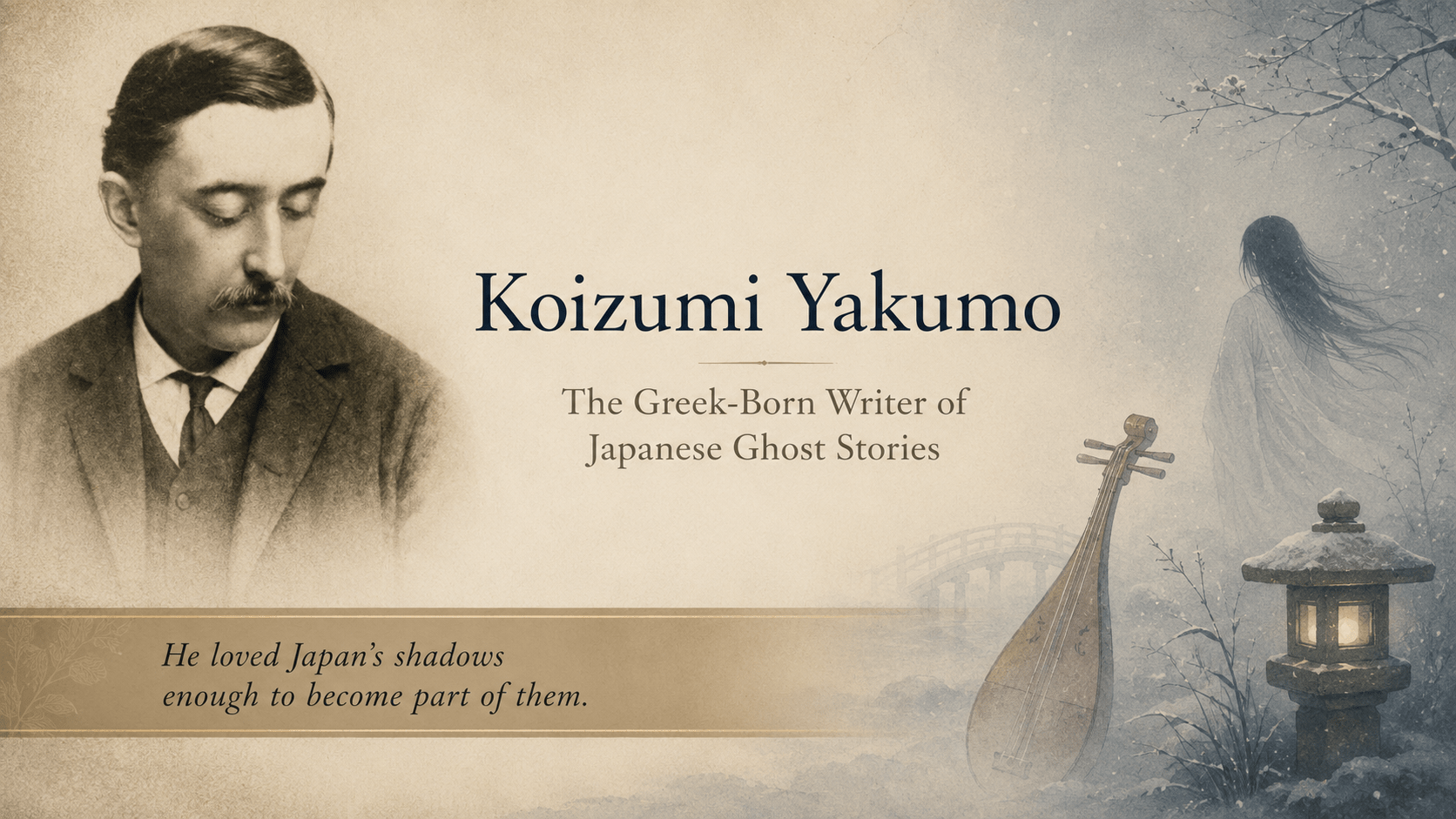
※This site uses affiliate advertising.The story of Lafcadio Hearn, the British writer born in Greece who loved Japan’s ghost stories so deeply that he became Japanese.Lafcadio Hearn, later known as Koizumi Yakumo, was a Greek-born British writer who loved Japan and its ghost stories so deeply that he eventually became Japanese.But his story is not simply about nationality. It is about listening.Born on the island of Lefkada, raised in Ireland, shaped by America and the Caribbean, Hearn arrived in Japan in 1890 and discovered a world where shadows still had meaning. In Japan’s old tales, he found something more than supernatural fear. He found memory, longing, grief, beauty, and a quiet wisdom hidden inside the unknown.Through stories such as “Mimi-nashi Hōichi,” “Yuki-Onna,” “Rokuro-Kubi,” and “Mujina,” Hearn introduced English-speaking readers to a Japan where ghosts were not just monsters, but messengers from the unseen side of life.Biography: From Lafcadio Hearn to Koizumi YakumoLafcadio Hearn was born in 1850 on Lefkada, one of the Ionian Islands. His mother was Greek, and his father was a British military doctor of Irish background. His childhood was marked by separation, loneliness, and displacement. He grew up in Dublin, studied in England and France, and later moved to the United States at the age of nineteen.In America, Hearn became a journalist. He worked in Cincinnati and New Orleans, writing about people and cultures often ignored by polite society. His curiosity moved toward the margins: forgotten neighborhoods, unfamiliar religions, strange customs, and the hidden lives of ordinary people. Later he lived in the French West Indies, where tropical landscapes and Creole culture deepened his sensitivity to language, atmosphere, and cultural memory.In 1890, Hearn arrived in Japan. He first came as a correspondent, but soon broke from that assignment and began teaching English in Matsue, a castle town in Shimane Prefecture. Matsue would become one of the spiritual centers of his Japanese life. There he encountered a Japan that was neither fully ancient nor fully modern—a place of mist, lakes, temples, samurai memories, and whispered stories. The Matsue tourism association describes him as a world traveler born in Greece and raised in Ireland who came to Japan in 1890 and introduced Matsue and Japan to the Western world through his writings.In 1891, Hearn married Koizumi Setsu, a woman from a former samurai family. In 1895, he became a Japanese subject and took the name Koizumi Yakumo—“Koizumi” from his wife’s family name, and “Yakumo,” often understood as “eight clouds” or “many clouds,” with a poetic connection to the Izumo region. Britannica records that he became a Japanese subject and took the name Koizumi Yakumo, while Visit Matsue notes that he became one of the first Westerners to receive Japanese citizenship.His life ended in Tokyo in 1904, but his literary afterlife had only begun. Through works such as Glimpses of Unfamiliar Japan, In Ghostly Japan, and above all Kwaidan: Stories and Studies of Strange Things, he became one of the most influential interpreters of Japanese culture for English-speaking readers. Britannica identifies Kwaidan as a collection of supernatural stories and haiku translations, and it remains the work most closely associated with his name.Episode: Setsu, the Live-In Maid Who Became His Wife and Creative PartnerOne of the most important figures in Hearn’s Japanese life was Koizumi Setsu. She was not only his wife; she was also his bridge to the living voice of Japan.When Hearn was living in Matsue, he needed help adjusting to everyday life in a country whose language he barely understood. Setsu came into his household as a live-in maid. She was from a former samurai family, but like many families after the Meiji Restoration, her household had experienced hardship. According to modern accounts, poverty and family circumstances brought her into Hearn’s home as domestic help.Hearn was forty-one. Setsu was twenty-three. She had been married before, and so had he. Their marriage was not a romantic fairy tale in the simple sense. It was a meeting shaped by class change, economic necessity, cultural misunderstanding, and the awkward intimacy of two people who did not fully share a language.And yet, from that imperfect beginning came one of the most quietly important partnerships in literary history.Hearn never mastered Japanese in a systematic way. Setsu helped him access stories, expressions, moods, and cultural details that would otherwise have remained closed to him. Nippon.com describes Setsu as instrumental to Hearn’s creative endeavors and emphasizes that he could not have created Kwaidan and his other retold literature without her support.She was, in a sense, the first listener before the writer. She carried stories to him, explained them, performed them, colored them with cadence and memory. Hearn then transformed them into English prose of strange delicacy. If he gave Japan’s ghosts an English voice, Setsu helped him hear them first.A beautiful way to understand their relationship is this:Hearn wrote the shadows, but Setsu opened the door to the room where those shadows lived.Episode: Becoming Japanese — The Name Koizumi YakumoWhen Lafcadio Hearn became a Japanese citizen and took the name Koizumi Yakumo, it was more than an administrative change. It was a symbolic crossing.For many writers, a pen name is a mask. For Hearn, his Japanese name became almost a second birth. “Koizumi” connected him to Setsu and her family. “Yakumo” evoked clouds gathering and unfolding over the Izumo region, a place associated with ancient myth. In Japanese cultural imagination, clouds are not merely weather. They suggest distance, concealment, transformation, and divine presence.This name suited him perfectly.Hearn had spent much of his life without a stable homeland. Greece was a birthplace but not a childhood home. Ireland was a place of upbringing but also abandonment. America gave him journalism and survival, but not rest. Japan gave him something different: not comfort exactly, but resonance. It gave him a world in which the unseen was not mocked, where household gods, ancestral spirits, Buddhist prayers, and local legends still formed part of the emotional landscape.To become Koizumi Yakumo was not to erase Lafcadio Hearn. It was to give his wandering self a final shape.He did not become Japanese because he stopped being foreign. He became Japanese because he found a country where foreignness itself could become a way of seeing.The Four Shadows Hearn Preserved: Hoichi, Yuki-Onna, Rokurokubi, and MujinaAmong Hearn’s many retellings, four stories are especially powerful because each one reveals a different face of Japanese folklore. Mimi-nashi Hōichi carries the grief of fallen warriors. Yuki-Onna turns snow into beauty, death, and forbidden memory. Rokuro-Kubi shows how the self can split between the body and the secret hunger within. Mujina strips horror down to its most silent form: a face without a face. Together, these tales show why Hearn’s work still feels modern. He was not only recording ghosts; he was recording the emotional grammar of fear.STORY: Mimi-nashi Hōichi — The Blind Musician Who Sang to the DeadThere was once a blind musician named Hōichi, whose art was so moving that people said he could make the dead remember their own tears.He lived at a Buddhist temple near the sea, in a region haunted by the memory of the Genpei War—a twelfth-century conflict between the Taira, also known as the Heike, and the Minamoto clans. For English-speaking readers, it may help to understand that this war occupies a place in Japanese cultural memory somewhat like a tragic epic: a story of warriors, loyalty, pride, downfall, and impermanence. The Heike were defeated in the famous sea battle of Dan-no-ura, where many nobles and warriors perished. The sea itself seemed to become a grave.Hōichi played the biwa, a Japanese lute-like instrument often associated with narrative chanting. His specialty was the tale of the Heike. Because he was blind, his world was made of sound: strings trembling under his fingers, voices rising and falling, temple bells, wind, footsteps, waves. Perhaps that is why the dead found him.One night, while the priest of the temple was away, Hōichi heard a stern voice calling his name.The voice belonged, or seemed to belong, to a samurai. It ordered him to come and perform before a noble household. Hōichi, humble and obedient, followed. He was led through what seemed to be gates and corridors, into a great assembly. He could not see the listeners, but he could feel their presence: the hush of many bodies, the rustle of armor and silk, the stillness of people waiting for grief to begin.Then he played.He sang the fall of the Heike. He sang of ships and arrows, of women and warriors, of the child emperor lost beneath the waves, of glory extinguished like a lamp in storm wind. As his voice moved through the night, the listeners wept. Their sorrow filled the unseen hall.But Hōichi did not know that he had been taken not to a living mansion, but to a cemetery. His audience was not a noble family, but the spirits of the defeated Heike.When the temple priest discovered what was happening, he understood the danger. Ghosts, in many Japanese Buddhist contexts, are not always evil; they may be bound by attachment, grief, or unfinished karma. But to be repeatedly summoned by the dead is to be pulled toward their world. The priest tried to save Hōichi by covering his body with sacred Buddhist scripture. The idea was that the written sutra would make him invisible to the spirits.Every part of his body was covered.Except his ears.That night the ghostly samurai came again. He called for Hōichi, but could not see him. Only the ears remained visible, suspended in the dark like two small betrayals of flesh. The spirit, thinking the rest of Hōichi had vanished, took what it could find.After that, Hōichi lived. But he became known forever as Mimi-nashi Hōichi—Hōichi the Earless.This story is terrifying, but its terror is not merely physical. It is a story about art and danger. Hōichi’s gift is so powerful that even the dead cannot resist it. He gives voice to history, but history answers by claiming part of his body. In that sense, Hearn’s retelling becomes a meditation on the cost of remembering.To sing the grief of the past is never harmless.Sometimes memory applauds.Sometimes it reaches out and takes something from us.STORY: Yuki-Onna — The Snow Woman and the Secret That Melted a LifeSnow in Japanese folklore is rarely only weather. It is silence made visible. It covers footprints, softens sound, erases roads, and turns the familiar world into a place without witnesses.In “Yuki-Onna,” Hearn gives us one of the most haunting figures in Japanese supernatural literature: the Snow Woman, beautiful, pale, merciless, and strangely sorrowful.The story begins with two woodcutters, an old man and a young man named Minokichi. They are caught in a terrible snowstorm and take shelter in a small hut. Outside, the world becomes white and formless. The storm is not just cold; it is a force that separates them from the human world. In the old imagination, such weather was a threshold. Beyond it, gods, spirits, and strange beings might pass.During the night, Minokichi wakes.A woman is there.She is dressed in white, or perhaps she is white itself. Her face is unearthly. Her breath is cold enough to kill. She bends over the old woodcutter and blows upon him, taking his life as effortlessly as winter takes the last warmth from a field.Then she turns to Minokichi.He is young. He is beautiful. Something in him moves her—not pity exactly, perhaps recognition. She tells him she will spare him, but only on one condition: he must never speak of what he has seen. If he tells anyone, she will know. And she will kill him.Years pass.Minokichi survives. He returns to ordinary life, or what seems to be ordinary life. One day he meets a young woman named O-Yuki. She is graceful, quiet, and pale. They marry. She becomes a devoted wife and mother. Their life appears blessed, almost too blessed, as if happiness has fallen like snow over an old terror and hidden it from view.But secrets do not disappear. They wait.One night, watching his wife in the lamplight, Minokichi remembers the woman from the storm. O-Yuki’s face, her whiteness, the strange stillness of her beauty—suddenly the past returns. He tells her the story he had sworn never to tell.The moment the words leave him, the room changes.O-Yuki reveals that she was the Snow Woman. She had spared him once. She had become his wife. She had borne his children. She had lived beside him in human tenderness. But he has broken the promise.In many versions of the tale, she does not kill him because of the children. Instead, she vanishes, leaving him with life, memory, and loss.That is the true cruelty of the story. Minokichi is not punished by death. He is punished by survival.“Yuki-Onna” is more than a ghost story. It is a story about the fragility of intimacy. Every marriage, every love, contains unknown weather. We live beside people whose depths we cannot fully measure. We are saved by promises, and sometimes ruined by the desire to speak what should have remained silent.The Snow Woman is terrifying because she is both death and wife, winter and tenderness, monster and mother. She reminds us that love does not always melt the supernatural. Sometimes it only gives the supernatural a human face.STORY: Rokuro-Kubi — The Neck That Wandered Away from the BodyThe rokuro-kubi is one of Japan’s most unsettling supernatural beings. The term is often used for a strange woman whose neck stretches impossibly long, but older traditions also include a darker type: a being whose head separates from the body and floats away at night.This is important for English-speaking readers. The horror here is not simply the grotesque image of an elongated neck. It is the anxiety that the human self may not be whole. The body sleeps, but something leaves. The face you love may drift into the night while the body remains behind like an empty house.In Hearn’s retelling, the atmosphere is one of travel, fatigue, and uneasy hospitality. A wandering man—often a former samurai or priest-like figure in older versions—finds shelter in a lonely place. The people who welcome him seem ordinary enough. They offer a roof, food, and rest. In Japanese folklore, hospitality is sacred, but it is also dangerous. The stranger who enters a house after dark enters not only a room, but the hidden life of the household.Night deepens.The guest cannot sleep. Something feels wrong. The air has the thickness of a secret. Then he sees it: a head, detached from its body, moving through the darkness. The body lies elsewhere, still and helpless, while the head wanders like a lantern of appetite.The image is grotesque, but also symbolic. In the rokuro-kubi, desire has slipped its human boundary. Hunger, resentment, or curse has separated the self from the form that usually restrains it. The head travels because the inner life can no longer remain contained.When morning comes, ordinary life returns. Faces become polite again. The household resumes its human shape. But the traveler now knows the truth: the monster is not always outside the door. Sometimes it sleeps in the next room. Sometimes it serves tea. Sometimes it smiles.The rokuro-kubi story lingers because it speaks to a fear deeper than physical horror. What if the people around us have a second life we cannot see? What if the self we present in daylight is only the body, while the true hunger goes wandering after midnight?Hearn understood this kind of fear. He did not make the monster loud. He allowed it to remain intimate.The most frightening door is not the gate of a ruined temple.It is the sliding door of an ordinary room, behind which someone you trust may be dreaming with a different face.STORY: Mujina — The Faceless Stranger on a Lonely RoadIn Japanese folklore, the word mujina can refer to a badger-like animal, but in ghost-story tradition it often points toward a shape-shifting creature. In Hearn’s famous tale, however, the terror is stripped down to its simplest possible form: a face that is not a face.The setting is lonely. A man walks at night near a moat or a deserted road. The city is not empty, but this particular place feels removed from human protection. Night in old Japan was not the brightly lit night of modern cities. Darkness had weight. A single lantern mattered. The edge of a road could feel like the edge of the known world.There, the man sees a woman weeping.She sits alone, her sleeves lifted to her face. At first, the scene seems sad rather than frightening. A woman crying alone at night suggests abandonment, shame, or grief. The man approaches. He speaks gently. In many cultures, this is the beginning of compassion.But ghost stories often begin exactly where compassion overcomes caution.Why Hearn’s Ghost Stories Still MatterHearn’s ghost stories survive because they are not only about fear. They are about the hidden structure of feeling.In “Mimi-nashi Hōichi,” memory is dangerous because it is sacred.In “Yuki-Onna,” love is fragile because it rests on silence.In “Rokuro-Kubi,” the self is frightening because it may not be whole.In “Mujina,” identity collapses when the face disappears.These are not outdated fears. They are modern fears wearing old clothes.We still live with histories that demand to be sung, even when singing hurts. We still keep secrets inside love. We still wonder what part of ourselves leaves the body at night—online, in dreams, in anger, in desire. We still fear the blank face: the person without expression, the profile without truth, the mask without a soul behind it.Closing: The Foreigner Who Became a ListenerLafcadio Hearn became Koizumi Yakumo, but his transformation was not a simple story of a foreigner “becoming Japanese.” It was something more delicate.He became a listener.He listened to a country in transition. He listened to women’s voices, servants’ stories, Buddhist echoes, samurai ruins, rural fears, and the quiet intelligence of old tales. He understood that a ghost story is never only about the dead. It is about the living who still need the dead to explain what life feels like.That may be the deepest reason Hearn remains beloved.He did not preserve Japanese ghost stories by freezing them. He gave them another life. He carried them into English, across oceans, into the minds of readers who had never heard the sound of a biwa, never walked through Meiji-era Matsue, never feared a snow woman in a mountain hut.And yet, through his prose, they could feel it.The trembling string.The white breath.The wandering head.The blank face.Hearn became Japanese not only by law or by name, but by devotion. He loved Japan’s shadows enough to listen to them carefully. And in those shadows, he found a form of wisdom that still speaks.The ghost, after all, is not always what frightens us.Sometimes the ghost is what helps us remember what we are.Hearn understood that folklore is not primitive psychology. It is psychology before psychology had a clinical name. Ghost stories are emotional maps. They tell us where a culture placed its dread, its tenderness, its warnings, and its wisdom.Perhaps that is why Hearn loved Japan so deeply. He found a culture where the unseen was not empty. A shadow might contain a memory. A snowstorm might contain a woman. A song might summon an army of the dead. A crying stranger might contain the end of the human face.And perhaps Japan, in return, gave Hearn what he had searched for across oceans: a language for the invisible.The woman slowly turns.Her face is smooth.No eyes. No nose. No mouth.Only blank skin.The horror of Mujina is almost abstract. There is no blood, no violence, no elaborate monster. There is only absence. A human form without a human face. A person reduced to the place where expression should be.The man flees in terror and finds a soba seller, a noodle vendor, still working in the night. The ordinary presence of food, trade, and another human being seems to restore the world. He tells the vendor what he has seen. The vendor listens—and then asks whether the face looked like this.And his own face becomes blank.This second revelation is what makes the story unforgettable. The first faceless figure breaks the man’s trust in appearance. The second breaks his trust in rescue. Even the safe place is not safe. Even explanation becomes part of the nightmare.“Mujina” is a masterpiece of minimal horror because it understands that fear does not always need a monster with claws. Sometimes fear is the removal of what should be there. A face is the first promise of human connection. We read eyes, mouth, expression; we search for intention. When the face disappears, the social world collapses.The story asks a question that still feels modern:What are we, when the face we show to others is only a surface?And what happens when that surface goes blank?In the age of masks, avatars, screens, and curated identities, Mujina may be more disturbing now than ever.