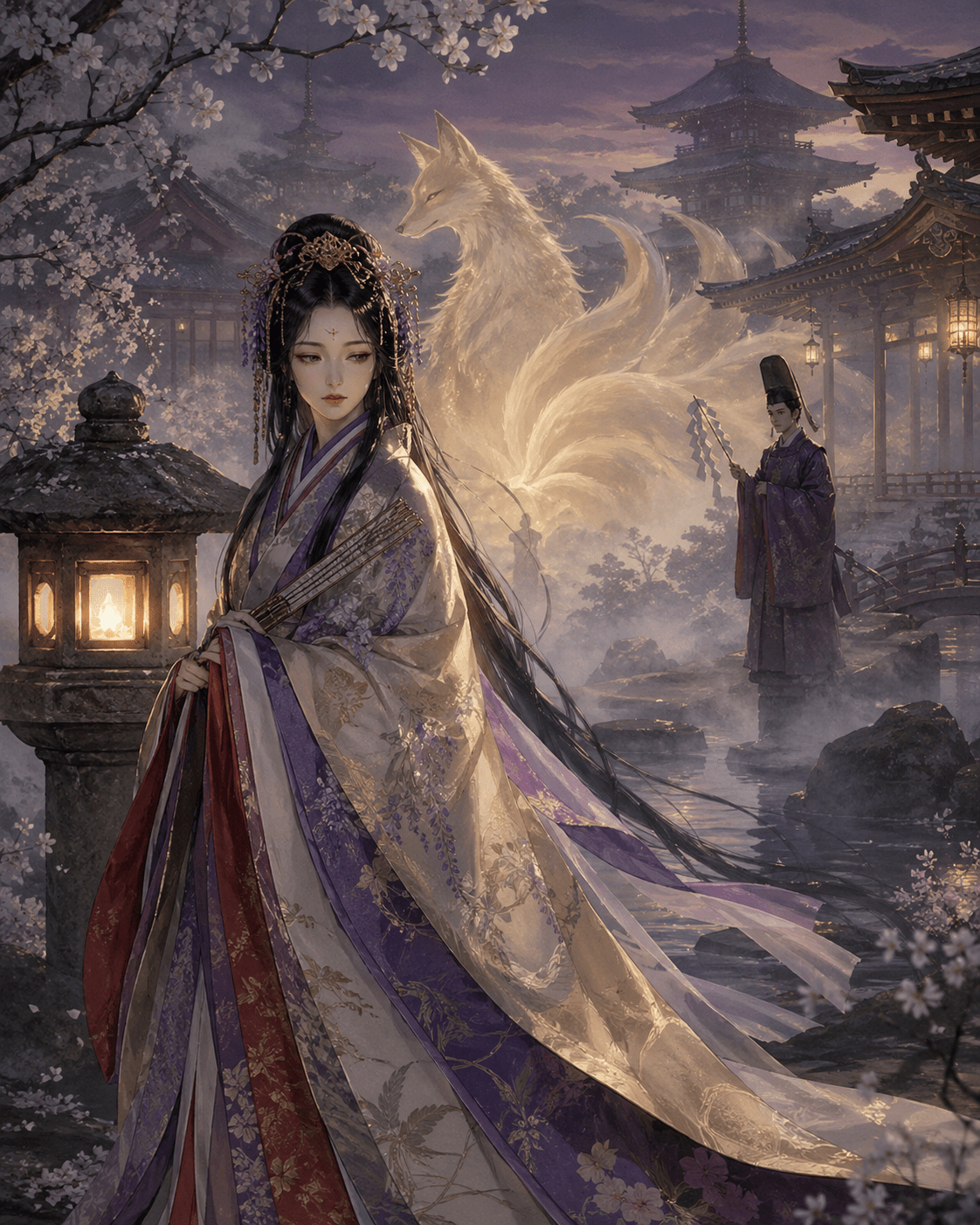
※This site uses affiliate advertising.Introduction: When Beauty Becomes a MysterySome folklore begins with a monster in the dark.The legend of Tamamo-no-Mae begins with a woman of almost impossible beauty.In Japanese folklore, Tamamo-no-Mae is remembered as a mysterious court lady whose true form was said to be a kyūbi no kitsune, a nine-tailed fox. She appeared elegant, intelligent, and graceful. Yet behind her beauty, the tale says, there was an ancient spirit that had crossed countries, dynasties, and centuries.This is not only a scary story. It is a strange tale with hidden wisdom.At its heart, the legend asks several quiet questions. Why are people so easily captivated by beauty and power? How can charm become dangerous when it hides the truth? And why do old cultures so often turn fear into stories, symbols, and warnings?To understand this legend, we need to understand two important ideas in Japanese folklore: the nine-tailed fox and the onmyōji.A nine-tailed fox is not an ordinary animal. In East Asian folklore, fox spirits are often believed to grow wiser, stronger, and more mysterious with age. The more tails a fox has, the greater its supernatural power is said to be. A fox with nine tails represents extreme age, deep magic, transformation, and sometimes danger.An onmyōji was a practitioner of Onmyōdō, a traditional Japanese system that combined divination, astrology, calendar knowledge, ritual, and cosmology. In legends, onmyōji often appear as spiritual specialists who can sense what ordinary people cannot see. They do not simply fight monsters with weapons. They read signs, perform rituals, and reveal hidden truths.The story of Tamamo-no-Mae brings these two worlds together: the seductive mystery of the fox and the careful insight of the onmyōji.The Nine-Tailed Fox: A Spirit of TransformationBefore Tamamo-no-Mae appears in Japan, the legend of the nine-tailed fox already has a long shadow across Asia.In many East Asian traditions, foxes are seen as unusual creatures. They live near human settlements, appear at twilight, move silently, and seem to belong to the border between the wild and the familiar. Because of this, foxes became powerful figures in folklore.In Japan, foxes are called kitsune. They can be sacred messengers, especially in traditions connected with Inari, a deity associated with rice, fertility, prosperity, and worldly success. But kitsune can also be tricksters. They may deceive humans, transform into women, create illusions, or test a person’s heart.This is why the fox is so fascinating. It is not purely evil. It is not purely good. It is ambiguous.A fox may guide you.A fox may deceive you.A fox may protect you.A fox may reveal your weakness.The nine-tailed fox is the most powerful form of this idea. Its nine tails suggest age, magical power, and accumulated experience. In folklore, such a fox is often said to possess deep knowledge of human desire. It knows what people want to see. It knows how to appear as beauty, comfort, authority, or love.That is what makes the nine-tailed fox frightening.It does not always attack from outside.It enters through longing.The legend of Tamamo-no-Mae uses this symbolism with great force. The fox does not merely become a monster. It becomes what people desire most. It appears as beauty in a court that values beauty. It appears as intelligence in a society that respects refinement. It appears as companionship to a ruler who wants affection and admiration.In this sense, the nine-tailed fox is not only a supernatural creature. It is also a mirror of human vulnerability.It is a tale of fear, but also of perception.It is a tale of deception, but also of wisdom.Across Kingdoms: The Fox Before JapanIn some versions of the legend, the nine-tailed fox first appears in ancient China as Daji, the beautiful consort of King Zhou of the Shang dynasty. The tale says that Daji was not merely a cruel woman, but a fox spirit who had entered the palace and taken control of human desire.The stories surrounding Daji are severe. She is said to have delighted in punishment and suffering. One famous scene tells of a condemned man ordered to walk across a bronze pillar coated with oil and heated until it burned. If he crossed it, he would be declared innocent. But no human could walk such a path. He slipped, clung to the burning metal, and died.Whether read as history, myth, or moral imagination, the image is unforgettable. A ruler becomes blind. A court becomes afraid. Cruelty is made into entertainment. Judgment is replaced by spectacle.In folklore, this is where the nine-tailed fox does its work. It does not destroy a kingdom with claws alone. It weakens the mind of power. It turns pleasure into cruelty and admiration into obedience.After the fall of the Shang dynasty, the fox is said to have crossed into other lands. Some tellings place it in India, where it appears again as a beautiful woman who captivates a prince and brings suffering to the people. Other versions say it returns to China in another age, repeating the same pattern: beauty, fascination, ignored warnings, and ruin.The details shift, but the structure remains.A ruler is enchanted.Wise counsel is ignored.Cruelty spreads.The kingdom collapses from within.This repetition is important. Folklore repeats patterns because human beings repeat patterns. The fox returns again and again because the weakness it represents also returns again and again.Every age has its own illusions.Every palace has its own blind spot.Tamamo-no-Mae at the Heian CourtIn Japan, the nine-tailed fox is said to have appeared during the Heian period as Tamamo-no-Mae.The Heian court was a world of elegance and ritual. Beauty was not a simple decoration. It was a language. Poetry, music, calligraphy, fragrance, clothing, and careful conversation shaped a person’s reputation. To be refined was to possess power of a quiet kind.Into this world came Tamamo-no-Mae.She was described as a woman of extraordinary beauty. Her skin seemed to glow softly. Her black hair flowed with graceful depth. Her voice was calm, her words intelligent, and her manners flawless. She understood poetry. She knew music. She could answer difficult questions with ease.She was not only lovely. She was cultivated.The ruler, often identified in the legend with Emperor Toba or the retired emperor connected to his court, became deeply fascinated by her. She was invited closer and closer into the center of power. Courtiers admired her. Some envied her. Others felt something they could not explain.There was a strange brightness around her.But brightness can sometimes cast a shadow.Soon, the ruler’s health began to fail. Physicians could not cure him. Ritual prayers did not bring relief. The atmosphere of the palace grew heavy. People whispered in corridors. Strange winds were felt at night. Some said they heard voices when no one was there.Suspicion slowly gathered around Tamamo-no-Mae.Yet suspicion is a dangerous thing in folklore. It may reveal the truth, or it may reveal the fears of those who are suspicious. The legend leaves room for both possibilities. Perhaps she was truly a fox spirit. Perhaps she became the shape into which the court poured its anxieties.Either way, the palace needed someone who could read what others could not.So an onmyōji was called.The Onmyōji: Reader of Hidden SignsTo English-speaking readers, an onmyōji may be unfamiliar, but this figure is essential to understanding the story.An onmyōji was not simply a wizard or magician. In traditional Japanese culture, onmyōji were specialists in Onmyōdō, a system influenced by Chinese yin-yang thought, the five elements, astronomy, divination, ritual practice, and calendar science.They studied the movement of stars, the direction of travel, lucky and unlucky days, spiritual pollution, and the unseen balance between forces. In historical contexts, onmyōji sometimes served courts and aristocrats by choosing dates for ceremonies, interpreting omens, and performing protective rituals.In folklore, however, the onmyōji becomes something more dramatic: a person who can stand between the human world and the unseen world.The onmyōji does not always defeat evil through force. His power lies in perception. He notices what others overlook. He reads the hidden pattern beneath visible events. When everyone else is dazzled by appearance, he asks what lies behind it.In the legend of Tamamo-no-Mae, the onmyōji is often identified as Abe no Yasuchika or connected to the famous tradition of the Abe clan of onmyōji. Through divination and ritual, he discovers the truth: Tamamo-no-Mae is not an ordinary woman. She is the nine-tailed fox.This moment is important not only because a monster is exposed. It is important because illusion loses its power when it is named.In many wisdom traditions, naming a fear is the first step toward no longer being ruled by it.The Moment of RevelationWhen the onmyōji reveals Tamamo-no-Mae’s true nature, the palace is thrown into fear.The woman who had been admired now becomes terrifying. The same beauty that once seemed divine begins to look dangerous. Her intelligence, once praised, becomes suspicious. Her silence becomes threatening. Her presence becomes unbearable.This reversal is one of the most psychologically interesting parts of the legend.Human beings often change their interpretation of a person once fear enters the mind. The same smile may become manipulation. The same grace may become concealment. The same mystery may become a warning.The legend says that when Tamamo-no-Mae was exposed, she fled from the court. Some versions describe her as suddenly revealing her fox form. Others suggest she disappeared quietly, leaving behind confusion, illness, and fear.Either way, the court is changed.The ruler, who had been captivated by her, must confront his own blindness. The courtiers, who had admired or envied her, must confront how quickly admiration can become hatred. And the onmyōji, who reveals the truth, becomes the figure of insight in a world ruled by appearances.At this point, the story is no longer only about a fox spirit. It becomes a meditation on perception.What do we see?What do we refuse to see?And what happens when the truth finally enters the room?The Flight to Nasu and the Battle on the PlainAfter leaving the court, Tamamo-no-Mae is said to have fled east to Nasu, a region associated with open fields, mountains, and volcanic landscapes.There, according to the legend, the fox spirit no longer hid behind courtly elegance. Reports spread of animals dying and people being harmed. The air itself seemed dangerous. Fear moved through the villages.The court sent warriors to hunt the fox. This was not an ordinary military mission. The enemy was not simply a beast. It was a supernatural being of ancient power. For this reason, some tellings include ritual specialists, prayers, and protective rites. Human courage alone was not enough. The hunters needed spiritual protection and clear minds.When the warriors reached the plain, Tamamo-no-Mae appeared again.Some versions say she stood before them in the form of a beautiful woman. Even at the edge of death, her beauty had not faded. For a moment, the warriors may have felt uncertainty. Was this truly a monster? Was she a spirit? A woman? A victim? A danger?Then the moment passed.Arrows flew across the field.Tamamo-no-Mae revealed her true form: a great fox with nine tails. The creature was radiant, terrible, and filled with supernatural force. Wind rose around it. The earth seemed to tremble. The battle became not merely a fight between warriors and a beast, but a symbolic confrontation between illusion and recognition, desire and discipline, fear and courage.At last, the nine-tailed fox was struck down.But in folklore, powerful spirits rarely vanish without a trace.Her body died, but her resentment remained. That lingering force was said to enter a stone. This stone became known as the Sesshō-seki, the Killing Stone.The Killing Stone: Fear Made VisibleThe Sesshō-seki, or Killing Stone, is one of the most powerful images in the legend of Tamamo-no-Mae.The stone was said to release poison. Birds that flew above it fell. Animals that came near it died. Plants could not grow around it. People feared the place and avoided it.From a cultural perspective, this image is meaningful. A stone is silent. It does not chase anyone. It does not speak. It simply remains.And yet, in the legend, it kills.That makes the Killing Stone a symbol of lingering harm. It represents the kind of pain that remains after the visible crisis is over. The fox has been defeated, but the atmosphere is still dangerous. The court has been saved, but suspicion remains. The monster is gone, but the wound continues to speak.This is one reason the story feels psychologically modern. Many people know this feeling. A conflict ends, but the unease remains. A lie is exposed, but trust does not immediately return. A frightening period passes, but the memory continues to affect the body and mind.Later traditions say that a monk named Gennō came to the Killing Stone and performed rituals to pacify the spirit. In some versions, he broke the stone, and pieces flew to different regions of Japan. In others, the spirit was finally calmed.This part of the legend adds an important layer. It suggests that fear is not only something to defeat. Sometimes fear must be understood, named, mourned, and purified.The Killing Stone reminds us that unresolved fear becomes part of the landscape.Healing begins when someone is willing to approach it carefully.Cultural Insight: Why This Folklore Still MattersThe legend of Tamamo-no-Mae survives because it contains more than fear. It contains cultural memory.The nine-tailed fox reflects the Japanese and East Asian imagination of transformation. A being can change shape. A person may not be what they appear to be. Beauty may hide danger, but danger may also hide sorrow. The visible world is never the whole world.The onmyōji reflects another important cultural idea: the need to read signs carefully. In a world where illness, disaster, politics, and emotion often felt connected to invisible forces, the onmyōji represented order. He was the person who could interpret hidden patterns when ordinary explanation failed.Together, the fox and the onmyōji create a powerful symbolic pair.The fox represents illusion, desire, and transformation.The onmyōji represents discernment, ritual, and interpretation.This is why the story fits so naturally into a site about proverbs, affirmations, wisdom quotes, and cultural insight. It is not only about a supernatural creature. It is about the human need for wisdom when appearances become confusing.Many cultures have proverbs warning against surface appearances:“All that glitters is not gold.”This proverb fits Tamamo-no-Mae beautifully. It does not say that beauty is false. It says that brightness alone is not proof of truth.The legend invites us to admire beauty, but not surrender judgment.It invites us to listen to charm, but also to listen to unease.It invites us to recognize that wisdom often begins with a second look.Psychological Reflection: Why We Fear the Beautiful MaskPeople are drawn to stories like Tamamo-no-Mae because they turn invisible anxiety into a visible image.The nine-tailed fox gives a body to a familiar fear: the fear of being deceived by what we admire.This fear is not limited to ancient courts. In modern life, people are still drawn to beauty, confidence, status, charisma, and polished appearances. We admire people who seem certain. We trust stories that feel comforting. We follow voices that say what we want to hear.None of this is wrong in itself. Human beings need beauty and trust. But the legend reminds us that attraction can become dangerous when it silences reflection.The onmyōji, in psychological terms, represents the inner voice that asks questions.Is this true?Why am I so drawn to this?What am I ignoring?What does my unease know that my desire does not?The story is not asking us to become suspicious of everything. A life ruled by suspicion becomes cold and lonely. Instead, the legend suggests a more balanced wisdom: stay open, but stay awake.Fear, in this sense, is not always an enemy. Sometimes fear is a messenger. It tells us where attention is needed.Folklore allows us to approach this truth gently. Instead of saying, “You may be deceived,” it tells us a story about a fox in a palace. Instead of giving direct instruction, it lets an image remain in the mind.A beautiful woman.A sick ruler.An onmyōji reading hidden signs.A fox fleeing into the wilderness.A stone that still remembers.These images stay with us because they speak the language of the unconscious.Life Lesson: Let Beauty Be Joined by WisdomOne possible lesson of Tamamo-no-Mae is simple but deep:Beauty needs wisdom beside it.This does not mean beauty is dangerous. It does not mean desire is shameful. It does not mean we should reject admiration, love, art, elegance, or wonder.Rather, the story reminds us that beauty becomes safer when accompanied by discernment.In daily life, the nine-tailed fox may not appear as a supernatural being. It may appear as a flattering opportunity, a persuasive leader, a charming relationship, a perfect image online, a shortcut that seems too easy, or a promise that makes us stop asking questions.The onmyōji may also appear in modern life, though not in robes or ritual. It may appear as a friend who gently warns us. It may appear as our own intuition. It may appear as the pause before a decision. It may appear as the uncomfortable question we almost avoid.This story may remind us that courage is not always loud. Sometimes courage is the willingness to look again.To ask one more question.To listen to one small doubt.To notice when admiration becomes surrender.To remember that not every shining thing is a guide.A useful affirmation for this story might be:“I can honor beauty without abandoning my wisdom.”Closing Reflection: The Fox That Still SpeaksThe legend of Tamamo-no-Mae has survived for centuries because it is not only about the past.It still speaks because people still encounter masks.People still confuse charm with truth.People still ignore quiet warnings when desire is loud.People still need someone, or something, to help them read the signs.The nine-tailed fox remains powerful because it is mysterious, but also because it is familiar. We may never meet a supernatural fox in a palace. But we all know what it means to be dazzled. We all know what it means to sense that something beautiful has a shadow.The onmyōji remains powerful because he represents a wisdom many of us still seek: the ability to see beneath appearances without losing compassion.Perhaps the real mystery of Tamamo-no-Mae is not whether a fox once became a woman, or whether a stone once held a spirit.Perhaps the deeper mystery is why we still recognize her.What beautiful thing in your own life might be asking not for fear, but for clearer seeing?Key Proverb, Quote, or Affirmation UsedProverb“All that glitters is not gold.”MeaningSomething may look beautiful, valuable, or trustworthy on the surface, but appearance alone does not prove truth.Original Affirmation“I can honor beauty without abandoning my wisdom.”Psychological / Philosophical Reflection SummaryThis story endures because it reflects a universal fear: being deceived by what we admire. The fox symbolizes charm without truth, while the onmyōji symbolizes the inner voice that asks us to look deeper.Rather than simply frightening us, the legend gives shape to uncertainty. It suggests that fear may sometimes be a messenger, asking us to pay closer attention.Life Lesson SummaryThe tale of Tamamo-no-Mae may remind us that beauty and wisdom should walk together. We do not need to reject beauty, admiration, or desire. But we may need to keep asking gentle questions when something feels too perfect.The modern “nine-tailed fox” may be a persuasive image, a charming person, an easy promise, or a story we want too badly to believe. The modern “onmyōji” may be intuition, patience, a trusted friend, or the courage to pause before saying yes.Reader Reflection QuestionWhat beautiful thing in your own life might be asking not for fear, but for clearer seeing?