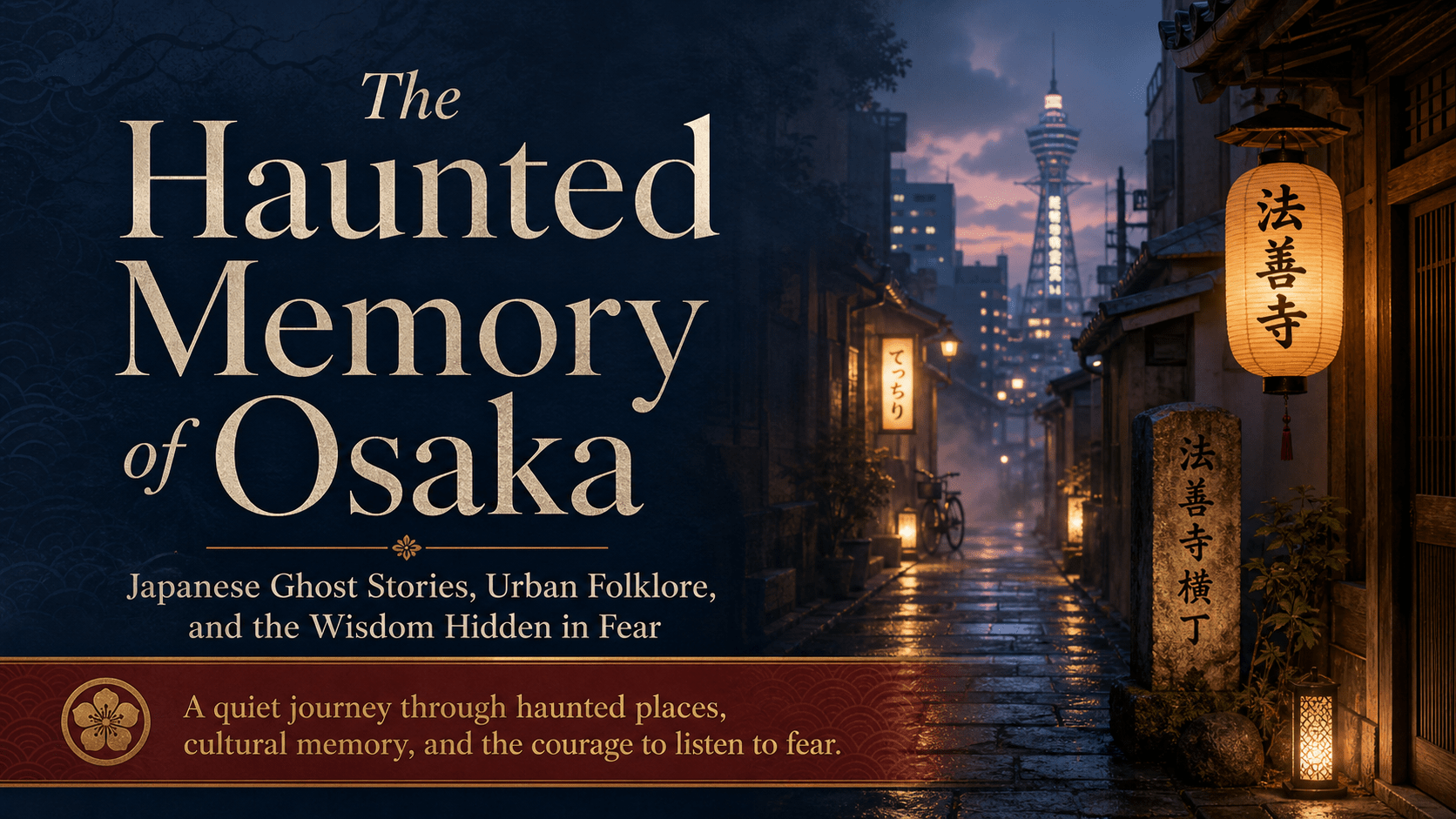
※This site uses affiliate advertising.Some ghost stories are not born from ancient castles or lonely mountain roads. Some are born in the middle of a city, beneath neon signs, train lines, department stores, and the ordinary footsteps of people going home.Osaka is often imagined as lively, humorous, and bright: a city of food stalls, comedy, shopping streets, and late-night lights. But like every old city, it has places where memory seems to gather more heavily. These are not simply “haunted spots” in the cheap sense of the word. They are places where tragedy, rumor, respect, and fear have become tangled together.Two stories from Osaka are often spoken of in this way: the former site of the Sennichi Department Store fire in Namba, and the so-called “Hanging Ruins” hidden in Shinsekai. One is connected to a documented disaster. The other belongs more to urban legend, rumor, and the uneasy silence of abandoned places.Taken only as horror, these stories may disturb us. But read more gently, they also reveal something deeper: how cities remember, how fear becomes folklore, and how human beings try to give meaning to places marked by suffering.Story Part One: The Sennichi Department Store Fire and the Voices Beneath NambaIn the busy Namba area of Osaka, there stands a large electronics store today. Shoppers pass through its doors, escalators carry people upward, and the city moves with its usual speed. Yet before this modern building, another structure stood on the same site: the Sennichi Department Store.From the late 1950s until the early 1970s, the building was a lively seven-story commercial space. There were shops, clothing floors, a game center, cafés, and on the top floor, a nightclub-like cabaret called Playtown. On the roof, there had even been amusement facilities. It was the kind of place that captured the energy of postwar urban Japan: busy, layered, crowded, and full of desire for modern entertainment.But on the night of May 13, 1972, that brightness changed.A fire broke out around 10:27 p.m. near the third floor. Reports and later accounts have discussed possible causes, including electrical work or an improperly extinguished cigarette or match; the precise origin has often been described with some uncertainty. What is clear is that the fire spread quickly through flammable materials. Smoke rose. The building’s safety problems became deadly. The site had no sprinkler system, and failures in evacuation routes and fire-prevention systems contributed to the disaster. The seventh-floor Playtown cabaret was still open, filled with customers and staff. The official record of the disaster is devastating: 118 people lost their lives.In the years afterward, the building was eventually demolished. A new department store opened there, and later, the site became the large electronics store known today. But according to urban legend, the story did not end with demolition.Employees and visitors have spoken, over the years, of strange announcements after closing time. Some stories describe voices over the loudspeakers warning of fire, though no fire existed. Others tell of elevators stopping at floors no one selected, the doors opening into a silence broken by distant cries for help. There are rumors of footsteps on stairways, women in kimono appearing near restrooms, and unseen hands pressing down on the shoulders of workers late at night.Some versions of the legend even say that when trains pass beneath the area, passengers have heard faint voices calling from somewhere below.Of course, these stories should not be treated as proven supernatural events. They are better understood as urban folklore: a way for the living to speak about a place where many people died suddenly, in fear and confusion. The ghost, in this sense, may not be only a spirit. It may be memory itself.In Japan, places of tragedy are often approached with a certain seriousness. People may leave flowers, pray, bow, or simply lower their voices. The act is not always religious in a formal sense. Sometimes it is a gesture of human respect. To remember is to say: what happened here still matters.Key Quote: A Proverb for Fear and Memory“Where there is shadow, there is also something asking to be remembered.”This is not an old proverb, but it carries the spirit of one. Fear often points toward something hidden: grief, guilt, uncertainty, or an unfinished story. A haunted place may frighten us, but it may also ask us not to look away too quickly.Story Part Two: The Hanging Ruins of ShinsekaiThe second story leads us away from the bright retail world of Namba and into the older atmosphere of Shinsekai.Shinsekai means “New World,” a name full of irony and history. Built as a modern entertainment district in the early twentieth century, it has long been associated with theaters, food stalls, cheap bars, glowing signs, and the famous Tsutenkaku Tower. It is not a forgotten village or a remote haunted forest. It is a living neighborhood.And yet, hidden in its alleyways, there is said to be a strange ruin.The place is commonly nicknamed Kubitsuri Haikyo, often translated as “the Hanging Ruins.” Kubitsuri means hanging by the neck, while haikyo refers to ruins or an abandoned place. The name is not official. It belongs to rumor, blogs, videos, and the kind of local storytelling that gathers around unsettling places.According to the stories, the ruin was once a four-story building, later damaged by fire until only a skeletal frame remained. After the fire, someone working nearby noticed something hanging from the remains of the structure. Police were reportedly called, and the object was said to have been a human body. In some tellings, shoes were found hanging nearby. Later, another hanging figure was discovered, then another. The details vary depending on who tells the story, and it is difficult to confirm every element. Some versions suggest suicide; others leave the possibility darker and more uncertain.What makes the place especially unsettling is not only the story, but the setting. Many abandoned buildings are far away, swallowed by mountains or countryside. This one, according to those who have visited, stands in the middle of the city, hidden in plain sight. Rusted metal, exposed stairways, and an unstable frame remain close to ordinary streets where people eat, drink, and walk home.That contrast gives the legend its power.A ruin in the wilderness feels separate from daily life. A ruin in the city suggests that darkness can stand beside us quietly while life continues around it. People may pass within a few meters without noticing. Laughter from a nearby bar may drift through the same air as a place associated with death.Some visitors have also mentioned a cat living around the ruin, almost like an accidental guardian. In folklore, cats often occupy the border between the ordinary and the uncanny. They move through alleys, rooftops, and thresholds. Whether or not one believes in omens, the image is memorable: a silent cat watching over a place that people approach with fear.The Hanging Ruins story is best handled carefully. It involves possible deaths, mental suffering, and urban rumor. It should not be treated as entertainment alone. If the tale has meaning, it may lie in the uncomfortable reminder that suffering can be close by, even in the busiest parts of a city, and that abandoned places often become mirrors for abandoned feelings.Cultural Insight: Ghosts, Place, and Respect in Japanese Urban FolkloreJapanese ghost stories often place great importance on location. A bridge, a tunnel, a stairway, a school, a hospital, a shrine, a train station—these are not just settings. They are containers of memory.In many Japanese traditions, the boundary between the living and the dead is not always imagined as completely sealed. This does not mean that every strange sound is treated as a ghost. Rather, it means that places associated with strong emotion may be approached with care. Grief, resentment, sudden death, and unfinished longing can become part of how a place is remembered.This is why urban legends often grow around sites of disaster. They give language to something difficult to process. A documented tragedy becomes surrounded by stories: voices, shadows, repeated warnings, elevators that stop on the wrong floor. These details may not prove the supernatural, but they reveal how people continue to feel the presence of the past.There is also a cultural lesson in the practice of paying respects. In Japan, even a small shrine, a quiet bow, or a moment of silence can express the idea that the dead should not be reduced to a spectacle. This matters especially when ghost stories are shared online. The more tragic the origin of a legend, the more carefully it should be told.Psychological Reflection: Why We Are Drawn to Scary StoriesWhy do people continue to tell stories like these?Perhaps because fear gives shape to what we cannot easily say. A ghost story lets us approach grief from a safe distance. It gives anxiety a face, memory a voice, and silence a setting.Urban legends are especially powerful because they live close to daily life. A haunted castle can feel like fantasy. A haunted elevator, restroom, stairwell, alley, or train line feels much nearer. It suggests that mystery is not far away. It may be folded into the ordinary.But the deeper purpose of such stories may not be to make us believe in ghosts. It may be to make us listen more carefully. When people say they hear voices in a building where many died, the story may be expressing a collective fear: the fear that suffering will be ignored, that the dead will become statistics, that tragedy will be paved over by commerce and routine.Folklore turns private unease into shared reflection. It allows a community to say, indirectly: something happened here, and we have not entirely forgotten.Life Lesson: Fear as a Form of AttentionOne way to read these Osaka ghost stories is not as proof of spirits, but as lessons in attention.Fear is not always an enemy. Sometimes fear is the mind’s way of saying: slow down. Notice where you are. Notice what happened before you arrived. Notice the pain that may be hidden beneath the surface of ordinary life.In modern life, we often move quickly. Buildings are demolished, businesses change, streets are renamed, and new lights cover old shadows. But memory does not always disappear at the same speed as architecture.These stories may remind us that respect is a form of wisdom. To stand in a place of tragedy without mockery, to speak of the dead without turning them into entertainment, to recognize that every city is built not only from concrete and glass but also from memory—these are quiet acts of maturity.The lesson is not simply “do not enter haunted places.” It is gentler than that.It may be this: when fear appears, ask what it is protecting. Sometimes fear guards a wound. Sometimes it guards a truth. Sometimes it guards the memory of people who should not be forgotten.Reader Reflection: The Question the Story Leaves BehindWhen an old story frightens you, what might it be asking you to remember?Perhaps the real mystery is not whether a ghost appeared in the dark. Perhaps the real mystery is why certain places continue to speak to us, long after the city has tried to move on.Key Proverb, Quote, or Affirmation Used“Where there is shadow, there is also something asking to be remembered.”Cultural Insight SummaryJapanese urban ghost stories often treat places as containers of memory. A haunted building, stairway, tunnel, or train line may symbolize grief, unfinished emotion, or collective unease. In stories connected to real tragedies, respect matters: the dead should not be reduced to entertainment.Psychological / Philosophical Reflection SummaryWe are drawn to scary stories because they give form to nameless anxiety. A ghost story allows people to approach grief, uncertainty, and memory from a safe distance. Rather than proving the supernatural, such stories often reveal how communities live with unresolved pain.Life Lesson SummaryThis story may remind us that fear is sometimes a form of attention. It asks us to slow down, respect what came before us, and listen to what ordinary places may be quietly carrying.Reader Reflection QuestionWhat fear in your own life might be asking to be understood rather than avoided?