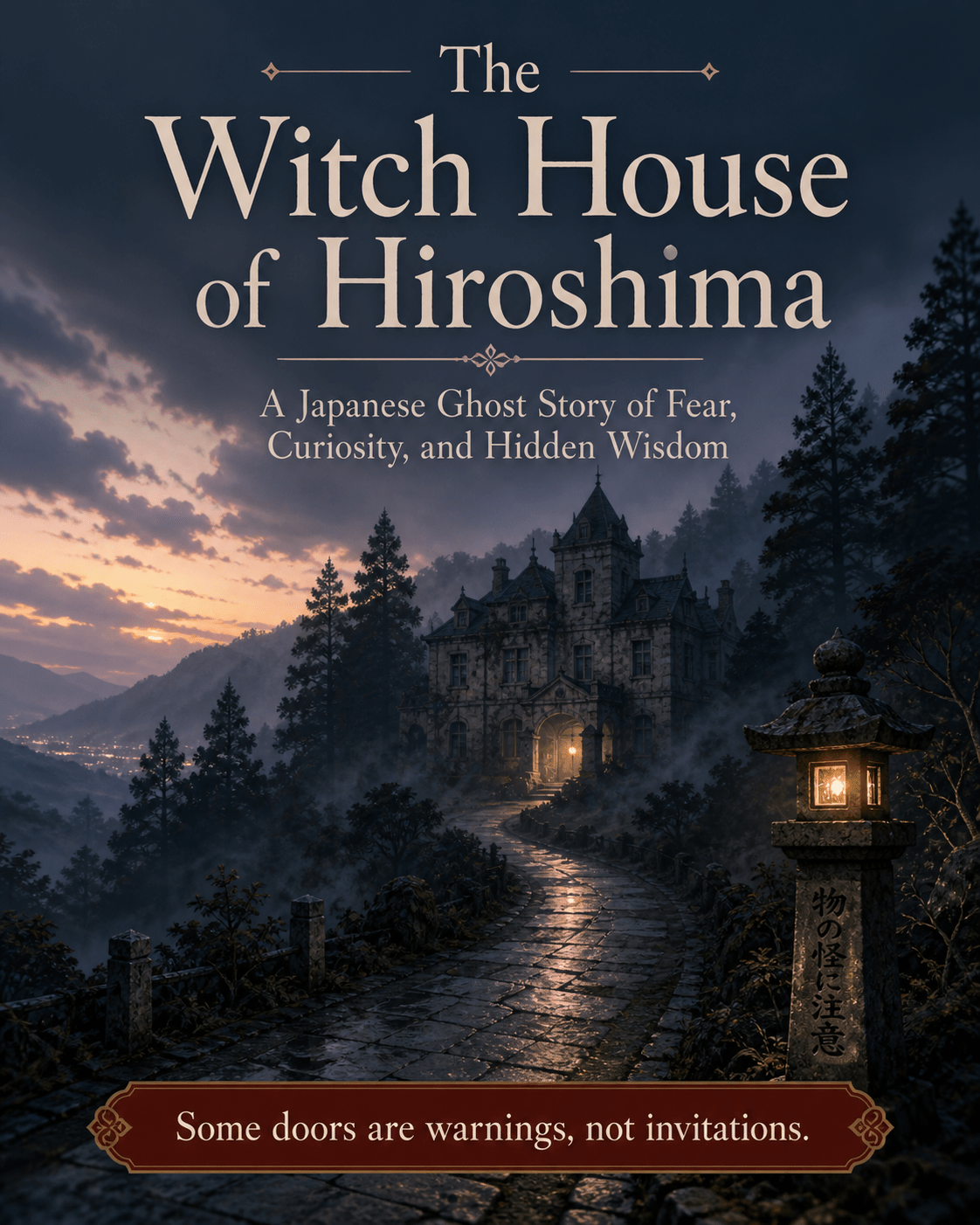
※This site uses affiliate advertising.A House That Became a WarningIn the mountains of Hiroshima, there is said to be an abandoned mansion known among certain urban legend circles as the Witch House. The tale is often told as a warning: women, especially young women, should never enter after dark. Some versions speak of sudden illness, strange heat in the body, cameras filled with static, and the feeling of being watched from the upper windows.Whether taken as folklore, urban legend, or a symbolic story about fear and curiosity, the Witch House of Hiroshima is more than a simple haunted-house tale. It belongs to a long tradition of stories in which a place remembers pain, silence becomes dangerous, and curiosity asks for a price.This article retells the legend not as proven fact, but as a mysterious Japanese ghost story with cultural meaning: a strange tale about abandoned places, the wisdom of old warnings, and the courage to listen when fear speaks quietly.The Road to the Witch HouseHannah did not believe in haunted places.She believed in roads, engines, camera lenses, and the stubborn clarity of daylight. She was a photography student, the kind of person who trusted what could be framed, measured, exposed, and developed. If a shadow looked like a face, it was only because the brain loved patterns. If a house had a reputation, it was because people enjoyed frightening one another.Sakura was different.She was an urban explorer who carried digital thermometers, spare batteries, motion sensors, and a camera small enough to fit into the palm of her hand. She spoke of abandoned hotels, closed tunnels, forgotten schools, and old mountain resorts as if they were not dead places, but sleeping witnesses. She did not say she believed every rumor. She only believed that stories clung to certain places for a reason.For weeks, Sakura had been reading posts on Japanese forums about a ruined mansion somewhere near Mount Noro in Hiroshima. The name appeared in fragments: Majo no Yakata, the Witch House. Some called it an abandoned resort. Others described it as a stone mansion hidden in the forest, with a spiral staircase, broken windows, and rooms that felt warmer than they should.The strangest warning appeared again and again:Women should not enter.No one explained it the same way twice. One post claimed that female visitors often became sick after returning home. Another mentioned a fever that came without infection. Another said that cameras failed on the third floor, as if the house itself rejected being seen. The more extreme versions spoke of a woman who had once lived there in isolation, betrayed and forgotten, until her bitterness became something that remained in the walls.Hannah laughed when Sakura read the posts aloud.“So the building hates women?” she said, turning her car keys around her finger. “That is not folklore. That is bad architecture and worse Wi-Fi.”Sakura smiled, but not fully. “Then prove it.”That was how they ended up on the mountain road after sunset.The city lights of Hiroshima slowly fell behind them. At first, there were vending machines, guardrails, and the ordinary reassurance of asphalt. Then the road narrowed. Trees leaned over the car, their branches scraping the roof with a dry, bony sound. The GPS cursor spun in circles on the dashboard, briefly placing them inside the mountain itself.“Signal error,” Hannah said.Sakura lifted her camera. “Say that again for the intro.”“No.”The air changed as they climbed. It became dense, almost metallic, as if every breath carried the taste of old coins. Sakura lowered the window, expecting cold mountain air, but what entered the car was still and dry. Even the forest seemed to be holding its breath.Then the house appeared.It stood beyond the tall grass like a dark crown on the hill. The stone walls were uneven and wet-looking in the beam of the headlights. The windows were broken, but not empty. They seemed too dark, too deep, like eyes that had been open for a very long time.Hannah turned off the engine.For a moment neither of them moved.The sudden silence was not peaceful. It was the kind of silence that makes a person aware of the blood moving in their own ears.Sakura whispered, “We film the entrance, the main hall, the staircase, the third floor. Then we leave.”“Fast,” Hannah said.“Fast.”They stepped into the grass.Inside the MansionThe front door was broken inward, as if the house had once swallowed its own entrance.Inside, the air was warmer.That was the first thing Hannah noticed, though she said nothing. Outside, the night had been cool enough to raise gooseflesh on her arms. In the hallway, the heat pressed against her skin like breath. The smell was old wood, damp stone, dust, and something coppery underneath.Sakura swept her flashlight over the walls.The wallpaper had peeled away in long strips. Black marks covered the plaster. Some were ordinary graffiti: names, dates, warnings left by other visitors. But one word appeared several times, written in rushed, uneven strokes.RUN.“People really commit to the atmosphere,” Hannah said.But her voice sounded smaller than she intended.They moved through the main hall. The floorboards complained beneath them. Every step produced a hollow creak that seemed to travel ahead into unseen rooms. Somewhere above, the house gave a sudden thud.Both women froze.“Wood settling,” Hannah said.Sakura did not answer.In one side room, they found a billiard table under a coat of dust. Its green cloth had been torn open, and the dark wooden frame looked strangely polished, as though touched often by invisible hands. Sakura placed her palm near it and pulled back.“It’s warm.”“Don’t start,” Hannah said.“I’m not starting anything. It’s warm.”The camera battery dropped from 74 percent to 58.Sakura held it up. “That is not normal.”“Batteries hate cold.”“It’s not cold.”That was true. The room was becoming hotter, though the air itself remained still. Hannah felt sweat gathering at the back of her neck. She told herself it was fear. Fear changed the body. Fear could make a person tremble, sweat, see shapes where there were none.Then she saw the shape.At the far end of the billiard room, just beyond the reach of the flashlight, stood a tall woman.Not clearly. Not fully. More like a person remembered incorrectly by the dark. Long arms. Narrow shoulders. A head slightly lowered, as if listening.Hannah swung the light toward her.Nothing.Only rotten curtains, a broken chair, and strips of wallpaper moving in a draft neither of them could feel.Sakura whispered, “Did you see that?”“No,” Hannah said too quickly.They left the room.The spiral staircase waited in the center of the mansion.It rose through the building like a coiled spine. The wood was dark, narrow, and damp-looking. The handrail curved upward into a darkness that seemed thicker than the rest of the house.In Japanese haunted-place legends, staircases often serve as thresholds. They are not simply architecture; they are transitions. A person moves from the everyday world into a space where ordinary rules begin to weaken. The staircase in the Witch House carried that feeling strongly. At its base, the two friends stood as if before a decision neither wanted to name.Sakura lifted the camera.“We go up,” she said.Hannah wanted to say no.Instead, she put her foot on the first step.The Third FloorHalfway up the staircase, the metallic taste returned.Hannah swallowed hard. Her ears felt full of pressure, as if she were underwater. Sakura’s breathing grew loud behind her, too quick and uneven for the small space.“Are you okay?” Hannah asked.“I’m fine.”The answer was automatic, not true.On the second-floor landing, the hallway stretched left and right. Guest rooms lined the corridor, their doors closed. On the dusty floor, bare footprints led away into the dark.Hannah stared at them.“Other explorers,” she said.But the footprints looked fresh.From behind one door came a soft scratching sound.Once.Then again.Then faster, like fingernails testing the wood.Sakura’s camera light flickered. “We should not open that.”“For once,” Hannah whispered, “we agree.”They climbed higher.The final curve of the staircase was tighter than the rest. Hannah felt the walls leaning inward. Her skin burned beneath her clothes. When she touched her own forehead, her fingers recoiled. She was feverish, suddenly and impossibly hot.Sakura checked a small thermometer. “It says twenty degrees Celsius.”“That thing is broken.”“Maybe.”But neither of them believed it.At the top of the stairs, the third floor waited in a silence so complete it felt deliberate.The hallway was narrower than below. The ceiling sagged in places. A mirror hung at an angle on one wall, its surface dark with age. Hannah refused to look into it directly. Some instinct, older than reason, told her that mirrors in abandoned places should be treated like water at night: beautiful, reflective, and not always empty.A sigh came from the end of the corridor.A woman’s sigh.Not loud. Not theatrical. Only tired.That made it worse.Sakura lifted the camera with both hands. The screen filled with interference. Gray lines bent across the image. For a moment, nothing appeared except static.Then Hannah saw herself on the screen.She was standing in the hallway, pale in the camera light, sweat on her face.Behind her, inches from her shoulder, stood the tall woman.This time there was no mistaking her.Her arms were too long. Her hands hung near the floorboards. Her face was narrow and almost white, with dark eyes that seemed not to reflect the light at all. Her mouth was open, but no sound came from it.Hannah turned.The figure was there.The house seemed to inhale.Sakura screamed.The spell broke.They ran.Down the spiral staircase, every step became a threat. The wood bent beneath them. Something moved above their heads with a rapid scratching sound, keeping pace with their descent. The staircase felt longer than before, as if the house were unfolding more steps in the dark.Hannah slipped once. Sakura caught her arm.Neither of them spoke.There are moments when language becomes too slow for survival.They reached the main hall. The word RUN flashed past them on the wall, no longer ridiculous. Outside, the broken doorway opened into moonlit grass. The forest looked less like safety than distance, but distance was enough.They burst through the entrance.The cold air struck Hannah’s fevered skin like water. She dropped the car keys in the grass, found them with shaking hands, and forced them into the lock.Before getting in, Sakura looked back.The third-floor window was not empty.A pale face watched from behind the broken glass.Then the car doors slammed shut.The engine failed once. Twice.On the third try, it roared alive.They drove down the mountain without looking in the rearview mirror.After the MountainBy the time the city lights returned, Hannah’s anger had vanished.Fear had taken its place, but not the sharp fear of running. This was slower. Heavier. It sat in the car between them with the smell of copper and dust.Sakura said nothing.At the apartment, Hannah tried to make tea. Her hands shook so badly that water spilled across the counter. Sakura sat on the floor with the camera in front of her, refusing to touch it.“We should delete everything,” Hannah said.Sakura did not answer.That night, Hannah developed a fever.At first, she blamed shock, exhaustion, and the cold air of the mountain. But the heat rose quickly. By morning, her skin was flushed deep red, and her breathing had become shallow. Sakura called emergency services in a voice she did not recognize as her own.At the hospital in Hiroshima, doctors treated the fever seriously, but according to the legend, they could not find an ordinary cause. The body burned, yet the usual explanations did not settle around it. Sakura waited under fluorescent lights, replaying the night in fragments: the staircase, the sigh, the camera screen, the long white hands.Finally, she opened the camera.Most of the files were damaged. Static covered the images. Hallways bent into gray lines. The third floor appeared as dark blocks and digital snow.Then one photograph loaded.Sakura did not remember taking it.In the image, Hannah stood in the hallway with her back to the camera. Behind her, the figure leaned close, its pale hands resting on her shoulders, as though borrowing her warmth.Sakura deleted the file.Then she deleted it again from the trash folder.Still, the image remained in her mind.Some versions of the tale say a local spiritual practitioner was called. In Japanese culture, such figures may be described in many ways depending on region and tradition: mediums, shrine-associated practitioners, or people believed to understand purification rituals. The story does not need us to prove the ritual. What matters is how the legend frames the problem: not simply as sickness, but as contact with something that should not have been invited.In the tale, Hannah survived.But survival did not mean returning unchanged.The fever broke, but her body remained strangely cold afterward. She no longer spoke easily about the mountain. Sakura destroyed the camera. They removed the videos, posts, and notes. Yet whenever new visitors discussed the Witch House online, Sakura felt the urge to warn them—and the fear that warning them might call the place back into her life.The house, the story says, remains on the mountain.Whether anyone believes the legend or not, the warning remains:Some doors are not locked to keep us out because they are empty.Some doors are warnings because something inside is still waiting to be noticed.Key Quote / Proverb / Affirmation“Not every fear is a wall. Sometimes fear is a lantern, asking us to look more carefully before we step forward.”This is not an old proverb, but an original affirmation inspired by the tale. It reframes fear not as weakness, but as a form of attention.Cultural Insight: Why the House MattersJapanese ghost stories often give emotional weight to places. A house, bridge, tunnel, staircase, or well may become more than a setting; it becomes a container of memory. In many tales, what is frightening is not only the ghost itself, but the feeling that a place has absorbed grief, resentment, loneliness, or silence.The Witch House legend also reflects a familiar pattern in urban folklore: the abandoned place as a threshold. Such places exist between public and private, past and present, safety and danger. They invite curiosity because they appear empty. Yet the story warns that emptiness can be deceptive.The warning that “women must not enter” should be handled carefully. It should not be read as a literal cultural rule, nor as a claim about actual danger based on gender. In the logic of folklore, such a taboo often marks vulnerability, social fear, or unresolved pain. The “witch” may symbolize a woman abandoned by society, a fear of female suffering, or the way old stories transform private grief into public warning.Psychological and Philosophical ReflectionWhy are we drawn to stories like this?Perhaps because frightening stories give shape to anxieties we cannot easily name. A ruined house is easier to imagine than the invisible pressures we carry in daily life. A ghost on the staircase is easier to picture than guilt, loneliness, curiosity, or the fear that we have gone too far.The Witch House story also speaks to the psychology of forbidden places. When someone says, “Do not enter,” the human mind often leans closer. We want to know whether the warning is superstition, control, wisdom, or fear. In that sense, the true haunting may begin before anyone reaches the door. It begins in the mind, in the small voice that says, “I know better.”Rather than proving the supernatural, the tale reveals something quieter: people do not only fear darkness. They fear discovering that their confidence was not courage, but carelessness.Life Lesson: Listening Before Crossing the ThresholdOne way to read this tale is as a quiet reminder about thresholds.A threshold is not only a doorway. It may be a conversation we are afraid to have, a decision we are rushing into, a relationship that feels wrong, or a risk we take because we do not want to appear afraid. Modern life is full of invisible Witch Houses: situations that look interesting from a distance, but ask us to ignore our discomfort in order to enter.The lesson is not that curiosity is bad. Curiosity is one of the roots of wisdom. But curiosity without humility can become a form of hunger. It wants proof more than understanding. It wants the image, the story, the thrill, the content.The old warning in this tale may be read gently:Pause before you enter.Listen before you dismiss fear.Respect the places, people, and memories you do not yet understand.Sometimes courage means stepping forward.Sometimes courage means turning back before the door closes behind you.Reader ReflectionWhat fear in your own life might not be trying to stop you, but trying to make you look more carefully?Key Proverb, Quote, or Affirmation Used“Not every fear is a wall. Sometimes fear is a lantern, asking us to look more carefully before we step forward.”Cultural Insight SummaryThis story can be understood as a Japanese urban legend about place, memory, taboo, and abandoned spaces. The mansion functions as a symbolic threshold: a place where curiosity meets warning. The “witch” may represent unresolved grief, social isolation, or the fear that forgotten suffering can remain attached to a place.Psychological / Philosophical Reflection SummaryWe are drawn to scary stories because they make invisible anxiety visible. The Witch House legend reflects the human desire to test warnings, especially when pride disguises itself as courage. The deeper fear is not only the ghost, but the realization that we ignored our own intuition.Life Lesson SummaryThis tale may remind us to pause before crossing thresholds. Curiosity is valuable, but it needs humility. Fear is not always an enemy; sometimes it is a signal asking us to slow down, observe, and respect what we do not yet understand.Reader Reflection QuestionWhat fear in your own life might not be trying to stop you, but trying to make you look more carefully?