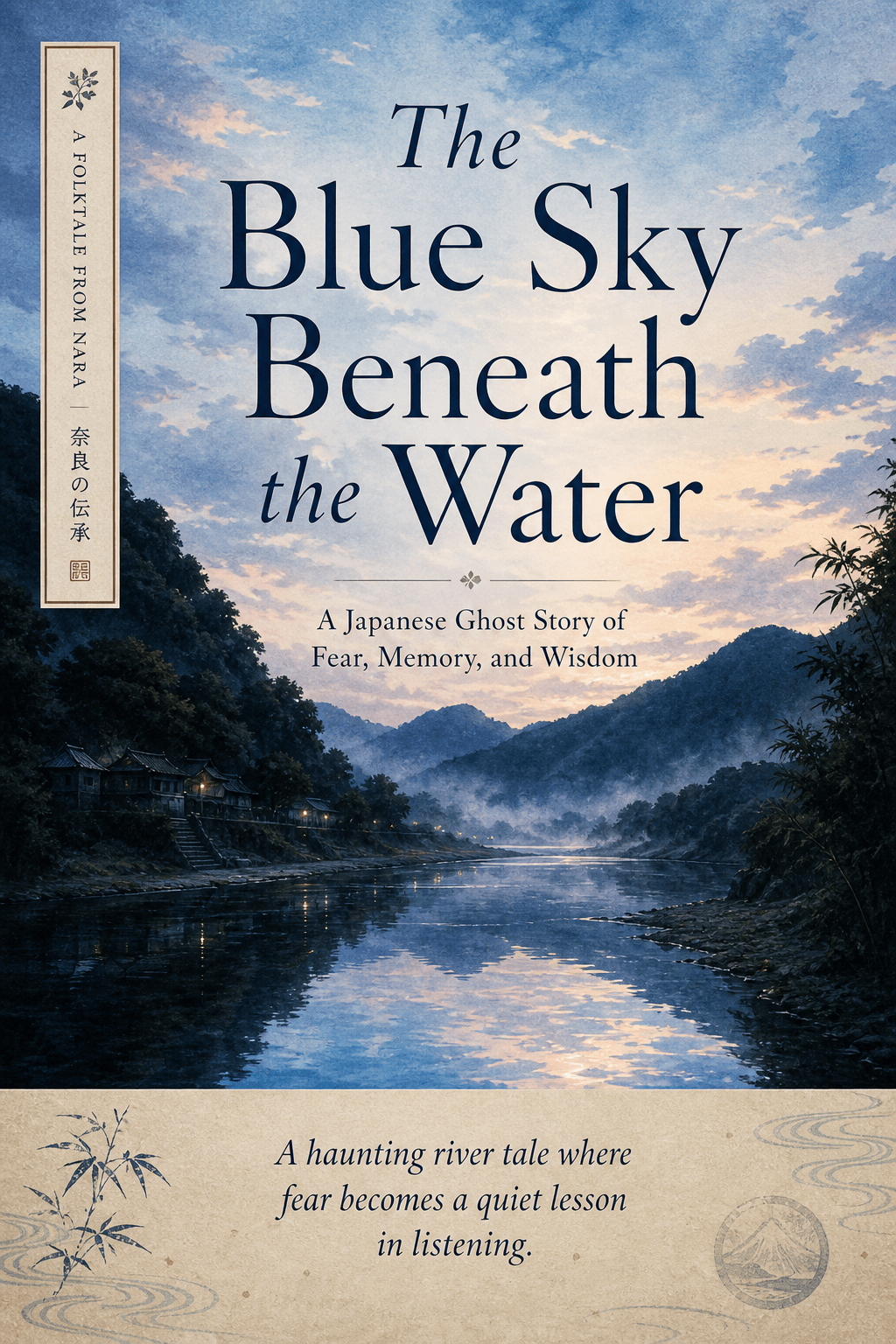
※This site uses affiliate advertising.In the mountains of Nara Prefecture, the Yoshino River has long carried more than water. It carries family visits, summer heat, childhood play, and, in stories like this one, the uneasy silence that comes after a narrow escape.This strange tale is often told as a personal memory rather than a formal folktale: a boy goes camping with his family near the Yoshino River, nearly drowns in a calm-looking section of water, and later learns that another child drowned in the same place around the same time. The story does not prove the supernatural, nor should it be treated as a confirmed ghost account. But as mysterious folklore, it speaks powerfully about fear, coincidence, grief, and the way a single image—the blue sky above the water—can remain in the heart for a lifetime.The original account describes a family camping trip to Yoshino, a calm-looking pool formed along the river, the narrator’s sudden loss of strength while swimming, and the later discovery that another child had drowned there during a summer camp. The narrator’s family wonders whether it was coincidence, a physical shock caused by the river’s currents and temperature differences, or something more mysterious.The Blue Sky Beneath the WaterIt happened during the summer of his fifth-grade year, in that bright and careless season when childhood still feels larger than the world itself.His mother’s family lived in Yoshino, a mountainous part of Nara Prefecture known for its old roads, temple histories, and cherry blossoms that draw visitors in spring. But to a child, Yoshino was not a place of history. It was where relatives lived. It was where adults spoke in familiar dialects, where the air smelled different from the city, and where summer seemed to stretch across mountains, rivers, and cicada song.Usually, when the family visited, they stayed at his mother’s parents’ house. There would be meals prepared by his grandmother, newspapers opened by his grandfather, relatives dropping by, and the quiet boredom that sometimes comes with being a child in an adult household.But that year, someone suggested something different.They would bring camping gear.Instead of simply staying at the grandparents’ house, they would set up a tent near the Yoshino River and spend the day outdoors. For the boy, the idea felt exciting in the way only small departures from routine can feel exciting. It was not a grand adventure, but it was enough. A tent. A river. A swimsuit packed into a bag. The promise of sleeping outside, or at least pretending the familiar world had become wild for a little while.They left in the morning.The roads into Yoshino wound through green slopes and narrow valleys. The mountains seemed to fold over one another, and the river appeared and disappeared between trees, flashing silver in the sun. The boy watched from the car window as the landscape changed. The farther they went, the more the air seemed to loosen. Houses became fewer. The sky widened. The ordinary noises of daily life were replaced by the dull rush of water and the cries of insects.The Yoshino River was beautiful, but it was not gentle.Even as a child, he understood that much. In many places, the current ran too quickly for swimming. The water struck rocks with a force that made it look alive. Adults always warned children about rivers in a tone different from the tone they used for pools. A pool could be deep, but it was still a place made by people. A river had its own will. It moved according to mountain rain, stone, depth, and hidden channels no child could see.Yet the place near the campground looked different.There, the river seemed to pause.A section of water had been slowed, as if gathered into a broad natural basin. Whether by a low barrier, the shape of the bank, or the meeting of currents, the surface was calm enough that families had come to play. To the boy, it looked almost like a pool made by nature. It was wide—perhaps half the size of a school auditorium—and at first glance there was little current. The water reflected the summer sky, trembling only when someone swam through it.Other people were already there.A group of older children, perhaps middle school students on a summer camp trip, had gathered near the bank. Their voices carried over the water. Someone laughed. Someone shouted. Adults stood nearby, keeping watch in that half-alert, half-relaxed way adults do when many children are playing at once. From a distance, everything looked ordinary. Bright towels. Plastic sandals. Bags set down on stones. The hot smell of riverbank grass. The glitter of sunlight on water.The boy’s family chose a place to set up their tent.The adults worked with poles, ropes, and canvas while the boy waited impatiently. The whole day seemed to be leaning toward the water. Once the tent was standing, he changed into his swimsuit. The fabric clung coolly to his skin. He could feel the heat of the ground under his feet as he made his way toward the river.At the edge, he hesitated only for a moment.Then he went in.The water was colder than he expected.That is often how rivers are. On the surface, under summer light, they seem warm, almost inviting. But once the body enters, the cold reaches up from below. It wraps around the legs first, then the waist, then the chest. The boy drew in his breath and laughed, because that was what children did when cold water surprised them. Around him, other children were splashing and calling out.The bottom dropped away quickly.The water was said to be around two meters deep. Deep enough that he could not stand. Deep enough that, once away from the bank, he had to keep moving. But he could swim. There was no reason to be afraid. Not at first.He paddled out into the stiller part of the water.The world from the surface looked simple and complete: the river around him, the bank behind him, the voices of his family somewhere nearby, the mountains holding the scene like a bowl. Above everything was the sky—wide, cloudless, almost painfully blue.He swam for a while.There was no warning.No hand closed around his ankle. No voice called his name from beneath the water. No dark shape rose from below. The strange thing about the moment was precisely that it did not arrive like a scene from a ghost story. It came quietly, almost politely, as if something had simply removed him from the day.He looked up at the sky.That was the image that remained.Blue.An ordinary summer blue. The kind of blue that should have meant safety, vacation, childhood, and warmth. But as he floated there, the sky began to feel far away. The voices around him thinned. The laughter of the middle school students faded as if carried down a long corridor. The brightness did not disappear, but it lost its comfort.His body stopped obeying him.At first, he did not understand what was happening. He knew he should move his arms. He knew he should kick. The instructions were still there in his mind, simple and familiar. But between thought and movement, something had opened. His limbs felt heavy, not with pain, but with a terrible softness. His strength was leaving him without drama.Then he began to sink.The surface rose above his face.For a moment, he must have seen the world broken by water: sky wavering into pieces, sunlight scattering, shapes bending at the edge of vision. Perhaps he tried to inhale and could not. Perhaps he did not even have time to panic properly. Memory often fails at the edge of danger. It preserves the image but not the sequence, the feeling but not the mechanics.What he remembered was not a struggle.He remembered the stillness.He remembered the sensation of being separated from everyone else by only a little water—and yet by an immeasurable distance. His family was nearby. Other children were nearby. The bank was not far. The day was ordinary. And still, he was sinking out of it.Then his father saw him.There are moments in families when thought disappears and the body acts first. His father jumped into the water and reached him before the river could take him completely. The boy was pulled upward, back toward air, sound, and the rough solidity of the human world.He survived.On the bank, there must have been confusion. Wet hands. Alarmed voices. Someone asking whether he had swallowed water. Someone telling him to sit still. Someone trying to decide whether the danger had passed. The boy himself could not explain what had happened. He had not been playing recklessly. He had not felt sick. He had not gone far beyond his ability.It had simply happened.That night, inside the tent, the air was close and heavy. The excitement of camping had changed. The canvas walls no longer felt adventurous; they felt thin. Outside, the river continued to move in the darkness, making the same sound it had made before, indifferent to what had nearly occurred.His family asked him again.“What happened to you?”“You don’t have a weak heart.”“Did you swallow water?”“Did your legs cramp?”He could only answer honestly.He did not know.It had been the first time in his life he had felt anything like it. Not exactly dizziness. Not exactly fear. Not exactly sleepiness. A strange feeling, he said. Something had come over him. Something had carried him away from himself.The adults decided they should not continue there. Perhaps it was caution. Perhaps discomfort. Perhaps no one wanted to say aloud that the place no longer felt innocent. The family packed up, moved away from the campground, and eventually returned to the grandparents’ house.There, ordinary life received them as if nothing had happened.His grandmother greeted them with the familiar warmth of someone welcoming tired travelers.“You must be exhausted,” she said.The house smelled of tatami, tea, and evening. After the glare of the river, the shaded rooms felt calm. The boy may have felt safer there, surrounded by family objects, sliding doors, low voices, and the comforting habits of older people.His grandfather was reading the local newspaper.He turned a page. Then, in the casual tone people use before realizing the weight of their own words, he said that a child had drowned at a campground.The words entered the room slowly.At first, perhaps no one understood.Then his grandmother reacted. Someone asked where. Someone asked when. The newspaper was read more carefully.A child attending a summer camp had drowned while playing in the river. The child had not been noticed at once. The body was found the next morning.The place named in the article was the same campground.The water was the same water.The time was the same day.The boy, who had been pulled from the river by his father, listened as the ordinary room became strange around him. The house did not change, and yet everything in it seemed to lean toward the newspaper. The tatami. The low table. His grandfather’s hands. His grandmother’s voice. The memory of the blue sky returned—not as scenery now, but as evidence of something he could not explain.Someone in the family tried to make the fear lighter.“Maybe your legs were pulled,” they said, half joking, half not.It was the kind of remark often made in Japanese family conversations around strange events: playful on the surface, but carrying an old uneasiness underneath. A way to speak of ghosts without fully speaking of ghosts.His grandfather offered a more practical explanation.That part of the river, he said, had several flows entering it. When different streams meet, the water can vary in temperature. A sudden difference in coldness, or a hidden current, might shock a person’s body. Perhaps that was what had happened. Perhaps there was no mystery at all.This explanation was reasonable.In fact, it may have been the truest one.Rivers can be dangerous even when they appear calm. Still water can hide movement. A child can lose strength suddenly. A body can react before the mind understands. The story does not need a ghost in order to be frightening.And yet, reason did not erase the other thought.What if, beneath the same blue sky, another child had been sinking too?What if, while the boy was being pulled upward, someone else nearby was already beyond help?What if the strange feeling that came over him had not been a message, not a curse, not a haunting, but the terrible nearness of another person’s final moment?The family eventually stopped talking about it. That is how many unsettling things pass through a household. They are discussed intensely for a short time, then folded into dinner, chores, fatigue, and sleep. Adults move on because they must. Children appear to move on because they do not yet know how to hold such things openly.But memory has its own way of keeping what conversation leaves behind.Years passed.The boy grew older. The campground became a place in the past. The faces of the people there blurred. The exact arrangement of the tent, the voices on the bank, the newspaper in his grandfather’s hands—all of it softened with time.But the sky remained.Whenever he remembered that day, he did not first remember water filling his mouth or the panic of drowning. He remembered looking upward. He remembered a blue so clear it felt almost empty. He remembered how beauty, for one suspended moment, had become lonely.The thought that stayed with him was not simply, “I almost died.”It was this:Did the other child see the same sky?A child who had come to the river for summer camp. A child who may have laughed with friends that morning, changed into a swimsuit, stepped into cold water, and looked up at the same blue expanse. A child whose final view of the world may not have been darkness, but light.That is why the story lingers.Not because it proves that the dead reach for the living.Not because it tells us that every river hides a spirit.But because it reminds us that mystery sometimes enters life through coincidence, and that coincidence can feel as heavy as fate.The Yoshino River continued to flow after that day. Families still visited. Summer still returned. The sky was still blue.But for the narrator, that blue had changed forever.It had become the color of survival.And perhaps, somewhere in the quiet chamber of memory, the color of another child’s farewell.Key Quote / Proverb / Affirmation“Fear is not always a warning to run; sometimes it is an invitation to listen.”This is not a traditional proverb, but an original affirmation shaped for this story. It reflects the idea that fear, when approached carefully, may reveal memory, grief, danger, or truth.Cultural Insight: Water, Memory, and the Japanese Sense of PlaceIn Japanese folklore, water is often more than scenery. Rivers, wells, ponds, waterfalls, and shorelines frequently appear as thresholds—places where the ordinary world touches something unknown. This does not mean every water-related story is “about spirits” in a literal sense. Rather, water often becomes a symbol of transition: between life and death, childhood and adulthood, safety and danger, memory and forgetting.The Yoshino River also carries cultural weight. Yoshino is associated with mountains, old roads, temples, cherry blossoms, imperial history, and spiritual retreat. For an English-speaking reader, it may help to understand that many Japanese ghost stories are not built around loud shocks or monsters. They often arise from place: a bend in a river, an abandoned house, a mountain path, a family memory, a silence no one can explain.This tale also reflects a common pattern in Japanese strange stories: the supernatural is suggested but not proven. One family member offers a ghostly interpretation—perhaps the drowned child pulled at the boy’s legs. Another offers a natural explanation—currents and water temperature may have affected the body. The story lives in the space between those explanations.That uncertainty is part of its power.Psychological / Philosophical Reflection: Why the Story Stays With UsWe are drawn to frightening stories because they give shape to feelings we cannot easily name. The fear in this tale is not only fear of drowning. It is the fear of almost crossing a line without understanding why. It is the fear of learning, afterward, that someone else did cross that line.The most haunting image is not a hand from beneath the water. It is the blue sky.That detail changes the story. A monster can be dismissed. A ghost can be doubted. But the sky is real. Everyone has looked up at the sky in childhood. Everyone knows how beauty can become unsettling when attached to loss.One possible interpretation is that the narrator’s memory became fused with the unknown child’s fate. The near-death experience, the newspaper report, the family’s uneasy conversation, and the image of the sky all became one emotional truth: life is fragile, and sometimes we survive without knowing why another person did not.Folklore often turns private fear into shared wisdom. It gives us a way to speak about danger without reducing it to statistics, and grief without reducing it to explanation.Life Lesson: Listening to Fear Without Being Ruled by ItThis story may remind us that fear is not always foolish. Sometimes fear is the body remembering danger before the mind can explain it. Sometimes fear is a sign that we should pause, look again, and respect what we do not fully understand.In modern life, we often try to dismiss discomfort quickly. We explain it away. We laugh it off. We say, “It was probably nothing.” And often, it is nothing. But the wisdom of old stories suggests another possibility: even when fear does not reveal a ghost, it may reveal a boundary.A river can be beautiful and dangerous.A memory can be frightening and meaningful.A coincidence can be only a coincidence—and still deserve silence.The lesson is not to become superstitious. It is to become attentive. To respect water. To respect place. To respect the quiet instincts that sometimes rise before words.Reader ReflectionWhen you remember a frightening moment from your own life, what remains most clearly: the danger itself, or one small detail—the light, the sound, the sky—that made the moment unforgettable?Key Proverb, Quote, or Affirmation Used“Fear is not always a warning to run; sometimes it is an invitation to listen.”Cultural Insight SummaryThis story connects with Japanese folklore through the symbolism of water as a threshold. Rivers in Japanese strange tales often represent the boundary between safety and danger, life and death, memory and forgetting. The Yoshino setting adds cultural depth because Nara and Yoshino carry associations with mountains, temples, old roads, and spiritual atmosphere.Psychological / Philosophical Reflection SummaryThe fear in this tale comes not only from the possibility of a ghost, but from the awareness that life can change in a moment. The blue sky becomes a symbol of beauty touched by loss. The story gives shape to survivor’s unease, childhood memory, and the human need to find meaning in coincidence.Life Lesson SummaryThe story may remind us to respect fear without being controlled by it. Fear can sometimes be a signal to slow down, notice hidden risks, and listen to the quiet instincts we often ignore. The lesson is not superstition, but attentiveness.Reader Reflection QuestionWhat fear in your own life might be asking to be understood rather than avoided?