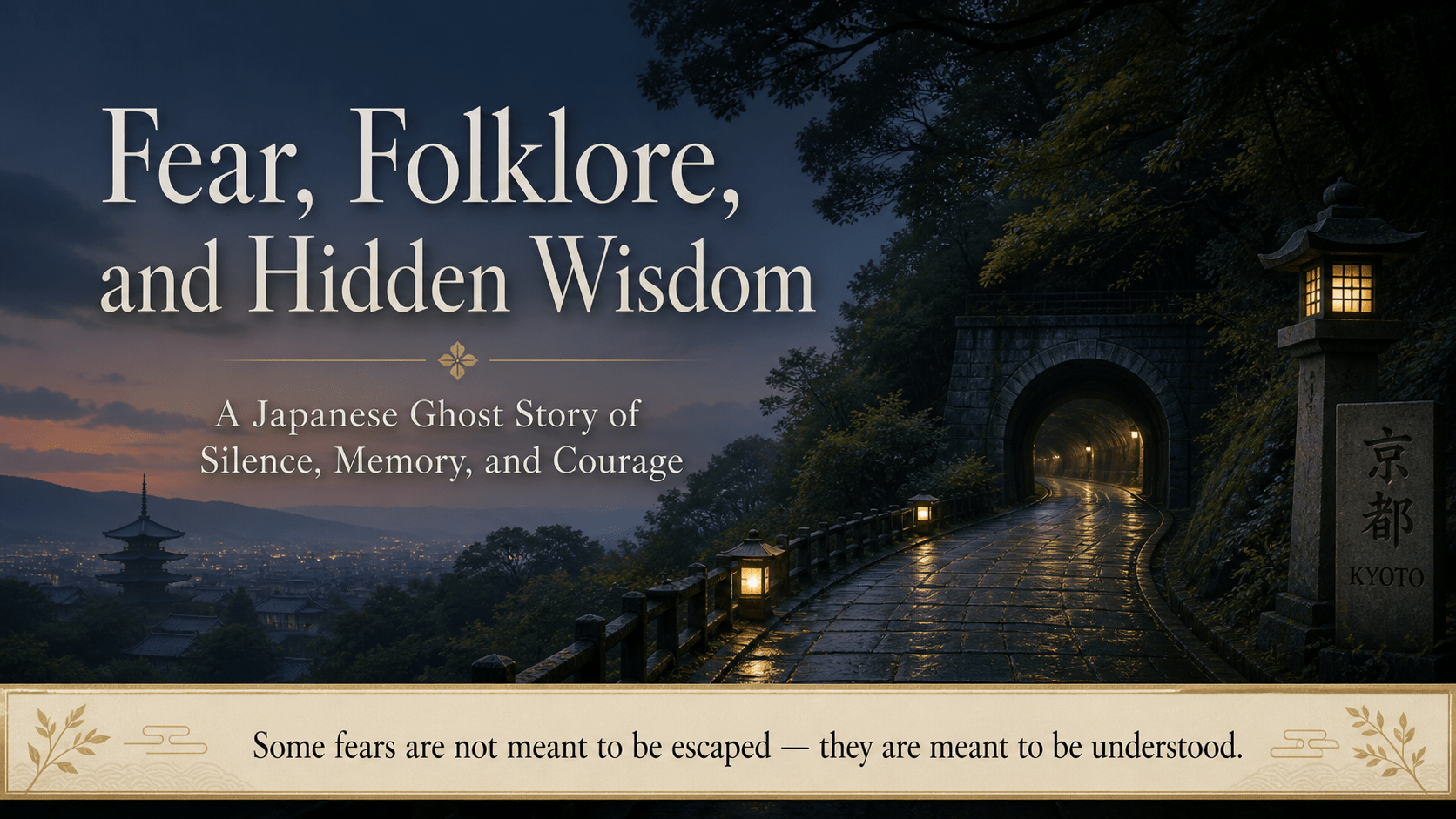
※This site uses affiliate advertising.A Strange Tale from the Old Roads of KyotoKyoto is often imagined as a city of quiet temples, maple leaves, vermilion gates, and old wooden streets where the past still seems to breathe. For many travelers, it is the cultural heart of Japan: a former capital, home to shrines, gardens, Buddhist temples, and UNESCO World Heritage sites.Yet in Japanese folklore, places of beauty are not always free from shadow.Among the mountains and narrow roads on the edge of Kyoto, certain locations have gathered a different kind of reputation. They are not famous only for history or scenery, but for stories whispered after dark: a tunnel where drivers claim to feel unseen eyes, a pond associated with sorrowful apparitions, and a shrine whose silence at 3 a.m. feels almost too deep to enter.These are not stories to be treated as proven supernatural events. They belong more properly to the world of urban legend, local memory, and mysterious folklore. But that does not make them meaningless. In many cultures, ghost stories preserve emotions that ordinary history leaves behind: grief, fear, guilt, loneliness, and the human need to give shape to the unknown.This article retells one such journey through Kyoto’s haunted edge—not simply as a scary story, but as a strange tale with hidden wisdom about fear, silence, and the courage to face what we do not fully understand.The Tunnel, the Pond, and the Shrine at NightThe road toward the old tunnel does not announce itself dramatically. It is not a place of thunder or cinematic darkness. Its unease is quieter than that.The city thins. The lights become fewer. The road narrows as it moves toward the wooded edges of Kyoto, where the mountains press closer and the air seems to change. Even before the tunnel appears, the atmosphere suggests transition. Behind you lies the known world of convenience stores, train stations, and evening traffic. Ahead lies a narrower road, a deeper silence, and the kind of darkness that makes every sound feel intentional.The place is commonly associated with Kiyotaki Tunnel, a single-lane tunnel in the area connecting northern Arashiyama with the neighboring region of Sagakiyotaki. In local legend, the tunnel has long carried a reputation for misfortune and strange sightings. It is said to have once been part of the Atagoyama Railway, constructed in the late 1920s, and stories about its past often mention accidents, harsh labor, and deaths connected with the surrounding area.Whether these details are historically precise or shaped by retelling, the result is the same: the tunnel has become a vessel for unease.In Japanese ghost lore, places like tunnels often become symbolic thresholds. They are not merely roads through stone. They are passages between worlds: daylight and darkness, safety and uncertainty, ordinary life and the realm of rumor. To enter such a place at night is to feel, if only for a moment, that the modern world has become thin.The legends surrounding the tunnel vary. Some say that its length is unlucky, sometimes rumored to be 444 meters, a number that sounds ominous in Japanese because the number four can be read as shi, a sound associated with death. Others speak of mirrors near the tunnel entrances, warning that a driver who sees something unnatural reflected there may invite misfortune.There are also tales of traffic lights changing without warning late at night, causing fear among those who must enter the single-lane passage. Some stories mention a woman in white who appears near the tunnel or throws herself onto the hood of a waiting car. Others describe sudden dizziness, nausea, headaches, or the sound of a woman’s scream coming from the trees.A skeptical reader may see these as the natural products of darkness, road stress, echo, expectation, and suggestion. A believer may hear something else. Folklore usually lives between those two responses. It does not demand that every listener believe. It asks only that we notice what fear does to the human mind when a place becomes heavy with stories.After the tunnel, the journey continues toward another site of mystery: Midorogaike, often translated as Midoro Pond or Midori Pond in informal retellings. Located in Kyoto, it is known not only for eerie legends but also for its unusual natural environment. The pond has been described as an important habitat, with rare plants and ecological value. In daylight, such a place may seem quiet, green, and scientifically interesting. But at night, the same water can feel like a dark mirror.According to one well-known urban legend, a taxi driver in Kyoto once picked up a woman dressed in white. Her hair was long and black, and she requested to be taken to the pond. The drive was long, leading away from the bright streets toward a more desolate edge of the city. When the taxi finally arrived and the driver turned to speak to his passenger, she was gone.Only a small object remained behind—sometimes told as a bottle of water, sometimes as another quiet token, depending on the version of the story.The vanishing passenger is a familiar figure in ghost folklore around the world. In Japan, as elsewhere, taxi ghosts often represent unresolved sorrow, a life interrupted, or a soul still trying to reach a destination. What makes the Kyoto version especially haunting is the setting: a pond already surrounded by stories of drowning, disappearance, and grief.Some local tales claim that bodies lost in the pond do not easily return. Others suggest that the water has depths or hidden places that make it feel bottomless, even if practical reports describe much of it as shallow. In folklore, physical depth and emotional depth often blend together. A pond does not need to be truly bottomless to feel bottomless to the human imagination.Visitors have described sensations of sadness near the water, as if the place itself remembers. Stories speak of ghostly hands, tugged clothing, figures appearing at the center of the pond, and a sorrow so thick it seems to rise from below the surface.Whether one interprets these stories as supernatural, symbolic, or psychological, the emotional pattern is clear. The pond becomes a place where grief gathers. It is not merely frightening because something may appear. It is frightening because it suggests that some sorrows do not vanish; they remain in the landscape, waiting for language.The final part of the journey takes place at a shrine after midnight—around 3 a.m., when even familiar places can feel unfamiliar.A shrine in Japan is not simply a scenic spot. It is a sacred space, often connected with kami, the spirits or divine presences honored in Shinto tradition. During the day, shrines may be filled with visitors, prayers, camera shutters, children, bells, and the soft movement of people passing beneath torii gates. But at night, especially in rain, the same place changes.There are no tourists. No worshippers. No casual conversation. Only the sound of raindrops, the movement of wind, and the glow of lanterns against wet stone.The silence is not empty. It feels occupied.Standing there in the dark, one may not see a ghost at all. Yet the mind becomes alert. Every shadow gains weight. Every sound asks to be interpreted. The shrine’s solemnity becomes more visible precisely because the world around it has grown quiet.And perhaps this is the most meaningful part of the story. The tunnel frightens because it is a passage into uncertainty. The pond frightens because it reflects sorrow. The shrine at night frightens because it returns us to reverence.Together, these three places form a strange map of fear. The tunnel asks, “What are you afraid to enter?” The pond asks, “What grief have you not named?” The shrine asks, “Can you stand quietly before what is greater than you?”The answer does not need to be dramatic. Sometimes the bravest thing a person can do is not to conquer the dark, but to walk through it with humility.Key Quote / Proverb / Affirmation“Fear is not always a warning to run; sometimes it is an invitation to listen.”This is not a traditional proverb, but an original reflective affirmation inspired by the story. It fits the emotional pattern of the tale: the tunnel, the pond, and the shrine do not merely frighten us. They ask us to pay attention.Cultural Insight: Why Haunted Places Matter in Japanese FolkloreJapanese folklore often gives strong emotional meaning to places. A bridge, a tunnel, a mountain path, a pond, a shrine, or an abandoned road may become more than scenery. It may become a meeting point between human memory and invisible presence.In Shinto and broader Japanese cultural imagination, nature is rarely treated as spiritually empty. Mountains, forests, stones, old trees, water, and thresholds can carry sacred or mysterious associations. This does not mean every strange story should be accepted literally. Rather, it helps explain why certain places become powerful in the imagination.A tunnel is a threshold.A pond is a mirror.A shrine is a place of reverence.Together, they create a symbolic journey. The traveler moves from fear of the unknown, to sorrow beneath the surface, to quiet respect before mystery.The number four also adds cultural texture to the story. In Japanese, one reading of four is shi, which sounds like the word for death. Because of this, four is sometimes avoided in hospitals, hotels, or buildings, much as the number thirteen may carry unlucky associations in some Western cultures. When a tunnel is rumored to measure 444 meters, the number itself becomes part of the legend, whether or not the measurement is accurate.Japanese ghost stories often speak through atmosphere rather than direct explanation. They leave room for silence. This restraint is part of their power. The most haunting detail is not always the apparition itself, but the feeling that something unresolved remains.Psychological / Philosophical Reflection: Why We Are Drawn to Scary StoriesWe are drawn to scary stories because they allow us to approach fear without being destroyed by it.A haunted tunnel gives shape to the fear of entering the unknown. A dark pond gives shape to sorrow that cannot easily be spoken. A shrine at night gives shape to awe—the feeling that human life is small, brief, and surrounded by mysteries we cannot control.In this sense, folklore is not only entertainment. It is a form of emotional language. It turns private anxiety into a shared story. Once fear becomes a story, we can look at it from a safer distance. We can ask what it means. We can listen to it without obeying it completely.Modern life is full of invisible tunnels. We enter uncertain careers, difficult relationships, grief, aging, illness, change, and loneliness. We do not always know what waits on the other side. Old stories remind us that fear is not new. Human beings have always stood at thresholds, listening into the dark.The value of a ghost story is not that it proves ghosts exist. Its value may be that it reveals how people live with uncertainty.Life Lesson: Listening to Fear Without Letting It LeadOne way to read this tale is as a reminder that fear should neither be worshipped nor ignored.If we worship fear, we become trapped by it. Every shadow becomes a command. Every uncertainty becomes a wall. But if we ignore fear completely, we may lose touch with intuition, caution, memory, and humility.The wiser path lies somewhere between panic and denial.When the road grows narrow, we slow down.When the water looks dark, we do not pretend it is shallow.When silence feels sacred, we lower our voice.This story may remind us that courage is not always loud. Sometimes courage is the act of moving carefully, respectfully, and honestly through a place we do not understand. Sometimes wisdom begins when we stop trying to explain everything at once.Reader ReflectionWhat fear in your own life might be asking to be understood rather than avoided?Perhaps the real mystery is not whether something waits in the tunnel, under the water, or beyond the shrine gate. Perhaps the deeper mystery is why certain stories stay with us—and what they quietly ask us to face.In daily life, fear may appear before a difficult conversation, a major decision, a change we did not choose, or a grief we have delayed facing. The lesson is not to become fearless. A fearless person may simply be careless. The deeper lesson is to become attentive.Fear can distort reality, but it can also reveal what matters. It shows us where we feel vulnerable. It shows us what we value. It shows us where healing may be needed.The dark road, the silent pond, and the empty shrine all offer the same quiet teaching: do not rush past what unsettles you. Some fears lose their power when they are finally seen clearly.Key Proverb, Quote, or Affirmation Used“Fear is not always a warning to run; sometimes it is an invitation to listen.”Psychological / Philosophical Reflection SummaryScary stories help people give shape to fear. They allow us to approach anxiety, grief, and uncertainty from a safe distance. Rather than proving the supernatural, folklore reveals how human beings live with what they cannot fully explain.Life Lesson SummaryThe lesson is not to become fearless, but to become attentive. Fear may distort reality, but it can also reveal vulnerability, intuition, memory, and the need for healing. Some fears lose their power when they are seen clearly.Reader Reflection QuestionWhat fear in your own life might be asking to be understood rather than avoided?