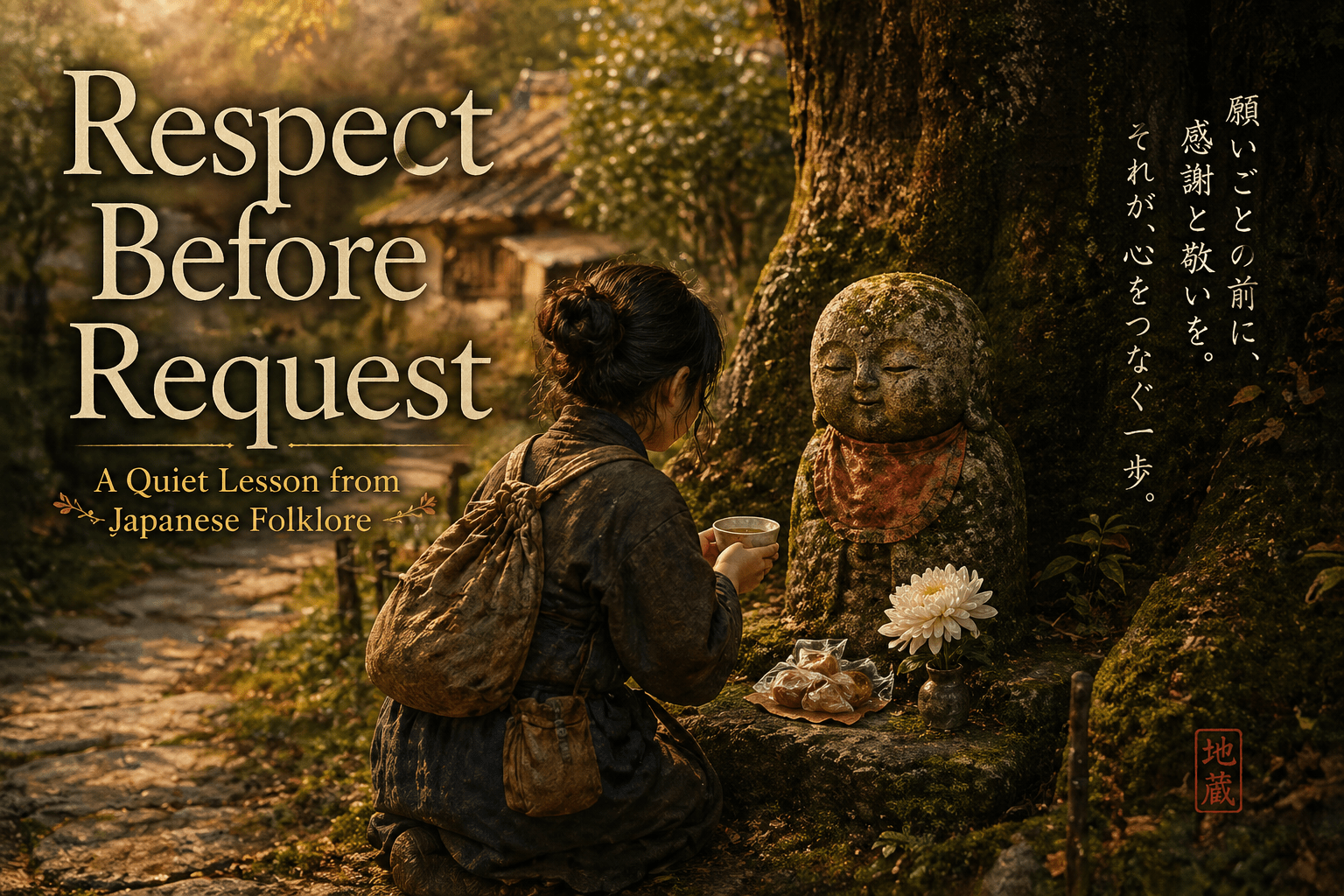
※This site uses affiliate advertising.There is an old kind of road in rural Japan that seems to remember every footstep.It is not the kind of road tourists usually photograph. There are no bright shrine gates, no famous temple halls, no carefully arranged gardens. It is only a narrow lane between fields, bending toward the dark line of a cedar grove. In the daytime, it looks ordinary enough. Farmers pass with small trucks. Children once walked it on their way to school. Old women in sun hats used to stop there to rest, leaning on their carts and speaking softly about weather, harvests, and neighbors long gone.But at dusk, the road changes.The mountains gather shadow first. Then the fields lose their color. The irrigation channels, which glittered in the afternoon sun, become black threads running beside the path. The wind moves through the grass with a dry whisper, and the village behind you begins to feel farther away than it should.At the bend of that road stands a small stone figure.It is not tall. A child could look it in the face. Its head is round, its features softened by rain, its hands folded in a gesture of prayer. Around its neck is a faded red bib, once bright, now darkened by weather. Someone has placed a small cup nearby, turned upside down. Beside it sits a cracked vase holding the brittle stems of flowers that have long since lost their petals.There is no signboard.No inscription remains clearly readable.No one passing for the first time would know who built it, or why.The villagers simply call it Ojizō-sama at the boundary.A Traveler Who Did Not Know the StoryOne autumn evening, a young man came to the village to visit relatives.He had been raised in the city. To him, the countryside was beautiful but slightly uncomfortable in the way unfamiliar silence can be uncomfortable. The houses were too far apart. The nights arrived too quickly. The darkness did not glow orange with streetlights, as it did in Tokyo or Osaka. It simply fell, deep and blue, swallowing the edges of things.His aunt had asked him to deliver a small package to a house on the other side of the fields.“It is not far,” she told him. “Just follow the old road. But come back before it gets too dark.”He laughed a little at that. He was not a child. The road was simple enough, and his phone still had battery. He took the package and walked out while the sky was still streaked with late sunlight.The errand took longer than expected. The old man at the house insisted he come in for tea. There were polite questions about his work, his parents, whether city life was tiring, whether he had found someone to marry. By the time he stepped outside again, the sky had lowered into violet dusk.On the way back, the young man noticed the silence first.No cars passed. No insects sang. Even the wind seemed to move without sound.Then he saw the stone figure at the bend.He had missed it on the way there.The Jizō stood beneath a leaning tree, half-hidden by tall grass. In the dim light, the red bib looked almost black. Its stone face was turned slightly toward the road, as if it had been waiting for him to notice it.The young man stopped.He had seen Jizō statues before, mostly in temple grounds or on travel websites. They looked gentle. Harmless. Almost cute, with their red caps and bibs. He knew only the simplest explanation: Jizō protected children and travelers.A traveler, he thought. That includes me.He smiled at his own superstition, but still, something about the little statue invited a gesture. Perhaps it was the loneliness of it. Perhaps it was the way the evening had made everything feel older than it was.He put the package bag under one arm, pressed his palms together, and bowed.Then, because he had been carrying a worry for many months, he whispered a wish.It was not a cruel wish. It was an ordinary human wish. He wanted his work to go well. He wanted his future to open. He wanted the uneasiness that followed him every morning to disappear.“Please help me,” he said softly. “Please let things turn out well.”The stone figure, of course, did not answer.A leaf fell from the tree.Somewhere behind him, water moved in the irrigation channel.The young man raised his head. For one instant, he had the strange feeling that the road ahead had become longer than before.The First Sign Was Not a GhostNothing appeared that night.No pale woman stood in the field. No child called from behind him. No hand touched his shoulder.That is why, when he returned to his aunt’s house, the young man said nothing.He ate dinner. He answered questions. He slept in the upstairs room where the sliding doors rattled softly whenever the night wind passed through the eaves.But sometime before dawn, he woke with a dry mouth.The room was dark. The old wooden ceiling was barely visible. For several seconds, he did not know where he was.Then he heard it.A small sound outside the window.Not a knock. Not exactly. More like the sound of water being poured slowly into a cup.He lay still.The sound stopped.Then came another sound, softer and stranger: the faint scrape of something being dragged across gravel.He sat up.Beyond the paper screen and glass window, the garden was dim. The moon was gone, and the sky had not yet begun to lighten. He could see only the vague shapes of stones, shrubs, and the low wall beyond the yard.There was nothing there.Still, he could not shake the feeling that someone thirsty was standing just outside the house.In the morning, he told himself it had been a dream.The mind, he thought, makes strange things out of old houses.But at breakfast, his aunt paused while pouring tea.“Did you go by the old boundary road yesterday?”He looked up.“Yes. Why?”She did not answer immediately. Her hand remained around the teapot, but the tea had stopped flowing.“Did you stop anywhere?”He remembered the Jizō.“I saw a little statue,” he said. “By the bend. I bowed to it.”His aunt’s expression changed—not dramatically, not like someone in a ghost story who has heard a fatal secret, but with a small tightening around the eyes. It was the expression of a person who knows a story she had hoped not to tell at breakfast.“You prayed there?”“Just for a moment.”“What did you pray for?”He felt embarrassed.“Nothing special. Just… ordinary things.”His aunt put the teapot down.“That Jizō is not for ordinary wishes.”The Story the Village RememberedHis aunt told the story quietly, as if speaking too loudly might disturb someone.Long ago, she said, the road had been the edge of the village. Beyond it were fields, then woods, then the old path toward the next settlement. Before cars, before electric lights, before the valley had a proper bus stop, travelers passed that way on foot.Some returned. Some did not.There had been accidents on that bend. A cart overturning in the rain. A child swept into the irrigation channel during a storm. A young mother who collapsed on the road before reaching help. A traveler found in winter, not far from the cedar trees, after the snow had begun to melt.People in the village did what people often do when grief has no grand memorial. They placed a stone. They offered flowers. They poured water. They tied cloth around the small figure’s neck so it would not seem cold.Over time, the stories blurred together.Was the Jizō first built for the child? For the traveler? For the mother? For all of them?No one could say with certainty anymore.But older villagers still treated it with care. They did not ask it for success, romance, money, or luck. They bowed when passing. Sometimes they left water. Sometimes sweets. Sometimes a flower from their own garden. The prayer offered there was not “Grant my wish,” but “May those who suffered here be at peace.”The young man listened without interrupting.His aunt continued.“Jizō-sama is compassionate,” she said. “That is why people go to him. But compassion is not the same as convenience. A place like that gathers things.”“What kind of things?”She looked toward the window.“Loneliness. Regret. Spirits, some would say. Hunger, maybe. Not always something with a face. Sometimes only the feelings people left behind.”He tried to laugh, but the sound did not come out naturally.“You really believe something follows people?”“I believe,” she said slowly, “that people should not touch sorrow as if it were an ornament.”Water for the ThirstyThat afternoon, his aunt prepared a small offering.Not an elaborate one. A clean cup of water. A few pieces of soft candy wrapped in paper. A single white chrysanthemum from the garden.“You do not have to come,” she told him.But he did.The road looked different in daylight. Narrow, yes, but not frightening. The fields were pale gold. Sparrows moved in the stubble. Somewhere a radio played from an open shed. The village, which had seemed so far away the night before, now felt close enough to call out to.Still, as they approached the bend, the young man felt his chest tighten.The Jizō stood as before beneath the leaning tree.In daylight, its face looked gentler. Yet that gentleness made him more uneasy, not less. It was not the blankness of stone that troubled him. It was the patience. The statue looked as if it had been standing there through every season, accepting rain, snow, heat, and neglect without complaint.His aunt knelt first.She turned the old cup upright, rinsed it with water from a bottle, and filled it. Then she removed the dead stems from the vase and placed the chrysanthemum there. The candy she set to one side, carefully, not scattered.Finally, she folded her hands.The young man did the same.“Do not ask for anything,” she whispered. “Not today.”So he did not.At first, his mind searched for words. He wanted to explain himself. To apologize properly. To say that he had not meant disrespect. But the longer he knelt there, the less useful words seemed.He thought of the child in the storm. The mother on the road. The traveler in the snow. Whether those stories were exact history or village memory hardly mattered at that moment. Someone had suffered. Someone had been remembered. Someone had been forgotten and remembered again through this small stone body.The young man lowered his head.He did not know what he believed. But he understood, for the first time, that belief was not the only reason people bowed.Sometimes people bow because certainty is impossible, and humility is still available.A breeze passed over the fields.The water in the cup trembled.For a moment, he felt the same sensation he had felt the night before: that something unseen was near. But now it did not feel like pursuit. It felt like thirst being acknowledged.When they stood to leave, his aunt bowed once more.The young man did the same.He did not look back until they had reached the straight part of the road. When he finally turned, the Jizō was almost hidden by the leaning tree and the grass, small and still, holding the boundary between village and field, living and dead, request and remembrance.What Followed Him HomeThat night, the young man slept deeply.No sound of water woke him. No scraping came from the garden. No dream remained in the morning.But something did follow him home.Not a ghost, perhaps. Not a curse. Not anything that could be photographed, named, or proven.What followed him was a change in attention.When he returned to the city, he began noticing small things he had ignored before: wilted flowers at the edge of a sidewalk, a cup of water placed beside a memorial after a traffic accident, an old woman bowing briefly before a tiny shrine squeezed between buildings. He noticed the way people leave traces of care in public places, often without explanation.Before, he might have walked past such things without thought.Now he slowed down.The wish he had made that evening did not come true in any sudden or miraculous way. His work remained difficult. His future remained uncertain. His anxiety did not vanish overnight.But the shape of his prayer changed.He no longer asked only to be rescued from uneasiness. He began to ask what his uneasiness was trying to show him. He no longer imagined that every quiet presence existed to answer him. Some quiet things, he learned, are not doors. They are memorials. They are thresholds. They are reminders that other lives have passed through the same world carrying burdens he cannot see.Years later, when he told the story, he did not tell it as proof that spirits exist.He told it as a story about a roadside Jizō, a cup of water, and the humility that fear can teach.And whenever he passed a small stone figure wearing a red bib, he did not hurry to make a wish.First, he bowed.Then he listened.Short Reflective Closing for the StoryA frightening story does not always need a monster.Sometimes all it needs is a quiet road, an old stone figure, and the sudden realization that we have asked for something before understanding where we stood.The roadside Jizō does not forbid prayer.It teaches the order of prayer.First, respect.Then remembrance.Only after that, perhaps, a wish.Jizō, Boundaries, and the Japanese Sense of PlaceTo understand the deeper meaning of this tale, we need to look beyond the statue itself.In Japan, Jizō is not merely a religious image placed in temples. Jizō often appears in the everyday landscape: beside rice fields, at crossroads, near bridges, at cemetery entrances, along mountain paths, and at the edges of old villages. These are not random locations. They are places of passage.A road is not only a road. It is a line between home and elsewhere.A bridge is not only a bridge. It is a crossing between one state and another.A cemetery entrance is not only an entrance. It is a threshold between the living and the dead.A village boundary is not only a border. It is the place where the known world begins to loosen.This is why Jizō statues often feel both comforting and mysterious. They stand where people are vulnerable: travelers far from home, children not yet grown, mothers facing birth, families grieving the dead, villagers remembering accidents that no longer have living witnesses.In Buddhist belief, Jizō is associated with compassion for beings in suffering. In Japanese folk practice, this compassion became very intimate. Jizō did not remain distant in a grand hall. He came to stand beside muddy paths and lonely roads. He became a guardian of the small, the lost, the unfinished, and the forgotten.The red bibs and caps placed on Jizō statues may surprise readers unfamiliar with Japanese customs. But they are often acts of tenderness. They can symbolize protection, warmth, childhood, and remembrance. To clothe a stone figure is to treat it not as an object, but as a presence. It is a way of saying, “You are cared for.”In this context, the warning not to pray carelessly becomes more than superstition. It expresses a cultural sensitivity toward place. A roadside Jizō may not be there to grant personal success. It may be holding a memory. It may be a marker of loss. It may be a quiet witness to suffering that the present generation has almost forgotten.The moral is not that Jizō is dangerous.The moral is that compassion gathers sorrow, and sorrow deserves respect.The Three Warnings Hidden in the TaleThe old warning about roadside Jizō can be understood through three layers of folklore.1. Places of Compassion May Attract the UnsettledIn the tale, the young man’s aunt says that “a place like that gathers things.” This is one of the most important lines in the story.In folklore, sacred or compassionate places are often imagined as gathering points. They do not gather darkness because they are evil. They gather sorrow because they offer shelter. A hospital gathers the sick. A memorial gathers grief. A temple gathers prayers. In the same way, a Jizō statue may symbolically gather the loneliness of those who had nowhere else to go.This is why the story warns against selfish prayer. A prayer made without awareness may disturb what the place is already holding.2. Boundary Spirits Require HumilitySome Jizō statues also carry the character of dōsojin, guardian figures associated with roads, borders, and village boundaries. In many cultures, boundaries are spiritually sensitive places. They are neither fully here nor fully there.A boundary asks for humility because it reminds us that we are entering a space we do not control.In the story, the young man’s mistake is not that he bows. Bowing is not the problem. His mistake is that he assumes the statue is there for his wish. He sees a sacred figure and immediately turns it toward himself.The tale gently reverses that impulse. It asks: before you bring your desire to a place, can you first ask what the place remembers?3. Hungry Ghosts Symbolize Unmet NeedThe reference to gaki, or hungry ghosts, may sound frightening to modern readers. But symbolically, hungry ghosts represent more than supernatural beings. They represent craving that cannot be satisfied, grief that cannot be spoken, and need that has no proper recipient.In the original belief, hungry ghosts suffer from a thirst and hunger that ordinary food cannot relieve. In the story, water becomes important because it is simple, humble, and compassionate. It does not display wealth. It does not demand attention. It is an offering of relief.Psychologically, this image is powerful. Many people carry a kind of inner hunger: for recognition, forgiveness, closure, love, or rest. When such hunger is ignored, it does not disappear. It lingers.The cup of water in the story is a symbol of acknowledging suffering without trying to possessKey Quote“Before you ask the road for guidance, honor the footsteps that came before you.”This is not a traditional proverb, but it is written in the spirit of proverbial wisdom. It fits the story because the young man learns that every road has a memory. His wish becomes wiser only after he understands that he is not the first person to stand in fear, uncertainty, or longingAffirmation for Fear and AnxietyI do not need to conquer every fear.Some fears are asking me to slow down, listen, and move with respect.Why We Are Drawn to Stories Like ThisPeople are drawn to mysterious folklore because it gives form to feelings that are otherwise difficult to name.The story of the roadside Jizō is not only about spirits. It is about uneasiness. It is about the strange discomfort of realizing that a place has a history we do not know. It is about the quiet shame of asking for something before we understand what has already been lost there.In horror psychology, fear often works by turning the familiar unfamiliar. A road is ordinary. A stone statue is ordinary. A cup of water is ordinary. But when these ordinary things are placed at dusk, in silence, at the edge of a village, they begin to carry emotional weight.That weight is what makes the story memorable.The tale also speaks to a modern anxiety: the fear that we are moving too quickly. We enter conversations, cultures, relationships, and places with our own needs already at the front of our minds. We ask, request, consume, interpret, and move on. But old folklore slows us down. It tells us that not everything exists to answer us.Sometimes the world is not refusing us.It is asking us to notice more.The young man’s fear does not destroy him. It educates him. It changes the way he sees small offerings, roadside memorials, and quiet gestures of care. In this way, the story turns fear into attention, and attention into wisdom.Fear as a Teacher of HumilityIn many modern stories, fear is something to overcome. We are told to defeat fear, master fear, silence fear, and move forward.But older stories often treat fear differently.In folklore, fear is sometimes a messenger. It tells us we have entered a place where ordinary confidence is not enough. It asks us to lower our voice. It asks us to admit that we do not know everything.The young man in the story begins with a very modern assumption: if something is sacred, perhaps it can help me. His fear begins when he realizes that sacredness does not always mean availability. A sacred place is not a service. A compassionate presence is not a tool.This is a subtle but important philosophical lesson.We live in a world that often turns everything into use. Nature becomes a resource. Silence becomes productivity. Tradition becomes content. Even prayer can become a transaction: I ask, something gives.The Jizō tale interrupts that pattern.It suggests that some things should first be honored without being used. Some places should be approached without a demand. Some silences should be allowed to remain silent.Fear, in this story, is not the opposite of wisdom.Fear is the doorway through which wisdom enters.Respect Before RequestOne possible lesson of this story is simple:Respect before request.This applies not only to spiritual places, but to everyday life.Before asking someone to understand us, we might ask what they have been carrying.Before entering a culture, we might learn what its symbols mean.Before speaking into someone’s silence, we might ask whether that silence is pain, rest, caution, or memory.Before demanding relief from fear, we might ask what fear is trying to protect.The young man’s first prayer was not evil. It was human. He was anxious and wanted help. Most of us have stood in that same place, even if not before a roadside Jizō. We have all wanted an answer quickly. We have all wanted comfort before understanding.That is why the story does not condemn him. Instead, it allows him to learn.By returning with water, he changes the direction of his prayer. He no longer stands before the statue as a customer before a counter. He stands as a person before a memory. This shift is small, but spiritually and psychologically profound.In modern life, the same shift can soften many things.It can make our conversations kinder.It can make our grief more patient.It can make our curiosity more respectful.It can make our fear less frantic.The lesson is not to stop wishing.The lesson is to let our wishes become mature enough to make room for others.A Question to Carry With YouThe next time you feel fear in a quiet place, you may not need to run from it immediately.You might ask:Is this fear warning me of danger, or is it inviting me to pay deeper attention?And when you encounter a silence that feels heavy, whether in a place, a person, or your own heart, another question may be worth asking:What should be honored here before anything is requested?Final ClosingThe roadside Jizō remains in the imagination because it is not merely frightening. It is tender, patient, and difficult to fully understand.It stands in the place where human certainty grows thin.Perhaps that is why such old stories endure. They remind us that wisdom is not always found in bright places, clear answers, or triumphant courage. Sometimes wisdom waits at the edge of the road, wearing a faded red bib, holding the grief of strangers, asking nothing for itself.And if we are fortunate, fear will slow us down long enough to notice.